
At Peralta, about 75 kilometers (47 miles) northwest of Lisbon, lie the river-laid rocks of the Lourinhã Formation. Named Lourinhanosaurus antunesi in 1998, this theropod lived about 150 million years ago. Its partial skeleton still held 32 gastroliths—stones carried in the gut—inside its rib cage. Yet nearly three decades on, paleontologists still disagree about where it fits among the big meat-eaters.
The story began in 1982, when a farmer named Luís Mateus came across fossil bones at Peralta. He removed them and later gave them to the GEAL – Museum of Lourinhã. In 1998, paleontologist Octávio Mateus described the skeleton as a new genus and species. He called it an allosauroid—a relative of Allosaurus. Since then, it has hopped around the family tree, and a nearby nest has been tied to it, then doubted. Its story shows how much a single headless skeleton can reveal—and how much it leaves open.
Lourinhanosaurus Key Facts
| Keyword | Fact |
|---|---|
| Pronunciation | Not specified |
| Meaning of name | Lourinhã Lizard |
| Group | Theropoda |
| Type Species | Lourinhanosaurus antunesi |
| Diet | Carnivore |
| When it Lived | Around 150 MYA |
| Period | Jurassic |
| Epoch | Late Jurassic (latest Kimmeridgian to earliest Tithonian stages) |
| Length | 13 to 20 feet (4 to 6 meters), estimated in 2010 |
| Height | Not specified |
| Weight | Not specified |
| Mobility | Moved on two legs (like all theropods) |
| First Discovery | 1982 by Luís Mateus, a local farmer |
| Described by | 1998 by Octávio Mateus |
| Holotype | ML370 |
| Location of first find | Peralta, near Lourinhã, Praia Azul Member (Sobral unit) of the Lourinhã Formation, Portugal |
Lourinhanosaurus Origins, Taxonomy and Timeline
The name Lourinhanosaurus refers to Lourinhã, the Portuguese town where the specimen was found. It ends in the familiar suffix “saurus,” meaning “lizard.” The species name antunesi honors Prof. Miguel Telles Antunes, a Portuguese paleontologist. Together, the name is Portuguese twice over—a hometown and a homegrown scientist.
In 1998, Mateus placed Lourinhanosaurus in Allosauroidea, within Avetheropoda—the branch uniting allosauroids with coelurosaurs, the line that led to birds. He judged it “probably a sinraptorid,” the only one then known in Europe. Its placement has shifted since. In 2006, Mateus and colleagues labeled it a eustreptospondylid, and a 2010 track study he co-wrote listed it among the megalosaurids—both without a new analysis. According to a 2017 study, a 2012 analysis by Carrano, Benson, and Sampson then recovered it as a basal coelurosaur. In 2022, Hendrickx and colleagues called it a putative metriacanthosaurid, the family of Sinraptor. Through it all, Lourinhanosaurus antunesi remains the type and only known species.
The original paper gave its age as both Lower Tithonian and Upper Kimmeridgian/Tithonian. Later work dates its rock unit to the latest Kimmeridgian to earliest Tithonian, about 150 million years ago. By contrast, the whole formation runs from the upper Kimmeridgian to the lowermost Berriasian, straddling the boundary between the Jurassic and Cretaceous periods. At the time, seaways largely separated Iberia from the rest of Europe and North America, with islands strung toward Newfoundland, though brief land links during low sea levels remain possible.
Discovery & Fossil Evidence
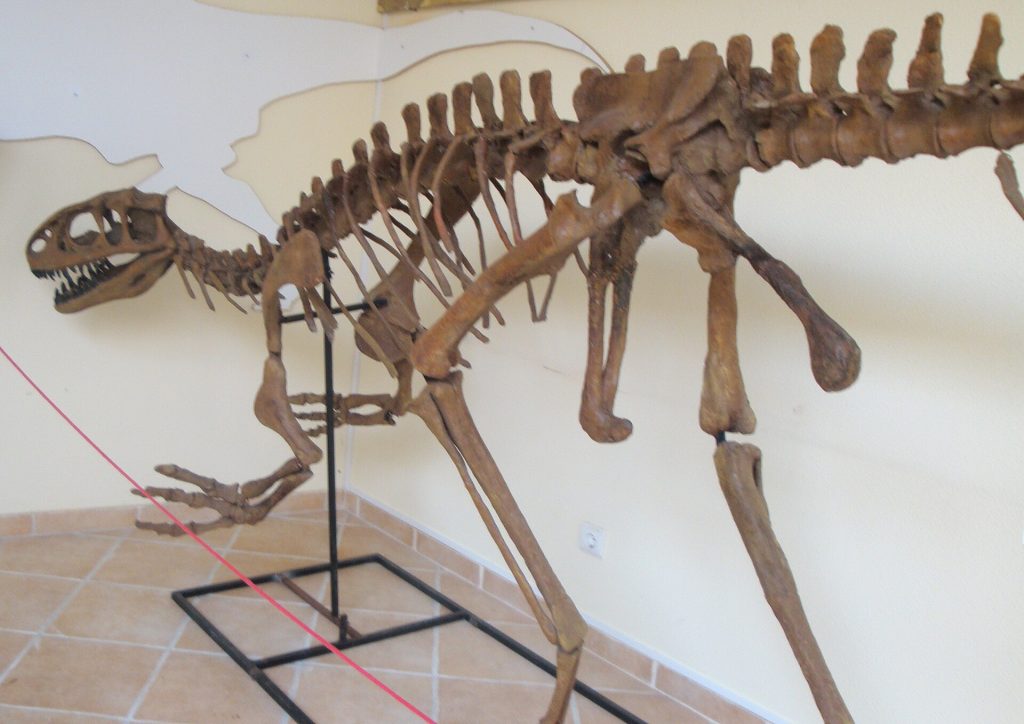
The holotype comes from Peralta, in rocks the original paper called the Sobral unit and later work equates with the Praia Azul Member. The skeleton lay on its right side, with the hips and hind limbs still in anatomical connection. Unfortunately, the block was broken up for transport, and its fragments now rest in the Lourinhã museum.
Cataloged as ML370, the holotype includes six cervical (neck) vertebrae and five dorsal (back) vertebrae, all with ribs. It also preserves five sacral (hip) vertebrae and 14 caudal (tail) vertebrae, plus eight chevrons—small bones beneath the tail. From the limbs come two incomplete femora (thigh bones) and the upper ends of the right tibia and fibula, plus possibly the upper end of one metatarsal. Both ilia survive too, along with the upper parts of the pubes and ischia, the lower hip bones. Notably, no skull material survives, so Mateus could not check the skull features used to diagnose allosauroids.

The Paimogo Eggs and Embryos
About 7 kilometers (4 miles) from the skeleton’s site lies Paimogo. There, on April 3, 1993, Isabel Mateus spotted eggshells and bones during an archaeological survey with Horácio Mateus. Digs from 1994 to 1996 then uncovered more than 100 closely grouped eggs. Four eggs in one block held bones, and sieving yielded several hundred embryonic fragments, including toothed jaw pieces and over 100 vertebrae. A 2024 recount found at least 73 whole or partial eggs, and up to 100 in the field reports.
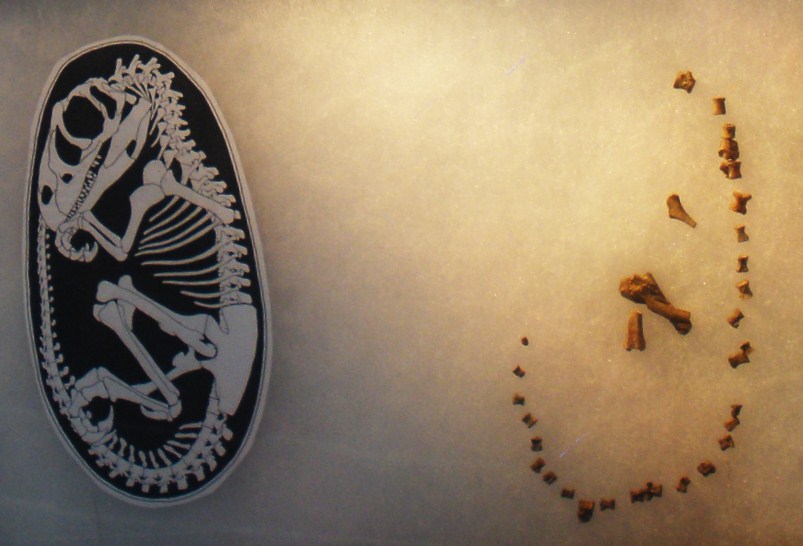

The 1998 embryo report did not name Lourinhanosaurus. Instead, it identified the embryos as theropods, adding that a small flange on the thigh bone “evokes very strongly” that of an allosauroid. In 2001, Mateus and colleagues attributed the clutch to Lourinhanosaurus. A 2024 review by Ezquerro and colleagues traces that case to similar age, nearby geology, and vertebral proportions reported by Ricqlès and colleagues in 2001. It also cites a large premaxilla—the front upper jaw bone—with four tooth sockets, unlike that of Allosaurus, noted by Carrano and colleagues in 2013.
In 2013, however, Araújo and colleagues found the Paimogo eggshells very different from those of a Torvosaurus clutch. Either the assignment was wrong, they reasoned, or eggshell traits evolved repeatedly, or the genus’s position is uncertain. That 2024 team instead attributed the eggs to “an undetermined allosauroid.” The nest also lies in the upper Porto Novo Member, slightly below the holotype’s member.
Lourinhanosaurus Size and Description
Without a skull, any portrait of Lourinhanosaurus rests on its spine, hips, and legs.
Short description of Lourinhanosaurus
Its neck vertebrae were strongly opisthocoelous, meaning ball-shaped in front and cupped behind. Each bore a keel underneath and one pair of pleurocoels—hollow pockets in the bone’s sides. Farther back, the rear dorsal vertebrae were cupped at both ends, lacked pleurocoels, and were relatively longer than those of Allosaurus fragilis. Meanwhile, the tail vertebrae were solid rather than hollow, with chevrons deeper than long.
The hip bones had not fused, and the ilium reached much farther behind the hip socket than in front. Its pubis was strong and straight, but the missing tips leave open whether it ended in a “boot”—the expanded tip typical of allosaurids. In the leg, the ball of the femur pointed inward, and the tibia seems shorter than the femur. No skin survives, so any body covering in a restoration is speculative.
Size and Weight of Type Species
The 1998 paper gave no body length or mass, so its size rests on individual bones. The femur and ilium measured an estimated 54 and 46 centimeters (21 and 18 inches).
In 2010, Mateus and Milàn gave an estimated total length of 13 to 20 feet (4 to 6 meters). They called it a small- to medium-sized tetanuran—a member of the broad “stiff-tailed” group that includes most large theropods. The studies of the holotype give no hip height or weight.
There is a further catch—the holotype had not finished growing. In 2017, Waskow and Mateus counted nine growth lines in one of its ribs. Those lines preserve only about 57 percent of its growth record. Even so, the pair estimated that it died at 14 to 17 years old, still skeletally immature.
The Dinosaur in Detail
What sets this dinosaur apart are four traits Mateus listed in his diagnosis. First, all of its vertebral centra—the spool-shaped bodies of the vertebrae—are longer than tall. Second, the front tail vertebrae carry a spike-like process on their neural spines. Third, a large, vertical, oval opening pierces the pubic blade. Finally, the lesser trochanter, a muscle-attachment flange on the thigh bone, stands well apart from the shaft. He also noted a pointed rather than squared-off rear tip on the ilium.
Unlike Neovenator, its last dorsal vertebra lacks pleurocoels, and its fourth trochanter sits on the back of the femur. Compared with Allosaurus, it had longer vertebrae and a smaller cnemial crest, the ridge at the front of the shin. Its reduced rib-attachment processes on the neck looked “more similar to Sinraptor.”
His two analyses gave mixed answers. One recovered it as a basal avetheropod. The other left it in an unresolved cluster with sinraptorids, Allosaurus, carcharodontosaurids, and two other theropods. According to a 2017 study, Benson, Carrano, and Brusatte grouped it with sinraptorids in 2010. In 2024, paleontologist Andrea Cau’s preferred analysis placed it inside Allosauroidea but outside the group of Sinraptor and Metriacanthosaurus. There, it sits in an unresolved three-way split with Aorun and the branch uniting Allosaurus with the carcharodontosaurians. In short, its exact branch is still open—a 2017 study simply called it “of uncertain affinity.”
Interesting Points about Lourinhanosaurus
- Its 32 gastroliths, the largest 22 millimeters long, lay below the 11th dorsal vertebra, and Mateus judged them to be the animal’s own.
- In 2022, Hendrickx and colleagues reported tiny scales about 0.3 millimeters across on the shoulder of a Paimogo embryo referred to Lourinhanosaurus.
- A 2010 study named Lourinhanosaurus as the suggested maker of small theropod tracks, 30 to 40 centimeters long, at Porto Dinheiro.
- Based on egg size, the 1998 embryo report estimated each embryo at about 16 inches (40 centimeters) long.
Dinosaurs from the Same Formation
Also known from the Lourinhã Formation (exact level relative to Lourinhanosaurus not known): the sauropods Lusotitan, Zby, Lourinhasaurus, and Supersaurus lourinhanensis, the long-necked stegosaur Miragaia, the iguanodontian ornithopod Draconyx, and the theropods Torvosaurus, Allosaurus europaeus, and Ceratosaurus. The formation spans the late Kimmeridgian to the lowermost Berriasian, so these animals may not all have lived at the same time.
Their levels differ, and several are disputed. Lusotitan shares Peralta and the holotype’s member, though no source puts the two skeletons in the same bed. Miragaia comes from the top of that member. Draconyx was placed there in 2017 and 2022, but a 2024 study put it higher, in the Santa Rita Member. Allosaurus europaeus sits at the top of the Praia Azul or the base of the Santa Rita. The Torvosaurus gurneyi holotype comes from the older Porto Novo Member, whereas Torvosaurus embryos come from the holotype’s member. Most Ceratosaurus bones come from the Praia da Amoreira Member, plus one tooth from Peralta. Zby also comes from the Porto Novo Member. Lourinhasaurus has been placed there and in the Arranhó unit, a southern equivalent of the holotype’s member. Sources also split Supersaurus lourinhanensis between the Porto Novo and Praia Azul members.
Lourinhanosaurus in its Natural Habitat
The world Lourinhanosaurus roamed was a low-lying coastal plain crossed by meandering rivers that fed deltas, sandy bays, and brackish lagoons. Its rocks are mostly red and green clays with river sandstones, holding plant fragments and large fossil tree logs. Calcretes, or hard soil crusts, point to a semi-arid climate with seasonal rainfall under 500 millimeters (20 inches). Yearly temperatures averaged 16 to 19 °C (61 to 66 °F), though other studies describe warm, wet, strongly seasonal conditions.
In 2014, Hendrickx and Mateus counted Lourinhanosaurus, Ceratosaurus, and Allosaurus among the top predators of Late Jurassic Portugal, with Torvosaurus as the very large form. While there is no direct evidence of its prey, three small bone fragments near its gastroliths “seemed to be food remains” to Mateus. Other animals from the Praia Azul Member include turtles, the crocodylomorphs Goniopholis and Machimosaurus, frogs, lizards, early snakes, pterosaurs, and small mammaliforms.
If the Paimogo eggs are its own, they hint at its nesting habits. In 2024, Ezquerro and colleagues proposed that a flood washed several allosauroid and crocodylomorph clutches together. They also suggested that the allosauroids buried their eggs, possibly in mounds. Back in 1998, the embryo team took three crocodile-like eggs as a sign of crocodile predators nearby, while a tiny mammal jaw raised the “suspicion” that small mammals were drawn to such clutches.
Frequently Asked Questions
It means “Lourinhã lizard,” after the Portuguese town where it was found, and the species name honors paleontologist Miguel Telles Antunes.
It lived in the Late Jurassic, around 150 million years ago, near the boundary between the Kimmeridgian and Tithonian stages.
A 2010 estimate puts it at 13 to 20 feet (4 to 6 meters) long, and no published study has estimated its weight.
It was a carnivore, and a 2014 study counted it among the top predators of Late Jurassic Portugal.
It was found in 1982 at Peralta, near Lourinhã in Portugal, in the Lourinhã Formation.
It was found with 32 gastroliths in its rib cage, among the first reported in a non-avian theropod. Its family-tree position is still debated.
Sources
The information in this article is based on various sources, drawing on scientific research, fossil evidence, and expert analysis. The aim is to provide a comprehensive and accurate overview of Lourinhanosaurus. However, please be aware that our understanding of dinosaurs and their world is constantly evolving as new discoveries are made.
- https://docentes.fct.unl.pt/sites/default/files/omateus/files/mateus_1998_lourinhanosaurus_antunesi.pdf
- https://docentes.fct.unl.pt/omateus/publications/lourinhanosaurus-antunesi-new-upper-jurassic-allosauroid-dinosauria-theropoda-l
- https://docentes.fct.unl.pt/sites/default/files/omateus/files/mateus_et_al_1998_-_upper_jurassic_theropod_dinosaur_embryos_from_lourinha_portugal_-_upper_jurassic_palaeoenvironments_in_portugal_ed._….pdf
- https://docentes.fct.unl.pt/sites/default/files/omateus/files/mateus_walen_antunes_-_2006_-_the_large_theropod_fauna_of_the_lourinha_formation__portugal__and_its_similarity_to_the_morrison_formation__with_a_description_of_a_new_species_of_allosaurus.pdf
- https://docentes.fct.unl.pt/omateus/files/mateus__milan_2010_-_diverse_l_j_ichnofauna_from_lourinha_fm_portugal.pdf
- https://doi.org/10.1038/srep01924
- https://pmc.ncbi.nlm.nih.gov/articles/PMC3943790/
- https://docentes.fct.unl.pt/omateus/files/waskowmateus2017_histology.pdf
- https://doi.org/10.21695/cterra/esj.v19i1.355
- https://doi.org/10.1111/brv.12829
- https://www.paleoitalia.it/wp-content/uploads/2024/05/01_Cau_2024_BSPI_631.pdf
- https://zaguan.unizar.es/record/135767/files/texto_completo.pdf
- https://doi.org/10.1007/s12371-021-00591-7
- https://docentes.fct.unl.pt/omateus/files/mannion_et_al_2013_sauropod_lusotitan_portugal.pdf
- https://pmc.ncbi.nlm.nih.gov/articles/PMC6853308/
- https://www.fct.unl.pt/en/news/2024/06/portuguese-and-spanish-paleontologists-unveil-mysteries-jurassic-dinosaur-reproduction
- https://docentes.fct.unl.pt/omateus/files/rotatori_etal2022.pdf
- https://www.mdpi.com/1424-2818/17/1/29
- https://peerj.com/articles/857/
- https://stratigraphy.org/ICSchart/ChronostratChart2024-12.pdf
This article was last fact checked: TheDinosaurs Team, 20-11-2026
Featured Image Credit: Artist’s restoration of Lourinhanosaurus antunesi with a speculative body covering. Audrey.m.horn, CC BY-SA 4.0, via Wikimedia Commons
