At Ghost Ranch in northern New Mexico, the Hayden Quarry exposes ancient stream deposits cut into red mudstones of the Chinle Formation. Here, paleontologists recovered Tawa hallae, a small early dinosaur that lived roughly 212 million years ago in the Late Triassic. Its describers presented it as a theropod whose skeleton blends primitive and advanced traits. Several nearly complete skeletons survive, and researchers even nickname one family of early-dinosaur datasets the “Tawa matrix.”
Volunteers taking a paleontology seminar at the Ruth Hall Museum of Paleontology found the first Tawa fossils in 2004. Five years later, paleontologist Sterling J. Nesbitt and five colleagues named the animal in the journal Science. They concluded that North America’s Late Triassic theropods were not endemic—found nowhere else—and suggested that dispersal between continents was common. Even so, researchers still debate where Tawa belongs on the dinosaur family tree.
Tawa Key Facts
| Keyword | Fact |
|---|---|
| Pronunciation | Not specified |
| Meaning of name | Named After the Hopi Word for the Puebloan Sun God |
| Group | Saurischia (originally Theropoda, possibly Herrerasauria) |
| Type Species | Tawa hallae |
| Diet | Carnivore |
| When it Lived | Around 212 MYA |
| Period | Triassic |
| Epoch | Late Triassic (Norian stage) |
| Length | Not specified |
| Height | Not specified |
| Weight | About 7.1 pounds (3.2 kilograms), Benson and colleagues’ estimate for a not fully grown individual |
| Mobility | Moved on two legs (bipedal) |
| First Discovery | 2004 by volunteers in a Ruth Hall Museum of Paleontology seminar |
| Described by | 2009 by S.J. Nesbitt, N.D. Smith, R.B. Irmis, A.H. Turner, A. Downs, and M.A. Norell |
| Holotype | GR 241 |
| Location of first find | Site 2, Hayden Quarry, Petrified Forest Member, Chinle Formation, Ghost Ranch, Rio Arriba County, New Mexico, USA |
Tawa Origins, Taxonomy and Timeline
According to the University of Utah’s 2009 announcement, Tawa comes from the Hopi word for the Puebloan sun god. The species name hallae honors Ruth Hall, whose name the Ghost Ranch museum also carries. Together, the name ties the animal to the region’s cultures and to the museum that catalogs its skeletons.
In the original description, Nesbitt and colleagues classified Tawa as a theropod within Saurischia, the “lizard-hipped” dinosaurs. Two years later, Nesbitt’s larger analysis recovered Tawa as the closest relative of Neotheropoda (the more advanced theropods), backed by seven unambiguous shared features. Later studies have challenged that placement. Tawa hallae is the type and only known species.
Its fossils date to the Norian stage of the Late Triassic, but studies disagree on where within it—middle Norian for Nesbitt in 2011, middle–late for Ezcurra and colleagues in 2025, and upper Norian for Srivastava and Nesbitt in 2026. In 2011, Irmis and colleagues reported a uranium–lead age of 211.9 ± 0.7 million years for the quarry, though only as a maximum age. Nesbitt’s monograph, citing earlier work, gave a slightly older bracket of roughly 215 to 213 million years ago. At the time, the quarry lay about 11 degrees north of the equator—far south of its present latitude near 36 degrees.
Discovery & Fossil Evidence
The Hayden Quarry takes its name from John Hayden, who discovered the site. It comprises three closely associated paleochannels—the beds of ancient streams. They lie within 30 meters (98 feet) of one another horizontally and 15 meters (49 feet) vertically. Full-scale excavation, sponsored by the National Geographic Society, began in 2006.
The Ruth Hall Museum of Paleontology catalogs the holotype, GR 241, which comes from Site 2. Nesbitt’s 2011 monograph describes it as a nearly complete but disarticulated—scattered rather than joined—skull and most of an articulated skeleton. The 2009 announcement described this individual as a juvenile.
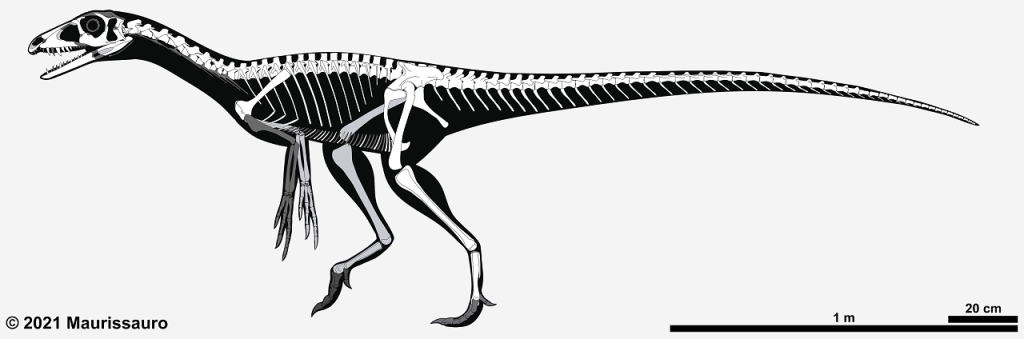

Six to seven Tawa individuals were found in a small area, amid the bones of many other animals. Their remains range from isolated bones to nearly complete articulated skeletons, and from small juveniles to subadults. Growth differences are plain—the smallest fibula, a slender lower-leg bone, is 70 percent the length of the largest. Other cataloged finds include two femurs (thigh bones), GR 244 and GR 1065, and a fibula and calcaneum (ankle bone) numbered GR 242. The Paleobiology Database records Tawa from three of the quarry’s paleochannels, sites 2, 3, and 4.
Tawa Size and Description
Tawa mixes features seen in later theropods with a few traits that are unusual among its relatives.
Short description of Tawa
Starting at the snout, Tawa shares a flange on the premaxilla (the upper jaw tip) and a gap in the upper tooth row with Dilophosaurus and coelophysoids, according to Zahner and Brinkmann in 2019. Farther back, Nesbitt’s 2011 analysis found that the quadratojugal cheek bone reaches the front of the lower temporal fenestra, an opening behind the eye, as in later theropods such as Coelophysis.
Its neck vertebrae carry deep, rimmed pits, or fossae, as in coelophysoids, whereas most other neotheropods have true openings there. In 2012, Butler and colleagues judged such pits ambiguous on their own. However, their position and continuity with later theropods supported a pneumatic, or air-filled, reading. Only two vertebrae made up the sacrum, the part of the spine joined to the hips.
The hand had lost its fifth finger entirely. Barta and colleagues judged this loss most likely convergent—reached independently—with later theropods such as allosauroids. Its fourth finger kept two tiny bones, a trait unique among the theropods they studied. On the hip, the ilium lacks a brevis fossa, a groove under the rear of the hip blade. Meanwhile, the pubis ends in a strongly developed boot, and the calcaneum is reduced. With an upper arm bone under 0.6 times the length of its thigh bone, a theropod hallmark in Nesbitt’s analysis, it likely walked on two legs. No skin or feather impressions have been reported, so any discussion of its outer covering is speculative.
Size and Weight of Type Species
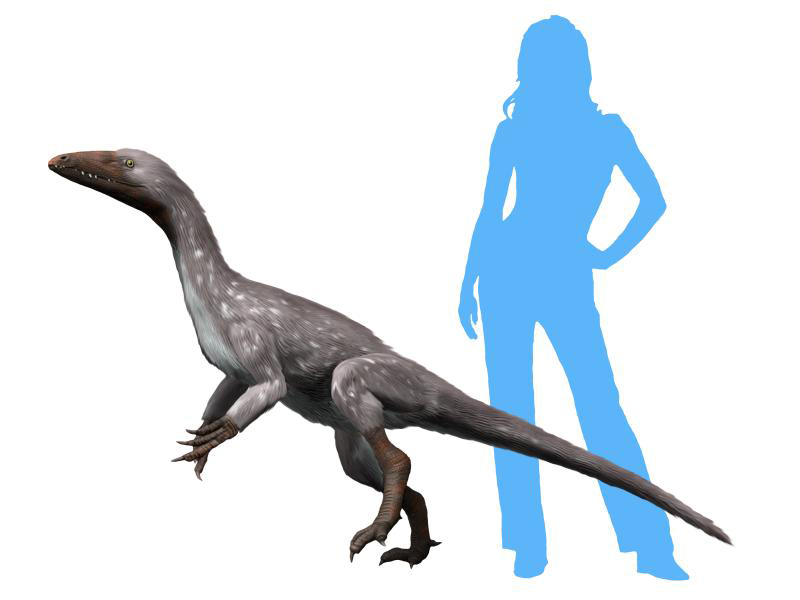
How large Tawa grew is harder to pin down than its anatomy. The 2009 Utah announcement gave the juvenile type specimen a length of approximately 6 feet (about 2 meters) from snout to tail. That release also put its hip height at about 28 inches (70 centimeters), which may not reflect adult size.
However, the same release gave the skeletons lengths of 6.6 to 13 feet (2 to 4 meters). Its fact sheet listed hip heights of 3.3 to 4.9 feet (1 to 1.5 meters). A Field Museum release compared the specimens to medium to large dogs. These informal press figures do not agree with one another, so the Key Facts leave length and height unspecified.
For body mass, paleontologist C.T. Griffin’s 2019 study listed about 7.1 pounds (3.2 kilograms) beside a femur length of 176 millimeters (6.9 inches). That figure repeats an earlier limb-bone estimate by Benson and colleagues. It also describes a not fully grown individual, so adults were probably heavier. Griffin also called Tawa one of the smaller known early theropods, though an earlier analysis had classified it as “large.”
The Dinosaur in Detail
What sets this dinosaur apart is less a single bone than its effect on the family tree. In 2011, Nesbitt found that Herrerasaurus, Staurikosaurus, and Eoraptor fall into Theropoda when Tawa is included in the analysis. Without Tawa, Saurischia collapses into a large polytomy—an unresolved knot of lineages with no clear branching order. The original paper also argued that Tawa reveals latitudinal differences among saurischian communities.
Later work complicated that picture. In 2019, Marsh and colleagues recovered Chindesaurus as the sister taxon, or closest relative, of Tawa, still within Theropoda. Novas and colleagues, however, placed Tawa and Daemonosaurus inside Herrerasauria in 2021, as reported by Ezcurra and colleagues. In 2025, Ezcurra’s team judged a broad Herrerasauria containing Tawa, Chindesaurus, and Daemonosaurus the most reliable hypothesis on their two datasets. They added that a herrerasaur position outside Eusaurischia, the core group of theropods and sauropodomorphs, seems to be gaining consensus.
In 2026, Srivastava and Nesbitt—the latter one of Tawa‘s original describers—named the clade Morphoraptora for Tawa and its closest relatives, including Chindesaurus and the new Ptychotherates. Both of their datasets placed this group inside Herrerasauria, as the sister of Herrerasauridae, the family of Herrerasaurus.
Even so, the question remains open. Some of Ezcurra’s own analyses still recovered Tawa and Chindesaurus as theropods, and the team cautioned that low support values mean more work is needed. Griffin’s 2019 study, by contrast, had treated Tawa as an early-diverging theropod.

Its describers also presented Tawa as evidence for the antiquity of bird-like features, including skeletal pneumaticity. Yet its known backbone is a composite—in 2026, Fonseca and colleagues noted that it combines several individuals. Wherever it finally lands, Tawa remains a pivot point that shapes how researchers draw the earliest branches of the dinosaur tree.
Interesting Points about Tawa
- The name Tawa comes from the Hopi word for the Puebloan sun god, while hallae honors Ruth Hall.
- Excavators found six to seven Tawa individuals together in a small area of the Hayden Quarry, from small juveniles to subadults.
- Data from the 2009 study seeded a family of datasets on early dinosaur relationships, nicknamed the “Tawa matrix.”
- A 2022 chemical study of a Tawa femur and other Hayden Quarry fossils detected no original organic preservation at the site.
Dinosaurs from the Same Formation
Also known from the Chinle Formation (exact level relative to Tawa not known): Chindesaurus, an early dinosaur of uncertain affinities. In 2019, Marsh and colleagues redescribed its holotype from the Chinle Formation of Petrified Forest National Park in Arizona. Several recent studies recover it among Tawa‘s closest relatives. Press materials in 2009 placed both animals in the same deposits. However, the Paleobiology Database lists a Hayden Quarry specimen once assigned to Chindesaurus as re-identified in 2019 as an indeterminate theropod. In 2019, Kent and colleagues correlated the entire formation, in a drill core from Arizona, to roughly 224 to 209 million years ago. As a result, Chindesaurus and Tawa may not have lived at the same time.
Tawa in its Natural Habitat
Tawa‘s world lay close to the equator, where streams cut channels into floodplains of red mudstone and siltstone. Its climate was generally arid but strongly fluctuating, swinging between dry and humid extremes. Conifers and seed ferns dominated the pollen record. Charcoal in at least four paleochannels points to widespread wildfire, and in one channel it formed at no less than 680 °C (1,256 °F).
Press materials from 2009 described Tawa as probably a meat-eater. Burch’s 2014 forelimb study adds indirect support, linking theropod shoulder muscles to seizing relatively large prey and the hand to powerful finger flexion. While there is no direct evidence of what Tawa caught, its arms may have helped it grab and grip prey.
Its neighbors at the quarry included metoposaurs (large amphibians), phytosaurs, aetosaurs, and Dromomeron romeri, a lagerpetid, or small dinosaur relative. The rauisuchid Vivaron haydeni, silesaurid bones assigned to Eucoelophysis, and an unnamed coelophysoid theropod also turn up. In the Chinle beds of the Chama Basin, dinosaurs and their close relatives make up less than 15 percent of specimens, except at the unusual Coelophysis Quarry. That younger Ghost Ranch site lacks an absolute date but is thought to be late Norian or Rhaetian, and it yielded Coelophysis and Daemonosaurus. It also produced Ptychotherates, a close relative of Tawa named in 2026—a sign, its describers argue, that the lineage may have survived until the end-Triassic extinction.
It is tempting to read the cluster of six to seven skeletons as a sign of group living. However, repeated floods also gathered bones, carcasses, and live animals into the channels. According to a Field Museum release, the animals likely died near where they were found and were buried quickly. As team member Nathan Smith put it, “We were lucky to find skeletons nearly intact.”
Frequently Asked Questions
It comes from the Hopi word for the Puebloan sun god, and the species name hallae honors Ruth Hall.
It lived during the Norian stage of the Late Triassic, around 212 million years ago.
Its 2009 press figures conflict, from about 6 feet (2 meters) for the juvenile type to 13 feet (4 meters). Benson and colleagues estimated one not fully grown individual at about 7.1 pounds (3.2 kilograms).
It was probably a carnivore, and a 2014 muscle study suggests theropod arms like its own suited grabbing relatively large prey.
It was an early saurischian, first described as a theropod, though several recent studies, one co-written by an original describer, place it among the herrerasaurs.
Its fossils come from the Hayden Quarry at Ghost Ranch, in the Chinle Formation of Rio Arriba County, New Mexico.
Sources
The information in this article is based on various sources, drawing on scientific research, fossil evidence, and expert analysis. The aim is to provide a comprehensive and accurate overview of Tawa. However, please be aware that our understanding of dinosaurs and their world is constantly evolving as new discoveries are made.
- https://doi.org/10.1126/science.1180350
- https://pubmed.ncbi.nlm.nih.gov/20007898/
- https://doi.org/10.1206/352.1
- https://zenodo.org/records/5405335
- https://doi.org/10.1080/02724634.2019.1645682
- https://pmc.ncbi.nlm.nih.gov/articles/PMC12077243/
- https://doi.org/10.1017/jpa.2019.13
- https://pmc.ncbi.nlm.nih.gov/articles/PMC6375289/
- https://pmc.ncbi.nlm.nih.gov/articles/PMC5735062/
- https://pmc.ncbi.nlm.nih.gov/articles/PMC3314707/
- https://pmc.ncbi.nlm.nih.gov/articles/PMC6669044/
- https://pmc.ncbi.nlm.nih.gov/articles/PMC13682567/
- https://pubmed.ncbi.nlm.nih.gov/25040486/
- https://pmc.ncbi.nlm.nih.gov/articles/PMC4491762/
- https://pmc.ncbi.nlm.nih.gov/articles/PMC5018681/
- https://pmc.ncbi.nlm.nih.gov/articles/PMC6730537/
- https://pmc.ncbi.nlm.nih.gov/articles/PMC9495945/
- https://doi.org/10.4202/app.00143.2014
- https://paleobiodb.org/classic/basicCollectionSearch?collection_no=92938
- https://archive.unews.utah.edu/news_releases/early-carnivorous-dinosaurs-crossed-continents/
- https://www.eurekalert.org/news-releases/544939
- https://doi.org/10.1002/spp2.70069
- https://doi.org/10.1016/j.epsl.2011.07.015
- https://doi.org/10.1371/journal.pbio.1001853
- https://doi.org/10.1111/pala.12329
- https://doi.org/10.1016/j.jsames.2021.103341
- https://doi.org/10.1029/2019GC008474
This article was last fact checked: TheDinosaurs Team, 17-11-2026
Featured Image Credit: Jeffrey Martz, CC0 1.0, via Wikimedia Commons
