
On a farm west of Kirkwood in South Africa’s Eastern Cape, red mudstones of the Kirkwood Formation held the skeleton of a small and unusual theropod. Named Nqwebasaurus thwazi in 2000, it most likely dates from early in the Cretaceous, possibly the Berriasian to Hauterivian stages. However, its site lacks a reliable direct date. Its describers called it one of the most complete and best preserved Cretaceous theropods yet described from Africa. Later work moved it to the very base of the Ornithomimosauria—a theropod group whose later members include the families Deinocheiridae and Ornithomimidae.
Billy de Klerk of the Albany Museum and Callum Ross discovered the skeleton in the late 1990s. In 2000, de Klerk and four colleagues described it in the Journal of Vertebrate Paleontology. Further preparation, reported in 2012, then exposed a toothed upper jaw and parts of the braincase. Its belly region even preserves gastroliths (stomach stones). As the first ornithomimosaur known from Africa, Nqwebasaurus gives its group a rare southern foothold very early in its history.
Nqwebasaurus Key Facts
| Keyword | Fact |
|---|---|
| Pronunciation | n-qu-web-ah-sore-us |
| Meaning of name | Nqweba Lizard, Fast-Runner |
| Group | Theropoda (Ornithomimosauria) |
| Type Species | Nqwebasaurus thwazi |
| Diet | Herbivore (probably) |
| When it Lived | Around 140 MYA |
| Period | Cretaceous |
| Epoch | Early Cretaceous (possibly Berriasian to Hauterivian stages) |
| Length | Not specified |
| Height | Not specified |
| Weight | About 11.7 pounds (5.3 kilograms) for the immature holotype, an estimate given by Watanabe et al. 2015 |
| Mobility | Not specified |
| First Discovery | Late 1990s by W.J. (Billy) de Klerk and Callum Ross |
| Described by | 2000 by W.J. de Klerk, C.A. Forster, S.D. Sampson, A. Chinsamy, and C.F. Ross |
| Holotype | AM 6040 |
| Location of first find | Umlilo farm, about 15–17 km west of Kirkwood, Kirkwood Formation, Algoa Basin, Eastern Cape Province, South Africa |
Nqwebasaurus Origins, Taxonomy and Timeline
The name Nqwebasaurus draws on a local language. According to co-describer Anusuya Chinsamy-Turan, “Nqweba” is the isiXhosa name for the Kirkwood region. The genus name therefore translates as “Nqweba lizard,” while the species name thwazi means “fast-runner.” Chinsamy-Turan has also called it the first dinosaur given an isiXhosa name.
In their 2000 description, de Klerk and colleagues placed Nqwebasaurus as a basal coelurosaurian—an early member of Coelurosauria, a major branch of theropods. They argued that it pushed the coelurosaur record of Gondwana, the southern supercontinent, back by about 50 million years. According to paleontologist Paul Sereno, he first recognized it as an ornithomimosaur in 2001. Allain and colleagues later noted that it had also been placed in Compsognathidae, the family of Compsognathus, citing Makovicky and colleagues (2010). In 2012, however, paleontologist Jonah Choiniere and colleagues restudied the skeleton and concluded that it is the basalmost ornithomimosaur. Nqwebasaurus thwazi remains the type species.
Its age has a tangled history of its own. In 2009, Forster and colleagues treated the Kirkwood Formation as early Early Cretaceous. Allain and colleagues gave a narrower mid-upper Valanginian age in 2014, following an earlier study. Two years later, McPhee and colleagues suggested a Berriasian to Hauterivian age, while noting that the formation lacks radiometric dates. Sereno then placed Nqwebasaurus in the Berriasian–Valanginian, roughly 140 million years ago. In a 2019 doctoral thesis, however, geologist Robert Muir found that zircon crystals from the exact site gave no useful maximum age. In his view, the Umlilo beds could date from anywhere between the Early Jurassic and the Early Cretaceous. The usual age, he argued, rests on an assumed link with the Sundays River Formation—whose nearest outcrops lie more than 14 miles (23 kilometers) away.
Discovery & Fossil Evidence
The skeleton came from Umlilo farm, about 9 to 11 miles (15 to 17 kilometers) west of the town of Kirkwood in the Algoa Basin. There, it lay in red sandy mudstones exposed in a natural cliff. Muir’s thesis gives about 15 kilometers, while the 2012 redescription corrected it to 17, as the Paleobiology Database records.
Today the Albany Museum in Grahamstown, now Makhanda, houses the holotype, AM 6040. Sereno’s 2017 list includes the skull roof, braincase, and a sclerotic ring—the bony ring that supported the eye. Neck and back vertebrae also survive, along with parts of both the shoulder and hip girdles and bones from the forelimbs and hind limbs. Continued preparation later revealed a maxilla, the main upper jaw bone, carrying small, conical teeth without serrations. Although the 2000 paper reported tail vertebrae, Sereno found that none survive—only a single chevron, a small bone from beneath the tail.

A second, smaller individual also exists. Its femur, tibia, and fibula belonged to an animal about half the holotype’s size. Sereno noted that earlier studies had not mentioned them. According to de Klerk, the femur and tibia came out of the trench wall during collection. Meanwhile, the fibula turned up beneath the holotype’s skull bones during preparation. Both individuals therefore come from the same excavation.
Nqwebasaurus Size and Description
Small and long-footed, Nqwebasaurus comes mainly from an immature individual, which shapes how scientists read its features.
Short description of Nqwebasaurus
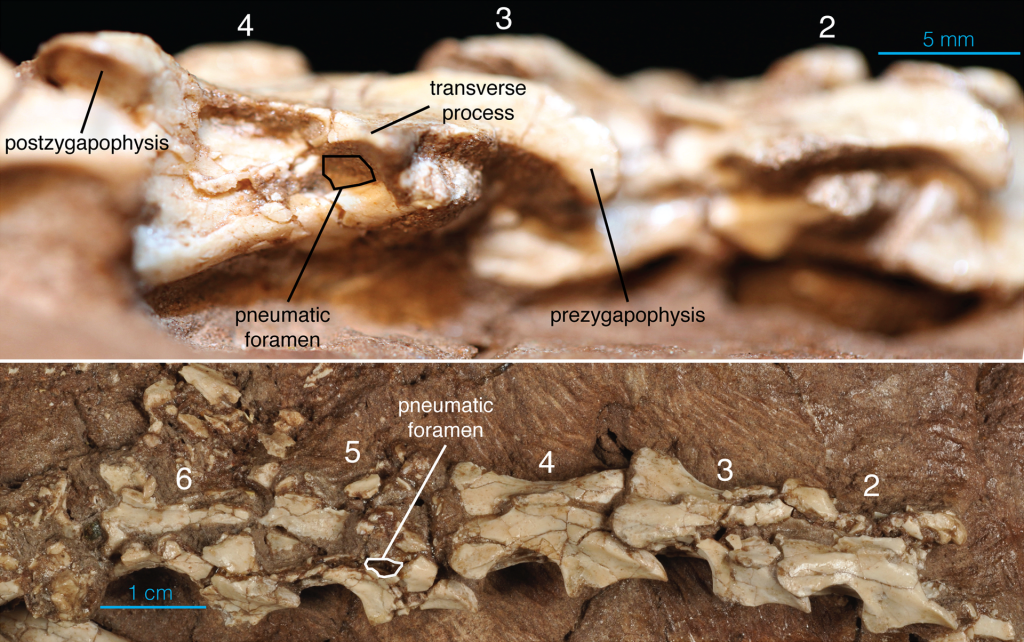
The skull was small, with a length that Sereno estimated at about 3.5 inches (90 millimeters) from the maxilla and frontal. Its snout appears to have been proportionately shorter than in other ornithomimosaurs. Sereno allowed that immaturity may explain part of this, though he noted that all but the youngest Sinornithomimus have longer snouts. Between the eyes, the skull roof was narrow, and five plates of the eye ring survive in the right orbit. Behind the head, seven and a half articulated vertebrae run from the mid neck into the back. In a 2015 study centered on Archaeornithomimus, Watanabe and colleagues reported that its neck bones were probably pneumatic—invaded by air sacs—while its back vertebrae were not.
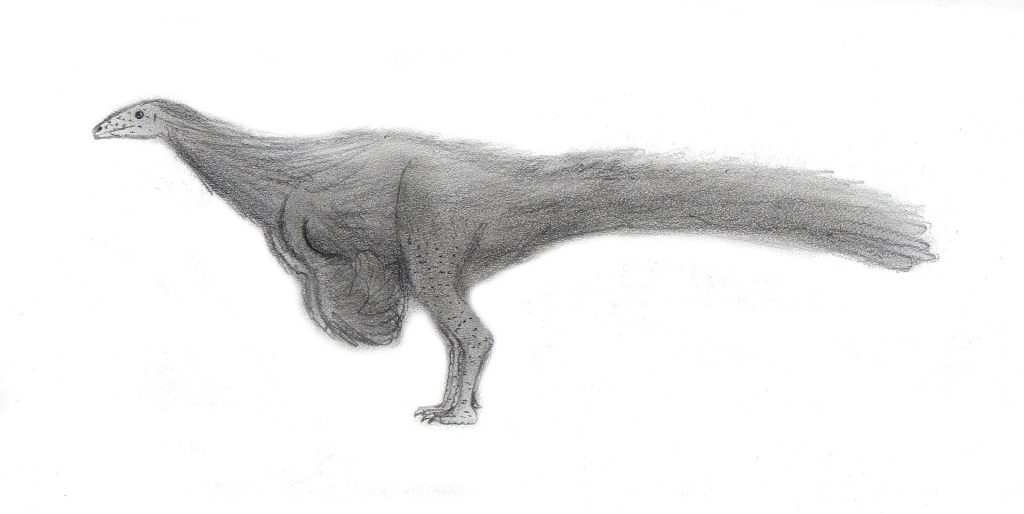
Its describers reported an elongate, three-fingered hand with a partially opposable first digit. Slender gastralia, or belly ribs, also survive, and farther down the foot was long and slender. Sereno found that its fourth metatarsal, far from being reduced, was slightly longer than the second—though its shaft was only about half as wide. No skin or feather impressions have been reported, so any picture of its outer covering is speculative.

Size and Weight of Type Species
No peer-reviewed study gives a body length or hip height. Instead, the clearest measure of its size is a single bone. Sereno directly measured the holotype’s right tibia, or shinbone, at 5.5 inches (140.2 millimeters). By comparison, the scapula measures about 2.5 inches (64.3 millimeters). The incomplete humerus comes to an estimated 2.3 inches (58.5 millimeters).
Body mass is just as uncertain. In 2015, Watanabe and colleagues gave an estimate of about 11.7 pounds (5.3 kilograms). Because the holotype was not fully grown, however, this is not an adult weight.
For a sense of scale within its group, Sereno estimated that Afromimus was about three times its size. Yet the ornithomimosaur status of Afromimus is itself disputed. Closer to home, the second individual from Umlilo was only about half the holotype’s size.
The Dinosaur in Detail
What sets this dinosaur apart is how it pairs ornithomimosaur traits with an older style of foot. According to Sereno, its foot keeps a functioning, weight-bearing first toe. Its third metatarsal also stays “unpinched” at the top, so the foot is not arctometatarsalian—the condition in which that bone is squeezed between its neighbors.
Sereno’s revised diagnosis adds a beveled edge on the eye socket’s rim. It also notes back vertebrae about three times longer than wide, plus a crest and a large outer knob on the first hand bone. Long claws on the second and third fingers and a slender fourth metatarsal complete the list.
In 2012, Choiniere’s team supported its basal position with traits of the maxilla, frontal, teeth, backbone, and limbs. Their analysis drew on a dataset of 97 taxa and 568 anatomical characters. Later, Watanabe and colleagues used a composite tree in which Nqwebasaurus, Pelecanimimus, and Shenzhousaurus branch off in turn below the more advanced families.
In 2017, Sereno redefined the clade Ornithomimoidea as all ornithomimosaurs more advanced than Nqwebasaurus. Likewise, in 2023, Hattori and colleagues noted a foot trait suggested to unite ornithomimosaurs more derived than Nqwebasaurus. Overall, these studies treat Nqwebasaurus as the baseline for later ornithomimosaurs—small, early, and still primitive in its feet.
Its claim to be the oldest ornithomimosaur has rivals. In 2014, Allain and colleagues treated England’s Valanginian Valdoraptor as equally old. Hattori’s team also suggested that Aviatyrannis, from the Late Jurassic (Kimmeridgian) of Portugal, may be the earliest ornithomimosaur. Even so, they still placed the earliest definitive ornithomimosaur in the Early Cretaceous. In 2025, Theda and colleagues called Nqwebasaurus the stratigraphically oldest. They also noted that China’s Hexing and Shenzhousaurus are similar in age, while Valdoraptor counts as a nomen dubium—a doubtful name.
Interesting Points about Nqwebasaurus
- Co-describer Chinsamy-Turan has called Nqwebasaurus the first dinosaur given an isiXhosa name, after “Nqweba,” the local name for the Kirkwood region.
- Its belly region preserved gastroliths, or stomach stones, which later researchers linked with a probable plant-based diet.
- Bones of a second, smaller individual turned up in the trench wall and beneath the holotype’s skull, yet went unmentioned until Sereno’s 2017 study.
- Sereno called it the oldest ornithomimosaur on record and, until his own description of Afromimus, the only accepted member of the group from a southern landmass.
Dinosaurs from the Same Formation
Also known from the Kirkwood Formation (exact level relative to Nqwebasaurus not known): Paranthodon, Iyuku and Algoasaurus. Raven and Maidment classified Paranthodon africanus as a stegosaur from the upper Kirkwood Formation at Bushmans River. Iyuku raathi was an iguanodontian ornithopod, known mainly from hatchlings and young juveniles in a single bonebed that its describers linked to a nesting site. Paleontologist Robert Broom named Algoasaurus bauri in 1904 from bones found in a clay quarry at Despatch. McPhee and colleagues, however, treat this sauropod as a nomen dubium. According to Muir and colleagues in 2017, the formation in the Algoa Basin likely spans the Tithonian to Valanginian stages. These animals may therefore not all have lived at the same time.
Nqwebasaurus in its Natural Habitat
The world Nqwebasaurus roamed was one of rivers, point bars, and muddy floodplains. Alluvial fans of the Enon Formation fed these channels, which graded downstream into the estuarine and marine Sundays River Formation. Some Kirkwood sediments also settled in lakes, while heavily burrowed soils show that the ground repeatedly dried out in the open air. Abundant fossil wood and silicified trunks, along with ferns, bennettitaleans, cycads, and conifers, point to a well-vegetated setting. Freshwater bivalves, gastropods, and crustaceans lived in its waters, and fragmentary fish, turtles, crocodyliforms, and lepidosaurs also turn up. At Umlilo itself, excavators also recovered fragmentary sauropod remains, and the formation preserves at least four kinds of sauropods.
In 2012, Choiniere and colleagues argued that its reduced teeth and gastric mill—a stone-filled grinding stomach—strongly suggest a herbivore. Sereno went further in 2017, describing a shift to a herbivorous or granivorous (seed-eating) diet. He also read a poorly marked muscle area on the skull roof as a sign that its jaw-closing muscles were not especially strong.
No study has examined how it used its partially opposable first finger. Likewise, no study estimates its speed, despite a species name that means “fast-runner.” Two individuals of different sizes came from one excavation, but nothing shows whether they lived together. Still, Nqwebasaurus shows that small theropods—probably plant-eaters—formed part of this Early Cretaceous fauna in southern Africa.
Frequently Asked Questions
It means “Nqweba lizard,” after the isiXhosa name for the Kirkwood region, and the species name thwazi means “fast-runner.”
Most studies place it in the Early Cretaceous, around 140 million years ago, but its site lacks a reliable direct date.
No study gives a body length. Its tibia measures 5.5 inches (140.2 millimeters), and one estimate puts the immature holotype at about 11.7 pounds (5.3 kilograms).
It was probably a herbivore, judging from its reduced teeth and stomach stones. Sereno also raised seeds as part of its diet.
Its fossils came from Umlilo farm, about 15 to 17 kilometers west of Kirkwood, in the Kirkwood Formation of South Africa’s Eastern Cape.
It was a theropod now regarded as the basalmost ornithomimosaur, though its describers first called it a basal coelurosaur.
Sources
The information in this article is based on various sources, drawing on scientific research, fossil evidence, and expert analysis. The aim is to provide a comprehensive and accurate overview of Nqwebasaurus. However, please be aware that our understanding of dinosaurs and their world is constantly evolving as new discoveries are made.
- https://doi.org/10.1671/0272-4634(2000)020[0324:ANCDFT]2.0.CO;2
- https://doi.org/10.1016/j.jafrearsci.2012.05.005
- https://ui.adsabs.harvard.edu/abs/2012JAfES..71….1C
- https://www.morphobank.org/index.php/Projects/ProjectOverview/project_id/2626
- https://doi.org/10.5710/AMGH.23.10.2017.3155
- https://d3qi0qp55mx5f5.cloudfront.net/neubauercollegium/i/banners/17-AM-Afr_K_Ornithomimos.pdf?mtime=1512063918
- https://doi.org/10.1016/j.cretres.2015.11.006
- https://discovery.ucl.ac.uk/id/eprint/10068549/1/Mannion_McPhee%20et%20al_Sauropods%20of%20the%20Kirkwood_REVISION.pdf
- https://doi.org/10.1344/105.000002083
- https://doi.org/10.1371/journal.pone.0145168
- https://doi.org/10.1038/s41598-023-40804-3
- https://doi.org/10.7717/peerj.4529
- https://doi.org/10.1002/ar.25038
- https://doi.org/10.1671/039.029.0101
- https://doi.org/10.25131/gssajg.120.2.281
- https://open.uct.ac.za/bitstream/11427/30432/1/thesis_sci_2019_muir_robert_anthony.pdf
- https://theconversation.com/unraveling-the-mystery-of-how-dinosaurs-get-their-names-44367
- https://paleobiodb.org/classic/checkTaxonInfo?taxon_no=66505
- https://www.nhm.ac.uk/discover/dino-directory/nqwebasaurus.html
- https://doi.org/10.4202/app.01262.2025
This article was last fact checked: TheDinosaurs Team, 20-11-2026
Featured Image Credit: J-H. Jang, CC BY-SA 4.0, via Wikimedia Commons
