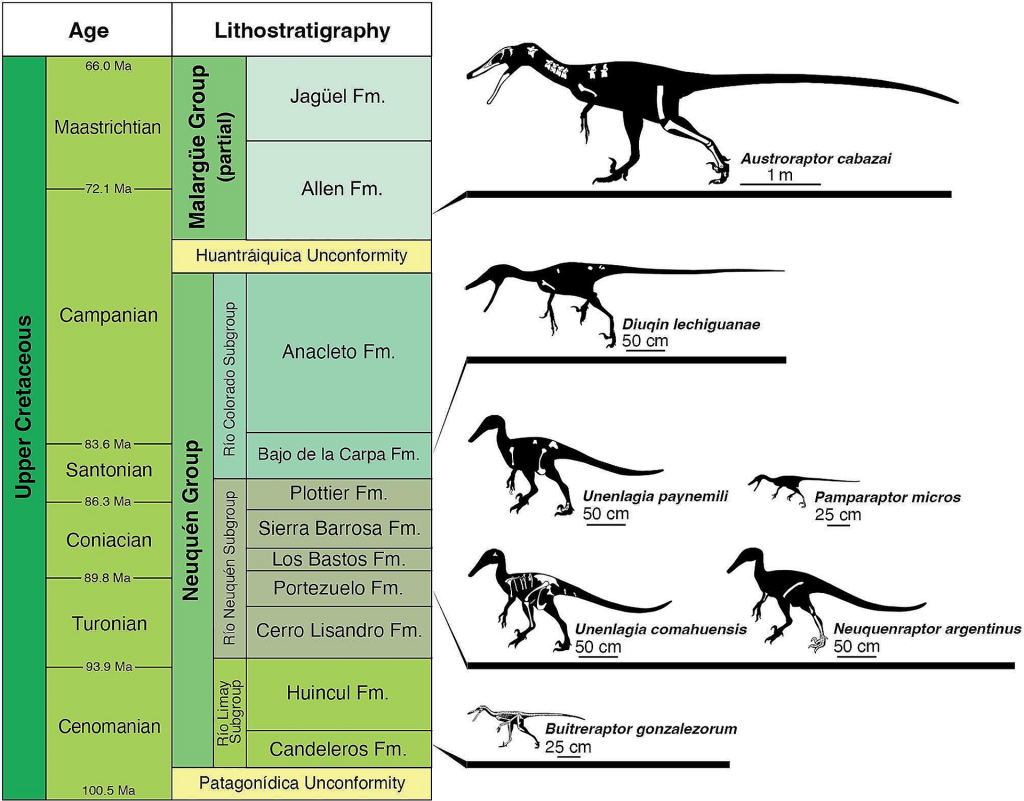
At Sierra del Portezuelo, about 12 miles (20 kilometers) west of Cutral Có in Argentina’s Neuquén Province, the river-laid rocks of the Portezuelo Formation hold one of Patagonia’s most debated theropods. Paleontologists Fernando Novas and Pablo Puerta named it Unenlagia comahuensis in 1997, in the journal Nature. It lived during the Turonian and Coniacian stages of the Late Cretaceous—roughly 90 million years ago. From the start, its describers argued that several of its features were more bird-like than in any other non-avian theropod then known.
Their 1997 paper presented it as a cursorial (running), non-flying animal that partly filled the gap between Archaeopteryx and the dromaeosaurids—then seen as birds’ closest non-avian relatives. A second species, U. paynemili, followed in 2004 from a quarry about 50 miles (80 kilometers) to the northeast. Since then, debate has continued over whether Unenlagia‘s family belongs on the line to birds or among the dromaeosaurids.
Unenlagia Key Facts
| Keyword | Fact |
|---|---|
| Pronunciation | Not specified |
| Meaning of name | Half Bird |
| Group | Theropoda (Paraves, Unenlagiidae) |
| Type Species | Unenlagia comahuensis |
| Diet | Carnivore |
| When it Lived | Around 90 MYA |
| Period | Cretaceous |
| Epoch | Late Cretaceous (Turonian to Coniacian stages) |
| Length | About 6.6 feet (2 meters) |
| Height | About 3.3 feet (1 meter), per a 1997 press report |
| Weight | About 138 pounds (62.5 kilograms), indirect 2014 estimate |
| Mobility | Moved on two legs (bipedal), described as a cursorial, non-flying runner |
| First Discovery | Year not specified for U. comahuensis, with U. paynemili material found 2002 to 2003 at the Futalognko site |
| Described by | 1997 by F.E. Novas and P.F. Puerta |
| Holotype | MCF-PVPH 78 |
| Location of first find | Sierra del Portezuelo, Portezuelo Formation, Neuquén Province, Argentina |
Unenlagia Origins, Taxonomy and Timeline
According to a 1997 report in Scientific American, the name Unenlagia means “half bird” in the language of the Mapuche people. The second species, U. paynemili, honors Maximino Paynemil, chief of the Paynemil Indian community of Loma de La Lata, where its quarry lies. Together, the names root the animal in the people and landscapes of Neuquén.
Unenlagia is a paravian theropod—part of the group that holds birds and their closest dinosaur relatives. It also gives its name to Unenlagiidae, a family that most earlier studies ranked as the subfamily Unenlagiinae. Jorge Calvo, Juan Porfiri and Alexander Kellner added the second species, U. paynemili, in 2004. In 2013, Novas and colleagues defined the family as all animals closer to U. comahuensis than to Velociraptor or Microraptor. Their wording built on a 2005 definition of the subfamily. They also listed both Unenlagia species, Neuquenraptor, Buitreraptor and Austroraptor as members, with Pamparaptor and Rahonavis more doubtful.
A thornier question surrounds Neuquenraptor argentinus, a similar unenlagiid named in 2005 from the same levels at Sierra del Portezuelo. Makovicky and colleagues in 2005, and later Turner and colleagues, suggested the two may be one animal. In contrast, Porfiri and colleagues argued in 2011 that both may be valid, citing foot anatomy. In 2017, Brissón Egli and colleagues were “not able to support nor dismiss” the idea. Even so, the toe bones referred to U. paynemili differ from those of Neuquenraptor. To them, this meant that at least two similar-sized unenlagiids lived in the formation.
As for age, Novas and colleagues placed U. comahuensis in the late Turonian to early Coniacian in 2013. A 2024 study gives the formation an age of about 90 million years. However, no absolute dating yet fixes that age—so every figure remains an estimate.

Discovery & Fossil Evidence
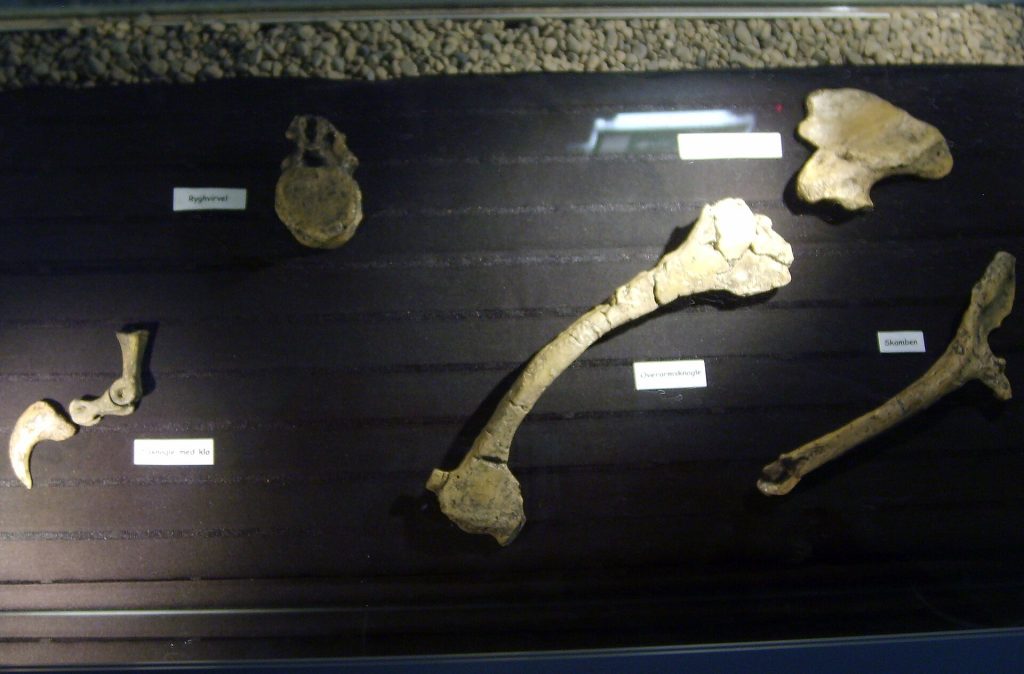
The describers’ paper reached Nature in December 1996. Today, the Museo Carmen Funes in Plaza Huincul houses the holotype, MCF-PVPH 78, an incomplete, partly articulated skeleton.
The holotype includes three dorsal (back) vertebrae, the sacrum (fused hip vertebrae), dorsal ribs and two haemal arches from beneath the tail. Also present are the left scapula (shoulder blade), part of the humerus, both ilia and pubes, the right ischium, the right femur (thigh bone) and the left tibia. Until a full osteology—a bone-by-bone study—appeared in 2021, researchers knew Unenlagia only from preliminary descriptions.
U. paynemili comes from the Futalognko site at Lago Barreales, about 56 miles (90 kilometers) northwest of Neuquén city. Its beds were long assigned to the top of the Portezuelo Formation. In 2023, however, Kellner, Figueiredo and Calvo placed them either there or in the middle of the Sierra Barrosa Formation.
Found in 2002, the holotype, MUCPv-349, is a left humerus and a left pubis that lay about 8 feet (2.5 meters) apart. Calvo and colleagues treat them as one individual. In 2003, surface collecting added a dorsal vertebra from a larger animal, probably washed out when Barreales lake flooded. The rear end of a right ilium lay about 75 feet (23 meters) from the pubis, and the team cautiously assigned it to another individual.

Unenlagia Size and Description
Short description of Unenlagia
Without a skull, the head of Unenlagia remains unknown. Other unenlagiids had a long front to the maxilla, the main upper tooth-bearing bone, and many small teeth without serrations—traits not yet seen in Unenlagia itself. Along the back, the dorsal vertebrae carried tall neural spines, the bony blades on top of each vertebra. The sacrum fused six vertebrae, while the ilia spanned the last two dorsals and the first tail vertebra.
The pubis was long, slightly shorter than the femur, and pointed downward. A bony sheet called the pubic apron ran along about three-quarters of its length. When Calvo and colleagues re-examined the holotype in 2004, however, the lower end of the pubis turned out to bend backward. The 1997 reconstruction had shown it running straight. The femur, meanwhile, was long and slender with a small head.
No skin impressions survive. In 1997, Scientific American noted that there was no evidence it had feathers—so any depiction of its body covering, including the featured artwork, is speculative.

Size and Weight of Type Species
In 2011, paleontologists F. A. Gianechini and S. Apesteguía put U. comahuensis at approximately 6.6 feet (2 meters) long, without stating a method. A 1997 Scientific American report describes it as standing perhaps 3.3 feet (1 meter) tall.
In 2014, a team led by R. B. J. Benson estimated about 138 pounds (62.5 kilograms) by scaling from the thickness of its limb-bone shafts. Their dataset lists a femur 15.6 inches (395 millimeters) long, a tibia of 16.5 inches (420 millimeters) and a humerus of 10.4 inches (265 millimeters).
U. paynemili had more gracile bones. Its humerus measures 8.5 inches (217 millimeters), roughly 20 percent smaller than that of the type species. Yet the Barreales vertebra came from an animal larger than the U. comahuensis holotype. Its referral to Unenlagia, however, rests on a single feature.
The Dinosaur in Detail
What sets this dinosaur apart is its shoulder. In 1997, Novas and Puerta read the glenoid—the shoulder socket for the upper arm bone—as facing sideways, as in birds. They argued that the avian way of folding the arm, and the wide upward sweep needed for flapping flight, were already present in non-flying theropods. In 1999, however, Norell and Makovicky argued that dromaeosaurids share this feature. Carpenter then countered in 2002 that the scapula had been oriented wrongly, which would turn the socket backward and downward. Even so, the 2021 redescription again reported a sideways-facing glenoid. It also described a reduced acromion, a process of the shoulder blade, that “may be related to” flight features in birds.
The backbone also held air spaces. In 2021, Gianechini and Zurriaguz used CT scans to reveal camellate tissue—many small air-filled chambers, a pattern also found in other coelurosaurs—inside the vertebrae. Among non-avian theropods, only U. paynemili shares its possibly air-filled pit beside the base of the neural spine. Calvo and colleagues compared a strongly curved claw, tentatively referred to U. paynemili, with the first-toe claw of Rahonavis. Turner and colleagues, however, later identified it as a hand claw.
Its family tree remains the deepest puzzle. Novas and Puerta proposed Unenlagia as the sister taxon, or closest relative, of Avialae, the bird lineage. By contrast, Forster and colleagues placed it inside Avialae in 1998, while Norell and colleagues recovered it as a dromaeosaurid. In 2011, Agnolín and Novas instead united unenlagiids with birds in Avialae. The 2021 redescription treated them as early offshoots of the bird lineage. Yet in 2024, Porfiri and colleagues still recovered the group within Dromaeosauridae, with a jackknife support of 83. A year later, Motta and colleagues placed unenlagiids among early avialans, outside Dromaeosauridae. For now, the question remains open.
Interesting Points about Unenlagia
- The name Unenlagia means “half bird” in the Mapuche language, according to a 1997 Scientific American report on the discovery.
- The same report described Alan Feduccia’s view that it was no intermediate, since it lived about 55 million years after Archaeopteryx.
- Its describers suggested the arms served in predation and probably also helped with balance and body control while running and leaping.
- At the Futalognko quarry, the humerus and pubis of U. paynemili lay close to the remains of a giant sauropod.
Contemporary Dinosaurs
Sharing these rocks was Megaraptor, the large-clawed theropod that gives the megaraptorids their name. In 2017, Brissón Egli and colleagues listed it among the theropods from “the same area and coeval levels” at Sierra del Portezuelo as U. comahuensis. New Megaraptor bones also turned up at the Futalognko site, home of U. paynemili.
Also reported from those same levels was Patagonykus puertai, an alvarezsaurid—a member of a theropod family once labeled “basal birds.” Recent studies of the Portezuelo fauna nevertheless treat it as a non-avian theropod. The unenlagiid Neuquenraptor also comes from the same area and levels. It is not listed separately because some studies consider it the same animal as Unenlagia, as noted under Origins.
The Futalognko site that yielded U. paynemili also produced Futalognkosaurus, a titanosaur its describers called “the most complete giant sauropod ever found.” Calvo and colleagues reported the quarry’s fossils as concentrated in a single horizon about 1.6 feet (0.5 meters) thick. The U. paynemili humerus and pubis also lay close to the sauropod’s remains. The quarry lies either at the top of the Portezuelo Formation or in the middle of the Sierra Barrosa Formation, according to the 2023 study. This link applies only to the second species, not to the type locality.
Also known from the Portezuelo Formation (exact level relative to Unenlagia not known): Macrogryphosaurus, Pamparaptor, Elemgasem, Muyelensaurus and, from Mendoza Province, Malarguesaurus. The formation is assigned to the middle Turonian to late Coniacian, so these animals may not all have lived at the same time.
Unenlagia in its Natural Habitat
The world Unenlagia roamed was one of meandering rivers crossing a flat landscape. Its rocks are yellowish sandstones with red and green mudstones, some 330 feet (100 meters) thick. Rivers laid them down in channels and floodplains with frequent fossil soils. An earlier study pictured these rivers running through lush vegetation in a humid climate. At Futalognko, standing bodies of water formed on flooded ground and preserved the fossils. Turtles, bony fish, crocodylomorphs, pterosaurs, flowering plants and gymnosperms (non-flowering seed plants) also appear there.
Researchers generally treat Unenlagia as a carnivore, although no gut contents or bite marks back this up. Brissón Egli and colleagues also linked features of unenlagiid feet to enhanced raptorial, or prey-seizing, ability. Its actual prey, however, remains unknown.
While there is no direct evidence of whether Unenlagia lived alone or in groups, its home was far from empty. The Sierra del Portezuelo levels also hold unnamed finds—fragments of an abelisauroid and a neornithine, or modern-type, bird. Shed teeth from the area fall into six types, which suggests a more diverse theropod community than once thought.
Frequently Asked Questions
It means “half bird” in the Mapuche language, according to a 1997 report on its discovery.
It lived during the Turonian to Coniacian stages of the Late Cretaceous, around 90 million years ago.
It reached about 6.6 feet long, with an indirect weight estimate of about 138 pounds.
It is treated as a carnivore, and its describers proposed that it used its arms in predation.
The type species comes from the Portezuelo Formation at Sierra del Portezuelo. A second species comes from the Futalognko quarry at Lago Barreales, and both sites lie in Neuquén Province, Argentina.
Its describers placed it as the closest relative of birds. Later studies remain split between an early avialan and a dromaeosaurid position.
Sources
The information in this article is based on various sources, drawing on scientific research, fossil evidence, and expert analysis. The aim is to provide a comprehensive and accurate overview of Unenlagia. However, please be aware that our understanding of dinosaurs and their world is constantly evolving as new discoveries are made.
- https://doi.org/10.1038/387390a0
- https://archive.org/download/biostor-248684/biostor-248684.pdf
- https://doi.org/10.1016/j.cretres.2013.04.001
- https://doi.org/10.4202/app.00348.2017
- https://doi.org/10.1590/S0001-37652011000100009
- https://doi.org/10.1002/ar.24641
- https://doi.org/10.1016/j.cretres.2021.104925
- https://doi.org/10.1186/s12862-024-02247-w
- https://doi.org/10.1186/s12862-024-02249-8
- https://doi.org/10.1371/journal.pbio.1001853
- https://doi.org/10.1590/S0001-37652011000100008
- https://doi.org/10.1007/978-94-007-5637-3
- https://doi.org/10.1080/14772019.2025.2529608
- https://doi.org/10.1590/S0001-37652011000100007
- https://archive.org/download/biostor-248728/biostor-248728.pdf
- https://archive.org/download/biostor-248725/biostor-248725.pdf
- https://paleobiodb.org/classic/checkTaxonInfo?taxon_no=65421
- https://www.scientificamerican.com/article/its-a-birdits-adinosaur/
- https://doi.org/10.1590/0001-3765202320230179
- https://doi.org/10.1590/S0001-37652007000300013
- https://doi.org/10.1206/748.1
This article was last fact checked: TheDinosaurs Team, 16-11-2026
Featured Image Credit: Veta yogurt, CC BY-SA 4.0, via Wikimedia Commons
