
On the eastern outskirts of Santa Maria, in southern Brazil, gullies cut into the orange-red rocks of the Santa Maria Formation. Here, a 1936 Harvard expedition collected the partial skeleton of a small, two-legged predator that paleontologist Edwin H. Colbert later named Staurikosaurus pricei. The rocks that held it belong to the Carnian stage of the Late Triassic, around 233 million years ago. In 2000, paleontologist P.M. Galton called it one of the oldest dinosaurs.
Only one partial skeleton is firmly known, and it lacks a skull, hands, and feet. Even so, its hips and hind limbs show what Colbert called a reptile strongly adapted for bipedalism—walking on two legs. Today, most studies pair it with Herrerasaurus in the family Herrerasauridae, a group of early meat-eating dinosaurs. Yet the exact place of that family in the dinosaur tree is still argued over. For a fossil without a skull, it has had a surprisingly long say in those debates.
Staurikosaurus Key Facts
| Keyword | Fact |
|---|---|
| Pronunciation | Not specified |
| Meaning of name | Southern Cross Lizard |
| Group | Saurischia (Herrerasauridae) |
| Type Species | Staurikosaurus pricei |
| Diet | Carnivore |
| When it Lived | Around 233 MYA (approximate) |
| Period | Triassic |
| Epoch | Late Triassic (Carnian stage) |
| Length | About 7.2 to 7.4 feet (2.20 to 2.25 meters), 2011 estimate |
| Height | Not specified |
| Weight | About 41 pounds (18.5 kilograms), 2012 estimate |
| Mobility | Moved on two legs (bipedal) |
| First Discovery | 1936 by the Museum of Comparative Zoology expedition of Llewellyn I. Price and Theodore E. White |
| Described by | 1970 by E.H. Colbert |
| Holotype | MCZ 1669 |
| Location of first find | Sanga Grande, Alemoa, Santa Maria Formation, Rio Grande do Sul, Brazil |
Staurikosaurus Origins, Taxonomy and Timeline
The name Staurikosaurus looks to the night sky. Colbert built it from “staurikos,” meaning “of a cross,” in allusion to the Southern Cross constellation, and “saurus,” meaning “lizard.” The species name pricei honors Llewellyn Ivor Price, who made extensive collections of fossil reptiles in Brazil. Together, the name pairs a southern constellation with the collector who brought the bones to light.
Colbert placed his new genus in Saurischia, the “lizard-hipped” dinosaurs, chiefly because its pelvis had an open acetabulum (hip socket). He then assigned it to the family Palaeosauriscidae, within an infraorder he renamed Teratosauria, replacing his earlier name Palaeosauria. Even so, he admitted the arrangement was tentative at best. In 1977, Galton erected a family of its own, Staurikosauridae, but by 2000 he had moved it into Herrerasauridae. In 2009, paleontologists J.S. Bittencourt and A.W.A. Kellner recovered it as the sister taxon—closest relative—of Herrerasaurus.
Colbert placed the Santa Maria fauna in the Carnian, the first stage of the Late Triassic. He did so partly by comparing it with the Ischigualasto fauna of Argentina, home of Eoraptor and Herrerasaurus, about 1,400 kilometers (870 miles) away.
In 2018, paleontologist M.C. Langer and colleagues dated a bone bed less than 0.5 kilometers from the probable type locality. Its maximum age came out at 233.23 million years, give or take 0.73 million. That mudstone lies about 5 meters below the top of the Alemoa Member. The probable Staurikosaurus site, by contrast, correlates with the lower part of the unit. The date therefore places Staurikosaurus around 233 million years ago—an approximate figure, since the skeleton may be slightly older than the dated bed. Langer’s team also judged the fauna consistent with a late Carnian, or Tuvalian, age.
Discovery & Fossil Evidence
In 1936, Price and Theodore White spent many months collecting Triassic reptiles from the Santa Maria Formation for Harvard’s Museum of Comparative Zoology. Their haul included Staurikosaurus, though Colbert never names its finder. The bones came from Sanga Grande, or Sanga Baixo, at Alemoa, and Langer’s team suggests that small ravines nearby most probably mark what remains of it. Colbert set the specimen aside for a time and visited Brazil before describing it in 1970.
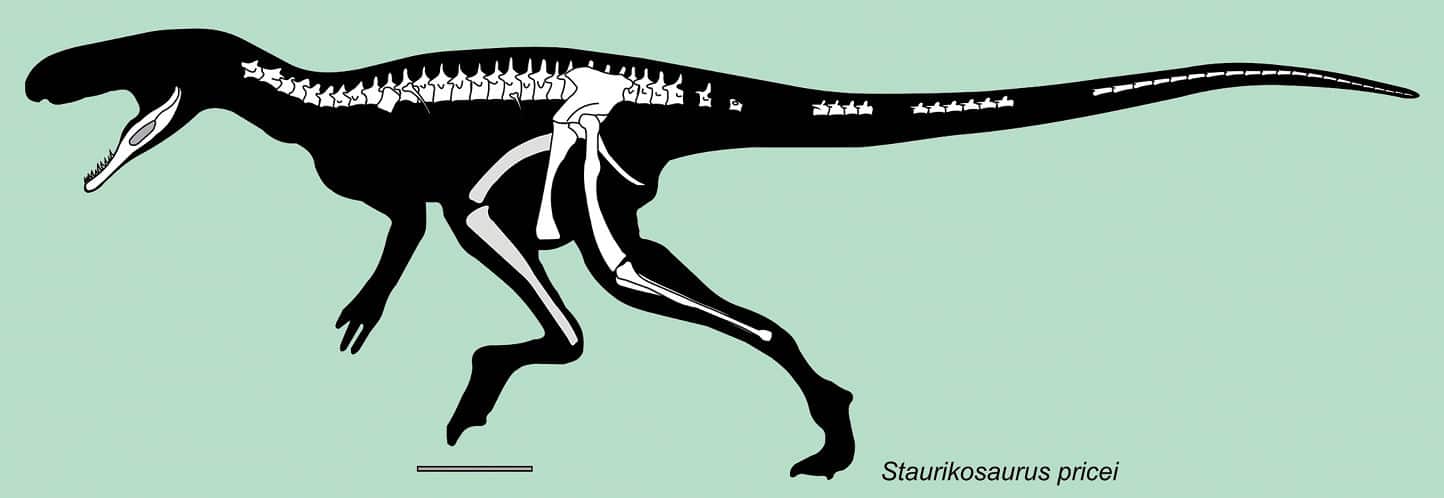
The holotype—the name-bearing specimen—is MCZ 1669, a partial skeleton at Harvard. In 2009, a cast (MN 6104-V) was reported at the Museu Nacional in Rio de Janeiro. Colbert listed both mandibular rami (the halves of the lower jaw), part of a scapula (shoulder blade), and part of the right humerus (upper arm bone). He also counted 20 presacral, three sacral (hip), and 35 caudal (tail) vertebrae, plus ribs, hip bones, and both legs minus the feet. After further preparation, Bittencourt and Kellner revised the tally to six neck, 15 back, three hip, and 34 tail vertebrae. They also listed a left scapula but no humerus.
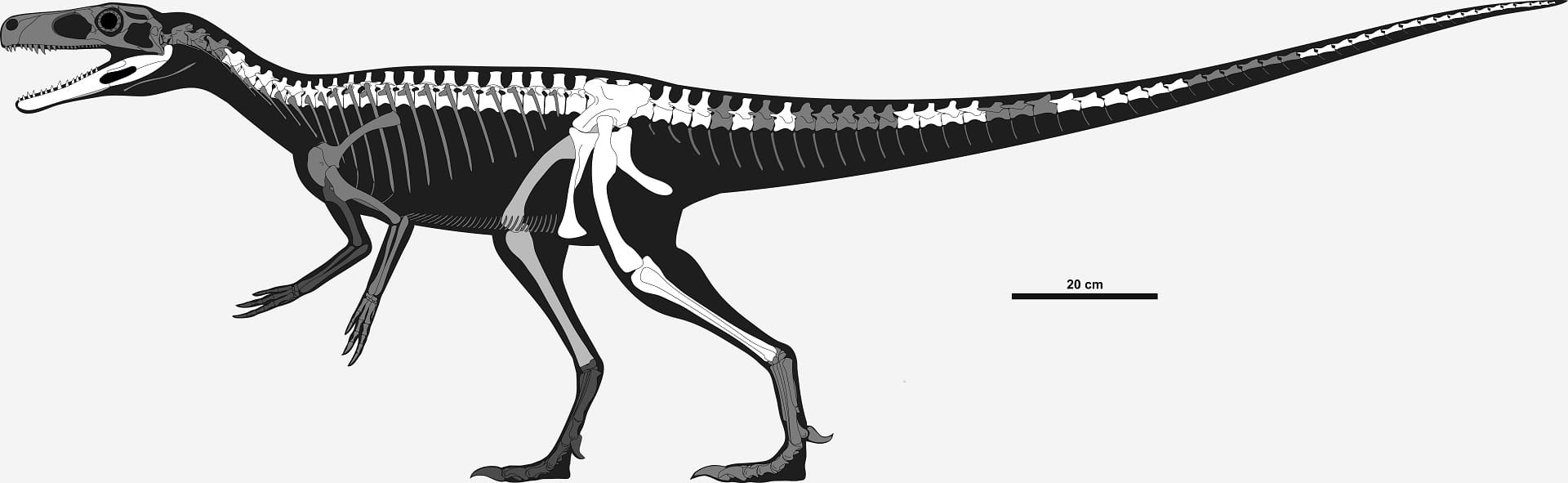

Growing minerals burst apart many Santa Maria bones during fossilization. This skeleton escaped that fate, though its bones are broken and crushed, and its hip sockets are eroded. In 2019, paleontologist M.S. Garcia and colleagues argued that a femur and tibia named Teyuwasu barberenai belong to Staurikosaurus. If accepted, these would be the first bones referred to it in almost half a century, yet even Garcia’s team called the femur–tibia pairing tentative. In contrast, paleontologist J.B. Desojo and colleagues in 2020 called the association doubtful and treated Teyuwasu as a nomen dubium, or doubtful name. For now, no second specimen has been confirmed without debate.
Staurikosaurus Size and Description
Short description of Staurikosaurus
The head is known only from the lower jaws, but they hint at a large skull. Each jaw was about as long as the femur (thigh bone), and the dentaries—the tooth-bearing jaw bones—were thin and deep, with a large opening called the mandibular fenestra. Since only tooth bases survive, Colbert inferred that the teeth were probably small, pointed, and straight.
Behind the head came the body and a tail longer than the rest of the animal combined. Colbert estimated 23 to 25 presacral vertebrae and a tail of perhaps 40 or more, and he described the bones as hollow but rather thick-walled. The forelimbs were small and the hind limbs strong. A short, deep ilium—the main hip bone—framed a very large hip socket, while the tibia (shin bone) ran slightly longer than the femur.
No skin or other soft tissue survives with the skeleton, so any picture of its outer covering is speculative.

Size and Weight of Type Species
Colbert gave no total length or weight, calling it simply a small, lightly built animal. In 2011, paleontologists O.N. Grillo and S.A.K. Azevedo estimated where the preserved tail vertebrae sat in the series and the size of the missing ones. As a result, they reached a total length of about 7.2 to 7.4 feet (2.20 to 2.25 meters). More than half of that—about 4.4 feet (1.34 meters)—was tail.
No hip-height estimate appears in the studies consulted, but Colbert measured the femur at 229 millimeters (9.0 inches). In 2012, paleontologist R. Delcourt and colleagues estimated a body mass of about 41 pounds (18.5 kilograms) from femur length, using a bone-scaling equation by Christiansen and Fariña. Their calculation, however, used a 220-millimeter femur, close to the roughly 22 centimeters that Garcia’s team gave.
Either way, Staurikosaurus was no giant, and Colbert noted that Herrerasaurus was about twice as large in linear dimensions. Both figures remain indirect estimates built on a single, incomplete skeleton.
The Dinosaur in Detail
What sets it apart lies mostly in its hips and legs. In 2009, Bittencourt and Kellner listed four autapomorphies—traits unique to the species. The first is a lower pubis beveled toward the front and midline. They also cited a reduced cranial trochanter on the femur, a subcircular lower end of the tibia, and a groove on the inner upper fibula. Garcia’s team later noted, however, that the rounded tibia also appears in Tawa and Sanjuansaurus.
The hip vertebrae have proved a sticking point. Colbert counted three sacral vertebrae, but Galton’s 1977 study counted two. Bittencourt and Kellner returned to three, with a tail vertebra drawn into the hip, unlike Herrerasaurus, which incorporates a back vertebra.

Other traits tie it to its relatives. Bittencourt and Kellner found herrerasaurid features such as shortened rear back vertebrae and a U-shaped cross-section at the lower pubis. By contrast, they judged Chindesaurus and Caseosaurus too incomplete to assign firmly to the family. In 2025, however, paleontologist M.D. Ezcurra and colleagues recovered Chindesaurus within the wider herrerasaur group, Herrerasauria, and cited an earlier analysis that placed Caseosaurus there too. Ezcurra’s team also noted the strongly developed pubic boot—an expanded tip—that it shares with Herrerasaurus, Gnathovorax, and other herrerasaurs.
Its wider placement remains the biggest open question. Bittencourt and Kellner noted some theropod-like traits in the teeth and tail. Even so, they did not place it within Eusaurischia, the group uniting theropods and sauropodomorphs. Delcourt and colleagues, following two 2011 analyses, treated it as a basal theropod. Ezcurra’s team instead recovered herrerasaurs as saurischians outside Eusaurischia, a view they say seems to be gaining consensus. Taken together, the resemblance to Herrerasaurus that Colbert noted in 1970 has held up, even though he placed the two in separate families. Meanwhile, the branch they sit on keeps moving.
Interesting Points about Staurikosaurus
- Its name is a nod to the Southern Cross, the constellation Colbert chose for a dinosaur from southern Brazil.
- Some 34 years passed between the 1936 expedition that collected the skeleton and Colbert’s formal description in 1970.
- From 1936 until Gnathovorax was described in 2019, it was the only herrerasaurid recorded from Brazil.
- In 2012, Delcourt and colleagues suggested that early dinosaurs like it may have held the trunk at least 20 degrees above horizontal during fast locomotion.
Staurikosaurus in its Natural Habitat
The world Staurikosaurus roamed was one of reddish mudstones and fine sands spread across floodplains. At Cerro da Alemoa, about 66 feet (20 meters) of these rocks include minor channels and ancient soils that record a rising and falling water table. Langer’s team links these beds to drier conditions than in the early Carnian. Rhynchosaurs, an extinct group of reptiles, dominated the fauna, especially the genus Hyperodapedon. The cynodont Alemoatherium huebneri comes from high in the Cerro da Alemoa section. More broadly, the Hyperodapedon Assemblage Zone faunas of southern Brazil also included small crocodylomorphs, aetosaurs, temnospondyls, and rauisuchoids.
Higher in the Alemoa Member at nearby Cerro da Alemoa, about 3 to 7 meters below its top, come the type specimens of the sauropodomorph Saturnalia tupiniquim. In 2012, it was estimated at about 14 pounds (6.5 kilograms). Even closer to the top lay Nhandumirim waldsangae, a small saurischian that paleontologist J.C.A. Marsola and colleagues tentatively assigned to Theropoda in 2019. Other dinosaurs come from different sites. Buriolestes schultzi, a strictly meat-eating sauropodomorph, lay beside the lagerpetid Ixalerpeton—not itself a dinosaur—in the Buriol ravine. Meanwhile, the herrerasaurid Gnathovorax cabreirai comes from the Marchezan site, in beds correlated with the dated layer. The formation has also produced Pampadromaeus barberenai and the sauropodomorph Bagualosaurus agudoensis.
Colbert pictured Staurikosaurus as a very active predator with strong jaws and a wide gape, perhaps capable of attacking animals equal to it in size. He contrasted the “ponderous” Herrerasaurus with the “agile” Staurikosaurus, and he wrote that the dinosaur shared the rhynchosaur’s environment. Whether it hunted alone or in groups is unknown, since a single skeleton cannot settle that question. Langer’s team, for its part, grouped it with Herrerasaurus among the “medium to large carnivores” of these faunas.
Frequently Asked Questions
It means “Southern Cross lizard,” and the species name pricei honors fossil collector Llewellyn Ivor Price.
It lived in the Carnian stage of the Late Triassic, around 233 million years ago.
Estimates suggest it was about 7.2 to 7.4 feet long and weighed about 41 pounds, though both figures are indirect.
It was a carnivore, and Colbert described it as a very active predator with strong jaws and a wide gape.
It was found at Sanga Grande in Alemoa, Santa Maria, Rio Grande do Sul, Brazil, in the Santa Maria Formation.
Most studies place it in Herrerasauridae beside Herrerasaurus, but its exact position among early saurischians is still debated.
Sources
The information in this article is based on various sources, drawing on scientific research, fossil evidence, and expert analysis. The aim is to provide a comprehensive and accurate overview of Staurikosaurus. However, please be aware that our understanding of dinosaurs and their world is constantly evolving as new discoveries are made.
- https://digitallibrary.amnh.org/handle/2246/2615
- https://www.mapress.com/zootaxa/2009/f/z02079p056f.pdf
- https://tb.plazi.org/GgServer/html/03BD5A05FF9CFFB3FF3525C5FD05FEDE
- https://tb.plazi.org/GgServer/html/03BD5A05FFB3FF9EFF3524D7FA9BFD05
- https://doi.org/10.1007/BF02986571
- https://doi.org/10.1007/BF02988109
- https://scielo.br/j/aabc/a/ZrzCcrvBskLCywvQBsrXnhF/?lang=en
- https://revistas.usp.br/paz/article/download/48030/51783/58191
- https://doi.org/10.1016/j.gr.2018.01.005
- https://tb.plazi.org/GgServer/html/03A6D706FFCF4E10FF2DFCA2FC20F8F5
- https://palaeo-electronica.org/content/pdfs/1026.pdf
- https://peerj.com/articles/7963/
- https://doi.org/10.1016/j.cub.2016.09.040
- https://doi.org/10.1080/02724634.2018.1531878
- https://pmc.ncbi.nlm.nih.gov/articles/PMC12077243/
- https://doi.org/10.1093/zoolinnean/zly028
This article was last fact checked: TheDinosaurs Team, 13-11-2026
Featured Image Credit: CaetaMS, CC0 1.0, via Wikimedia Commons
