
Among the red river sandstones of La Rioja Province, Argentina, the upper Los Colorados Formation holds one of the larger theropods of the Triassic. Named Zupaysaurus rougieri in 2003, this carnivore lived during the Norian stage of the Late Triassic. It was probably no younger than about 213 million years old. Its only known specimen includes an almost complete skull, still joined to its lower jaws. At first, it was hailed as the oldest known tetanuran—a member of one of the two great branches of advanced theropods.
The fossil was found by S. Reuil, and a team under Guillermo Rougier collected it. A 1997 abstract first reported the find, and in 2003 paleontologists Andrea B. Arcucci and Rodolfo A. Coria formally named it. Later studies recast it as a coelophysoid—a relative of Coelophysis—or as an early relative of Averostra, which unites ceratosaurs and tetanurans. Its shifting identity shows how much weight a single skull can carry in the story of early theropod evolution.
Zupaysaurus Key Facts
| Keyword | Fact |
|---|---|
| Pronunciation | Not specified |
| Meaning of name | Devil Lizard |
| Group | Theropoda |
| Type Species | Zupaysaurus rougieri |
| Diet | Carnivore |
| When it Lived | Probably no younger than about 213 MYA |
| Period | Triassic |
| Epoch | Late Triassic (Norian stage) |
| Length | About 9.8 feet (3 meters), rough estimate |
| Height | Not specified |
| Weight | Not specified |
| Mobility | Moved on two legs (bipedal) |
| First Discovery | Year not specified, by S. Reuil (first reported in 1997) |
| Described by | 2003 by A.B. Arcucci and R.A. Coria |
| Holotype | PULR-076 |
| Location of first find | Quebrada de los Jachaleros, upper Los Colorados Formation, La Rioja Province, Argentina |
Zupaysaurus Origins, Taxonomy and Timeline
The name Zupaysaurus draws on two very different languages. Zupay is the Quechua word for “devil,” while saurus is Greek for “lizard.” The species name rougieri honors Dr. Guillermo Rougier, under whose direction the specimen was found and collected. Together, the name pairs a native South American language with classical Greek and honors the scientist behind the dig.
Zupaysaurus is a theropod, but its exact branch has moved more than once. Arcucci and Coria originally placed it in Tetanurae and presented it as the oldest record of that group. Several studies from 2005 to 2014 then placed it within Coelophysoidea, alongside Coelophysis and its close kin. In recent years, however, several analyses have found it to be an early neotheropod—the wider group holding both coelophysoids and averostrans—just outside Averostra. Zupaysaurus rougieri is the type and only known species.
Arcucci and Coria placed the fossil midway through the formation’s upper part, in the latest Late Triassic. They noted the wide view of a Norian age but did not commit to a stage. In 2014, Kent and colleagues used magnetostratigraphy—dating rocks by their magnetic record—to place the formation between 227 and 213 million years ago. They judged the La Esquina fauna probably no younger than about 213 million years old, though their section lay 30 kilometers (19 miles) away. Building on that work, Ezcurra placed the upper levels in the middle Norian. In 2026, Gaetano and colleagues gave a mid-Norian window of about 220 to 211 million years ago. Other studies have called the formation lower–middle Norian or late Norian–Rhaetian, so the exact sub-stage remains open.
Discovery & Fossil Evidence
The specimen came from Quebrada de los Jachaleros, 7 kilometers (4.3 miles) west of National Route 126. The 2003 paper gives no year of discovery, and Rougier, M. de la Fuente, F. Abdala, and their assistants collected the bones. A 2004 faunal table by Arcucci and colleagues, however, gives the locality as northwest of La Esquina. The site may therefore differ from the classic Jachaleros quarry that yielded Bonaparte’s older finds.
The holotype, PULR-076, is housed at the Universidad Nacional de La Rioja. It preserves a skull lacking only the premaxillae (the front upper jaw bones). The first ten vertebrae of the neck and front of the back survive, still linked, with two incomplete fused sacral (hip) vertebrae. Also preserved are the upper right scapula and coracoid (shoulder girdle) and the lower right tibia and fibula (shin bones). A fused right astragalus and calcaneum (ankle bones) and parts of two pedal unguals (toe claws) complete the list. The original authors set aside the skull roof and occiput—the back of the skull—for a separate study.
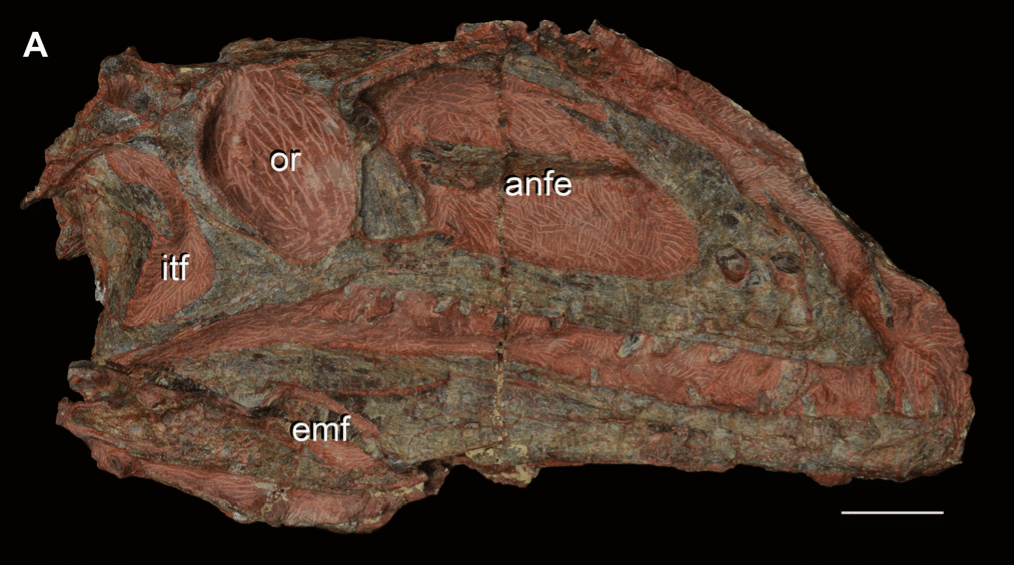

Three more bones lay with the holotype—a fused left scapulocoracoid, a left ilium, and the end of a right femur. Arcucci and Coria assigned them to a smaller individual of uncertain affinities and left them out. Later work by Ezcurra, however, counts partial girdles and limb bones, including a femur, as part of PULR-076. As a result, the contents of the holotype differ between studies. In 2017, Ezcurra still called PULR-076 the only known specimen, and no others have been confirmed.
Zupaysaurus Size and Description
Short description of Zupaysaurus
The skull was long, narrow, and low, with an estimated total length of 45 centimeters (17.7 inches). Because the premaxillae are missing, the preserved part measures only 38 centimeters (15 inches) to the jaw joint. Its maxilla, the main upper tooth-bearing bone, kept 15 teeth from an estimated 23 or 24. The fourth seems to have been the largest, at 3 centimeters (1.2 inches) tall. An enlarged lower tooth suggests a gap between the premaxillary and maxillary teeth—a notch known as a subnarial gap.
Behind the head, the neck vertebrae were long, low, and pinched at mid-length, with thin ribs fused to them. Its ankle bones fused to each other but not to the tibia. The authors also described the whole ankle joint as intermediate in shape between basal theropods and derived tetanurans. According to Arcucci and colleagues, the theropods of its formation were strictly bipedal. In 2019, CT scans by Ariana Paulina-Carabajal and colleagues revealed a short but tall brain cavity with clearly marked fore-, mid-, and hindbrain regions.
Size and Weight of Type Species
In 2004, Arcucci and colleagues gave Zupaysaurus a rough length of about 9.8 feet (3 meters), without explaining how they obtained it. No other peer-reviewed body length appears in the sources reviewed. In 2016, Ezcurra and Novas called it medium-sized, noting its skull of about 45 centimeters.
No peer-reviewed estimate of hip height or body weight appears in the sources reviewed, so both remain unknown. In 2019, Griffin counted it among only three named species of unambiguously larger Triassic neotheropods. Judging by its skull, the 2003 authors found it larger than Coelophysis, Liliensternus, Eoraptor, and Herrerasaurus, and similar in size to Gojirasaurus. That comparison sits uneasily with the 3-meter figure, since Ezcurra and Novas credit Herrerasaurus with a length of about 20 feet (6 meters).
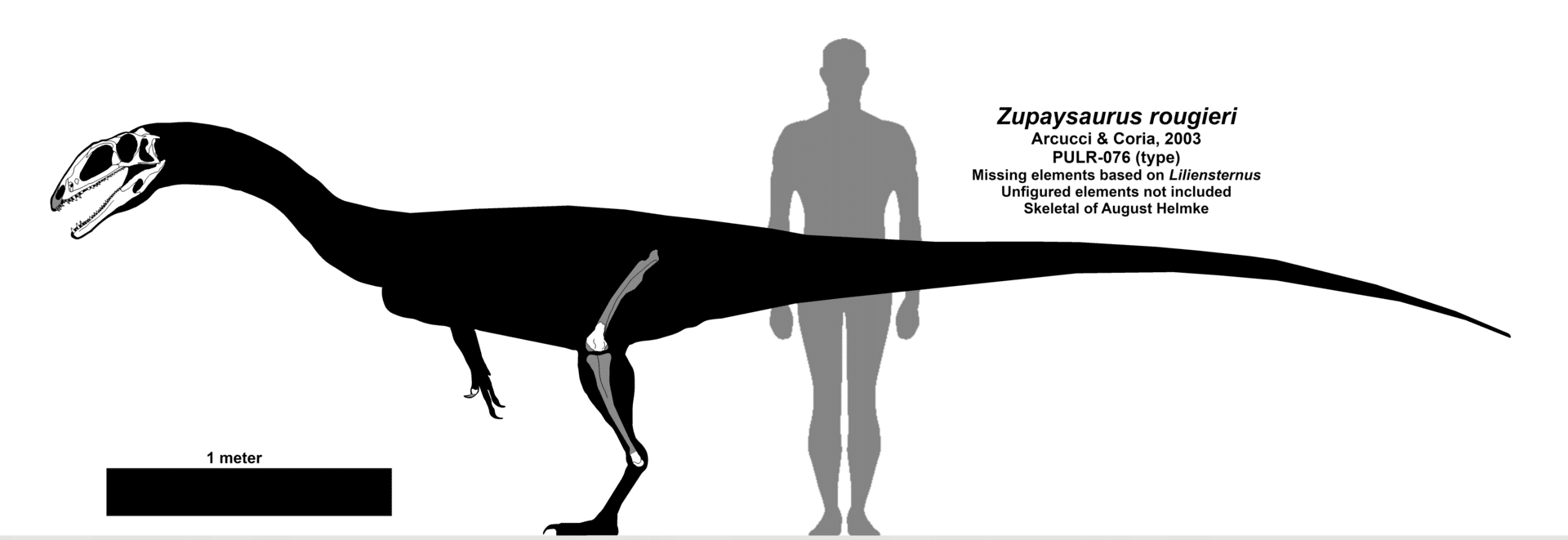

The only specimen was probably not fully grown. Ezcurra pointed to its tibia and fibula, which had not fused to the ankle bones. Griffin likewise listed it among ontogenetically immature—still-growing—specimens. By direct comparison, its astragalus was 342 and 543 percent broader than in two Powellvenator specimens.
The Dinosaur in Detail
One of the most distinctive features of Zupaysaurus is its maxilla. The bone ran 26 centimeters (10.2 inches) long but was only 3 centimeters (1.2 inches) high at its horizontal process. Unlike the tapering process of most theropods, its upper and lower edges ran parallel. In 2007, Ezcurra listed skull traits then unknown in any other Triassic dinosaur. These include a pneumatic (air-filled) lacrimal and a maxillary fenestra (an extra opening in the upper jaw). An oval orbit and a wide squamosal–quadratojugal contact at the rear of the skull complete the set.
Arcucci and Coria originally described a pair of thin nasal crests along its snout, each about 1 millimeter thick. In 2020, however, Marsh and Rowe, citing Ezcurra’s studies, wrote that the supposed crest was determined to be crushed nasal or lacrimal bone. If so, the crest was simply an artifact of crushing.
Arcucci and Coria’s analysis of 10 taxa and 19 characters nested it in Tetanurae in all 12 of its shortest trees. They interpreted ceratosaur-like traits, such as its fused ankle, as independently evolved or primitive. In 2007, by contrast, Ezcurra and Novas recovered it as a coelophysoid. They treated its tetanuran-like features as homoplasies—similar traits that arose separately. Yates had already linked it in 2005 with Dilophosaurus and Dracovenator, in a clade he called not robustly supported.
In 2017, Ezcurra recovered it on the branch leading toward Averostra, finding that forcing it into Coelophysoidea cost two extra steps. Griffin’s 2019 consensus left it unresolved near the base of Neotheropoda. Meanwhile, Marsh and Rowe placed it among stem-averostrans with Dilophosaurus and Cryolophosaurus. Taken together, its mosaic of primitive and derived traits keeps its exact branch open.
Interesting Points about Zupaysaurus
- Its name combines the Quechua word zupay, meaning “devil,” with the Greek saurus, meaning “lizard.”
- When it was named in 2003, it was presented as the oldest known tetanuran, living at the same time as early coelophysids such as Coelophysis.
- In 2007, Ezcurra and Novas called it the first coelophysoid record from South America, a status later work disputed.
- CT scans of its braincase show all three semicircular canals of the inner ear, with the rear canal proportionally large.
Contemporary Dinosaurs
Sharing the formation’s upper levels was Powellvenator podocitus, a small early coelophysoid that Ezcurra named in 2017. It comes from a locality also called Quebrada de los Jachaleros, though the shared name may not mean the same quarry. Ezcurra called it markedly smaller than the probably sympatric Zupaysaurus. He likened the pairing to the two-sized theropod pairs of Early Jurassic faunas. Even so, no bed correlation ties the two sites together, and no interaction between them is recorded.
Zupaysaurus in its Natural Habitat
The world Zupaysaurus roamed was one of rivers and floodplains. Arcucci and Coria described its sandstones and mudstones as the work of moderately sinuous rivers. Kent’s team measured about 600 meters (nearly 2,000 feet) of these red beds in one section. Although earlier work had argued for aridity, Arcucci and colleagues found no sedimentary sign of it and supported a seasonally humid climate. The basin lay at about 48 degrees south, in the humid temperate belt of the Southern Hemisphere.
Plant fossils are scarce, but the abundance of herbivores suggests a cover of low vegetation and forest. Dinosaurs made up about one third of the vertebrate taxa at La Esquina. In fact, that fauna records the first numerical dominance of herbivorous dinosaurs. Sauropodomorphs 3 to 10 meters (10 to 33 feet) long were its major element. Also known from the upper Los Colorados Formation, around La Esquina, are Riojasaurus incertus, Coloradisaurus and Lessemsaurus sauropoides. None, however, has been tied to the exact level of the Zupaysaurus skull.
While there is no direct evidence of what Zupaysaurus ate, Arcucci and colleagues grouped it with the formation’s carnivorous archosaurs. Among them was the rauisuchid Fasolasuchus, whose skull was almost 1 meter (3.3 feet) long. Other residents were the aetosaur Neoaetosauroides, the ornithosuchid Riojasuchus, small crocodylomorphs, and the early turtle Palaeochersis. Newer finds add the cynodont Tessellatia and the sphenodontian Coloradosphenodon, a tuatara relative, to the cynodont Chaliminia. Ezcurra and Novas also saw these theropods as signs of a turnover in carnivorous dinosaurs. Ischigualasto’s Herrerasaurus and Eodromaeus, by comparison, were roughly 10 to 15 million years older.
Frequently Asked Questions
It means “devil lizard,” from the Quechua zupay and the Greek saurus. The species name honors Guillermo Rougier.
It lived in the Norian stage of the Late Triassic, probably no younger than about 213 million years ago.
The one peer-reviewed length we found is a rough 9.8 feet (3 meters), with a skull of about 45 centimeters.
It was a carnivorous theropod, first placed in Tetanurae and later treated as an early neotheropod.
Its only specimen came from the upper Los Colorados Formation in La Rioja Province, Argentina.
Its skull shows several traits that, as of 2007, were unknown in other Triassic dinosaurs, including an air-filled lacrimal and a maxillary fenestra.
Sources
The information in this article is based on various sources, drawing on scientific research, fossil evidence, and expert analysis. The aim is to provide a comprehensive and accurate overview of Zupaysaurus. However, please be aware that our understanding of dinosaurs and their world is constantly evolving as new discoveries are made.
- https://www.ameghiniana.org.ar/index.php/ameghiniana/article/view/955
- http://hdl.handle.net/11336/97772
- https://doi.org/10.1080/08912960600845791
- https://doi.org/10.1080/08912960600861467
- https://pmc.ncbi.nlm.nih.gov/articles/PMC4050597/
- http://hdl.handle.net/11336/47298
- http://hdl.handle.net/11336/56719
- https://doi.org/10.1080/02724634.2019.1630421
- http://hdl.handle.net/10539/16005
- https://doi.org/10.1017/jpa.2019.13
- https://doi.org/10.1017/jpa.2020.14
- https://naturalhistory.si.edu/sites/default/files/media/translated_publications/Bonaparte%26amp%3BPumares%25201995.pdf
- https://staff.mef.org.ar/images/investigadores/diego_pol/papers/68.pdf
- https://staff.mef.org.ar/images/investigadores/diego_pol/papers/20.pdf
- https://pmc.ncbi.nlm.nih.gov/articles/PMC9038739/
- https://bibliotecadigital.exactas.uba.ar/collection/paper/document/paper_00167878_v123_n1_p155_Ezcurra
- http://hdl.handle.net/11336/300146
- https://paleobiodb.org/data1.2/occs/list.txt?base_name=Zupaysaurus&show=loc,strat,coll,ref&vocab=pbdb
This article was last fact checked: TheDinosaurs Team, 13-11-2026
Featured Image Credit: FunkMonk, CC BY-SA 3.0, via Wikimedia Commons
