
Beneath the village of Stonesfield, about twelve miles (19 kilometers) northwest of Oxford, miners dug shafts down to the Stonesfield Slate until 1911. This thin bed of rock lies within the Taynton Limestone Formation. From these mines came the jaw, teeth, and bones that William Buckland described in 1824 as Megalosaurus, the “great Fossil Lizard of Stonesfield.” Its only species, Megalosaurus bucklandii, lived during the Bathonian stage of the Middle Jurassic—roughly 168 to 165 million years ago. A 2025 history by Nicholls and colleagues calls it “the first dinosaur to be scientifically named and described.”
Buckland presented Megalosaurus to the Geological Society of London on February 20, 1824. He had no skeleton to show—only bones and teeth from “several individuals of various ages and sizes.” Later, the name became a catch-all for meat-eating dinosaurs from many periods and continents. A 2010 redescription by paleontologist Roger Benson then assigned the species only English Bathonian fossils. Its story shows how a name can sprawl for more than a century, then shrink once the bones are sorted.
Megalosaurus Key Facts
| Keyword | Fact |
|---|---|
| Pronunciation | Not specified |
| Meaning of name | Great Lizard |
| Group | Theropoda |
| Type Species | Megalosaurus bucklandii |
| Diet | Carnivore |
| When it Lived | About 168 to 166 MYA (lower to middle Bathonian) |
| Period | Jurassic |
| Epoch | Middle Jurassic (Bathonian stage) |
| Length | Not specified |
| Height | Not specified |
| Weight | About 2,080 pounds (943 kilograms), 2010 estimate |
| Mobility | Not specified |
| First Discovery | Type jaw acquired in 1797 by Christopher Pegge. Possible earlier finds: Plot 1677, Lhuyd 1699, Platt 1758 |
| Described by | 1824 by William Buckland (genus), 1827 by Gideon Mantell (species M. bucklandii) |
| Holotype | Lectotype OUMNH J.13505, a right dentary (no holotype was designated) |
| Location of first find | Stonesfield Slate, Taynton Limestone Formation, Stonesfield, Oxfordshire, England |
Megalosaurus Origins, Taxonomy and Timeline
Buckland’s title translates the name as “great Fossil Lizard,” and the Oxford University Museum of Natural History renders it as “Great Lizard.” He chose it “in concurrence with” his friend the Rev. W. Conybeare. Three years later, Gideon Mantell coined the species name M. bucklandii to honor Buckland. In 1832, however, Hermann von Meyer erroneously dropped the second “i,” and his spelling lingered. Together, the name records a friendship, a tribute, and a stubborn misspelling.
Buckland placed his animal among the “Saurians or Lizards,” judging from its teeth. In 1842, anatomist Richard Owen used it, Iguanodon, and Hylaeosaurus to found Dinosauria itself. Today the type and only species sits among the theropods, within Megalosauroidea and the family Megalosauridae. Benson’s 2010 analysis recovered Torvosaurus as its sister taxon, or closest relative. In 2016, however, Rauhut and colleagues found Wiehenvenator closer still to Torvosaurus, with low support.
Rauhut and colleagues noted that almost all theropod remains found later went into Megalosaurus, from the Late Triassic to the latest Cretaceous. By 1995, paleontologists Benton and Spencer counted fossils “ascribed to 20 or more species of Megalosaurus.” Many have since moved—Duriavenator, Magnosaurus, Proceratosaurus, and Metriacanthosaurus all began under the name.
Its diagnostic fossils span the lowest to middle Bathonian. The international time scale places this stage at roughly 168 to 165 million years ago. Museums and news reports round this to either 168 or 166 million years. Even the ammonite zone, a time slice defined by coiled-shell fossils, varies by source. Benson placed the Stonesfield beds in the Procerites progracilis Zone. Borehole work by Boneham and Wyatt, reported by O’Sullivan and Martill in 2018, instead placed them in the Procerites hodsoni Zone.
Discovery & Fossil Evidence
The story may begin in 1677, when Robert Plot illustrated a partial thigh bone from a quarry at Cornwell, near Chipping Norton. Now lost, it may have been the first Megalosaurus fossil, according to the Oxford museum. Plot took it first for a Roman-era elephant, then for a giant human. Benton and Spencer add two Stonesfield finds—Edward Lhuyd’s 1699 megalosaur tooth and Joshua Platt’s 1758 femur, probably from Megalosaurus or Cetiosaurus. On October 24, 1797, Professor Christopher Pegge acquired the jaw behind the name for ten shillings and six pence. It went to Christ Church Anatomy School at Oxford. No record names its finder, though it was most likely a mine worker.
Of the head, Buckland had only “many single teeth and a fragment of the lower jaw.” His five plates, drawn by Mary Morland (later Mary Buckland), figured 15 specimens. Nicholls and colleagues read the meeting minutes as showing that Buckland brought illustrations, not the jaw.
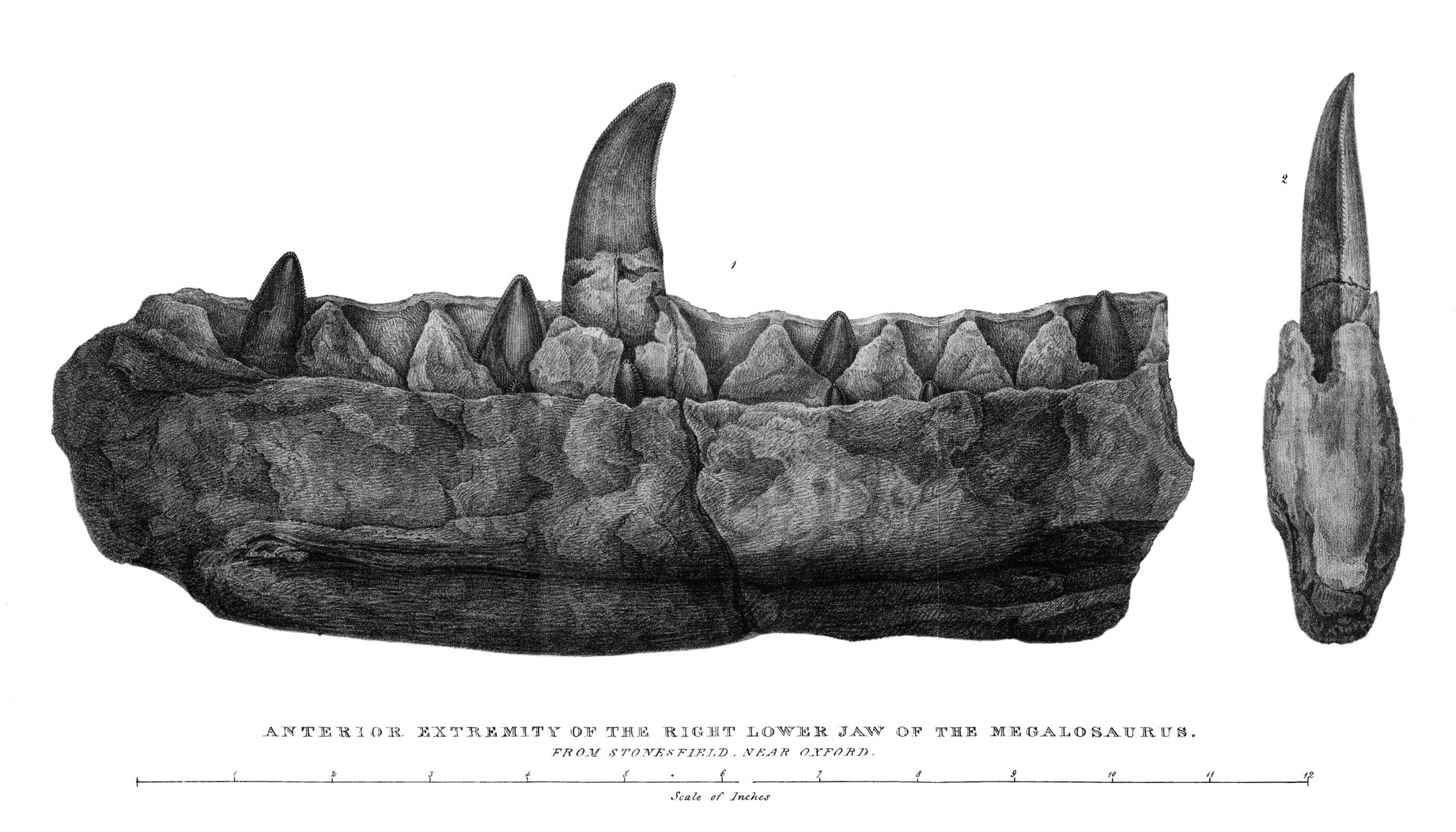

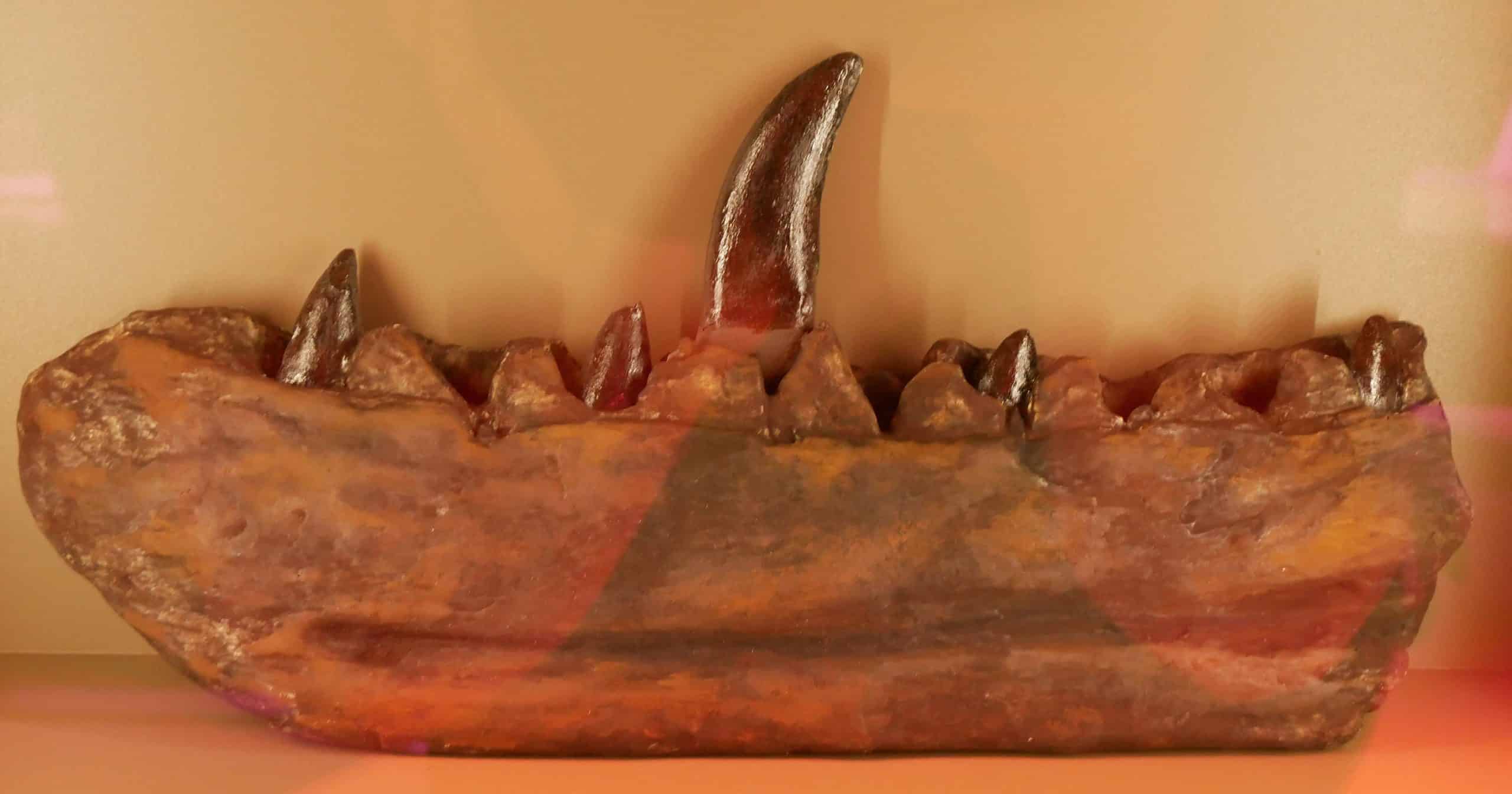
Ten of those 15 specimens survive at the Oxford museum, including the jaw. Cataloged as OUMNH J.13505, it is a right dentary (the tooth-bearing lower jaw bone) and serves as the lectotype—a name-bearing specimen picked later from the original set. Rauhut and colleagues credit that choice to Benson and colleagues in 2008, while Nicholls and colleagues credit Molnar and colleagues in 1990.
In 2008, Benson and colleagues concluded that “no further material can be referred to this species with any certainty.” Benson’s later studies, in contrast, treated the large Stonesfield theropods as one species. His hypodigm (the full set of material assigned to the species) lists only English Bathonian sites, such as Stonesfield and New Park Quarry. The Sussex bones Buckland had included are absent.
Megalosaurus Size and Description
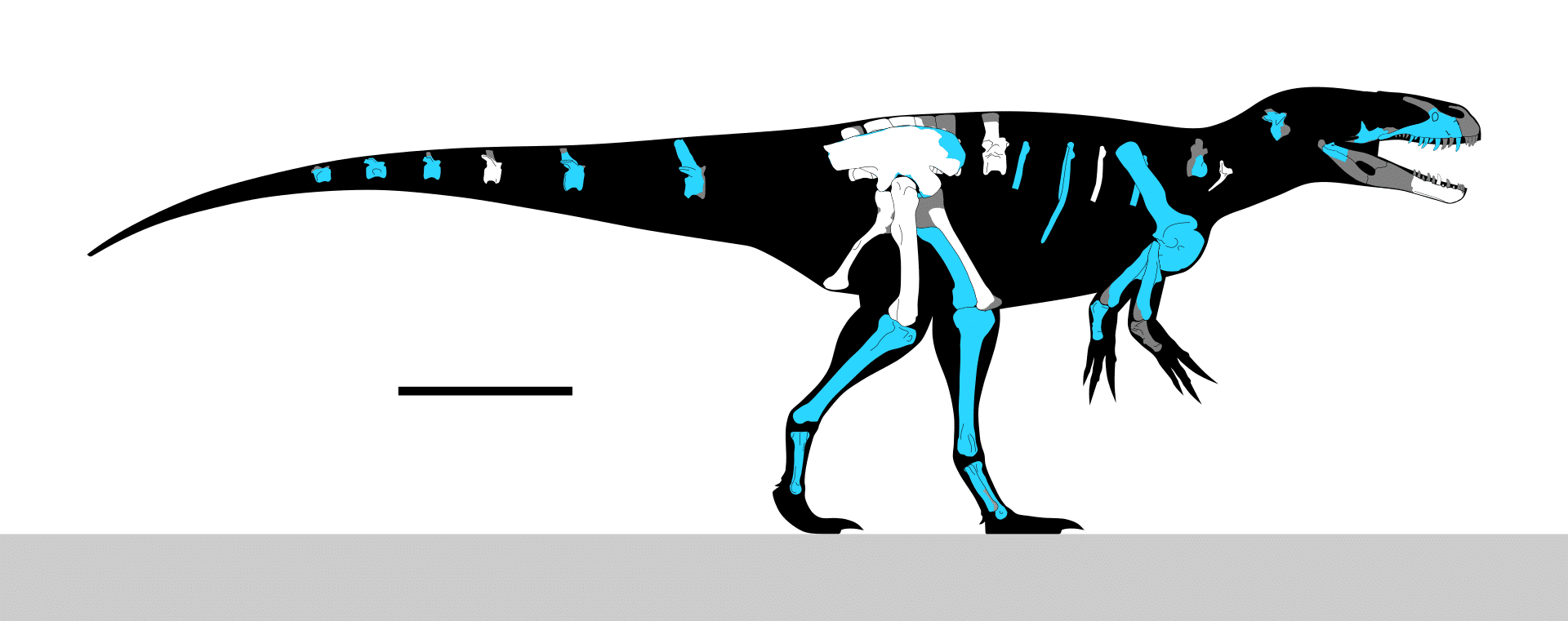
Because no one has found anything close to a complete skeleton, every picture of Megalosaurus combines scattered bones with reconstruction.
Short description of Megalosaurus
Stonesfield has yielded little of the skull—mainly the lectotype dentary, two left maxillae (upper jaw bones), a right jugal (cheek bone), and part of the rear lower jaw. Buckland described the teeth as “flattened laterally, and recurved backwards,” with a serrated rear cutting edge. The front edge, serrated only in young teeth, was thicker and “like the back of a knife.”
Behind the head, the back vertebrae carried spines more than 1.9 times the height of the vertebral body. Buckland noted ribs with “a double articulation at their head, as in the crocodile.” Benson found the skeleton well ossified for a large tetanuran (a major branch of theropods). It had a fused scapulocoracoid (shoulder blade and coracoid) and a relatively robust forearm. Its hindlimb, however, was “not as robust as that of Torvosaurus.”

Size and Weight of Type Species
Early estimates were enormous. Buckland reported Cuvier’s view that the owner of an Oxford femur “two feet nine inches long” (0.84 meters) exceeded 40 feet (12.2 meters). Cuvier also gave it the bulk of “an elephant seven feet high” (2.1 meters). Buckland cautioned that “we cannot safely attribute exactly the same proportions to recent and extinct species.” Even so, he scaled a larger Sussex femur to an animal “from sixty to seventy feet” (18.3 to 21.3 meters) long.
Modern figures are smaller, but we found no peer-reviewed length for the species as Benson defined it. Before that revision, Benton and Spencer gave lengths of 11.5 to 23 feet (3.5 to 7.0 meters). A 2025 University of Oxford news story called it a 9-meter (29.5-foot) predator. Smithsonian Magazine, meanwhile, put its adult length at more than 20 feet (6.1 meters). No modern source we found gives a height.
Weight has a more precise, if indirect, basis. Benson’s best-preserved femur, BMNH 31806, is 31.7 inches (805 millimeters) long and 11.9 inches (302 millimeters) around at its narrowest. From that circumference, he estimated about 2,080 pounds (943 kilograms), while warning that the equation “tends to underestimate” body mass. He still ranked Megalosaurus as “one of the largest Middle Jurassic theropods known,” comparing its femur with the 21.4-inch (543-millimeter) thigh bone of Piatnitzkysaurus.
The Dinosaur in Detail
What sets this dinosaur apart begins with its lower jaw. In 2008, Benson and colleagues diagnosed the lectotype by two unique features. One is a lengthwise groove low on the jaw’s outer face, and the other is a “slit-like anterior Meckelian foramen”—a narrow opening toward the front. Benson’s 2010 diagnosis instead stressed a unique mix of jaw traits, such as 13 to 14 teeth and tall interdental plates (the bony walls between teeth).
Referred bones supply more autapomorphies, or traits unique to the species. They include a ridge beneath the second sacral vertebra and a flange on the shoulder blade. A matching groove and ridge also join the second and third metatarsals (foot bones). Benson also listed an air-filled jugal and those tall back spines as features absent in other megalosaurids. These well-ossified bones, he suggested, “may indicate that Megalosaurus was a stout, muscular animal.”

Its family placement has shifted, too. In 2008, Benson and colleagues even urged that “use of the family Megalosauridae should be discontinued” until its position became clearer. Two years later, Benson recovered Megalosauridae as a natural group—descended from one common ancestor—and as the sister group of the spinosaurids. His Megalosauridae holds Megalosaurus, Torvosaurus, Afrovenator, Eustreptospondylus, and three other genera. Taken together, these studies cast Megalosaurus as a possibly stout predator whose exact branch on the megalosaurid tree is still shifting.
Interesting Points about Megalosaurus
- In 1814, Stonesfield worker George Griffin wrote that he had sold a “Grate Back Bone”—a Megalosaurus sacrum that Philip Powell thinks came from beds above the Slate—to an Oxford undergraduate.
- Buckland unveiled Megalosaurus at his first meeting as the Geological Society’s President, where Conybeare also introduced Plesiosaurus dolichodeirus.
- Among Buckland’s figured bones, a pubis was “originally described as a fibula” and an ischium “originally described as a clavicle.”
- Buckland wrote in 1824 that the shafts cut through “more than 40 feet” (12 meters) of rock, though Benton and Spencer say “usually about 6 m” (20 feet).
Contemporary Dinosaurs
Sharing these Bathonian landscapes was Cetiosaurus, a long-necked sauropod whose species C. oxoniensis was historically “the first sauropod known from adequate remains.” That species comes from somewhat younger, late Bathonian rocks, however, so the overlap is only at genus level. Stonesfield has yielded only a few Cetiosaurus elements. At New Park Quarry, Cetiosaurus bones come from the same bone horizon as Megalosaurus, and both genera appear at Workhouse Quarry. In 2025, Oxford researchers reported probable Cetiosaurus tracks and a Megalosaurus trackway at Dewars Farm Quarry. No fossil records any direct interaction between them.
Overhead flew Klobiodon rochei, a pterosaur (flying reptile) rather than a dinosaur. Known from a lower jaw with fang-like front teeth, it had an estimated adult wingspan of about 6.6 feet (2 meters). That jaw most likely comes from the Stonesfield Slate, though Benton and Spencer listed its locality as Stonesfield or Sarsden.
Much smaller was the mammal Amphitherium, a holotherian (a broad group that includes living marsupials and placentals) known from fragmentary lower jaws. Its fossils come from the same middle Bathonian Stonesfield Slate. No fossil records contact with Megalosaurus, so it is best pictured as a neighbor.
Megalosaurus in its Natural Habitat
The world Megalosaurus roamed was largely under water. During the Bathonian, shallow seas covered much of Britain and Europe, with higher ground forming substantial island landmasses. Buckland described the slate as crowded with ammonites, belemnites, shark teeth, and fish, mixed with tree fragments, ferns, beetle wing-cases, crocodiles, and turtles. Benton and Spencer linked the land-derived material to “the nearby London landmass” and suggested that storm-driven burial may have concentrated the bones.
While no fossil shows exactly what Megalosaurus ate, its flattened, serrated teeth fit a large predator. Benson called it the most abundant large predator in its faunas and “probably the apex predator in British Bathonian ecosystems.”
Dinosaur tracks add a sense of movement. At Ardley in Oxfordshire, more than 40 theropod and sauropod trackways cross a lime-mud surface that was emergent or very shallowly submerged. According to the Oxford museum, scientists believe Megalosaurus made the theropod footprints. In 2004, Day and colleagues described one theropod trackway there that records “a temporary increase of speed,” though their abstract names no trackmaker. Benson also suggested that high endemism—animals confined to one region—may explain why Megalosaurus seems restricted to England.
Frequently Asked Questions
It means “great lizard”—Buckland’s 1824 title calls it the “great Fossil Lizard”—and the species name bucklandii honors Buckland himself.
Its known fossils date to the lower to middle Bathonian of the Middle Jurassic, about 168 to 166 million years ago.
Benson estimated about 2,080 pounds (943 kilograms) in 2010. Published lengths vary widely, and we found none from a modern peer-reviewed study.
It was a carnivore, and Benson considered it probably the apex predator of Britain’s Bathonian ecosystems.
Its type material comes from the Stonesfield Slate near Stonesfield, about twelve miles northwest of Oxford, England.
A 2025 history calls it the first dinosaur to be scientifically named and described.
Sources
The information in this article is based on various sources, drawing on scientific research, fossil evidence, and expert analysis. The aim is to provide a comprehensive and accurate overview of Megalosaurus. However, please be aware that our understanding of dinosaurs and their world is constantly evolving as new discoveries are made.
- https://doi.org/10.1144/transgslb.1.2.390
- https://www.biodiversitylibrary.org/part/91364
- https://doi.org/10.1111/j.1096-3642.2009.00569.x
- http://treatment.plazi.org/id/604C1154FF98615051C4F943FD80FB96
- http://treatment.plazi.org/id/604C1154FF86614B52A3FA32FBC7FDFF
- http://treatment.plazi.org/id/604C1154FF8661645653FD7BFD67FC68
- https://doi.org/10.1111/j.1475-4983.2008.00751.x
- https://palass.org/publications/palaeontology-journal/archive/52/4/article_pp857-877
- https://doi.org/10.17704/1944-6187-44.1.267
- https://ora.ox.ac.uk/objects/uuid:8407768d-a918-4f18-b499-9c76c2bc885a
- https://palaeo-electronica.org/content/pdfs/654.pdf
- https://webaccess.app.pan.pl/archive/published/app69/app011132023.pdf
- https://data.jncc.gov.uk/data/574eac76-683c-47c6-a1de-b22439031f4c/gcr-v10-fossil-reptiles-of-great-britain-c6.pdf
- https://www.app.pan.pl/archive/published/app63/app004902018.pdf
- https://palass.org/publications/palaeontology-journal/archive/44/1/article_pp1-20
- https://archive.org/download/biostor-284266/biostor-284266.pdf
- https://tb.plazi.org/GgServer/html/0073C5185766F9524679FBF2FDDFFB1C
- https://palass.org/publications/palaeontology-journal/archive/47/2/article_pp319-348
- https://oumnh.web.ox.ac.uk/sitefiles/oumnh-megalosaurus-200-press.pdf
- https://www.geolsoc.org.uk/media/vsipfns2/hogg-meeting-feb-2024-abstracts-bicentenary-symposium.pdf
- https://stratigraphy.org/ICSchart/ChronostratChart2024-12.pdf
- https://www.ox.ac.uk/news/2025-01-02-major-new-footprint-discoveries-britain-s-dinosaur-highway
- https://www.smithsonianmag.com/science-nature/paleontologists-are-still-unraveling-the-mystery-of-the-first-dinosaur-180983672/
- https://museumofoxford.org/oxfords-history-of-dinosaur-discoveries/
- https://lindahall.org/about/news/scientist-of-the-day/robert-plot
This article was last fact checked: TheDinosaurs Team, 28-10-2026
Featured Image Credit: Federico benzan, CC BY-SA 4.0, via Wikimedia Commons
