Along the Dzharakuduk escarpment in the central Kyzylkum Desert of Uzbekistan, river-laid sandstones of the Bissekty Formation hold a rich dinosaur fauna. Among its finds is Ulughbegsaurus uzbekistanensis, a large meat-eating theropod named in 2021 from a single upper jaw bone. It lived during the middle to late Turonian stage of the Late Cretaceous—roughly 92 to 90 million years ago. Its describers called it the first definitive carcharodontosaurian from Central Asia, filling a gap between Europe and East Asia.
The jaw waited a long time for a name—news reports date its collection to the 1980s, although the 2021 paper gives no date. A field team member of paleontologist Lev Alexandrovich Nessov brought it to the State Geological Museum in Tashkent. According to Popular Science, researchers later rediscovered it there, and paleontologist Kohei Tanaka and four colleagues named the new genus. Within four years, paleontologists Hans-Dieter Sues and Alexander Averianov had first questioned its identity and then, with new evidence, supported it. A single bone, it turns out, can carry a large story.
Ulughbegsaurus Key Facts
| Keyword | Fact |
|---|---|
| Pronunciation | Not specified |
| Meaning of name | Ulugh Beg’s Reptile from Uzbekistan |
| Group | Theropoda (Carcharodontosauria) |
| Type Species | Ulughbegsaurus uzbekistanensis |
| Diet | Carnivore |
| When it Lived | 92 to 90 MYA |
| Period | Cretaceous |
| Epoch | Late Cretaceous (Turonian stage) |
| Length | About 24.6 to 26.2 feet (7.5 to 8.0 meters), indirect estimate |
| Height | Not specified |
| Weight | More than 2,200 pounds (1,000 kilograms), indirect estimate |
| Mobility | Not specified |
| First Discovery | Year not specified (news reports say the 1980s), brought to the museum by a field team member of Lev A. Nessov |
| Described by | 2021 by K. Tanaka, O.U.O. Anvarov, D.K. Zelenitsky, A.S. Ahmedshaev, and Y. Kobayashi |
| Holotype | UzSGM 11-01-02 |
| Location of first find | Bissekty Formation, Dzharakuduk, central Kyzylkum Desert, Navoi Viloyat, Uzbekistan |
Ulughbegsaurus Origins, Taxonomy and Timeline
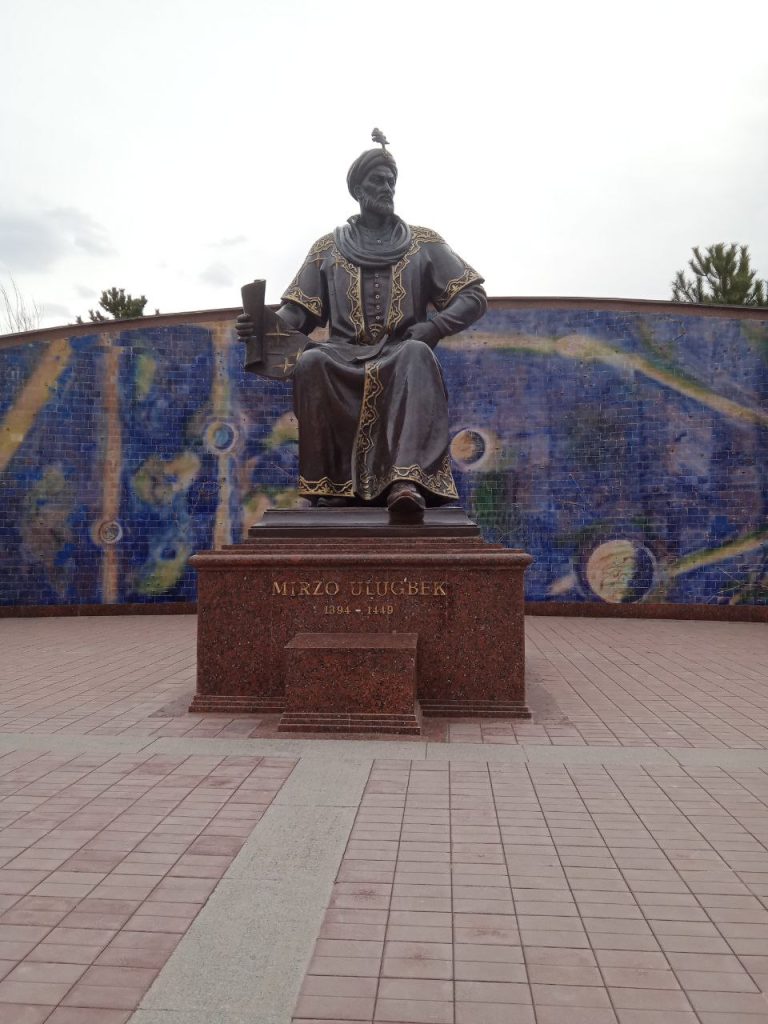
The name Ulughbegsaurus honors Ulugh Beg, the Timurid sultan who was also a 15th-century astronomer and mathematician. “Sauros,” a Greek-derived word for “reptile,” completes the genus name. Meanwhile, the species name uzbekistanensis refers to the Republic of Uzbekistan, the country of the find. Together, the name links a Cretaceous predator to a medieval scholar.

In 2021, Tanaka and colleagues placed Ulughbegsaurus within Tetanurae and Allosauroidea, then narrowed it to Carcharodontosauria, a lineage of predatory allosauroids. Their first analysis nested it within a poorly resolved Neovenatoridae alongside Neovenator, Fukuiraptor, and Megaraptor. By contrast, the second left it in an unresolved cluster with Siamraptor, Concavenator, and a group containing Acrocanthosaurus. Both results support a carcharodontosaurian identity, but its exact position remains unresolved. Ulughbegsaurus uzbekistanensis is the type and only known species.
Marine invertebrate fossils from the rock units above and below bracket its age, as do comparisons with other Central Asian vertebrate faunas. On that basis, researchers place it in the middle to late Turonian, roughly 92 to 90 million years ago. For Tanaka’s team, that timing matters—they argue carcharodontosaurians remained the dominant predators, at least in Asia, as late as the Turonian. Tyrannosauroids were present too, but in their reading only as smaller mesopredators—mid-level hunters below the top. In their view, the Bissekty fossils record the geologically latest co-occurrence of the two groups in Laurasia, the northern supercontinent of the time.
Discovery & Fossil Evidence
The holotype comes from Dzharakuduk, a long escarpment of Bissekty rocks about 20 miles (32 kilometers) southwest of Mynbulak. Where along those exposures it lay is unknown, since nobody recorded coordinates in the field. Co-author Darla Zelenitsky told CBC News she was “kind of surprised,” since the fossils from this formation “have been well studied.”
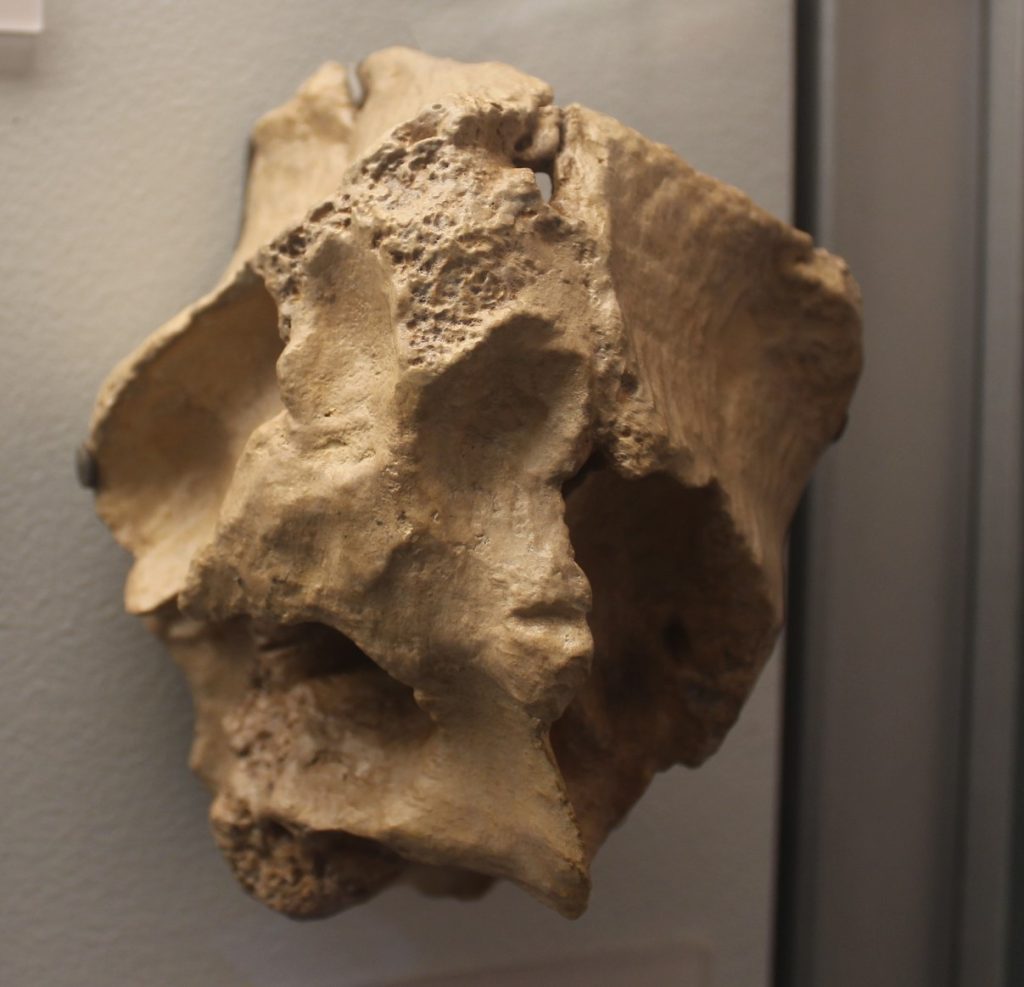
The holotype, UzSGM 11-01-02, consists of a left maxilla—the main tooth-bearing bone of the upper jaw. It preserves the main body and the front half of the jugal ramus (the rear branch toward the cheek). The entire ascending ramus (the upward branch) is missing. As preserved, it measures 9.5 inches (24.2 centimeters) long and 5.2 inches (13.1 centimeters) high. Its first eight tooth sockets survive, and an unerupted tooth still sits in the fifth.
Tanaka’s team also referred two fragments to the genus. The first, CCMGE 600/12457, is the jugal ramus of another left maxilla. Nessov first described it in 1995 as a tyrannosauroid. Later, Sues and Averianov tentatively assigned it to the small theropod Itemirus medullaris. The two pieces do not overlap anatomically, but both come from a similarly large bone. Both have fused interdental plates (bony plates between the tooth sockets). Both also bear tubercles on the rim of the antorbital fossa (a recess in front of the eye). The second, ZIN PH 357/16, is the back end of a right maxilla that “could also belong” to the genus. Some large, narrow teeth from the formation may also be carcharodontosaurian, though the authors call this “difficult to demonstrate unequivocally.”
Ulughbegsaurus Size and Description
Short description of Ulughbegsaurus
The maxilla is subtriangular in side view, and its front upper margin is nearly straight, like that of Allosaurus and Neovenator but unlike Acrocanthosaurus. The contact with the premaxilla (the bone at the snout tip) was presumably near-vertical—unlike the backward-sloping margin of carcharodontosaurids and Sinraptor. As in many carcharodontosaurians, the outer surface is rugose, or roughened. At least six vertical ridges run between the second and seventh tooth sockets—similar to ridges in some tyrannosaurids, including Tarbosaurus and Tyrannosaurus.
Inside the jaw, fused interdental plates form a slightly rugose wall 1.9 inches (47 millimeters) deep at the fourth socket. Four large nutrient foramina—small openings for blood vessels—pierce this region. The paper’s skull reconstruction fills in the missing bones using Neovenator as a model. No skin or soft tissue survives, so any discussion of its outward appearance is speculative.
Size and Weight of Type Species
Without a complete skeleton, size estimates rest on comparisons—the preserved tooth row from the second to the eighth socket measures about 9.1 inches (23 centimeters). That is at least about 20 percent longer than in Yangchuanosaurus, a 23-foot (7-meter) animal with a 7.7-inch (19.5-centimeter) row. On that basis, Tanaka and colleagues concluded that Ulughbegsaurus reached at least 23 feet (7 meters).
A second method used regressions—statistical trend lines—linking maxilla and tooth-row length to body length in allosauroids. Combining the holotype with CCMGE 600/12457, the team estimated a complete maxilla of about 18 inches (46 centimeters). The result was a body length of about 24.6 to 26.2 feet (7.5 to 8.0 meters). The same method gives femora, or thigh bones, roughly 35 inches (90 centimeters) long. Tanaka also told the Express, as reported by Popular Science, that the skull would have measured about 3.3 feet (1 meter)—a figure not in the paper.
The paper states the weight only as more than 2,200 pounds (1,000 kilograms). That figure is also indirect, resting on the judgment that the animal was at least as large as Yangchuanosaurus. For one comparative table, the authors borrowed a mass from Neovenator, which they judged roughly the same size. For scale, its estimated maxilla is nearly twice as long as that of Timurlengia, a 10- to 13-foot (3- to 4-meter) tyrannosauroid.
The Dinosaur in Detail
What sets this dinosaur apart is a suite of jaw features in its formal diagnosis. They include shallow oval pits along the lower edge of the outer maxilla and vertical ridges on its side. Large foramina also line the upper edge of the dental plates. Most distinctive are small bumps, or tubercles, along the ridged rim of the antorbital fossa—an autapomorphy (a trait unique to one species). Inside that fossa sit an oval accessory recess 1.5 inches (39 millimeters) across and a smaller 0.7-inch (18-millimeter) recess, presumably the promaxillary recess.
The tooth sockets offer more clues—the largest, the fifth, measures 1.3 by 0.65 inches (33.3 by 16.6 millimeters). They are relatively narrow next to those of Timurlengia, although the ranges overlap, and compare most closely with Neovenator and Shaochilong.
Not everyone accepts the carcharodontosaurian identity. In 2023, Sues, Averianov, and paleontologist Brooks Britt argued that the maxilla lacks unambiguously diagnostic features of Carcharodontosauria. In their view, its supposed carcharodontosaurian traits are taphonomic artifacts—damage from burial and fossilization—or also occur in dromaeosaurids, the “raptor” family. They concluded that its relationships remain uncertain.
However, Averianov and colleagues reached a different verdict in 2025. Their study described a new maxilla from the older, Cenomanian-age Khodzhakul Formation of Uzbekistan. They identified it as Ulughbegsaurus sp.—a member of the genus not assigned to a species. Their revised characters support placing the genus within Carcharodontosauridae, a narrower family inside Carcharodontosauria. Sues and Averianov co-authored the 2023 critique, a 2024 vertebra paper and the 2025 study. Their 2024 paper already treated Ulughbegsaurus as a carcharodontosaurid. Taken together, its identity still rests on a handful of jaw bones, and the most recent study favors the carcharodontosaurid view.
Interesting Points about Ulughbegsaurus
- Its name honors Ulugh Beg, a 15th-century Timurid sultan who was also an astronomer and mathematician.
- News reports say the holotype was collected in the 1980s and rediscovered decades later in an Uzbek museum.
- Researchers first called one referred jaw fragment a tyrannosauroid and then, tentatively, Itemirus, before Tanaka’s team assigned it to Ulughbegsaurus.
- Its describers argue that the Bissekty Formation records the geologically latest known co-occurrence of a carcharodontosaurian and a tyrannosauroid in Laurasia.
- In 2021, they named only one other Late Cretaceous pairing of this kind in Laurasia—Siats and Moros from the Cenomanian Cedar Mountain Formation. In 2025, Averianov and colleagues added a third, Uzbekistan’s Cenomanian Khodzhakul Formation. The Bissekty remains the latest of the three.
Dinosaurs from the Same Formation
Also known from the Bissekty Formation (exact level relative to Ulughbegsaurus not known): the tyrannosauroid Timurlengia, the early hadrosauroid Levnesovia, the horned dinosaur Turanoceratops, the rebbachisaurid sauropod Dzharatitanis, the caenagnathid oviraptorosaur Caenagnathasia, and the alvarezsaurid Dzharaonyx. The formation spans the middle to late Turonian, about 92 to 90 million years ago, so these animals may not all have lived at the same time.

Ulughbegsaurus in its Natural Habitat
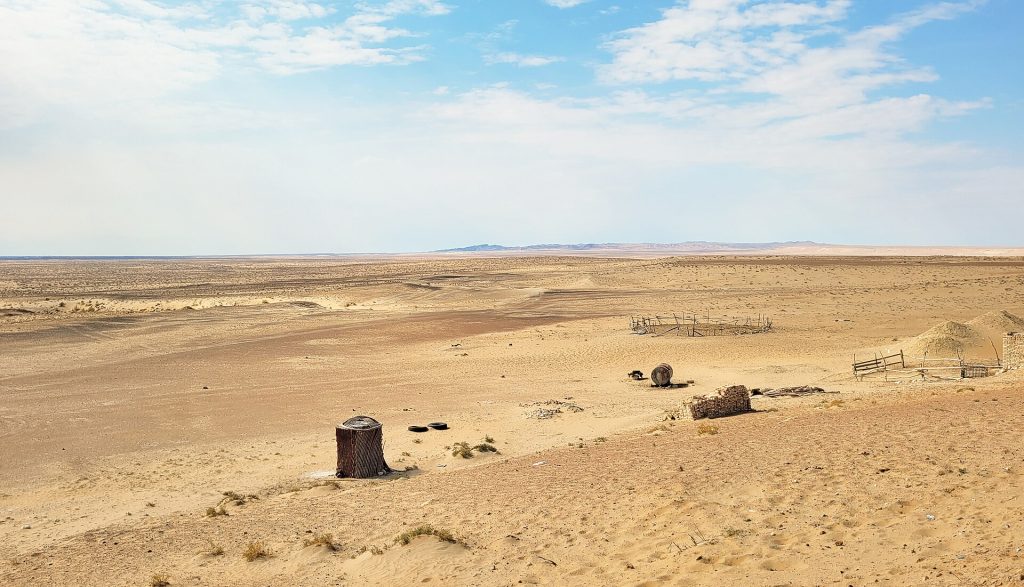
Up to 262 feet (80 meters) of cross-bedded river sandstones and conglomerates record the world Ulughbegsaurus inhabited. One study examined how marine influence varied among its fossil assemblages. Most of its bones turn up scattered rather than joined, yet many are exquisitely preserved. The fauna includes hadrosauroids, ceratopsians, sauropodomorphs, ornithomimids, dromaeosaurids, and tyrannosauroids. Unnamed finds add a titanosaur braincase, a toe bone from a giant dromaeosaurid, and therizinosauroid remains. A 2024 study also identified a back vertebra from the formation only as an indeterminate carcharodontosaurid.

Tanaka and colleagues place Central Asia on a land connection between Europe and Asia that appeared as the Turgai sea retreated. They suggest this route may have let dinosaurs disperse. The team also found the Bissekty fauna most comparable to that of the Baynshiree Formation in eastern Mongolia. To them, this hints at faunal uniformity across Laurasia during the Turonian.
Its describers see Ulughbegsaurus as the probable apex predator of the Bissekty ecosystem. That idea challenges a 2014 proposal by Sues and Averianov, as summarized by Tanaka’s team. In it, a giant dromaeosaurid and a tyrannosauroid shared the top-predator role. In 2023, Sues and colleagues wrote that a giant dromaeosaurid occurred together with the medium-sized tyrannosauroid Timurlengia. Nothing in its few bones reveals how it hunted or whether it lived alone or in groups. In 2025, Averianov and colleagues counted the Bissekty Formation among just three known “transitional ecosystems” with both carcharodontosaurids and tyrannosauroids. Both teams frame this interval as part of a turnover in top predators—at least according to the current fossil record.
Frequently Asked Questions
It honors the 15th-century astronomer-sultan Ulugh Beg, while uzbekistanensis refers to Uzbekistan, the country of the find.
The type species lived in the middle to late Turonian, roughly 92 to 90 million years ago. A 2025 study referred an older, Cenomanian jaw bone to the genus.
Indirect estimates suggest a length of about 24.6 to 26.2 feet and a weight of more than 2,200 pounds.
It was a carnivore, and its describers interpret it as the probable apex predator of its ecosystem.
The type species comes from the Bissekty Formation at Dzharakuduk, in Uzbekistan’s central Kyzylkum Desert. A 2025 study added a jaw bone of the genus from Uzbekistan’s Khodzhakul Formation.
Its describers classified it as a carcharodontosaurian theropod. A 2023 study questioned that, while a 2025 study placed it in Carcharodontosauridae.
Sources
The information in this article is based on various sources, drawing on scientific research, fossil evidence, and expert analysis. The aim is to provide a comprehensive and accurate overview of Ulughbegsaurus. However, please be aware that our understanding of dinosaurs and their world is constantly evolving as new discoveries are made.
- https://doi.org/10.1098/rsos.210923
- https://pmc.ncbi.nlm.nih.gov/articles/PMC8424376/
- https://doi.org/10.6084/m9.figshare.16553626
- https://doi.org/10.1017/S0016756822000954
- https://doi.org/10.1080/08912963.2024.2423675
- https://doi.org/10.1017/jpa.2025.1
- https://doi.org/10.1073/pnas.1600140113
- https://doi.org/10.1371/journal.pone.0246620
- https://doi.org/10.1098/rspb.2009.0229
- https://doi.org/10.1007/s00114-009-0518-9
- https://doi.org/10.1080/02724634.2021.2036174
- https://doi.org/10.1016/j.cretres.2014.12.001
- https://doi.org/10.2110/palo.2007.p07-072r
- https://doi.org/10.1016/j.cretres.2014.06.007
- https://doi.org/10.1080/02724634.2014.889145
- https://paleobiodb.org/classic/basicTaxonInfo?taxon_no=444000
- https://popsci.com/animals/new-apex-dinosaur-discovered-uzbekistan
- https://amp.cbc.ca/news/canada/calgary/ulughbegsaurus-1.6166455
This article was last fact checked: TheDinosaurs Team, 17-11-2026
Featured Image Credit: Kohei Tanaka, Otabek Ulugbek Ogli Anvarov, Darla K. Zelenitsky, Akhmadjon Shayakubovich Ahmedshaev and Yoshitsugu Kobayashi, CC BY 4.0, via Wikimedia Commons
