In the Yujingzi Basin of northwestern China, gray mudstones of the Xinminpu Group hold a tyrannosauroid from the missing middle chapter of its family’s history. Named Xiongguanlong baimoensis, this predator lived in the Aptian to Albian stages of the Early Cretaceous—roughly 121.4 to 100.5 million years ago. Its describers called that age “probable.” What makes the animal special is its long, narrow snout, yet it also shows several hallmarks of the later tyrannosaurids, the family of Tyrannosaurus.
Paleontologist Daqing Li and four colleagues, including Mark A. Norell and Peter J. Makovicky, named the animal in Proceedings of the Royal Society B. Their paper went online in April 2009 and appeared in print in January 2010. The holotype (the name-bearing specimen) preserves a complete skull without its lower jaws, every vertebra ahead of the hips, part of the pelvis, and a femur. At the time, its describers called it the most complete tyrannosauroid known from the long stretch between the Barremian and Campanian stages.
Xiongguanlong Key Facts
| Keyword | Fact |
|---|---|
| Pronunciation | shong-GWAN-long (Field Museum, 2009) |
| Meaning of name | Grand Pass Dragon |
| Group | Theropoda |
| Type Species | Xiongguanlong baimoensis |
| Diet | Carnivore |
| When it Lived | 121.4 to 100.5 MYA |
| Period | Cretaceous |
| Epoch | Early Cretaceous (Aptian to Albian stages) |
| Length | Not specified |
| Height | About 5 feet (1.5 meters) at the hips (Field Museum, 2009) |
| Weight | About 375 to 600 pounds (170 to 272 kilograms), 2016 and original estimates |
| Mobility | Not specified |
| First Discovery | 2006 to 2007 field seasons (Field Museum, 2009), excavated with help from the Fossil Research and Development Center, Gansu |
| Described by | 2010 (online 2009) by D. Li, M.A. Norell, K.-Q. Gao, N.D. Smith, and P.J. Makovicky |
| Holotype | FRDC-GS JB16-2-1 |
| Location of first find | White Ghost Castle field area, Xinminpu Group, Yujingzi Basin, Gansu, China |
Xiongguanlong Origins, Taxonomy and Timeline
The name Xiongguanlong draws on the local landscape. “Xiong Guan” is Mandarin for “Grand Pass,” a historic name for the nearby city of Jiayuguan, while “long” means “dragon.” The species name baimoensis means “White Ghost” in Mandarin, after a field-area landform dubbed the White Ghost Castle. Together, the name ties this dragon to a historic pass and an eerie local landmark.
Xiongguanlong belongs to Coelurosauria, a large branch of theropods, and more specifically to Tyrannosauroidea—tyrannosaurs and their early relatives. Li and colleagues ran an analysis of 293 anatomical characters across 72 theropods. It recovered Xiongguanlong as the sister taxon (closest relative) of a group formed by Tyrannosauridae and Appalachiosaurus. Later studies have shuffled its neighbors, yet analyses from 2016, 2019, and 2022 all keep it outside Tyrannosauridae, close to the Late Cretaceous radiation. Xiongguanlong baimoensis is the type and only known species.
The describers placed the fossil in the Aptian–Albian Xinminpu Group, roughly 121.4 to 100.5 million years ago. That age rests on faunal links with nearby basins and a preliminary study of fossil pollen and spores. Still, they cautioned that those localities may not be completely correlative (equivalent in age). Their family tree even draws the Xiongguanlong branch stippled to flag the uncertainty. In 2018, Suarez and colleagues used carbon isotopes to place the basin’s fossil-rich gray mudstones in the late Aptian. Either way, it sits in the middle of the Cretaceous—between the Barremian tyrannosauroids and the Late Cretaceous giants.
Discovery & Fossil Evidence
The skeleton lay in gray mudstone near the bottom of the Early Cretaceous rocks exposed in the basin. The original paper names no finder or year of discovery. Still, its acknowledgments thank members of the Gansu Fossil Research and Development Center for help excavating and preparing it. A 2009 Field Museum release adds that the team dug in the basin in the summers of 2006 and 2007.
Lanzhou’s Fossil Research and Development Center catalogs the holotype as FRDC-GS JB16-2-1. It consists of the skull and the complete presacral series—every vertebra from the neck to the hips. It also includes much of the right ilium (main hip bone), part of the left, and a femur (thigh bone). The skull lay inside a mineralized nodule, a hard lump of cemented rock that hid many sutures (seams between bones).
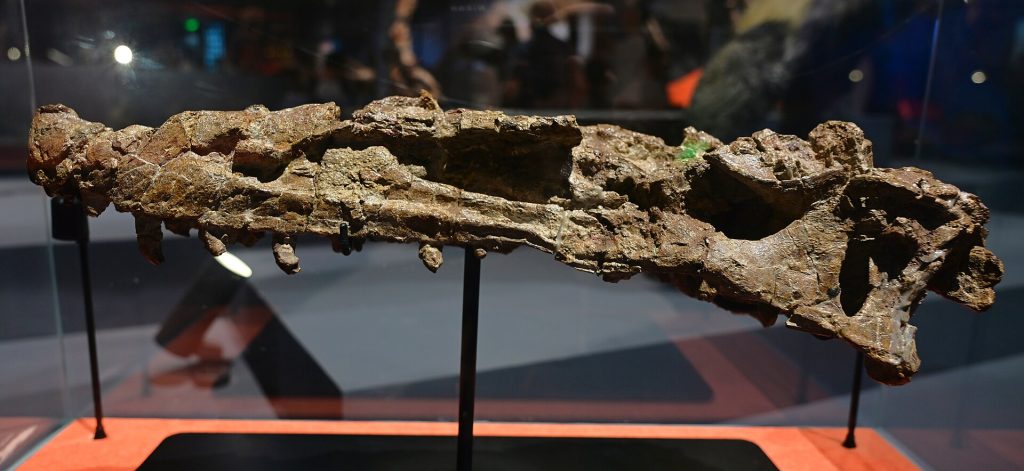

Li and colleagues judged that a theropod tibia (shin bone) found alongside probably did not belong to the holotype. It is markedly shorter and more slender than the femur, though consistent with a coelurosaur. For that reason, in 2019 Zanno and colleagues recoded every tibial character of Xiongguanlong as uncertain. Postdepositional deformation—distortion after burial—also obscures some features of the skeleton.
Xiongguanlong Size and Description
Xiongguanlong was a midsized tyrannosauroid—intermediate in size between its Barremian relatives and the later giants.
Short description of Xiongguanlong
In the long, low skull, the region in front of the eyes made up over two-thirds of the length. That region is just over twice as long as the part behind the eyes. In turn, the back of the skull is almost twice as wide as the snout. On top of the snout, the slender nasal bones are fused at the front, yet they lack dorsal rugosities (roughened ridges) or pronounced vaulting.
Each premaxilla, at the tip of the upper jaw, held four teeth that were D-shaped in cross-section and unserrated. Behind them, the left maxilla (main upper tooth-bearing bone) has 15 tooth positions for narrow teeth serrated on both edges. Farther back, each neck vertebra carries one pair of small pneumatic foramina—openings linked to air sacs—where tyrannosaurids have two pairs. Over the hips, the upper edges of the two ilia press together, as in Late Cretaceous tyrannosaurids.
Skin impressions and feathers are not preserved, so any discussion of its outer covering is speculative.

Size and Weight of Type Species
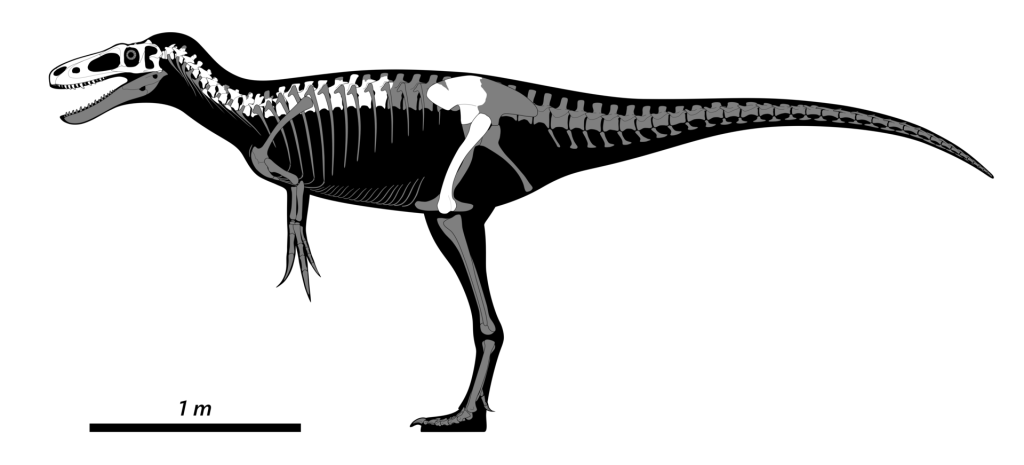
The scientific studies cited here give no length for Xiongguanlong. Its describers listed the specimen’s measurements in supplementary files rather than in the main paper. However, a 2009 Field Museum release put its hip height at about 5 feet (1.5 meters) and its skull at over 1.5 feet (46 centimeters).
Both published masses are indirect estimates. Li and colleagues arrived at about 600 pounds (272 kilograms), using equations by Christiansen and Fariña from 2004. In 2016, however, paleontologists Brusatte and Carr cited about 375 pounds (170 kilograms) from a 2014 study by Benson and colleagues. Combined, the estimates range from about 375 to 600 pounds.
Even the higher figure is modest, since all known Late Cretaceous tyrannosaurids had significantly greater adult masses. In fact, Brusatte and Carr noted that the lower figure is an order of magnitude below tyrannosaurid masses. Still, Xiongguanlong was much larger than Dilong. Its nearly closed neurocentral sutures (seams within each vertebra) led its describers to judge it close to fully grown.
The Dinosaur in Detail
What sets this dinosaur apart is its narrow, elongate muzzle. In 2010, its describers wrote that among tyrannosauroids only Alioramus approached these proportions. In 2022, however, paleontologists Naish and Cau counted Guanlong, Dilong, and some megaraptorans as long-snouted too. They found that these forms do not make up a clade (a single natural group).
Its bite was probably gentler at the snout tip than that of its giant relatives. Li and colleagues argued that the long lever arm to the jaw joint would have tempered bite forces there. They also suggested its slender nasals were less suited to extreme asymmetrical bite forces. Unlike Dilong, Eotyrannus, Gorgosaurus, and adult Tyrannosaurus, it lacked serrations on its premaxillary teeth.
Meanwhile, the skull shows the earliest known appearance of several tyrannosaurid features. These include a sharp sagittal crest on the parietal (a skull-roof bone) and a quadratojugal (a rear cheek bone) with a flaring upper process. Its basicranium (braincase floor) was boxy and wider than long. It also had an extensive secondary palate—a bony roof between nasal passage and mouth—as in tyrannosaurids and Dilong. Yet its lacrimal, the bone in front of the eye, lacks the hornlike process of Late Cretaceous tyrannosauroids. Unlike those relatives, it kept flattened tooth crowns and back vertebrae without air-sac openings.
In 2016, Brusatte and Carr ranked Dilong, Eotyrannus, and Xiongguanlong as successively closer outgroups to Tyrannosauridae. They saw in Xiongguanlong the earliest taxon with “something of a ‘tyrannosaurid-grade bauplan'” (body plan). Later, Zanno and colleagues linked the diminutive North American Moros to mid-Cretaceous Asian forms such as Xiongguanlong. In contrast, Naish and Cau made it the sister of a clade containing Dryptosaurus, the arctometatarsalian (pinched-foot) tyrannosauroids, and the megaraptorans. Even so, all three studies keep it near the Late Cretaceous radiation.

Interesting Points about Xiongguanlong
- Its species name, baimoensis, means “White Ghost” and refers to the White Ghost Castle, a prominent landform in the field area.
- Smooth muscle scars on its braincase resemble those of juvenile Gorgosaurus, though its nearly closed vertebral sutures suggest it was close to fully grown.
- In 2016, Brusatte and Carr noted that it “does not show any clear signs of developing gigantism,” despite its many tyrannosaurid-like features.
- Its skull was preserved inside a mineralized nodule, which made many of the seams between its bones hard to trace.
Contemporary Dinosaurs
Sharing the same gray mudstones was Beishanlong grandis, a giant ornithomimosaur—one of the “ostrich-mimic” theropods. Its describers report the same field area and horizon as those of Xiongguanlong—gray mudstones near the bottom of the basin’s Early Cretaceous rocks. Makovicky and colleagues called it one of the largest definitive ornithomimosaurs yet described. They estimated its still-growing holotype at about 1,380 pounds (626 kilograms) from the length of its femur. Xiongguanlong was distinctly smaller, and Li and colleagues counted Beishanlong among the basin’s presumably non-predatory theropods.
Also known from the Xinminpu Group of the Yujingzi Basin (exact level relative to Xiongguanlong not known): Suzhousaurus, Qiaowanlong, Jintasaurus, and Xuwulong. Li and colleagues listed therizinosauroids such as the large Suzhousaurus among the animals “from these strata,” but its holotype reportedly came from sandy shale. In addition, the 2018 isotope study placed the basin’s therizinosaur-bearing red sandstones in the younger early Albian. Qiaowanlong was a sauropod known from neck vertebrae and a right hip girdle, found in the group’s Middle Unit. Jintasaurus and Xuwulong were hadrosauriform ornithopods (early duck-bill relatives), though Norman doubted in 2015 that they are separate valid taxa. The beds are dated only broadly, from the late Aptian to the early Albian, so these animals may not all have lived at the same time.
Xiongguanlong in its Natural Habitat
The Xinminpu Group of the Yujingzi Basin records a world of rivers, lakes, and marshes. In 2021, Harper and colleagues studied these rocks at the White Pagoda Site in the same basin, where soils record alternating wet and dry periods. Clumped isotopes, a geochemical thermometer, gave an average of about 59 °F (14.9 °C) across the record. The team took this as likely close to the mean annual air temperature—a relatively cool mid-latitude climate. They put the basin at a paleolatitude of roughly 35° to 48° N, depending on the reconstruction used. Because these records come from another site, they describe the basin rather than the exact bed of Xiongguanlong.
Its own gray mudstones belong to the lower, mesic (moderately moist) facies of the group, where tyrannosauroids occur with therizinosauroids, hadrosauroids, turtles, and ornithomimosaurs. Makovicky and colleagues called Xiongguanlong the largest known predatory taxon in this fauna. While there is no direct evidence of its diet, its describers set it apart from the presumably non-predatory theropods of the basin.
The overlying red beds hold a fauna dominated by small neoceratopsians (early horned dinosaurs). Li and colleagues compared them with Auroraceratops, which the 2018 study records from those red sandstones. Maniraptorans, the bird-like theropods, turn up there too. The lower beds, by contrast, mirror other mesic Central Asian faunas, such as that of the Iren Dabasu Formation. Whether Xiongguanlong lived alone or in groups remains unknown. Even so, its basin preserves a tyrannosauroid of middling size from the long stretch before the giants appeared.
Frequently Asked Questions
It means “Grand Pass dragon,” after a historic name for nearby Jiayuguan, and the species name means “White Ghost.”
It lived in the Aptian to Albian stages of the Early Cretaceous, roughly 121.4 to 100.5 million years ago.
It stood about 5 feet tall at the hips, and weight estimates run from about 375 pounds (2016) to 600 pounds (original description).
It was a carnivore, called the largest known predator in its fauna, though no gut contents are known.
It was found in Xinminpu Group rocks at the White Ghost Castle field area, Yujingzi Basin, Gansu, China.
Its snout is exceptionally long and narrow, and it shows the earliest known appearance of several tyrannosaurid skull features.
Sources
The information in this article is based on various sources, drawing on scientific research, fossil evidence, and expert analysis. The aim is to provide a comprehensive and accurate overview of Xiongguanlong. However, please be aware that our understanding of dinosaurs and their world is constantly evolving as new discoveries are made.
- https://doi.org/10.1098/rspb.2009.0249
- https://pmc.ncbi.nlm.nih.gov/articles/PMC2842666/
- https://doi.org/10.1098/rspb.2009.0236
- https://doi.org/10.1098/rspb.2009.1278
- https://doi.org/10.1038/srep20252
- https://doi.org/10.1038/s42003-019-0308-7
- https://doi.org/10.7717/peerj.12727
- https://doi.org/10.5194/cp-17-1607-2021
- https://doi.org/10.1111/zoj.12193
- https://stratigraphy.org/ICSchart/ChronostratChart2024-12.pdf
- https://paleobiodb.org/classic/basicCollectionSearch?collection_no=88840
- https://doi.org/10.1080/02724634.2018.1510412
- https://www.eurekalert.org/news-releases/755011
This article was last fact checked: TheDinosaurs Team, 17-11-2026
Featured Image Credit: Cesar Diaz, CC BY-SA 4.0, via Wikimedia Commons
