In Jianchang County of western Liaoning, the Tiaojishan Formation has yielded several small, feathered theropods. Xiaotingia zhengi, a chicken-sized animal named in 2011, most likely belongs among them. Its exact source is uncertain—the only skeleton came from a fossil dealer, and its slab looks most like Tiaojishan rock. If that assignment holds, it probably lived during the Oxfordian stage of the Late Jurassic, about 160 million years ago. Yet its real fame comes from a family tree—adding it to one analysis pulled Archaeopteryx out of the birds.
Paleontologist Xing Xu led the description with Hailu You, Kai Du, and Fenglu Han, and Nature published it on 27 July 2011. The timing was pointed, since 2011 marked 150 years since the 1861 discovery of Archaeopteryx. Writing in the same journal, paleontologist Lawrence Witmer warned that the result was “likely to be met with considerable controversy.” Later studies bore that out—they have placed Xiaotingia on at least four different branches of the tree. Its story shows how a single specimen can unsettle a long-held picture of bird origins.
Xiaotingia Key Facts
| Keyword | Fact |
|---|---|
| Pronunciation | Not specified |
| Meaning of name | Honors Zheng Xiaoting |
| Group | Theropoda (Paraves) |
| Type Species | Xiaotingia zhengi |
| Diet | Not specified |
| When it Lived | Around 160 MYA, if from the Tiaojishan Formation |
| Period | Jurassic |
| Epoch | Late Jurassic (probably Oxfordian stage) |
| Length | Not specified |
| Height | Not specified |
| Weight | About 1.8 pounds (0.82 kilograms), indirect estimate from femur length |
| Mobility | Not specified |
| First Discovery | Year not specified, acquired from a fossil dealer by the Shandong Tianyu Museum of Nature |
| Described by | 2011 by X. Xu, H. You, K. Du, and F. Han |
| Holotype | STM 27-2 |
| Location of first find | Linglongta area, Jianchang, western Liaoning, China, as reported by the dealer, most probably the Tiaojishan Formation |
Xiaotingia Origins, Taxonomy and Timeline
The name Xiaotingia zhengi is a tribute rather than a description. It honors Zheng Xiaoting for founding the Shandong Tianyu Museum of Nature. Fittingly, that same museum acquired the specimen and holds it today. Together, the name links the animal to the man and the museum that preserved it.
Xiaotingia is a theropod within Paraves, the group made up of birds and their closest relatives, the deinonychosaurs. In 2011, Xu and colleagues built on a 2009 data set by Hu and colleagues, adding eleven new characters. Their analysis grouped Xiaotingia with Archaeopteryx, Wellnhoferia, and Anchiornis in the family Archaeopterygidae. They then placed that family inside Deinonychosauria—the branch holding dromaeosaurids, or raptors, and troodontids—rather than in Avialae, the birds. Later analyses have instead moved it to the troodontids, to the base of the dromaeosaurids, or into early Avialae. In 2017, Lefèvre and colleagues even recovered it as a basal scansoriopterygid, although they called its position “highly unstable.” Xiaotingia zhengi is the type and only known species.
The describers called the Tiaojishan Formation “early Late Jurassic.” Later studies suggest that the beds near Linglongta are probably Oxfordian, roughly 160 million years old. Witmer’s 2011 commentary, however, gave about 155 million. Dates from the formation itself span the Callovian to Kimmeridgian stages—roughly 165 to 153 million years ago. In 2019, Hartman and colleagues flagged the age of the Xiaotingia lineage as uncertain. Even so, its describers stressed that the specimen’s geological age would not affect their main results.
Discovery & Fossil Evidence
The records give no quarry or collection date for Xiaotingia. Instead, a fossil dealer sold it to the Shandong Tianyu Museum of Nature and said it came from the Linglongta area of Jianchang, but he could not say which quarry yielded it. That gap matters, because Linglongta mainly exposes the Tiaojishan Formation but also has limited outcrops of the Early Cretaceous Yixian Formation. The slab is most similar to Tiaojishan beds, yet the authors admitted that the two shales are difficult to tell apart.
The holotype, STM 27-2, is the only known specimen. It consists of one main block with multiple breaks, plus four small separate blocks of identical rock. The bones lie articulated—still joined as in life—and the team found no evidence of forgery. They also rated the chance that the slab is a composite of several animals as low.
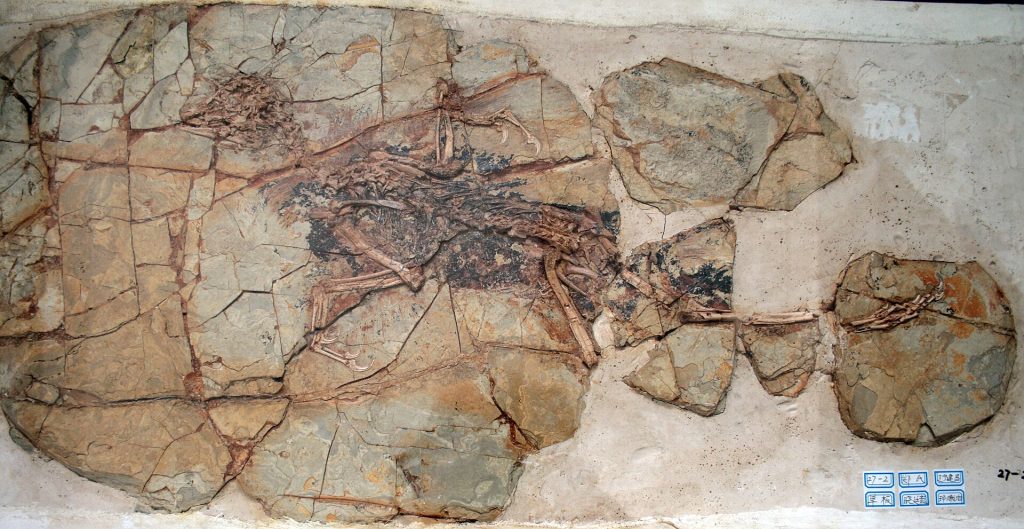

The skeleton lies in shale that is mainly off-white, with yellowish patches the authors called “filemot.” Witmer described a “chicken-sized skeleton … surrounded by a halo of feather impressions.” No additional specimens of Xiaotingia have been confirmed, so everything known about it comes from this one individual.
Xiaotingia Size and Description
Because one articulated skeleton survives, scientists can measure Xiaotingia bone by bone.
Short description of Xiaotingia
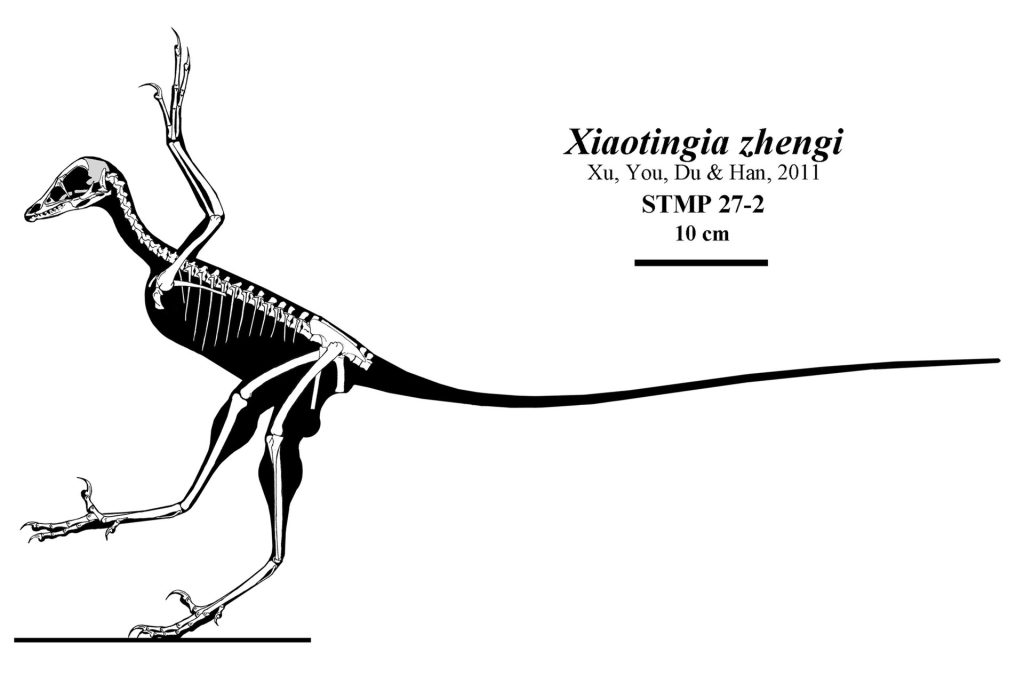
The skull was small, with a basal length the authors estimated at about 2.4 inches (61 millimeters). Its antorbital fossa—a hollow in front of the eye—was short, a trait shared with early avialans. Godefroit and colleagues later described its teeth as “bulbous,” unlike the sharp teeth of its relative Eosinopteryx. Behind the head, the neck measured about 3.1 inches and the back about 4.6 inches.
The forelimbs were long and robust, as in other early paravians. A furcula, or wishbone, about 1.7 inches wide spanned the shoulders, and the humerus, or upper arm bone, measures about 2.8 inches. In the hand, metacarpal IV is the most robust palm bone and reaches farther than metacarpal III, as in scansoriopterygids. Meanwhile, the authors estimated the femur, or thigh bone, at about 3.3 inches. In 2018, Hu and colleagues noted that it shares a long front blade of the ilium, the main hip bone, and a short lower leg with Caihong. Toward the tail, the front caudal vertebrae carried long, tapering side processes like those of troodontids.
Feathers are part of the record rather than guesswork. Pennaceous feathers, the vaned type seen in a modern quill, grew on the shin, and long feathers also covered the upper foot. However, colors and finer soft tissue are not known, so any restoration of them is speculative.

Size and Weight of Type Species
No length or hip-height estimate appears in the sources we could verify. However, an indirect estimate from femur length gives a body mass of about 1.8 pounds (0.82 kilograms).
That figure comes from an equation by Christiansen and Fariña that links femur length to mass. In 2016, Dececchi, Larsson, and Habib used the estimate in a study of early flapping. The same team estimated a wing about 9.4 inches long and a wingspan of about 20 inches, although they borrowed feather length from Anchiornis.
For a modern comparison, Witmer called the skeleton chicken-sized, while Discover likened it to a Cornish hen. Its humerus reaches about 85 to 86 percent of femur length. In their 2019 scheme, Hartman and colleagues found no other troodontid with a humerus over 70 percent of femur length.
The Dinosaur in Detail
What sets this dinosaur apart is the argument it started. Xu and colleagues argued that some supposed bird hallmarks, such as long and robust forelimbs, actually characterize all of Paraves. Without Xiaotingia, their analysis put Archaeopteryx at the base of Avialae. With it, Archaeopterygidae moved inside Deinonychosauria in all 540 most parsimonious trees—the simplest trees fitting the data. Still, the authors called the statistical support “only tentative,” and few branches passed their 50 percent bootstrap test.
Part of the difficulty is its mosaic of features. Xiaotingia shares a sub-triangular dentary, the tooth-bearing lower jaw bone, and closely packed front lower teeth with troodontids. By contrast, its large quadrate foramen—an opening near the jaw joint—and fused joints between its sacral, or hip, vertebrae recall dromaeosaurids. In 2017, Foth and Rauhut listed two possible diagnostic traits of their family Anchiornithidae that are known only in Xiaotingia.
Responses came quickly. Lee and Worthy reanalyzed the same data with likelihood and Bayesian methods. Their trees returned Archaeopteryx to the birds and grouped Xiaotingia weakly with troodontids. Senter and colleagues then placed it at the base of Dromaeosauridae in 2012. A year later, Godefroit and colleagues recovered Archaeopteryx as an avialan—forcing it, Xiaotingia, and Anchiornis into Deinonychosauria with the troodontids cost ten extra steps. In 2019, Hartman’s team placed Xiaotingia in the early troodontid subfamily Sinovenatorinae, alongside Sinovenator and Mei, a genus from the Early Cretaceous Yixian Formation.
Foth and Rauhut grouped Xiaotingia with Anchiornis in what may be the oldest known avialan clade. However, Foth’s 2025 team placed it outside the Anchiornis group, in a more stemward position within Avialae. No study we reviewed has declared the genus invalid. Taken together, these results leave its place among paravians an open question—and with it, part of the story of bird origins.
Interesting Points about Xiaotingia
- The name honors Zheng Xiaoting for founding the Shandong Tianyu Museum of Nature, the same museum that holds the holotype today.
- Its description appeared 150 years after the 1861 discovery of Archaeopteryx, the very animal whose bird status it questioned.
- In the news story that Nature ran alongside the paper, Xu admitted, “I am kind of nervous about presenting this result.”
- Discover magazine ranked the find number 30 among its top science stories of 2011.
- A 2022 study by Pittman and colleagues, citing earlier work, noted that early avialans seem to have had the potential for flapping flight “except possibly Xiaotingia.”
Dinosaurs from the Same Formation
Because only the look of its slab ties Xiaotingia to this formation, the animals below carry a double caveat. Also known from the Tiaojishan Formation (exact level relative to Xiaotingia not known): Anchiornis, Eosinopteryx, Serikornis, Caihong, and Pulaosaurus. The first four are feathered paravians, with Anchiornis bearing large vaned feathers on its feet and Eosinopteryx showing reduced plumage. Caihong had bony crests in front of its eyes and shows evidence of iridescent feathers. Meanwhile, the describers of Serikornis suggested that it lived on the ground. Caihong and Pulaosaurus, an early member of the ornithischian branch called Neornithischia, both come from Qinglong in Hebei rather than Liaoning. Depending on the dating study, the formation spans about 9 to 12 million years, so these animals may not all have lived at the same time.
Xiaotingia in its Natural Habitat
Lakes and volcanoes most likely shaped the world Xiaotingia inhabited. Near Linglongta, the fossil beds are greenish or yellowish mudstone and fine sandstone with tuff, a rock made of volcanic ash, alongside off-white, ash-rich shale. Press coverage of the announcement said the fossil came from lake deposits. Meanwhile, recurrent volcanic eruptions laid down the ash layers credited with the fine preservation of Tiaojishan fossils.
These rocks preserve part of the Yanliao Biota, a fauna dated to about 168 to 157 million years ago. A 2025 study combining rock, pollen, and climate-model evidence suggests that the Yanliao region had already shifted from wet to sub-humid conditions in the late Bathonian, about 167 to 165 million years ago, before the Tiaojishan beds were laid down. While there is no direct evidence of its diet, its bulbous teeth set it apart from the sharp-toothed Eosinopteryx. Witmer linked the new placement to “carnivorous skulls,” although he wrote this of archaeopterygids as a group, not of Xiaotingia. Movement has been tested more directly—in 2016, Dececchi’s team found that flapping raised its running speed by less than 17 percent.
Before 2025, the known non-avian dinosaurs of the Yanliao Biota were all small-bodied theropods, apart from one ornithischian that may come from younger rocks. In 2013, Godefroit and colleagues suggested that varied feather coats helped many closely related paravians live side by side in the formation. The formation has also yielded Yi, a membrane-winged scansoriopterygid from Hebei. Xu’s 2011 team counted scansoriopterygids among the birds, but Miller and Pittman in 2021 considered Yi probably non-avialan. Similarly, Godefroit’s team described Aurornis, from the same formation at Yaolugou in Jianchang, as an early avialan. Its status is debated—it is possibly the same animal as Anchiornis.
Frequently Asked Questions
It honors Zheng Xiaoting, the founder of the Shandong Tianyu Museum of Nature, where the only known skeleton is kept.
If it came from the Tiaojishan Formation, it probably lived in the Oxfordian stage of the Late Jurassic, around 160 million years ago.
Witmer called it chicken-sized, and an indirect estimate from femur length puts its weight at about 1.8 pounds.
Its diet is not specified in any verified source, although its teeth have been described as “bulbous.”
A dealer reported that it came from the Linglongta area of Jianchang in western Liaoning, China, but the exact quarry is unknown.
Adding it to a 2011 analysis moved Archaeopteryx out of the birds, a result later studies have disputed.
Sources
The information in this article is based on various sources, drawing on scientific research, fossil evidence, and expert analysis. The aim is to provide a comprehensive and accurate overview of Xiaotingia. However, please be aware that our understanding of dinosaurs and their world is constantly evolving as new discoveries are made.
- https://www.nature.com/articles/nature10288
- https://static-content.springer.com/esm/art%3A10.1038%2Fnature10288/MediaObjects/41586_2011_BFnature10288_MOESM297_ESM.pdf
- https://people.ohio.edu/witmerl/Downloads/2011_Witmer_N&V_icon_knocked_from_perch.pdf
- https://pmc.ncbi.nlm.nih.gov/articles/PMC3297401/
- https://journals.plos.org/plosone/article?id=10.1371/journal.pone.0036790
- https://www.nature.com/articles/ncomms2389
- https://www.nature.com/articles/nature12168
- https://static-content.springer.com/esm/art%3A10.1038%2Fnature12168/MediaObjects/41586_2013_BFnature12168_MOESM5_ESM.pdf
- https://peerj.com/articles/2159/
- https://bmcecolevol.biomedcentral.com/articles/10.1186/s12862-017-1076-y
- https://www.nature.com/articles/ncomms14972
- https://doi.org/10.1007/s00114-017-1496-y
- https://www.nature.com/articles/s41467-017-02515-y
- https://peerj.com/articles/7247/
- https://pmc.ncbi.nlm.nih.gov/articles/PMC9704744/
- https://doi.org/10.3897/fr.28.e131671
- https://peerj.com/articles/19664/
- https://pmc.ncbi.nlm.nih.gov/articles/PMC12258141/
- https://pmc.ncbi.nlm.nih.gov/articles/PMC12638977/
- https://doi.org/10.1038/nature08322
- https://doi.org/10.1038/nature14423
- https://pmc.ncbi.nlm.nih.gov/articles/PMC8519158/
- https://www.asianscientist.com/2011/07/in-the-lab/archaeopteryx-original-bird-ivpp-cas-china-xiaotingia-zhengi/
- https://www.scientificamerican.com/article/first-bird-fossil-archaeopter/
- https://www.discovermagazine.com/30-new-fossil-casts-doubt-on-oldest-bird-17050
This article was last fact checked: TheDinosaurs Team, 17-11-2026
Featured Image Credit: El fosilmaníaco, CC BY-SA 3.0, via Wikimedia Commons
