In the Nemegt Basin of southern Mongolia, the pale orange sandstones of Ukhaa Tolgod—”brown hills” in Mongolian—form one of the world’s richest Late Cretaceous fossil sites. Within these beds, tentatively assigned to the Djadokhta Formation, paleontologists found a small, bird-like dinosaur named Shuvuuia deserti. It lived about 75 to 71 million years ago, although that age remains tentative. Shuvuuia belongs to the Alvarezsauridae, a family of unusual theropods, and its skulls were the first known for the group.
Joint expeditions of the American Museum of Natural History and the Mongolian Academy of Sciences found Ukhaa Tolgod in 1993. Then, in 1998, paleontologists Luis Chiappe, Mark Norell, and James Clark named the animal in Nature. By 2009, researchers had more than 15 specimens, many of them exceptional. At the time, Turner and colleagues noted, no other alvarezsaurid had well-preserved material or more than one specimen. Since then, Jaculinykus has been described from a nearly complete skeleton.
Shuvuuia Key Facts
| Keyword | Fact |
|---|---|
| Pronunciation | Not specified |
| Meaning of name | Bird, with deserti for its desert setting |
| Group | Theropoda (Alvarezsauridae) |
| Type Species | Shuvuuia deserti |
| Diet | Possibly small prey such as insects (later hypothesis) |
| When it Lived | About 75 to 71 MYA (tentative) |
| Period | Cretaceous |
| Epoch | Late Cretaceous (Campanian stage) |
| Length | About 1.47 m (4.8 ft) (indirect estimate, Meso et al. 2025) |
| Height | Not specified |
| Weight | About 5.1 pounds (2.33 kilograms), indirect 2025 estimate |
| Mobility | Moved on two legs (bipedal) |
| First Discovery | Year not specified |
| Described by | 1998 by L.M. Chiappe, M.A. Norell, and J.M. Clark |
| Holotype | MGI 100/975 |
| Location of first find | Ukhaa Tolgod, Djadokhta Formation (tentative), South Gobi (Ömnögov) Province, Mongolia |
Shuvuuia Origins, Taxonomy and Timeline
The name Shuvuuia comes from the Mongolian word “shuvuu,” meaning “bird.” The species name deserti refers to the semi-arid setting in which the Djadokhta Formation’s sands accumulated. Together, the name records how its describers saw the animal in 1998—a bird of the ancient desert.
Chiappe and colleagues placed Shuvuuia within Aves, the birds, inside the family Alvarezsauridae. They also coined a subgroup, Mononykinae, uniting Mononykus, Shuvuuia, and Parvicursor. Their cladistic analysis—a method that groups animals by shared derived traits—recovered alvarezsaurids as the sister group of all birds except Archaeopteryx. Most later studies, however, placed the family outside birds. In 2019, Lee and colleagues wrote that alvarezsaurs “are now generally thought to be basal maniraptorans”—early non-avian members of the lineage that led to birds. In 2023, Kubo and colleagues placed Shuvuuia in the subgroup Parvicursorinae. Named in 1996, Parvicursorinae has priority over Mononykinae, now often treated as a synonym or as the smaller group Mononykini. Shuvuuia deserti is the type and only known species.
The 1998 authors listed its age as “Late Cretaceous/Campanian?”—a question mark that still lingers. In 2005, Dashzeveg and colleagues measured magnetic signals at Bayn Dzak and other Djadokhta sections, but not at Ukhaa Tolgod. They showed that deposition there probably came after about 83.5 million years ago. The pattern, they wrote, “suggests, but does not clearly establish” a late Campanian age of roughly 75 to 71 million years ago. That window reaches Ukhaa Tolgod only through a later correlation. In 2008, Dingus and colleagues assigned the Ukhaa Tolgod beds to the Bayn Dzak Member, the formation’s lower part. A 2025 compilation by Meso and colleagues uses the full Campanian of the Cretaceous Period, 83.6 to 72.1 million years ago.
Discovery & Fossil Evidence
Ukhaa Tolgod lies about 400 miles (650 kilometers) southwest of Ulaanbaatar. By 1998, the joint expeditions had recovered “over 20 alvarezsaurid” specimens in the Gobi. At first, a 1996 study referred the early Shuvuuia specimens, holotype included, to Mononykus. The published descriptions do not give the year the holotype was collected.
The holotype, MGI 100/975, is a partial skeleton whose prefix stands for the Mongolian Geological Institute, the former name of Ulaanbaatar’s Mongolian Paleontological Center. Three referred specimens accompanied it in 1998—MGI N 100/99, MGI 100/977, and MGI 100/1001. While the holotype and two of these came from Ukhaa Tolgod, MGI N 100/99 came from Tögrögiin Shiree. The two skulls figured in 1998 are MGI 100/1001, with a hyoid (tongue-support bone), and MGI 100/977. The latter preserves a sclerotic ring—the bony ring inside the eye. Later papers list the same specimens under the prefix IGM.
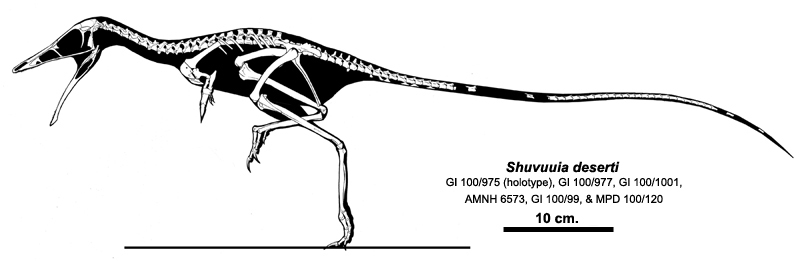

More material followed in 2002, when Suzuki and colleagues described MPD 100/120, an articulated juvenile skeleton from Tögrögiin Shiree. Judged by its metatarsals (long foot bones), it was about 60 percent of the holotype’s size. MGI 100/977 came from Ukhaa Tolgod’s Camel’s Humps horizon, where one dune collapse buried several dinosaurs in life positions. Not everyone accepts every referral, though. In 2009, Turner and colleagues reported that Longrich and Currie consider some Tögrögiin Shiree juveniles a new taxon. Suzuki’s team, by contrast, had found MPD 100/120 “indistinguishable from the holotype and referred specimens” in all shared bones. All the specimens discussed here come from Ukhaa Tolgod and Tögrögiin Shiree.
Shuvuuia Size and Description
Short description of Shuvuuia
The 1998 authors’ manuscript calls the skull “delicate” and elongate, with large orbits (eye sockets) and tear-shaped nostrils at the tip. Its jaws held “numerous tiny, unserrated teeth,” which stopped at the front third of the antorbital fossa, a recess before the eye. Behind the head, the neck vertebrae had large pneumatic foramina, openings linked to air sacs.
In the 2002 juvenile, the lower jaws met in a short, unfused chin joint—less than 7 percent of the jaw’s estimated length. The hand, however, is strange, since no other known alvarezsaurid then preserved a full set of fingers. That hand confirmed two tiny second and third digits beside a large first one. As the 1998 diagnosis noted, the thigh and shin bones bowed sideways. In the juvenile, about 35 vertebrae fit the preserved tail, with more probably present.
Soft tissue remains more controversial. In 1999, Schweitzer and colleagues reported fibers that reacted to antibodies against beta-keratin, a protein of reptiles and birds. In 2018, however, Saitta and colleagues found one such fiber “inorganic and composed mainly of calcium phosphate.” Even so, they argued that the fibers probably came from feathers, citing their tapering shape and position.
Size and Weight of Type Species
The 1998 description gives no body length or mass. In 2025, Meso and colleagues estimated about 5.1 pounds (2.33 kilograms), using equations based on limb bones. The same study gave an indirect length of about 4.8 feet (1.47 meters), though no hip height has been published.
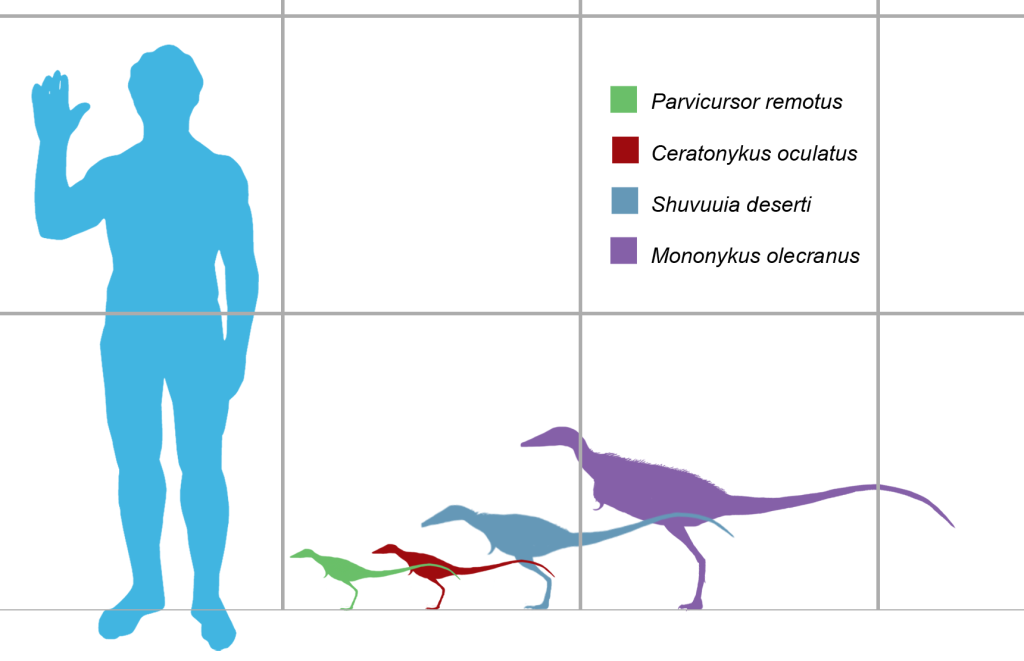

Earlier estimates vary widely, starting from 0.75 pounds (0.34 kilograms), proposed by Choiniere and colleagues in 2010. In contrast, Qin and colleagues in 2021 and Averianov and colleagues in 2023 both arrived at 6.7 pounds (3.05 kilograms). Overall, published estimates range between 0.75 and 6.7 pounds.
In life, it weighed about as much as a chicken but was much longer. Its Ukhaa Tolgod relative Kol ghuva was far bigger. Judged from the metatarsus, every earlier alvarezsaurid, Shuvuuia included, reached an adult size under half that of Kol.
The Dinosaur in Detail
What sets this dinosaur apart from Mononykus is a list of subtle traits. Shuvuuia has less compressed neck vertebrae and a pubis (a hip bone) that is nearly round in cross-section. On its humerus, the deltopectoral crest (a ridge for chest muscles) merges with the bone’s head. Its astragalus (an ankle bone) is also less excavated along its inner margin. Beyond the skull, its one autapomorphy—a feature unique to the genus—is a sharp ridge on the inner side of the lower tibia (shin bone).
The skull drew the most attention in 1998, when its describers argued that it “support[s] the theory that the group is related to birds.” The postorbital bone does not reach the jugal (cheek bone), so the eye socket merges with the opening behind it. Its jugal and quadratojugal also form a single fused bar. Its foramen magnum, where the spinal cord exits, is proportionally larger than in any non-avian dinosaur, its describers noted. In addition, the skull’s design indicates a capacity for prokinesis—raising the snout as one unit, independent of the braincase. Unlike the modern type, however, its upper hinge lay between the frontals and the nasal and preorbital bones.
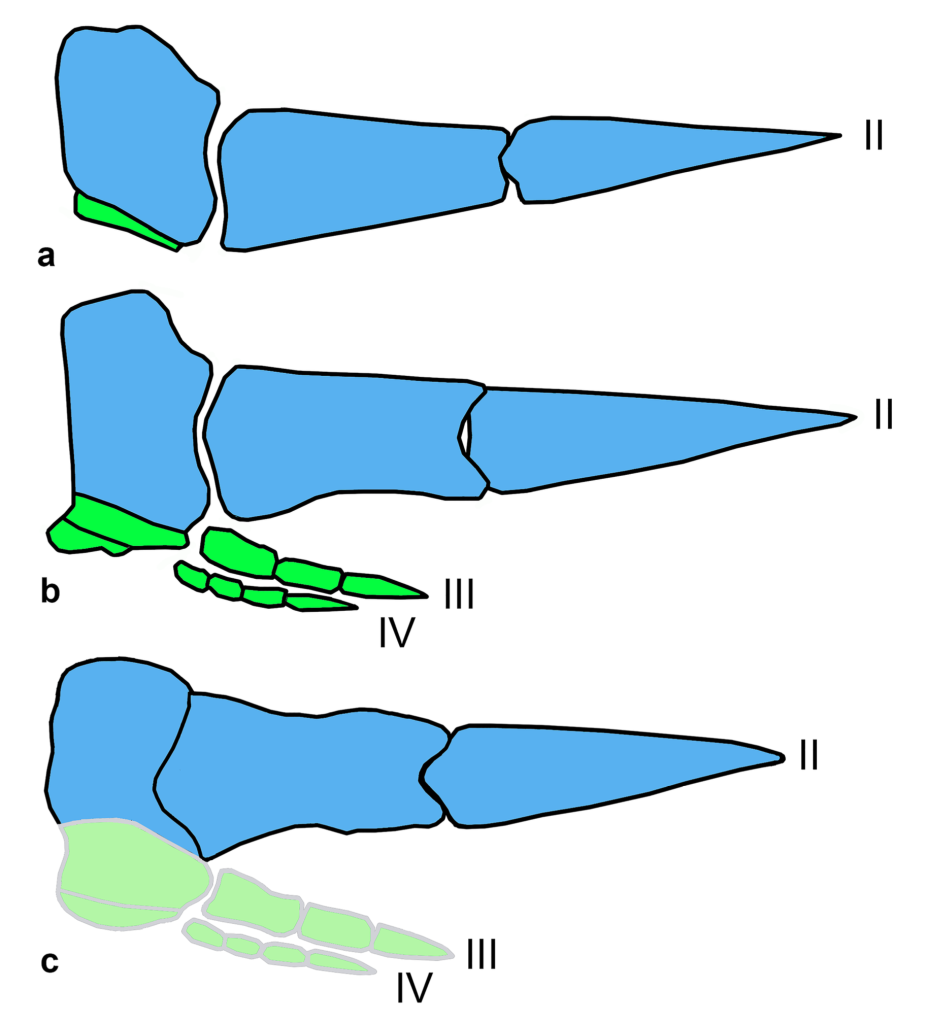

Its three-fingered hand fits a larger pattern. In 2023, Kubo and colleagues placed the two-fingered hand of Jaculinykus between the three-fingered Shuvuuia and the one-fingered Linhenykus. They also grouped Jaculinykus with Mononykus and Shuvuuia. In 1998, the describers had called alvarezsaurid likenesses to ostrich-like ornithomimosaurs and other non-maniraptoran theropods “convergent.” Later, Suzuki’s team judged support for an ornithomimid link, proposed by paleontologist Paul Sereno, “weak.” Taken together, Shuvuuia has moved from the bird branch to a non-avian lineage, bird-like skull and all.
Interesting Points about Shuvuuia
- The two Shuvuuia skulls described in 1998 were the first skulls known for any member of the alvarezsaurid family.
- A young skeleton described in 2002 showed that earlier tail counts of 25 or 26 vertebrae fell short by at least 10.
- Under the microscope, a Shuvuuia thigh bone, IGM 100/99, appears “well-vascularized,” meaning it carried many blood-vessel channels.
- A 2021 study reported that Shuvuuia had some of the proportionally largest pupils yet measured, judged from its sclerotic ring.
Contemporary Dinosaurs
Buried in the same catastrophe was Citipati, an oviraptorid theropod whose specimen IGM 100/1004 is “a second dinosaur nest attended by an adult oviraptorid.” In 2018, Norell and colleagues placed it in the Camel’s Humps horizon, the layer that yielded Shuvuuia specimen MGI 100/977. Nothing records an interaction, so the two are best pictured as neighbors in one dune field.
Lumbering across the same dunes was Pinacosaurus, an armored ankylosaurid. Two of its skeletons, IGM 100/3186 and IGM 100/1014, lie in life positions in that horizon. Nothing links it to Shuvuuia beyond this shared burial.
Also known from the Djadokhta Formation (exact level relative to Shuvuuia not known): the dromaeosaurid Velociraptor and the frilled ceratopsian Protoceratops, both from Tögrögiin Shiree, and the theropod of uncertain placement Archaeornithoides from Bayn Dzak. Ukhaa Tolgod adds Kol ghuva, the small crestless oviraptorid Khaan mckennai and the troodontid Byronosaurus jaffei. On its tentative dating, the formation spans roughly 75 to 71 million years ago, so these animals did not necessarily coexist.
Shuvuuia in its Natural Habitat
The world Shuvuuia roamed at Ukhaa Tolgod was an arid landscape of sparsely vegetated dunes. Between them, ephemeral ponds and lakes left mudstones, while conglomerates washed in at the basin margins. Vertebrates walked over mobile dunes, leaving depressions now interpreted as tracks. When rain saturated the dunes, debris flows broke loose and buried animals. At Tögrögiin Shiree, mostly westerly winds piled up dune sands, and arthropods probably left burrows. That site also produced the famous “fighting dinosaurs”—an interlocked Velociraptor and Protoceratops.
The original description is silent on diet, noting only tiny teeth. In 2021, Qin and colleagues suggested that shrinking body size in alvarezsauroids “might have been driven by” a shift to eating ants and termites. Their study addressed the wider group, not Shuvuuia specifically. That same year, Choiniere’s team hypothesized that it hunted small mammals and insects at night, using its forelimbs to “pry the prey out of burrows.”
How well it sensed that prey remains disputed. The same team reported hearing “rivaling that of today’s barn owl,” based on its lagena, an inner-ear organ. Manley and Köppl, however, argued in 2025 that the comparison rests on “an ill-chosen metric.” In their view, the outlier value reflects a small brain rather than a long cochlear duct. They estimated an upper hearing limit of 3.4 to 5 kilohertz—against more than 10 in the barn owl. Birds such as Gobipteryx and Apsaravis, lizards, mammals and the turtle Zangerlia also lived at Ukhaa Tolgod. No work on the coloring or social life of Shuvuuia has been published.
Frequently Asked Questions
It comes from the Mongolian word “shuvuu,” meaning “bird,” while deserti refers to the semi-arid setting of the Djadokhta Formation.
It lived in the Campanian stage of the Late Cretaceous, about 75 to 71 million years ago, though that age is tentative.
It weighed about as much as a chicken, roughly 5.1 pounds (2.33 kilograms) by a 2025 indirect estimate. The same study gives a length of about 4.8 feet (1.47 meters).
Its diet is unknown, but later studies propose small prey such as insects.
Its fossils come from Ukhaa Tolgod and Tögrögiin Shiree, in beds tentatively assigned to Mongolia’s Djadokhta Formation.
Its skulls were the first found for any alvarezsaurid, and their design suggests a bird-like snout that could rise as one unit.
Sources
The information in this article is based on various sources, drawing on scientific research, fossil evidence, and expert analysis. The aim is to provide a comprehensive and accurate overview of Shuvuuia. However, please be aware that our understanding of dinosaurs and their world is constantly evolving as new discoveries are made.
- https://www.nature.com/articles/32642
- https://static-content.springer.com/esm/art%3A10.1038%2F32642/MediaObjects/41586_1998_BF32642_MOESM1_ESM.doc
- https://archive.org/details/biostor-214985
- https://pubmed.ncbi.nlm.nih.gov/10440726/
- https://eprints.whiterose.ac.uk/137093/
- https://pubmed.ncbi.nlm.nih.gov/33958472/
- https://oumnh.ox.ac.uk/files/dinosaursthathuntedinthedarkfinalpdf
- https://pmc.ncbi.nlm.nih.gov/articles/PMC12055281/
- https://pubmed.ncbi.nlm.nih.gov/34233160/
- https://pmc.ncbi.nlm.nih.gov/articles/PMC11811816/
- https://pmc.ncbi.nlm.nih.gov/articles/PMC10651048/
- https://pmc.ncbi.nlm.nih.gov/articles/PMC6820876/
- https://digitallibrary.amnh.org/items/351218eb-6678-4a0d-b282-2215840ed84e
- https://pmc.ncbi.nlm.nih.gov/articles/PMC2756958/
- https://digitallibrary.amnh.org/items/668c9af8-b83e-4a20-a3ba-fd12d6177545
- https://digitallibrary.amnh.org/items/0bc869cd-8fa4-4dfd-b1aa-9a7cf0f2cbae
- https://digitallibrary.amnh.org/items/3f1ac844-9c94-4743-ba49-55d6b1833c0d
- https://archive.org/details/bulletin-american-museum-natural-history-372-001-077
- https://ajsonline.org/article/124100
This article was last fact checked: TheDinosaurs Team, 17-11-2026
Featured Image Credit: FunkMonk, CC BY-SA 3.0, via Wikimedia Commons
