Along the Milk River in southeastern Alberta, the lower Oldman Formation yielded a horned dinosaur that broke a familiar pattern. Named Albertaceratops nesmoi in 2007, this herbivore lived during the Campanian stage of the Late Cretaceous—about 78 million years ago. It belonged to the centrosaurines, one of the two great branches of the horned dinosaur family. Yet it carried long, robust brow horns—a trait the 2007 announcement linked with chasmosaurines such as Triceratops.
Paleontologist Michael Ryan’s team found the skull in 2001, while he was a PhD student. Six years later, Ryan named the genus on his own, basing it on a single, almost complete skull. That skull remains its only specimen, because the Montana bonebed material once referred to it now belongs to another species. Even so, that one head has shaped how paleontologists picture early centrosaurines.
Albertaceratops Key Facts
| Keyword | Fact |
|---|---|
| Pronunciation | Not specified |
| Meaning of name | Alberta Horned Face |
| Group | Ceratopsidae (Centrosaurinae) |
| Type Species | Albertaceratops nesmoi |
| Diet | Herbivore |
| When it Lived | Around 78 MYA |
| Period | Cretaceous |
| Epoch | Late Cretaceous (Campanian stage) |
| Length | About 20 feet (6.1 meters), 2007 press release estimate |
| Height | Not specified |
| Weight | Not specified |
| Mobility | Moved on all four legs (quadrupedal) |
| First Discovery | 2001 by Michael J. Ryan’s research team |
| Described by | 2007 by Michael J. Ryan |
| Holotype | TMP 2001.26.1 |
| Location of first find | Lower Oldman Formation, Pinhorn Provincial Grazing Reserve, near Manyberries, southeastern Alberta, Canada |
Albertaceratops Origins, Taxonomy and Timeline
The name Albertaceratops honors the province where the skull was found, while “-ceratops” means “horned face” in Latinized Greek. Its species name, nesmoi, honors Cecil Nesmo, a local rancher living near Manyberries. According to Ryan’s 2003 thesis, Nesmo’s generosity and hospitality made it possible to collect many specimens, including this one.
Albertaceratops belongs to Ceratopsidae, the family of large horned dinosaurs, and to its subfamily Centrosaurinae rather than the Chasmosaurinae of Triceratops. In 2007, a limited phylogenetic analysis placed the new genus as the basal—earliest-branching—member of the centrosaurines. Ryan also noted that long, robust brow horns, a shared trait of ceratopsids and Zuniceratops, occur in Centrosaurinae too.
The animal lived in the middle Campanian, roughly 78 million years ago. However, that figure comes from correlations and age models, not a date on the skull’s own bed. The best anchor is the top of the Taber Coal Zone, 8 to 9 meters (26 to 30 feet) below the skull. Its Montana equivalent, the Marker A Coal, holds an ash dated to 78.594 million years, so the animal is younger. Published estimates range from about 78.3 to 79.1 million years, depending on how researchers calibrated older radiometric dates. In 2024, paleontologist Mark Loewen and colleagues preferred newer uranium–lead dates, which favor the younger end. The Oldman Formation as a whole was laid down as the Western Interior Seaway retreated toward its farthest point. Some researchers, however, place that maximum retreat slightly later, near the base of the overlying Dinosaur Park Formation.
Discovery & Fossil Evidence
The skull came from the Pinhorn Provincial Grazing Reserve, about 15 kilometers (9 miles) south of Manyberries. Ryan spent four or five summers searching for long-horned centrosaurs—the press release and his thesis differ—after seeing similar fossils from Montana. Surface finds gave it away—two pieces of the rostral (upper beak bone) and a partial right dentary (lower jaw bone), the thesis notes.
The holotype, TMP 2001.26.1, resides at the Royal Tyrrell Museum of Palaeontology in Drumheller, Alberta. It is a single, almost complete skull, and the thesis reports no postcranial bones—those behind the head. As the thesis records, the skull lay on its left side, flattened from side to side. Some pieces, including the predentary (the beak bone of the lower jaw), had shifted up to 0.5 meters (1.6 feet) away.
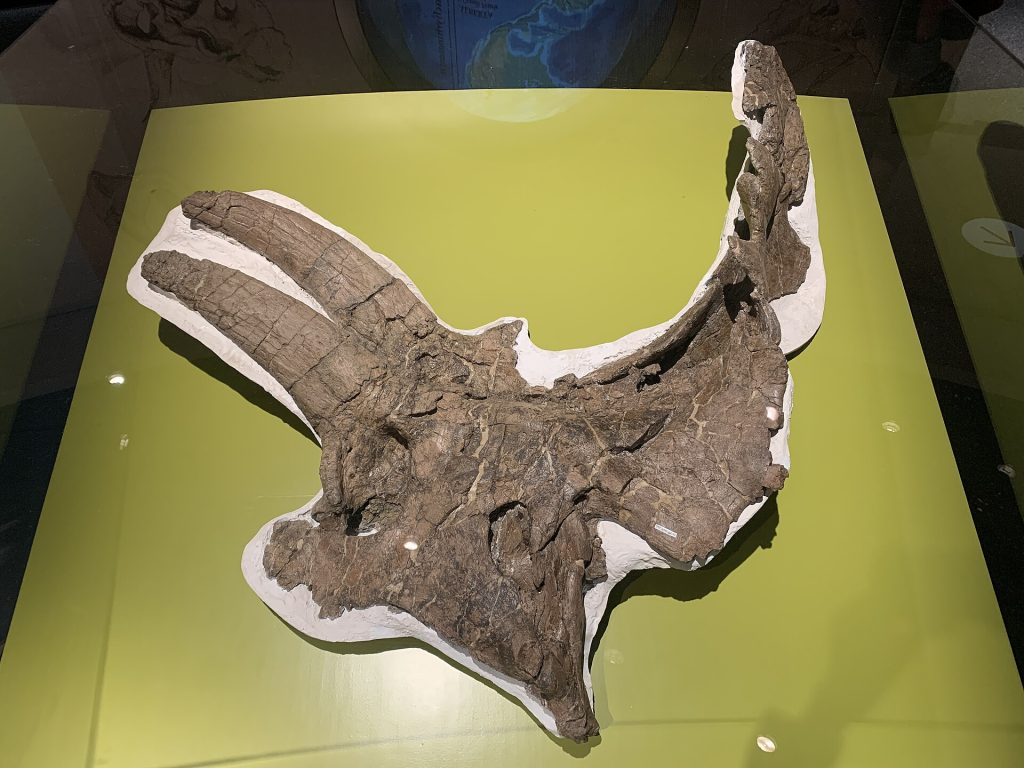

Ryan’s 2003 PhD thesis described this skull under the name “Medusaceratops nesmoi,” after its snake-like frill spikes. That name never appeared in a formal publication, and in 2010 Medusaceratops went to a Montana species, M. lokii.
In 2007, Ryan also referred Montana bonebed material “from equivalent beds in the Judith River Formation” to the new genus. In 2018, however, Kentaro Chiba and colleagues assigned this material to Medusaceratops lokii. They found no diagnostic bones of any other ceratopsid there.
Albertaceratops Size and Description
With only a skull to go on, Albertaceratops is far easier to picture from the neck up.
Short description of Albertaceratops
At the front of the lower jaw, Ryan’s thesis found the predentary’s cutting surfaces steeply inclined, as in other centrosaurines. Still, he noted that crushing may have altered them. Above the nose sat a long ornament, although the sources describe it differently. The 2007 press release called it “a long, low banana-shaped bump in place of a nasal horn.” Ryan’s thesis, by contrast, measured a blade-like ornament 80 millimeters (3.1 inches) high. In 2015, paleontologist David Evans and Ryan grouped it with centrosaurines bearing “a rugose ridge or small eminences.” Loewen’s team, however, described an elongate, blade-like nasal horn in 2024. None of these accounts describes a tall, upright horn.
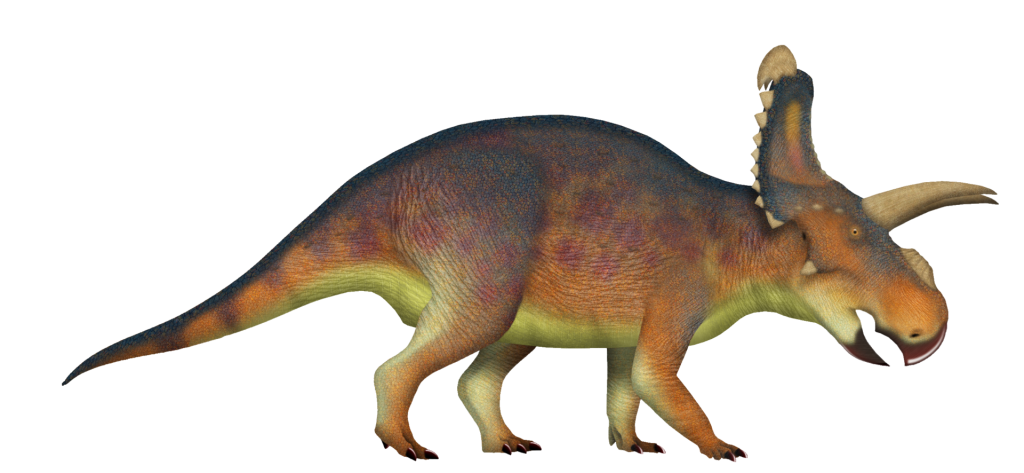
Over the eyes rose two robust, elongate brow horns. Behind them spread a long, asymmetrical frill, and the press release described two large, thick hooks curling forward from its corners. Like other basal centrosaurines, it had a vaulted skull roof. Its limbs are missing, but like other ceratopsids it most likely walked on all four legs. Ryan’s thesis read the animal as a large subadult (not yet fully grown), with a heavily fused skull but an unfused nasal. He suggested the nasals fused only late in growth—atypical for centrosaurines.

Size and Weight of Type Species
Only the single skull is known, so any body length or weight is an estimate. The Cleveland Museum of Natural History’s 2007 press release gave about 20 feet (6.1 meters), without explaining its method.
Its height at the hips is also unknown. The press release’s weight of “nearly one half ton, or the weight of a pickup truck” does not add up, because pickups weigh more.
Instead, the skull offers firmer numbers. Ryan’s thesis gives a preserved length of 1,105 millimeters (about 3.6 feet)—longer than a yardstick. He estimated the basal skull length at 970 millimeters (3.2 feet). By the 2018 measurements of paleontologist Caleb Brown, one brow horncore (the bony core of the horn) reaches a straight-line height of 431 millimeters (17 inches). His table puts these horns close in size to those of Nasutoceratops.
The Dinosaur in Detail
When it was named in 2007, the pairing of a centrosaurine skull with long brow horns set this dinosaur apart. Since then, Diabloceratops, Nasutoceratops and other early centrosaurines have shown it too. At the base, the holotype’s horncores measure 350 and 357 millimeters (about 14 inches) around. The horns curve forward, although Brown notes that the curve lies mostly in their apical half—the half toward the tip.
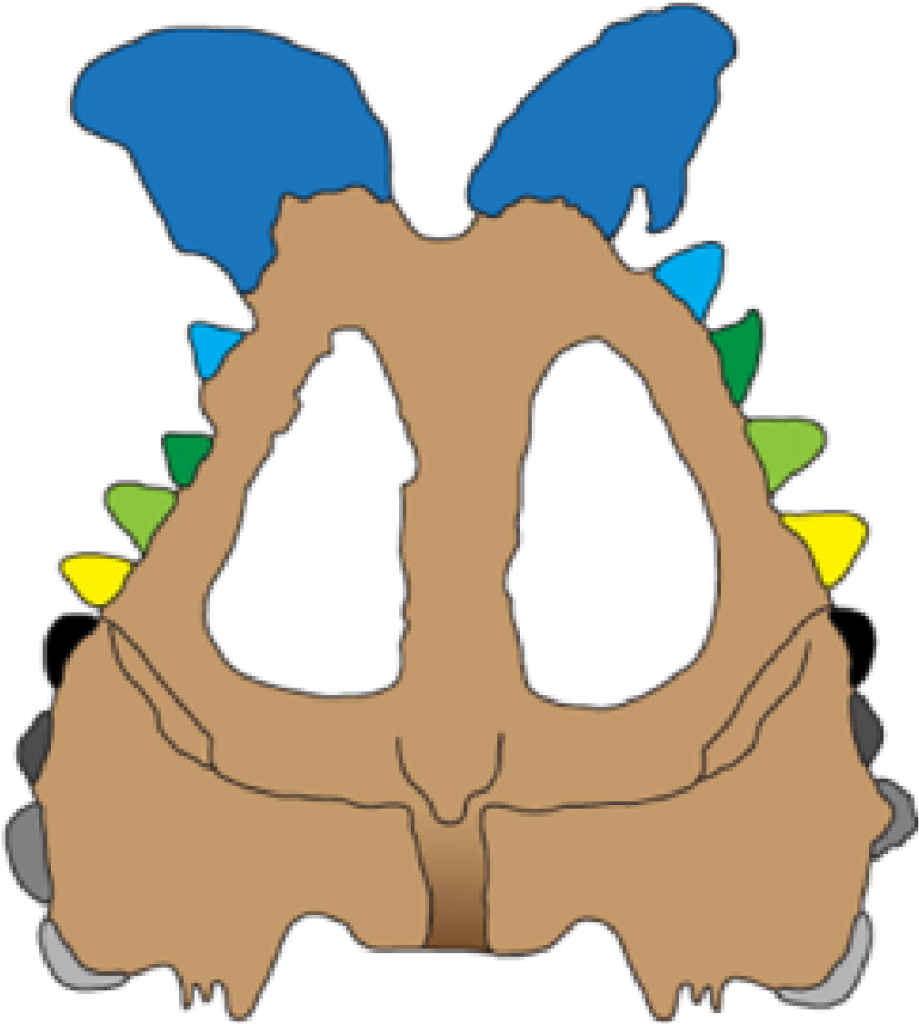
The frill carries five epiparietals and four episquamosals—small bony ornaments along the parietal and squamosal edges. In Loewen’s account, the first epiparietal is a blade curving backward and outward, while the next four curl upward as spikes. Unlike Medusaceratops, it lacks a large, blade-like second epiparietal. Its fan-shaped squamosals meet the parietal at a large step, and its elongated, asymmetrical frill resembles that of Diabloceratops.

In 2015, Evans and Ryan’s analysis, like earlier ones, placed Diabloceratops at the base of the centrosaurines. Their tree left Albertaceratops in a polytomy—an unresolved branching point—on weak support. Later, in 2024, Loewen and colleagues named a new clade, Albertaceratopsini, for all taxa closer to Albertaceratops than to Centrosaurus. They recovered Lokiceratops as the sister of Albertaceratops and Medusaceratops. Taken together, these studies keep Albertaceratops among the early-branching centrosaurines, while its exact branch remains open.
Interesting Points about Albertaceratops
- Fossil horsetail roots grew through the skull, which Ryan’s 2003 thesis read as a sign that it lay nearly exposed in marshy ground.
- Albertaceratopsini, the clade named for it in 2024, so far comes only from a 25-kilometer range in northern Montana and southern Alberta.
- Loewen and colleagues placed Albertaceratops and three other centrosaurines from the area within a window of roughly 200,000 years. However, they note that such short known ranges almost certainly underestimate how long each species existed.
- In 2005, Ryan, Evans and colleagues founded the Southern Alberta Dinosaur Research Group, two years before Albertaceratops got its name.
Contemporary Dinosaurs
Sharing the same level of the lower Oldman Formation was Wendiceratops pinhornensis, a highly adorned basal centrosaurine. More than 200 of its bones come from a bonebed about 3 kilometers (2 miles) away. Evans and Ryan called the two essentially contemporaneous, although no interaction between them is on record.
From the neighboring Judith River Formation at Kennedy Coulee, Montana, comes Medusaceratops lokii. First described as a chasmosaurine in 2010, it was re-identified as an early centrosaurine in 2018. The Mansfield bonebed lies about 10 meters (33 feet) above the Marker A Coal. Its modeled median age is 78.18 million years, against 78.28 for Albertaceratops. Evans and Ryan treat these beds as equivalent to the lower Oldman. Loewen and colleagues, in turn, group both sides of the border in the Kennedy Coulee Assemblage.
A second Kennedy Coulee centrosaurine, Lokiceratops rangiformis, was named in 2024 from the same Montana formation. Its quarry sits 11.4 meters (37 feet) above the Marker A Coal, at a modeled age of about 78.1 million years. Its describers place Albertaceratops slightly lower in the section and recover the two as close relatives.
Also known from the Oldman Formation (exact level relative to Albertaceratops not known): Gremlin slobodorum, a leptoceratopsid (a ceratopsian outside the Ceratopsidae) named in 2023 from one frontal bone. Its describers report it from the lower unit on the same grazing reserve. It came from the Herronton sandstone zone, within 15 meters (49 feet) of the top of the Taber Coal Zone. Researchers differ on whether that zone caps the Foremost Formation or begins the Oldman, and no study ties its level to the Albertaceratops skull. The Oldman Formation spans a little over 2 million years, from about 78.6 to 76.5 million years ago, so the two may not have lived at the same time.
Albertaceratops in its Natural Habitat
The world Albertaceratops roamed was one of rivers and floodplains. Across the Oldman Formation as a whole, these deposits built up seasonally on a relatively well-drained landscape. Below them lay the Foremost Formation—a transitional unit between sea and land. Locally, though, the ground may have been wetter. At the same level as the skull, the Wendiceratops bonebed formed in mudstone rich in coalified root traces, a sign of waterlogged ground. Across the border, the Loki Quarry records a poorly drained river system with gar scales and mollusks. The lower Oldman has also yielded Gryposaurus, a duck-billed dinosaur not identified to species, and a pachycephalosaur tentatively compared with Stegoceras.
Like other ceratopsids, Albertaceratops was a herbivore, although no direct evidence of its diet survives. In a narrow interval of the Kennedy Coulee Assemblage, Loewen and colleagues counted five possibly coexisting ceratopsids—four centrosaurines and one chasmosaurine.
There is no direct evidence of its behavior. Still, the 2007 museum press release suggested its horns could have served for sexual display or self-defense against Daspletosaurus. However, the species Daspletosaurus torosus comes from the upper Oldman, about 77 million years ago. Later Oldman rocks hold other horned dinosaurs, such as Coronosaurus from the middle unit, roughly 77.5 to 76.4 million years ago. Centrosaurus turns up in the upper unit, which correlates with the lower Dinosaur Park Formation. In that sense, Albertaceratops marks an early chapter in a long run of centrosaurines in southern Alberta.
Frequently Asked Questions
It means “Alberta horned face,” after the Canadian province where Ryan’s team found it, and nesmoi honors local rancher Cecil Nesmo.
It lived during the Campanian stage of the Late Cretaceous, around 78 million years ago.
Only the skull is known, so its body size is uncertain. A 2007 press release gave about 20 feet (6.1 meters), and the preserved skull is about 3.6 feet long.
It was a herbivore like other ceratopsids, although no fossil preserves direct evidence of its diet.
It came from the lower Oldman Formation on the Pinhorn Provincial Grazing Reserve, south of Manyberries in southeastern Alberta, Canada.
It was the first centrosaurine found with long, robust brow horns, a trait once thought typical of chasmosaurines such as Triceratops. Several other early centrosaurines are now known to share them.
Sources
The information in this article is based on various sources, drawing on scientific research, fossil evidence, and expert analysis. The aim is to provide a comprehensive and accurate overview of Albertaceratops. However, please be aware that our understanding of dinosaurs and their world is constantly evolving as new discoveries are made.
- https://doi.org/10.1666/0022-3360(2007)81[376:ANBCCF]2.0.CO;2
- https://ucalgary.scholaris.ca/items/99fe94c2-7004-4e1e-96e9-de87c37e16ba
- https://doi.org/10.1371/journal.pone.0130007
- https://doi.org/10.7717/peerj.17224
- https://doi.org/10.1017/jpa.2017.62
- https://doi.org/10.7717/peerj.4265
- https://doi.org/10.1371/journal.pone.0154218
- https://doi.org/10.1038/s41598-022-19896-w
- https://doi.org/10.7717/peerj.14461
- https://www.paleolab.snu.ac.kr/_files/ugd/ed6e15_ce41b1eea0474934b1c8fcb5ebf33813.pdf
- https://www.sciencedaily.com/releases/2007/03/070304115019.htm
This article was last fact checked: TheDinosaurs Team, 16-11-2026
Featured Image Credit: Nick Longrich, CC BY-SA 4.0, via Wikimedia Commons
