Among the farm fields of Teruel Province in northeastern Spain lie the rocks of the Camarillas Formation. Here, a theropod turned up whose identity has been argued over for more than a decade. Named Camarillasaurus cirugedae in 2014, it comes from Barremian rocks of the Early Cretaceous. Its describers placed them in the early part of that stage. They saw it as a ceratosaur close to the base of that lineage. Since 2021, however, a series of studies has placed it among the spinosaurids instead.
The first bones surfaced during ploughing in a field called Fuente Arnar. Pedro Cirugeda Buj—the man the species honors—found them. Paleontologists Bárbara Sánchez-Hernández and Michael J. Benton described the remains, and their paper appeared online in 2012 before its 2014 print issue. In 2025, paleontologists Rauhut, Canudo and Castanera described new finds and recast the animal as a spinosaurine. In the end, its story shows how far a fragmentary skeleton can travel across the family tree.
Camarillasaurus Key Facts
| Keyword | Fact |
|---|---|
| Pronunciation | kah-mah-REE-yah-SORE-us |
| Meaning of name | Camarillas Reptile |
| Group | Spinosauridae (originally described as a ceratosaur) |
| Type Species | Camarillasaurus cirugedae |
| Diet | Carnivore |
| When it Lived | 125.77 to 121.4 MYA (span of the whole Barremian stage, exact level not known) |
| Period | Cretaceous |
| Epoch | Early Cretaceous (Barremian stage) |
| Length | Not specified, described as medium- to large-sized in 2025 |
| Height | Not specified |
| Weight | Not specified |
| Mobility | Moved on two legs (bipedal) |
| First Discovery | Before 2012 by Pedro Cirugeda Buj during ploughing (no year in the scientific literature, though a 2025 newspaper says 2002) |
| Described by | 2014 by Bárbara Sánchez-Hernández and Michael J. Benton |
| Holotype | MPG-KPC1-46 as originally designated (the 2025 revision changed which numbers belong to it) |
| Location of first find | Fuente Arnar, near Camarillas, Teruel Province, Aragón, Spain (Camarillas Formation) |
Camarillasaurus Origins, Taxonomy and Timeline
The name Camarillasaurus comes straight from the map. “Camarillas” is the name of both the locality and the formation where the bones lay, while “saurus” means “reptile.” The species name cirugedae, in turn, honors its finder, Pedro Cirugeda Buj. Together, the name ties the animal to its village and to the person who first noticed it.
As first described, Camarillasaurus belonged to Ceratosauria, a lineage of theropods—the mostly meat-eating dinosaurs. Sánchez-Hernández and Benton placed it close to the base of that clade, perhaps just above Limusaurus. In a 2019 conference abstract, though, Rauhut, Canudo and Castanera proposed that it was a megalosauroid and probably a spinosaurid. Two years later, Samathi and colleagues found it to be a spinosaurid, and Barker and colleagues recovered it as an early-branching spinosaurine. In 2022, Sereno and colleagues tentatively positioned it as the most basal spinosaurid. The 2025 revision then placed it within Spinosaurinae. Once five unstable taxa were set aside, it came out as the sister taxon—closest relative—of Spinosaurus plus a specimen catalogued FSAC-KK 11888. Throughout, Camarillasaurus cirugedae has remained the type and only known species.
The original paper dated the beds to the lower Barremian. The 2025 revision, however, dates the formation here from the Early Barremian to the early Late Barremian. It relies on charophytes (stoneworts), ostracods (tiny crustaceans) and palynomorphs (pollen and spores). No published radiometric date exists for the site, but the Barremian spans roughly 125.8 to 121.4 million years ago. For Sánchez-Hernández and Benton, this interval sat inside a “ceratosaur gap” of about 20 million years—from the Berriasian to the Barremian—that their find could partly fill.
Discovery & Fossil Evidence
Fuente Arnar is a farm field about 3.5 kilometers (2.2 miles) north-northwest of Camarillas village, in the Iberian Range. Its bones turned up during ploughing, scattered within an area of about five square meters (54 square feet). A 2025 newspaper report places the find in 2002, although neither scientific paper gives a year. These were also the first vertebrate remains reported from the Camarillas locality.
The holotype, MPG-KPC1-46, sits in the collections of the Museo Paleontológico de Galve. As first described, it included a tooth tip, two “sternal plates” (breastbone elements), a right scapulocoracoid (shoulder blade and coracoid), a rib and a chevron (a bone beneath the tail). Vertebrae from the neck, back, hips and tail joined the upper end of a right tibia (shin bone). Sánchez-Hernández and Benton thought it all came from one individual.
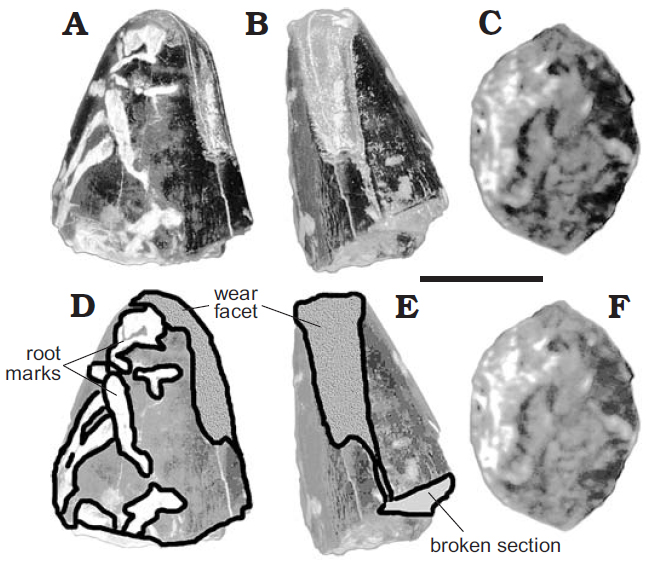

Most of that original material came from the surface. In 2017, researchers visited Fuente Arnar with Pedro Cirugeda and found a tail vertebra in place. A systematic dig in 2018 then yielded part of the lower jaw, a right femur (thigh bone) and a toe claw. Later, one more tooth emerged in 2024. Rauhut and colleagues judged that these bones “almost certainly represent the same individual” as the holotype. So far, they describe Camarillasaurus as known from that single specimen at Fuente Arnar.
Camarillasaurus Size and Description
The 2025 revision moved Camarillasaurus on the family tree and reidentified several of its bones.
Short description of Camarillasaurus
Only scraps of the head survive. A fused surangular and articular—two rear lower-jaw bones—preserve about 8.5 inches (215 millimeters) of length and reach just over 3.5 inches (90 mm) wide at the jaw joint. A similar rough bump on its outer surface has been described in no other theropod except Irritator. The newer tooth, which its describers say “clearly represents a spinosaurid tooth,” carries about eight well-developed flutes (lengthwise ridges) on one side and an unserrated rear edge.
One broad neural spine (the upward blade of a vertebra) stands 9 inches (23 centimeters) tall as preserved. Its plate-like shape resembles the spines of Ichthyovenator and Baryonyx. Farther back, Sánchez-Hernández and Benton read the sacrum as six vertebrae forming an upward arch. By contrast, the 2025 team found three articulated sacral vertebrae lying in a straight line. The mid-tail vertebrae carried rod-like spines that bend slightly forward toward their tips.
Lower down, a 5.7-inch (145 mm) toe claw probably came from the fourth toe of the left foot. Neither paper states its posture outright, although the 2025 skeletal drawing shows a two-legged animal. Since no skin or soft tissue has been reported, any picture of its outward appearance is speculative.
Size and Weight of Type Species
No peer-reviewed source we found gives a body length or weight. The original paper offers no size estimate, and the 2025 revision calls it only a “medium- to large-sized” theropod.
Instead, the most useful yardstick is a single bone. The complete right femur measures 32.7 inches (830 millimeters) long—a direct measurement, not a body-size estimate. This thigh bone is slender, with a minimum width of about 3.6 inches (91 mm).
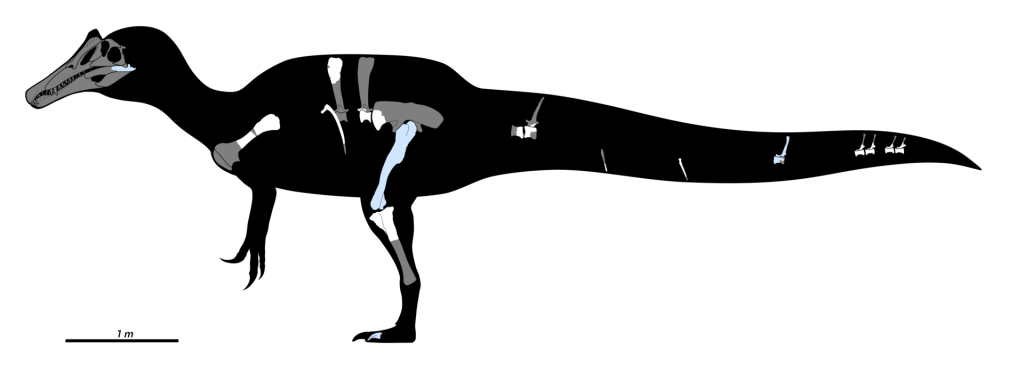

The original tibia—the bone behind the first diagnosis—preserves 11.5 inches (293 mm) of length, while its upper end measures 7.1 by 2.5 inches (180 by 64 mm). Until more of the skeleton turns up, however, any figure for total length remains a guess.
The Dinosaur in Detail
What sets Camarillasaurus apart is how thoroughly scientists have reread its anatomy. Sánchez-Hernández and Benton diagnosed it on two features of the tibia. The first was an extremely broad upper end, whose front-to-back to side-to-side ratio of 2.8 was “the highest of any theropod,” they wrote. The second was a narrow, deep groove that gave the shaft a g-shaped cross-section. However, Rauhut and colleagues called the groove “quite certainly an artefact of preservation” caused by sideways crushing.
Several other bones changed identity too. Sánchez-Hernández and Benton had hailed the two “sternal plates” as only the second such find in a ceratosaur, after Carnotaurus. Yet the 2025 team identified them as the end of a right scapula and a back or hip neural spine. The supposed right scapulocoracoid became part of the left scapula and, tentatively, a piece of the left ilium (upper hip bone). Meanwhile, the team dropped a small neck vertebra from the taxon—it proved too small to fit.
The two teams also disagree about its age at death. The original authors took extensive fusion of the hip vertebrae as a sign that it “had reached adulthood.” In contrast, the 2025 team read an unfused joint surface on the first sacral as a mark of immaturity.
Its exact branch remains uncertain. The 2025 analysis could score only 67 of 404 characters, but a ceratosaur position still cost at least 20 extra steps (evolutionary changes). The same paper named Spinosauria, the clade of Baryonyx walkeri, Spinosaurus aegyptiacus and all descendants of their last common ancestor. In 2022, Barker and colleagues flagged it as a “wildcard” taxon, while Mateus and Estraviz-López could not resolve it beyond its likely place in Spinosauridae. Taken together, the studies since 2021 point to the same family, while its precise twig remains open.
Interesting Points about Camarillasaurus
- The bones of Camarillasaurus came to light during ploughing on land that the 2014 paper described as belonging to the family of Pedro Cirugeda Buj.
- Its 2014 describers called it Iberia’s first ceratosaur, overlooking a 2000 report of Ceratosaurus from Late Jurassic Portugal—and newer studies no longer class it as a ceratosaur.
- Its describers could score only 17 of 151 characters, and, as the 2025 revision pointed out, their analysis used just three non-ceratosaurian outgroups.
- In 2023, Santos-Cubedo and colleagues floated that it and Iberospinus might be close relatives or even the same animal, but the 2025 revision found the two morphologically different.
Contemporary Dinosaurs
From neighboring Portugal comes Iberospinus, a spinosaurid whose associated remains researchers once assigned to Baryonyx. These remains come from the Papo Seco Formation at Cabo Espichel, in Setúbal District—beds dated to the early Barremian. That window overlaps with the Early to early Late Barremian span of the Camarillas Formation. In 2024, Montealegre and colleagues counted both among at least five spinosaurid taxa in the early Barremian of the Iberian Peninsula. Still, no fossil places the two together.
Also known from the Camarillas Formation (exact level relative to Camarillasaurus not known): Iguanodon galvensis (moved to its own genus, Paulodon, in 2025) and Gideonmantellia. The first is an iguanodontian ornithopod named from perinates (newly hatched young) at Galve. The second is a small basal ornithopod from the formation’s upper part. Because the formation runs from the Early Barremian into the early Late Barremian, these animals may not all have lived at the same time.
Camarillasaurus in its Natural Habitat
The world Camarillasaurus inhabited lay in the Galve sub-basin, at the western edge of the Maestrazgo rift basin. Sánchez-Hernández and Benton read the Camarillas sandstones as river deposits, with low-sinuosity channels spreading across an alluvial fan. However, work by Soria and colleagues in 2023 limits that river origin to the lower part and western areas. The rest records estuaries and a barrier-island setting. At Galve, plant fossils include the conifer Pseudofrenelopsis, fern spores, and pollen of gymnosperms (conifers and their kin) and flowering plants.
The holotype itself came from alluvial plain deposits—”an environment without permanent water bodies,” in the 2025 authors’ words. Rauhut and colleagues suggested that Iberian spinosaurids were “probably predators in more terrestrial environments,” specialized on “rather smaller and elusive prey.” They allowed that these animals may also have fished in shallow water, but judged a fully aquatic lifestyle “rather unlikely.” In their view, the Iberian spinosaurids would have had weaker aquatic ties than later spinosaurs. Six parallel depressions on a shoulder bone might mark a muscle attachment or tooth marks, and the original authors left that question open.
At Fuente Arnar, the bones lay with a small theropod, coprolites (fossil dung) and a partial turtle shell. A crocodylomorph tooth, by contrast, came from a slightly higher level. Across the formation, iguanodontians form the most abundant dinosaur record, and several spinosaurid tooth types have turned up. Finally, Rauhut’s team suggested that Iberia’s mostly spinosaurine spinosaurids may point to closer ties with North Africa’s younger fauna than with the coeval British one.
Frequently Asked Questions
It means “Camarillas reptile,” after its locality and formation, and cirugedae honors Pedro Cirugeda Buj, who found the bones.
It lived in the Barremian stage of the Early Cretaceous, between 125.77 and 121.4 million years ago, and its describers placed it early in that stage.
No peer-reviewed source gives a length or weight. Its femur measures 32.7 inches, and the 2025 revision calls it medium- to large-sized.
Its describers called it a ceratosaur in 2014, but later studies have recovered it as a spinosaurid theropod.
It was a carnivore, and its 2025 revisers suggested that Iberian spinosaurids like it probably hunted smaller, elusive prey in largely terrestrial settings.
Its bones come from Fuente Arnar, near Camarillas in Teruel Province, Aragón, in the Camarillas Formation of Spain.
Sources
The information in this article is based on various sources, drawing on scientific research, fossil evidence, and expert analysis. The aim is to provide a comprehensive and accurate overview of Camarillasaurus. However, please be aware that our understanding of dinosaurs and their world is constantly evolving as new discoveries are made.
- https://www.app.pan.pl/archive/published/app59/app20110144.pdf
- https://doi.org/10.4202/app.2011.0144
- https://palaeo-electronica.org/content/2025/5627-revision-of-early-cretaceous-theropod-dinosaur
- https://doi.org/10.26879/1543
- https://doi.org/10.1080/08912963.2021.1874372
- https://www.nature.com/articles/s41598-021-97870-8
- https://doi.org/10.1371/journal.pone.0262614
- https://elifesciences.org/articles/80092
- https://www.nature.com/articles/s41598-023-33418-2
- https://europepmc.org/article/PMC/PMC9188774
- https://ddd.uab.cat/record/288360
- https://doi.org/10.1016/j.crpv.2012.06.001
- https://doi.org/10.1016/j.cretres.2015.05.010
- https://www.mdpi.com/1424-2818/16/9/586
- https://stratigraphy.org/ICSchart/ChronostratChart2024-12.pdf
- https://www.eldiario.es/spin/ciencia-acaba-descubrir-camarillasaurus-dinosaurio-hallado-teruel_1_12615410.html
- https://doi.org/10.1080/08912963.2024.2308220
- https://doi.org/10.1080/08912963.2014.931385
- https://link.springer.com/article/10.1007/s41513-025-00299-5
- https://doi.org/10.11646/mesozoic.2.4.3
- https://docentes.fct.unl.pt/sites/default/files/omateus/files/mateus__antunes_2000_-_ceratosaurus_in_portugal.pdf
This article was last fact checked: TheDinosaurs Team, 16-11-2026
Featured Image Credit: Connor Ashbridge, CC BY-SA 4.0, via Wikimedia Commons
