Near the village of Cerro Cóndor in Chubut, Argentina, ancient lake deposits of the Cañadón Asfalto Formation have yielded an almost complete theropod skeleton. Paleontologists Diego Pol and Oliver Rauhut named it Eoabelisaurus mefi in 2012 and classified it as the earliest-branching abelisaurid. That family later supplied the top predators of Late Cretaceous Gondwana—the southern supercontinent. The describers dated the rocks to the early Middle Jurassic, although later dating places the formation in the Early Jurassic’s Toarcian stage. By their count, it predated the oldest secure abelisaurid then known by more than 40 million years.
Field crews found and excavated the skeleton in 2009 and 2010. Much later, a 2025 study called it by far the most complete of the putative abelisaurid material from the Jurassic. Its family placement is now debated—yet its describers saw in its arms an early step toward the reduced forelimbs of later abelisaurids.
Eoabelisaurus Key Facts
| Keyword | Fact |
|---|---|
| Pronunciation | Not specified |
| Meaning of name | Dawn Abelisaurus |
| Group | Theropoda |
| Type Species | Eoabelisaurus mefi |
| Diet | Carnivore (inferred from its group) |
| When it Lived | About 179 to 176 MYA (dates for the formation, originally thought Aalenian to Bajocian in age) |
| Period | Jurassic |
| Epoch | Early Jurassic (Toarcian stage) |
| Length | About 19.7 to 21.3 feet (6 to 6.5 meters) |
| Height | Not specified |
| Weight | About 1,610 pounds (730 kilograms), 2024 estimate from femur circumference |
| Mobility | Moved on two legs (bipedal), inferred from its group |
| First Discovery | 2009 to 2010 by the field crews of Pol and Rauhut’s campaigns (finder not named) |
| Described by | 2012 by D. Pol and O.W.M. Rauhut |
| Holotype | MPEF PV 3990 (also written MPEF-PV 3990) |
| Location of first find | Jugo Loco locality, near Cerro Cóndor, Cañadón Asfalto Formation, Chubut, Argentina |
Eoabelisaurus Origins, Taxonomy and Timeline
The name Eoabelisaurus begins with eos, Greek for “dawn,” a reference to the animal’s early occurrence. Its second part comes from Abelisaurus, the type genus of Abelisauridae. The species name mefi refers to MEF, the popular abbreviation for the Museo Paleontológico Egidio Feruglio in Trelew. Together, the name marks an early abelisaurid and honors its museum.
Eoabelisaurus belongs to Ceratosauria, a branch of theropods that also includes Ceratosaurus. In 2012, Pol and Rauhut’s analysis, built on two earlier datasets, placed it as the most basal member of Abelisauridae. However, one alternative was not significantly worse—a slightly more basal position just outside the family, as a stem-abelisauroid. Later analyses have split—some keep it as an early abelisaurid, while others recover it as an abelisauroid outside the family, an early neoceratosaur, or a ceratosaurid beside Ceratosaurus. According to a 2025 summary, one of those outside placements came from a 2021 study by Rauhut and Pol themselves. Eoabelisaurus mefi is the type and only known species.
Pol and Rauhut assigned the skeleton to the Aalenian–Bajocian stages of the early Middle Jurassic. Later, high-precision uranium–lead dating of volcanic ash layers reshaped the timeline. A 2013 study still treated the beds near Cerro Cóndor as early Middle Jurassic. Even so, it allowed a latest Toarcian age for those just above the basalt flows. It also grouped Eoabelisaurus with the theropods of the middle to upper formation, above the uppermost basalt. In 2020, however, Pol and colleagues dated the upper formation to about 178.1 million years ago, within the Toarcian. Dated ash layers across the formation span roughly 179.5 to 176.2 million years ago. A 2025 study accordingly places Eoabelisaurus in the middle to late Toarcian. No date has been published for the Jugo Loco layer itself, so its exact age remains open.
Discovery & Fossil Evidence
The skeleton lay at the Jugo Loco locality, in finely bedded mudstones, marls (lime-rich muds), and limestones. Pol and Rauhut credit the field crews of the January 2009 and February 2010 campaigns with finding and excavating it. A 2022 review of the museum’s collections lists “Pol, Rauhut et al.” as collectors, but no individual finder is named. Mariano Caffa and Santiago Bessone then prepared the bones rapidly, while Norberto Pfeiffer handled additional preparation and curation.
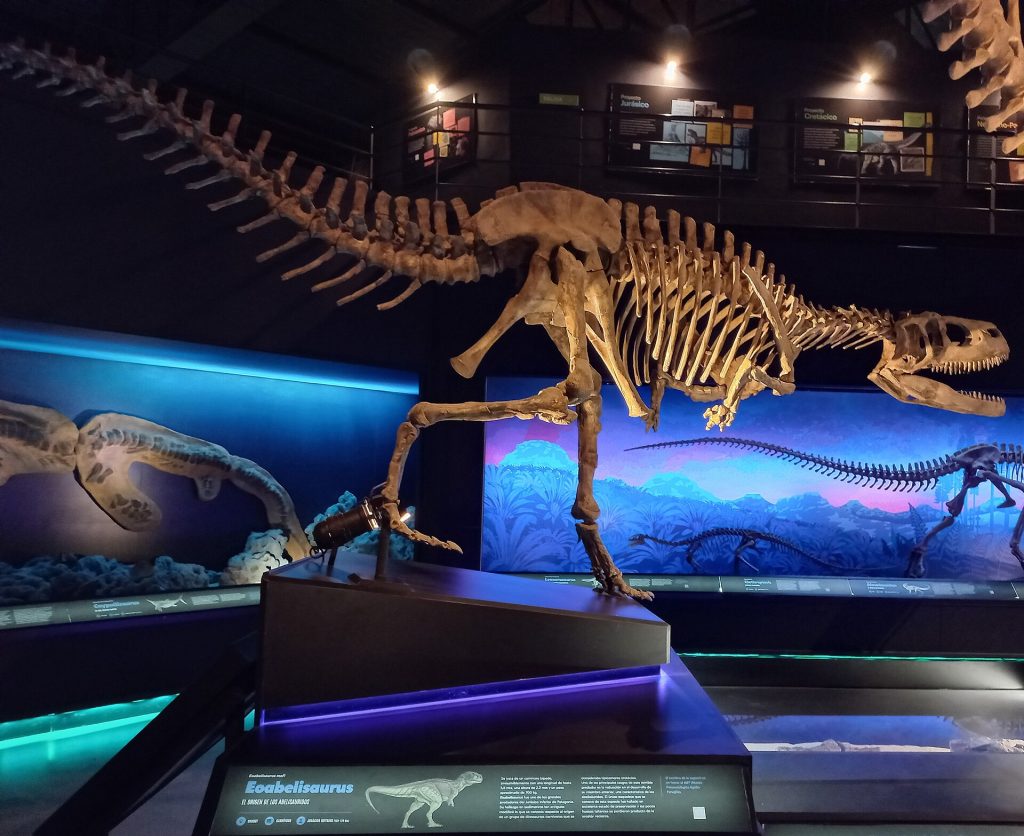
The holotype, MPEF PV 3990, resides at the Museo Paleontológico Egidio Feruglio in Trelew. It includes the back half of the skull, five cervical (neck) and nine dorsal (back) vertebrae, a complete sacrum, and 27 caudal (tail) vertebrae. Both scapulocoracoids (shoulder girdles), both forelimbs with much of both hands, the complete pelvis, and both hind limbs down to the toe bones are also present. Before burial, the front of the skeleton had partly come apart, and the skull had shifted slightly. Erosion had also damaged the exposed skull and front vertebrae before the find.
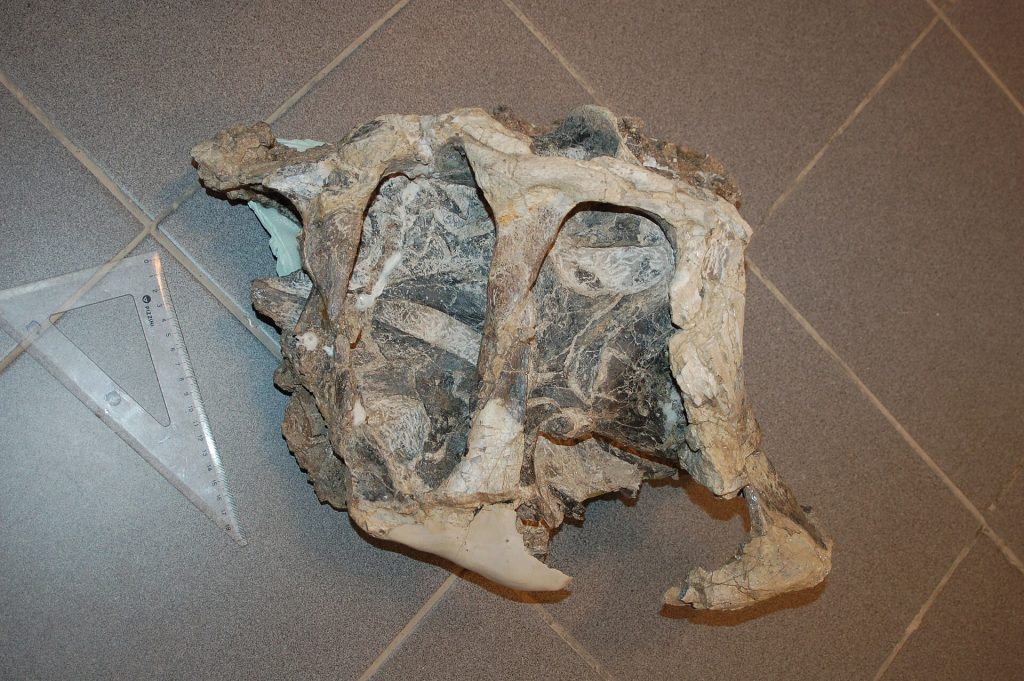

The snout is the great gap. Only a fragment of the right maxilla—the main tooth-bearing bone of the upper jaw—survives from it. The teeth are just as scarce, represented by a single unerupted tooth in a small piece of maxilla. On the other hand, the fused tibia, astragalus, and calcaneum (shin and ankle bones) suggest a mature individual, according to a 2018 review. All of the anatomy described below comes from this one skeleton.
Eoabelisaurus Size and Description
Eoabelisaurus pairs a sturdy theropod body with forelimbs that look half-remodeled—an old-fashioned upper arm above a newly reduced hand.
Short description of Eoabelisaurus
The back of the skull was high, with an oval eye socket and an enlarged opening behind it. It carried no cranial ornamentation, and the skull roof was not notably thickened. The nuchal crest at the back of the head was raised, though less so than in advanced abelisaurids. A 2018 review grouped it with Ceratosaurus and possibly Genyodectes as having longer skulls than abelisaurids. Its snout, however, is too incomplete to show this directly.
Its neck vertebrae were short and broad, with very low spines and strongly pneumatized arches—hollowed by air sacs. Behind them, six vertebrae formed an arched sacrum, the fused hip section of the spine. The tail began with tall, massive vertebrae that carried long transverse processes, or side projections. The forearms, meanwhile, were short, ending in a strongly foreshortened four-fingered hand with reduced claws.
By contrast, the hind limbs were robust, with a stout, only slightly bowed femur and a long, slender foot. Its third metatarsal, a long foot bone, reached almost half the length of the femur. Since only bones survive, any restoration of its skin or coloring is speculative.

Size and Weight of Type Species
Pol and Rauhut estimated the medium-sized Eoabelisaurus at about 19.7 to 21.3 feet (6 to 6.5 meters) long. Their main text does not explain how they reached that figure. A 2025 study of abelisaurid teeth cited a slightly shorter 19.1 feet (5.82 meters). Combined, published lengths run from about 19 to 21 feet.
In 2024, paleontologist Romain Pintore and colleagues estimated its weight at about 1,610 pounds (730 kilograms). They worked from the thigh bone’s minimum shaft circumference, using an equation for two-legged dinosaurs. Their prediction error was about 25 percent either way. By contrast, the left femur’s length of 24.2 inches (614.5 millimeters) is a direct measurement of the fossil.
The same study found that medium-sized abelisauroids such as Eoabelisaurus and Skorpiovenator had sturdier femora than the larger Carnotaurus. Its table puts Skorpiovenator at about 1,960 pounds (891 kilograms), heavier than Eoabelisaurus but well short of Carnotaurus. None of these studies gives its height at the hips.
The Dinosaur in Detail
Its forelimb sets this dinosaur apart—Pol and Rauhut described it as a unique combination of primitive and advanced features. The humerus, or upper arm bone, shows what they called “remarkably primitive characters.” Its head is only slightly expanded, far from the globular shape seen in noasaurids (small, lightly built ceratosaurs) and abelisaurids. Farther down, however, the forearm was short and the hand strongly foreshortened. Metacarpal I, the palm bone of the first finger, reached only about half the length of the stout, blocky metacarpal II. The describers suggested the arm changed in a modular fashion, starting with the bones farthest from the body.
Elaphrosaurs (kin of Elaphrosaurus) and noasaurids show abelisaurid-like changes in the humerus. So either those traits arose independently or Eoabelisaurus reversed them. Either way, Pol and Rauhut saw a surprisingly high level of homoplasy—similar traits appearing, or vanishing, more than once.
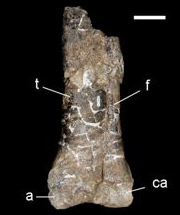

Its describers also listed five features unique to it. One is an enlarged olecranon—the bony point of the elbow—making up more than 30 percent of the ulna’s length. Another is a pubic foramen, an opening in the hip, more than twice as long as it is high. Elsewhere, the quadrate—the bone that hinges the lower jaw—has a thickened inner lower end with nearly parallel joint surfaces. Mid-back vertebrae carry a double V-shaped bony strut. Finally, the ambiens process, a muscle attachment on the pubis, forms a large forward-and-outward bulge.
For its abelisaurid placement, Pol and Rauhut cited a covered antorbital fossa—the recess in front of the eye—and broad fossae (shallow pits) on the neck vertebrae. They also pointed to front tail spines that were short from front to back. Reduced finger-bone joints and a broad depression under the toe claws made the list too. Later analyses disagree, however, so its place within Ceratosauria remains open.
Interesting Points about Eoabelisaurus
- Its genus name pairs the Greek eos, meaning “dawn,” with Abelisaurus, marking what its describers saw as an early occurrence of the abelisaurid family.
- The species name mefi refers to MEF, the popular abbreviation of the Trelew museum where the holotype is kept.
- In a 2012 press release, Rauhut said the find “reveals that the abelisaurid lineage is more ancient than we thought.”
- Pol and Rauhut argued that the lines leading to elaphrosaurs, ceratosaurids, noasaurids, and abelisaurids were all established by the time Eoabelisaurus lived.
Dinosaurs from the Same Formation
Also known from the Cañadón Asfalto Formation (exact level relative to Eoabelisaurus not known): the theropods Piatnitzkysaurus, Condorraptor, and Asfaltovenator, and the eusauropods—advanced long-necked sauropods—Patagosaurus and Volkheimeria. Dated ash layers in the formation span about 179.5 to 176.2 million years ago, a window of roughly three million years. Not every fossil site has been dated, so these animals may not all have lived at the same time.
Eoabelisaurus in its Natural Habitat
The world Eoabelisaurus knew was one of rivers, lakes, and ash. As the main Lonco Trapial eruptions waned, river and lake systems returned around 179 million years ago, laying down the formation. Near Cerro Cóndor, lakes formed while the Chon Aike volcanoes were still active—their muds, sands, and gravels are rich in volcanic material. Pulses of nutrients boosted lake productivity, which favored oxygen-poor bottom waters. On land grew conifers, seed ferns, and cycads, and most pollen came from cheirolepidiaceous conifers, an extinct family.
While there is no direct evidence of what Eoabelisaurus ate, its relatives offer the best clue. Pol and Rauhut described abelisaurids as large predatory dinosaurs, so it was probably a meat-eater too. However, its teeth are nearly unknown. Working from photographs, a 2025 study put its single preserved upper tooth at about 1.2 to 1.4 inches (3 to 3.5 centimeters).
Whether it lived alone or in groups is unknown, since only one skeleton has been found. Other animals from the formation include the pterosaur Allkaruen and the frog Notobatrachus. Early mammals, the turtle Condorchelys, the rhynchocephalian Sphenocondor (a tuatara relative), and the heterodontosaurid dinosaur Manidens come from Queso Rallado, low in the formation. The sauropod Bagualia comes from near the base, dated to about 179.2 million years ago. Both levels lie below the middle to upper formation, where the 2013 study placed Eoabelisaurus.
In 2024, Pradelli and colleagues described a lower jaw, MPEF-PV 6775, from near the formation’s base, probably from a ceratosaurid. If so, Eoabelisaurus was not the formation’s only ceratosaur. On a wider scale, Pol and Rauhut proposed that a vast desert in central Gondwana may have kept early abelisauroids in the south. They said the idea needs further work.
Frequently Asked Questions
It means “dawn Abelisaurus,” for its early occurrence, and the species name mefi refers to the Museo Paleontológico Egidio Feruglio.
Its describers dated it to the Aalenian–Bajocian, but later work places its formation in the Toarcian, about 179 to 176 million years ago.
Its describers estimated a length of about 19.7 to 21.3 feet, and a 2024 study estimated its weight at about 1,610 pounds.
It was probably a carnivore, judging from its abelisaurid relatives, since its own teeth are almost unknown.
Its skeleton came from the Jugo Loco locality near Cerro Cóndor, in the Cañadón Asfalto Formation of Chubut, Argentina.
Its nearly complete skeleton pairs a primitive upper arm with a strongly reduced hand, and its family placement remains debated.
Sources
The information in this article is based on various sources, drawing on scientific research, fossil evidence, and expert analysis. The aim is to provide a comprehensive and accurate overview of Eoabelisaurus. However, please be aware that our understanding of dinosaurs and their world is constantly evolving as new discoveries are made.
- https://doi.org/10.1098/rspb.2012.0660
- https://pmc.ncbi.nlm.nih.gov/articles/PMC3385738/
- https://staff.mef.org.ar/images/investigadores/diego_pol/papers/63.pdf
- https://staff.mef.org.ar/images/investigadores/diego_pol/papers/109.pdf
- https://doi.org/10.1016/j.gr.2020.10.001
- https://peapaleontologica.org.ar/index.php/peapa/article/download/376/726/7691
- https://doi.org/10.5710/AMGH.17.09.2025.3654
- https://www.nature.com/articles/s41598-018-28154-x
- https://doi.org/10.1017/pab.2024.6
- https://doi.org/10.1038/s41598-019-53672-7
- https://www.eurekalert.org/news-releases/795524
- https://doi.org/10.1080/14772019.2024.2318262
This article was last fact checked: TheDinosaurs Team, 16-11-2026
Featured Image Credit: Conty, CC BY-SA 3.0, via Wikimedia Commons
