
Within Grand Staircase-Escalante National Monument in southern Utah, the gray and bluish-gray sandstones and shales of the Kaiparowits Formation hold one of the strangest horned dinosaurs yet described. Named Nasutoceratops titusi in 2013, this herbivore lived during the Campanian stage of the Late Cretaceous—roughly 76 to 75.5 million years ago. Its snout was short and swollen, and its brow horns were the longest known among centrosaurines, a subfamily of horned dinosaurs. Yet its frill was surprisingly plain, a combination that set it apart from most of its relatives.
The first skeleton came to light in 2006. Eric Lund, then a master’s student at the University of Utah, found it inside the monument. Seven years later, paleontologist Scott Sampson, Lund, and three colleagues named the new genus in Proceedings of the Royal Society B. Its bones offer a rare glimpse of horned dinosaur evolution in southern Laramidia—the western landmass of Late Cretaceous North America.
Nasutoceratops Key Facts
| Keyword | Fact |
|---|---|
| Pronunciation | Not specified |
| Meaning of name | Large-Nosed Horned Face |
| Group | Ceratopsia |
| Type Species | Nasutoceratops titusi |
| Diet | Herbivore |
| When it Lived | 76 to 75.5 MYA |
| Period | Cretaceous |
| Epoch | Late Cretaceous (Campanian stage) |
| Length | About 15 feet (museum figure, given as 5 meters), not a peer-reviewed estimate |
| Height | Not specified |
| Weight | About 5,500 pounds (2.5 metric tons), museum estimate |
| Mobility | Moved on all four legs (quadrupedal) |
| First Discovery | 2006 by Eric Lund |
| Described by | 2013 by S.D. Sampson, E.K. Lund, M.A. Loewen, A.A. Farke, and K.E. Clayton |
| Holotype | UMNH VP 16800 |
| Location of first find | UMNH VP Locality 940, middle unit of the Kaiparowits Formation, Grand Staircase-Escalante National Monument, Kane County, Utah, USA |
Nasutoceratops Origins, Taxonomy and Timeline
The name Nasutoceratops blends Latin and Greek. “Nasutus” is Latin for “large-nosed,” while the Latinized Greek “ceratops” means “horned face.” The species name titusi honors Alan Titus, a paleontologist at Grand Staircase-Escalante National Monument. Together, the name celebrates the animal’s oddest feature and a scientist from the very monument where it was found.
In 2013, Sampson and colleagues placed Nasutoceratops in Centrosaurinae, a subfamily of Ceratopsidae—the family of large-bodied, plant-eating horned dinosaurs. Supporting traits include a premaxilla (front snout bone) with a pronounced downward angle and a short, stepped squamosal (side bone of the frill). Their analysis found its closest relative in Avaceratops, an older centrosaurine from Montana’s Judith River Formation. Later work grouped the pair in a clade called Nasutoceratopsini. Nasutoceratops titusi is the type and only known species.
The original paper placed the fossils in the late Campanian, approximately 75.97 to 75.51 million years ago. In 2024, Loewen and colleagues used uranium–lead dates to bracket a window of about 76.39 to 75.61 million years ago. However, they cautioned that such windows do not fix an exact position in time. Both studies therefore point to roughly 76 to 75.5 million years ago. At that time, high seas split North America in two, and Nasutoceratops lived in southern Laramidia.
Discovery & Fossil Evidence
The holotype comes from UMNH VP Locality 940 in Kane County, southern Utah. It lay in the middle unit of the Kaiparowits Formation, about 250 to 320 meters (820 to 1,050 feet) up in the sequence. The find came from a multi-institutional effort that has uncovered a previously unknown late Campanian dinosaur assemblage there since 2000.
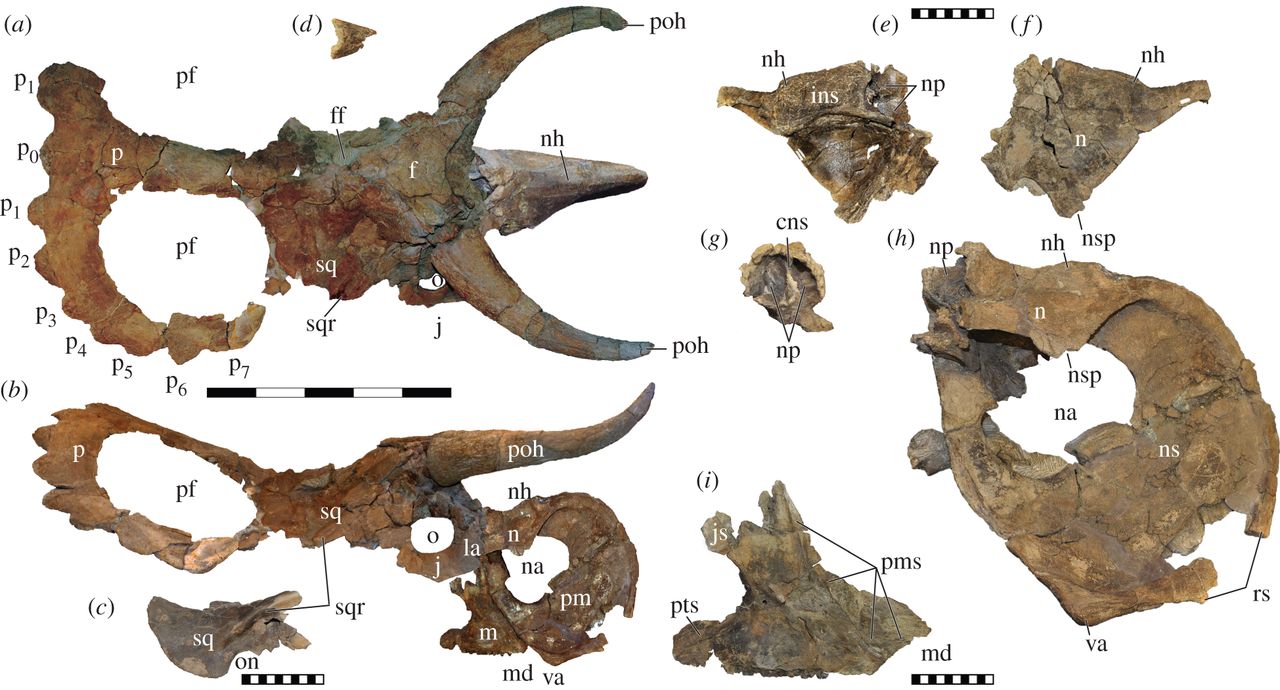
Catalogued as UMNH VP 16800, the holotype is housed at the Natural History Museum of Utah in Salt Lake City. It includes a mostly complete, articulated skull 1.8 meters (5.9 feet) long. Behind the head come a syncervical (fused front neck vertebrae), three fragmentary dorsal (back) vertebrae, an associated left forelimb, and a fragmentary right forelimb.
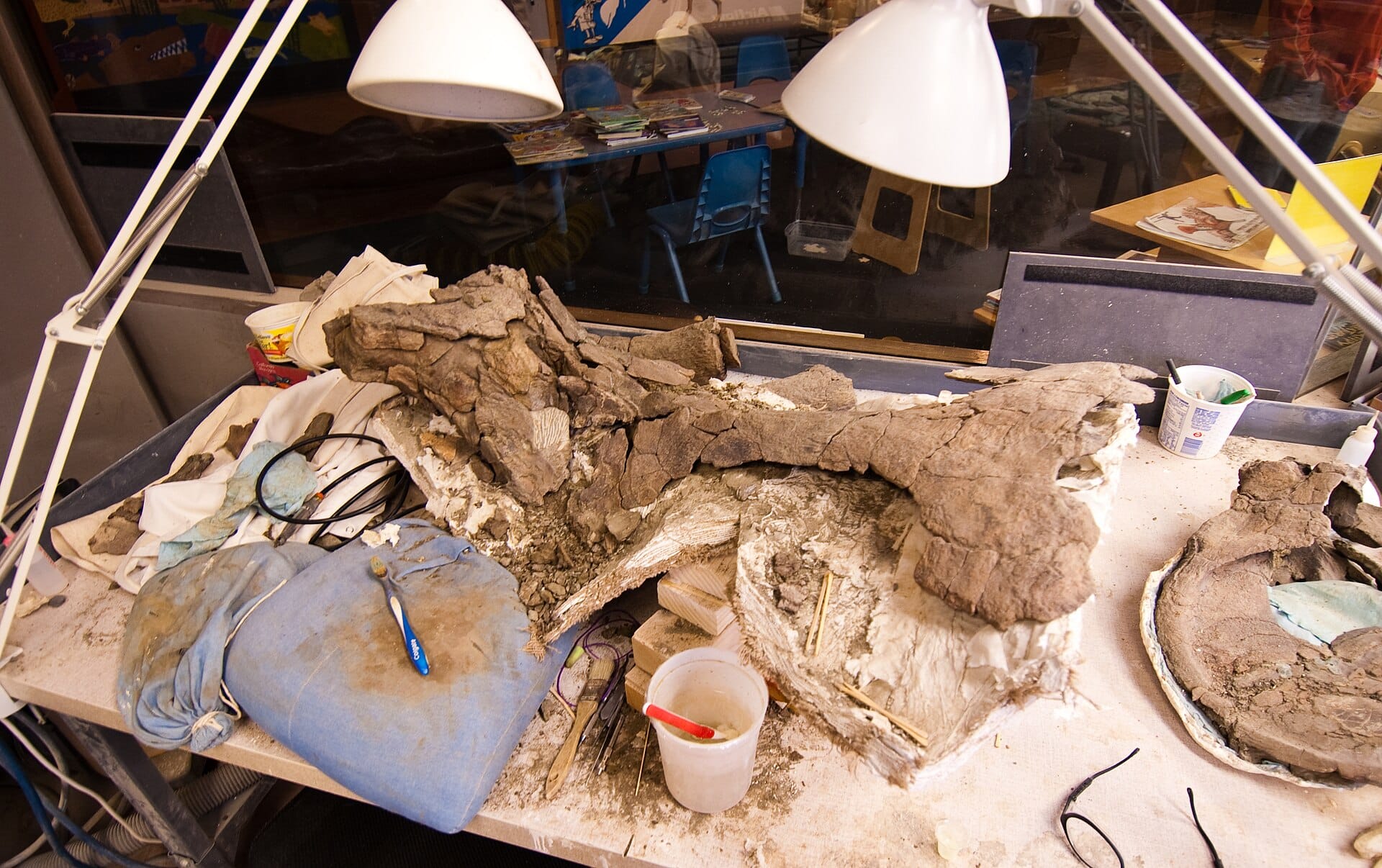

In addition, two referred specimens add to the picture. UMNH VP 19466 is a disarticulated adult skull with parts of the premaxilla, maxilla (upper jaw bone), and nasal (nose bone). Meanwhile, UMNH VP 19469 is an isolated squamosal from the same stratigraphic interval. The museum notes that more specimens turned up later—yet in 2024, Loewen and colleagues still knew the species only from the formation’s middle unit. Today, a reconstructed skull is on display on the museum’s Ceratopsian Wall, while the original fossils are kept in its collections.
Nasutoceratops Size and Description
Short description of Nasutoceratops
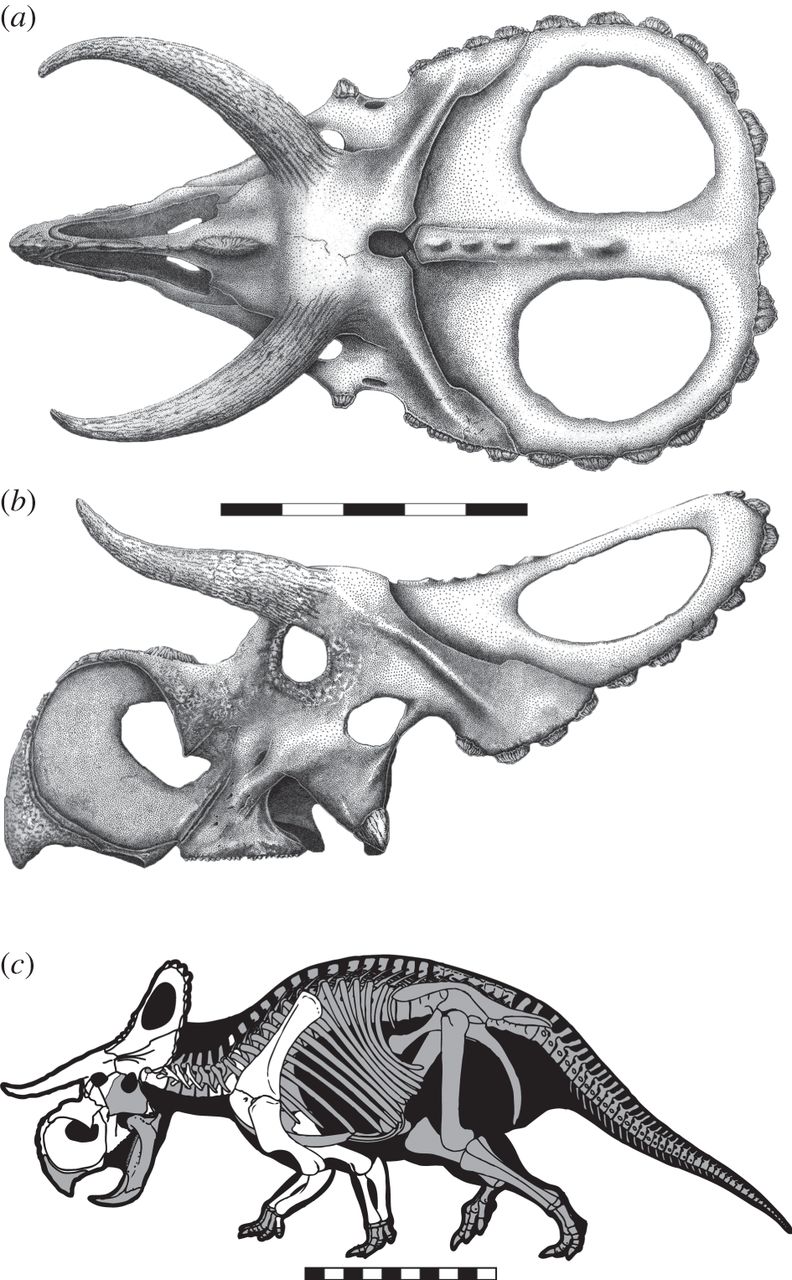
The skull was dominated by a hypertrophied (greatly enlarged) narial region—the nostril area. This region made up about 75 percent of the skull’s length in front of the eyes. In fact, the face in front of the eyes was shorter, relative to the whole skull, than in any other known ceratopsid. Its snout front also swelled upward, giving it what the describers called an “inflated” appearance. Inside the fused nasal bones lay an air-filled cavity, a trait unknown in any other ceratopsid.
Above the nose sat a low, bladelike nasal horn. Far more striking were the brow horns, which curved forward, twisted near their tips, and reached almost to the end of the snout. Between the nose horn and the eyes, the skull roof rose steeply into a pronounced “forehead.” Below the eyes, a very large epijugal—a bony knob on the cheek—jutted from the side of the face.
The frill was subrectangular, broadest in the middle, and pierced by two large oval openings. Unlike the frills of most centrosaurines, its edge carried only small, crescent-shaped bony ornaments with no prominent spikes or hooks. Behind the skull, the record is thinner—the holotype humerus (upper arm bone) measures 475 millimeters (18.7 inches). The museum describes the animal as a four-legged herbivore. However, no source describes its skin or coloring, so any reconstruction of its outer appearance is speculative.

Size and Weight of Type Species
The 2013 paper gives no body length or mass. Instead, it notes that the holotype skull matches the largest skulls of Centrosaurus in size. In addition, fused vertebrae and adult bone texture indicate that this skull belonged to a grown animal.
The Natural History Museum of Utah describes Nasutoceratops as about 15 feet (5 meters) long. Those two numbers do not quite match—15 feet is closer to 4.6 meters, and 5 meters is about 16.4 feet. Neither comes with a stated method.
For weight, both the museum and the Royal Society give about 2.5 metric tons (about 5,500 pounds). Neither figure is a peer-reviewed estimate, and none of these sources gives a height. Until more of the skeleton is described, its body size remains poorly constrained.
The Dinosaur in Detail
Its horns and frill strike an unusual balance. In the holotype, the brow horns span about 40 percent of total skull length. Even so, long brow horns are probably an ancestral feature for centrosaurines, also seen in Diabloceratops and Albertaceratops. In 2018, paleontologist Caleb Brown considered long brow horns the likely primitive condition for the whole family.
In other ways, it is old-fashioned for its age. Although it lived in the late Campanian, it retained a low-set upper tooth row, elongate brow horns, and pronounced epijugals. By contrast, its frill was secondarily simplified, as in Avaceratops, with no notch at the back and only a gentle midline wave. In 2013, its describers compared a long ridge on its squamosal with bones from Arizona and New Mexico—now part of the holotypes of Crittendenceratops and Menefeeceratops. In 2024, however, Loewen and colleagues treated the Nasutoceratops ridge as a form of the rounded ridge seen in other early centrosaurines, distinct from the lower ridge of those southern forms.

Sampson and colleagues read these traits as evidence of an early split within Centrosaurinae. One branch, the Avaceratops–Nasutoceratops clade, kept short nasal horns, elaborated its brow horns, and simplified the frill. Meanwhile, the other branch, leading toward Pachyrhinosaurus, evolved elaborate frills and nasal ornament.
Later studies have broadly kept the pairing. In 2016, Lund and colleagues recovered Avaceratops as its closest relative with both Bayesian and parsimony methods—the former a first for ceratopsians. They also proposed that this short-snouted, long-horned lineage arose in the southern Western Interior Basin. In 2024, the study that named Lokiceratops found Nasutoceratopsini to be a natural group. Its position, however, varies between analyses because of missing data. Taken together, Nasutoceratops looks like a late survivor of an early branch, and among the youngest known members of its clade.
Interesting Points about Nasutoceratops
- Sampson said its oversized nose likely had nothing to do with a keen sense of smell, and its function remains uncertain.
- Its brow horns reach almost to the tip of its snout, making them the longest, both relatively and absolutely, of any known centrosaurine.
- The holotype’s epijugal, a bony cheek knob, is the largest example known among centrosaurines, both relatively and absolutely.
- When it was described in 2013, it was the first late Campanian centrosaurine named from southern Laramidia, and only the second southern centrosaurine after Diabloceratops. Several more have been named since.
Contemporary Dinosaurs
Sharing the Kaiparowits landscape was Kosmoceratops, a chasmosaurine (a member of the other main ceratopsid subfamily). Its describers credited it with “the most ornate skull of any known dinosaur.” Its fossils, dated to about 76 million years ago, span the upper lower and lower middle units. In 2019, a faunal table by paleontologist Jordan Mallon placed both horned dinosaurs in the same lower middle unit.
Adding further diversity was Utahceratops, another chasmosaurine, with an elongate frill and short, rounded brow horns—a sharp contrast to the long horns of Nasutoceratops. Its describers also found it alongside Kosmoceratops in the same units. Later, in 2020, Fowler and Freedman Fowler dated it to about 76.0 to 75.6 million years ago.
Prowling the same formation was Teratophoneus, a tyrannosaurid. One referred specimen comes from about 290 meters (950 feet) up in the Kaiparowits, inside the interval that yielded Nasutoceratops. In 2013, Loewen and colleagues dated the Kaiparowits Teratophoneus to about 76 million years ago. Still, no bite marks or other direct evidence connect the two.
Among the smaller members of the fauna was Talos sampsoni, a gracile (slender) troodontid theropod. Its holotype came from about 260 meters (850 feet) up, within the interval that yielded Nasutoceratops. Lower still, an ash bed 75 meters (246 feet) beneath it gave a date of about 75.95 million years ago.
No fossil yet records a direct encounter between Nasutoceratops and any of these neighbors.
Nasutoceratops in its Natural Habitat
The world Nasutoceratops roamed was a low-relief alluvial plain crossed by rivers and dotted with flood-basin ponds and lakes. In 2022, Ramezani and colleagues described the setting as warm and subhumid. In 2021, by contrast, Titus and colleagues read the climate as humid, tropical to subtropical, and seasonally wet and dry. They added that longer dry spells struck from time to time. The museum adds that it lived in a subtropical swampy environment about 100 kilometers (62 miles) from the seaway. Fossil plants, clams, fishes, amphibians, lizards, turtles, crocodiles, and mammals have also turned up in the monument.
Like other ceratopsids, Nasutoceratops was a herbivore. Its holotype maxilla held 22 tooth positions, while a referred maxilla has 29, and the teeth are typical of centrosaurines. Beyond that, no study has examined its diet in detail, so the plants it favored remain unknown.
No direct evidence shows whether Nasutoceratops lived alone or in herds. However, co-author Mark Loewen suggested that its horns served as visual signals of dominance and, when that failed, as weapons against rivals. On a wider scale, Sampson’s team saw it as strong support for separate northern and southern dinosaur communities on Laramidia. Those communities, they argued, lasted over a million years. Not everyone agrees. In 2017, Ryan and colleagues argued that the wide spread of Nasutoceratopsini, from Utah to Alberta, weakens that idea. That same year, Fowler argued that the hypothesis was affected by earlier miscorrelations of rock ages. In 2022, Ramezani’s team still called it a subject of particular debate.
Frequently Asked Questions
It means “large-nosed horned face,” and the species name titusi honors paleontologist Alan Titus.
It lived in the late Campanian stage of the Late Cretaceous, roughly 76 to 75.5 million years ago.
The museum gives about 15 feet (5 meters) and 2.5 metric tons (about 5,500 pounds), but neither figure is a peer-reviewed estimate.
It was a herbivore like other ceratopsids, although no study has examined its diet in detail.
It was found in the Kaiparowits Formation of Grand Staircase-Escalante National Monument in southern Utah.
Its short, inflated snout held an air-filled nasal cavity unknown in other ceratopsids, and its brow horns are the longest of any centrosaurine.
Sources
The information in this article is based on various sources, drawing on scientific research, fossil evidence, and expert analysis. The aim is to provide a comprehensive and accurate overview of Nasutoceratops. However, please be aware that our understanding of dinosaurs and their world is constantly evolving as new discoveries are made.
- https://doi.org/10.1098/rspb.2013.1186
- https://pmc.ncbi.nlm.nih.gov/articles/PMC3730592/
- https://doi.org/10.1080/02724634.2015.1054936
- https://figshare.com/articles/journal_contribution/3141940
- https://doi.org/10.1371/journal.pone.0154403
- https://doi.org/10.1139/cjes-2016-0110
- https://doi.org/10.1098/rsos.200284
- https://doi.org/10.7717/peerj.4265
- https://doi.org/10.7717/peerj.17224
- https://doi.org/10.1038/s41598-019-51709-5
- https://doi.org/10.1038/s41598-022-19896-w
- https://doi.org/10.1371/journal.pone.0188426
- https://doi.org/10.7717/peerj.9251
- https://doi.org/10.1371/journal.pone.0012292
- https://doi.org/10.1371/journal.pone.0024487
- https://doi.org/10.1371/journal.pone.0079420
- https://doi.org/10.7717/peerj.11013
- https://nhmu.utah.edu/press/big-nosed-long-horned-dinosaur-discovered-utah
- https://nhmu.utah.edu/articles/nhmu-dinosaur-stars-jurassic-world-dominion
- https://royalsociety.org/news/2013/new-horned-dinosaur-nasutoceratops/
- https://globalnews.ca/news/724027/big-nosed-horned-faced-dinosaur-unearthed-in-utah
- https://paleobiodb.org/classic/basicTaxonInfo?taxon_no=273963
This article was last fact checked: TheDinosaurs Team, 03-11-2026
Featured Image Credit: Jens Lallensack, CC BY-SA 4.0, via Wikimedia Commons
