In the countryside of Calvados, Normandy, the pale limestone of the Calcaire de Caen Formation once held the bones of a young predator. Named Dubreuillosaurus valesdunensis, this megalosaurid theropod lived in the middle Bathonian of the Middle Jurassic—about 167 million years ago. Its skull ranks among the most complete theropod skulls known from Europe. The French Ministry of Culture calls the skeleton one of the last surviving witnesses of Normandy’s dinosaurs. The original Poekilopleuron skeleton, found near Caen in the 1830s, was destroyed in the 1944 bombings.
The story began in 1994, when André Dubreuil, then mayor of Conteville, found bones on his own land. Paleontologist Ronan Allain named the species in 2002 and gave it a genus of its own in 2005. Even so, one 2024 study has questioned whether it deserves that genus at all. In November 2026, as the skeleton faced auction, the French state stepped in to buy it. The ministry now describes it as a specimen of considerable scientific and heritage importance.
Dubreuillosaurus Key Facts
| Keyword | Fact |
|---|---|
| Pronunciation | Not specified |
| Meaning of name | Dubreuil’s Lizard |
| Group | Theropoda |
| Type Species | Dubreuillosaurus valesdunensis (originally Poekilopleuron? valesdunensis) |
| Diet | Carnivore |
| When it Lived | Around 167 MYA |
| Period | Jurassic |
| Epoch | Middle Jurassic (Bathonian stage) |
| Length | 9 to 16.4 feet for the juvenile holotype (estimates differ), about 20 feet for adults (National Geographic), 29.5 feet for the species (2026 dataset) |
| Height | Not specified |
| Weight | About 2,000 pounds (2026 dataset estimate for the species) |
| Mobility | Moved on two legs (bipedal) |
| First Discovery | 1994 by André Dubreuil |
| Described by | 2002 by R. Allain (as Poekilopleuron? valesdunensis), genus named by R. Allain in 2005 |
| Holotype | MNHN 1998-13 |
| Location of first find | Calcaire de Caen Formation, Conteville, Calvados, Normandy, France |
Dubreuillosaurus Origins, Taxonomy and Timeline
The name Dubreuillosaurus honors its discoverer, André Dubreuil, joined to -saurus, the familiar Greek-derived ending for “lizard.” Meanwhile, the species name valesdunensis points to Val-ès-Dunes, where William, duke of Normandy, won an 11th-century battle. One half of the name salutes a modern mayor, while the other reaches back almost a thousand years. Together, the name ties a Jurassic predator to a Norman village and a medieval battlefield.
Dubreuillosaurus belongs to Theropoda, the two-legged dinosaur group, and within it to Megalosauroidea. It is usually placed in the family Megalosauridae. Allain originally put the species, with a question mark, in the genus Poekilopleuron as Poekilopleuron? valesdunensis. In 2003, he and Xabier Pereda Suberbiola listed it with Poekilopleuron bucklandii and Streptospondylus among the “megalosaurid spinosauroids” of France’s Middle Jurassic. Two years later, Allain moved it into its own genus, and D. valesdunensis remains the type and only known species. However, one 2024 study has challenged that decision, as later sections show.
Its rocks date to the middle part of the Bathonian stage, which ran from roughly 168.2 to 165.3 million years ago. Within that span, the French Ministry of Culture puts it at about 167 million years ago. At the time, most of Europe lay under shallow seas dotted with numerous smaller and larger islands. That watery setting frames everything else known about this animal.
Discovery & Fossil Evidence
Dubreuil came across the first bones in 1994 during landscaping work at Conteville, about 9 miles (14 kilometers) southeast of Caen. The Ministry of Culture’s announcement, and news reports based on it, place Conteville in the Eure department. Peer-reviewed and museum sources, however, point to Calvados, where the village now belongs to Valambray. Paleontologists of the MNHN, whose team is now part of the CR2P research center, ran the excavations. National Geographic reports a first dig in 1998, followed by four more seasons through 2001.
The holotype—the name-bearing specimen—carries the catalog number MNHN 1998-13, and its centerpiece is a nearly complete skull. Later studies citing Allain’s work discuss the premaxilla (front upper jaw bone), maxilla (main upper tooth-bearing bone) and dentary (lower jaw bone). They also cover the ectopterygoid (a bone of the palate), the tail vertebrae and the femur (thigh bone). Allain and his colleagues spent two years piecing the fragments together, and the Paléospace museum counts 77 pieces in all.
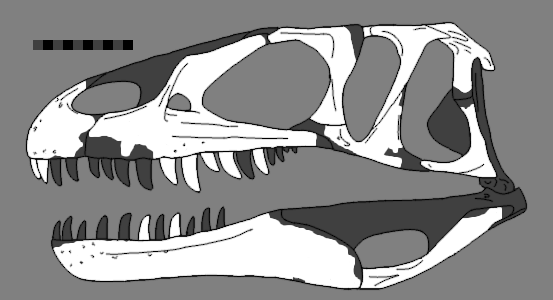

No additional specimens have been confirmed—this skeleton remains the only known representative of its species. At Dubreuil’s wish, the MNHN held it on deposit from 1998, and the Paléospace museum in Villers-sur-Mer displayed it from 2014. After the owner’s death, his heirs set a public sale for 18 November 2026. The auction house Millon was to sell it at Hôtel Drouot in Paris, and scientists protested. In early November, however, the ministry announced a private purchase for the national collections, assigned to the MNHN. Following the deal, Euronews reported on 9 November 2026, the skeleton was withdrawn from the sale. At the Jardin des Plantes, researchers plan CT scanning and a new biomechanical mount. The ministry gave no price, but National Geographic reported a pre-sale estimate of about US$280,000 to $390,000 on 6 November 2026.
Dubreuillosaurus Size and Description
Because the only skeleton belonged to a young animal, scientists have to read its anatomy with growth in mind.
Short description of Dubreuillosaurus
At the snout tip, the premaxilla was slightly longer than high, says a 2025 study citing Allain’s 2002 description. Behind it, the maxilla held a maxillary fossa—a depression shared with other megalosauroids outside the spinosaurids. In 2016, paleontologist Oliver Rauhut and colleagues noted a kink in the front edge of its ascending process, as in Duriavenator. In the lower jaw, the third tooth was enlarged, while the teeth further back grew gradually smaller. A groove also ran along the rear part of the dentary.
Farther back, the braincase and vertebrae had not yet fused. Paleontologist Andrea Cau stressed this sign of youth in 2024. The tail vertebrae bore a small separate spur in front of the neural spine. On the femur, however, the distal extensor groove—a furrow near the knee end—was absent. Like every known theropod, it presumably walked on two legs. Because the sources do not describe skin or feathers, any picture of its body covering is speculative.
Size and Weight of Type Species
The Paléospace museum describes the skeleton as a juvenile theropod about 16.4 feet (5 meters) long—a little longer than a typical family car. However, the museum does not explain how it obtained that figure. National Geographic, by contrast, described the juvenile in 2026 as about 9 feet (2.7 meters) long. It also suggested that adults reached about 20 feet (6 meters).
In a 2026 dataset, Boisvert and colleagues gave the species about 29.5 feet (9 meters) and 2,000 pounds (907 kilograms). Those values rest on earlier estimates and comparisons with related species, and the same file even gives Poekilopleuron identical numbers.
In short, the museum’s figure describes the juvenile skeleton, while the dataset’s figure is a species value whose basis is not stated. Height at the hips has not been reported. Without more fossils, any adult size remains an educated guess built on comparison.
The Dinosaur in Detail
One of the most distinctive features of Dubreuillosaurus sits in its palate. In 2002, Allain proposed an autapomorphy—a trait unique to one species—on the ectopterygoid. It is a stout process projecting forward and down from the jugal ramus, the arm reaching toward the cheek. In 2019, however, Rauhut and Diego Pol reported the same process in Asfaltovenator. Its tail spur and dentary groove also served as reference points when Rauhut’s team described the German megalosaurid Wiehenvenator in 2016.
Its place within the family has shifted too. As later authors report, Matthew Carrano, Roger Benson and Scott Sampson placed it in 2012 within Afrovenatorinae, with Afrovenator, Magnosaurus, Leshansaurus and Piveteausaurus. Four years later, Rauhut and colleagues recovered it as the sister of Magnosaurus. They called the wider clade Eustreptospondylinae, a name they argued has priority over Afrovenatorinae. In contrast, Lacerda and colleagues did not recover Megalosauridae at all in 2023. Their clade uniting Megalosaurus and Torvosaurus left Dubreuillosaurus outside.
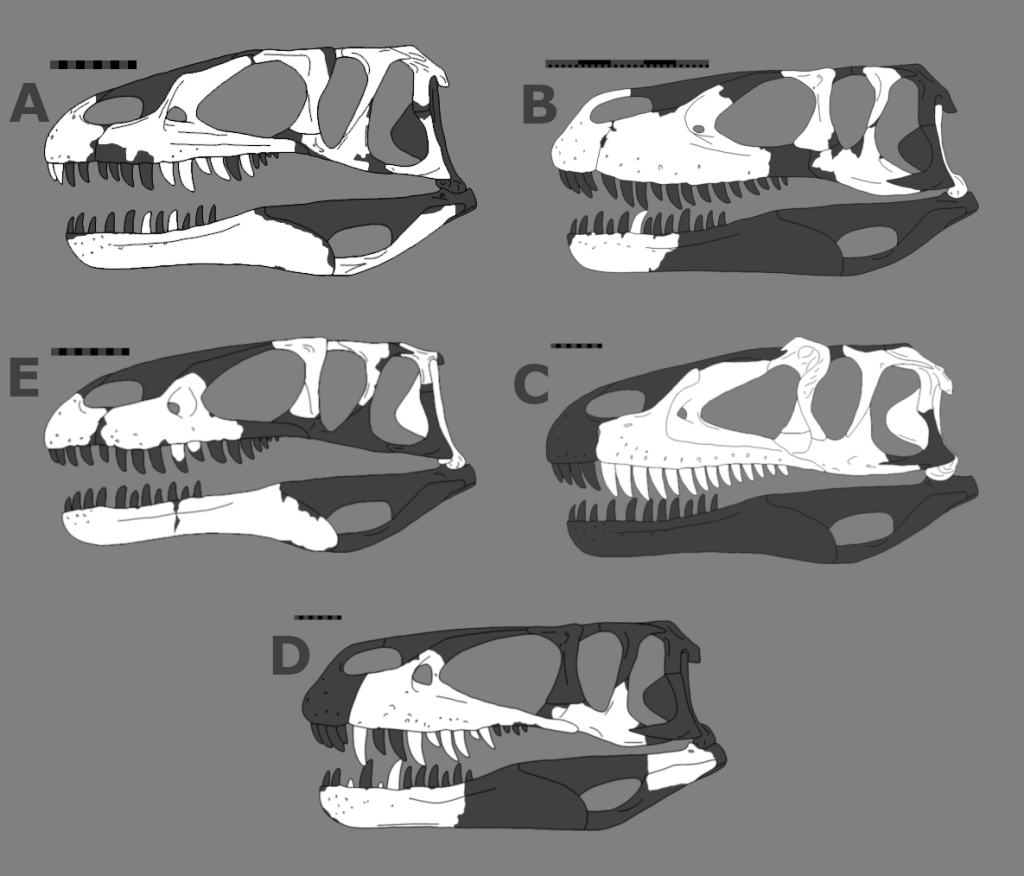

The sharpest question is whether the genus stands. Allain based his 2005 split from Poekilopleuron on new bones from behind the skull, as later sources report. In 2024, however, Cau called the genus a junior synonym of Poekilopleuron—the unfused braincase and vertebrae, he noted, mark a juvenile. He put the remaining differences—in the tail ribs, the accessory spur and the zygapophyses (vertebral joints)—down to individual variation and position along the spine. He also placed both in the same unit and locality, although they were found at Conteville and La Maladrerie. Still, analyses before and since, such as Rauhut’s team in 2016 and Boisvert’s in 2026, keep them as separate genera.
Taken together, these studies leave a young megalosauroid whose identity hangs on a few bones—and on how much a juvenile might change.
Interesting Points about Dubreuillosaurus
- The species name valesdunensis recalls Val-ès-Dunes, where William, duke of Normandy, won an 11th-century battle.
- Its finder, André Dubreuil, was mayor of Conteville when he found the bones on his land in 1994.
- The original skeleton of Poekilopleuron, kept in Caen, was destroyed in the 1944 bombings.
- According to National Geographic, museum teams gathered more than 2,000 fossil fragments during digs between 1998 and 2001.
- In November 2026, the French state agreed to buy the skeleton for the MNHN, and it was withdrawn from the auction planned for 18 November.
Dinosaurs from the Same Formation
Also known from the Calcaire de Caen Formation (exact level relative to Dubreuillosaurus not known): Poekilopleuron bucklandii. This megalosaurid turned up in 1835 in the quarries of La Maladrerie near Caen. One 2024 study argues that it is the same genus as Dubreuillosaurus. Its original skeleton was lost in 1944, so Allain and Daniel Chure redescribed it in 2002 from surviving casts and its first describer’s monograph. The formation is 20 to 25 meters (66 to 82 feet) thick and assigned entirely to the middle Bathonian. However, no published bed correlation ties the two finds, so they may not have lived at exactly the same time.
Dubreuillosaurus in its Natural Habitat
The world Dubreuillosaurus knew was one of warm, shallow seas and scattered islands. During the middle Bathonian, the Calcaire de Caen built up as platform sediment—limestone laid down on a broad, shallow sea floor. The formation is famous for its vertebrates, from crocodilians and dinosaurs to ichthyosaurs and fish. Driftwood is common, while invertebrates are scarce. Like other Middle Jurassic theropods from England and France, it comes from marine deposits. Rauhut’s team interpreted such animals as island dwellers.
As a carnivore, it belonged to Megalosauroidea, which a 2026 study lists among the obligate faunivorous—strictly animal-eating—clades of large theropods. Citing Allain’s 2005 study, Boisvert and colleagues note that fish remains were reported with Dubreuillosaurus, as with Poekilopleuron. Allain suggested that these finds point to fish-eating being primitive for megalosauroids, an idea Boisvert’s team repeats. Rauhut and colleagues also found megalosauroids more common in nearshore settings than allosauroids, which favored inland areas. However, they cautioned that this pattern may partly reflect geographic bias in the European record.
While there is no direct evidence of whether it lived alone or in groups, a single juvenile skeleton cannot settle the question. The same formation has also yielded teleosauroids—marine crocodile relatives—such as Teleosaurus cadomensis, found at Allemagne, south of Caen. Fish remains reported with the skeleton hint at a life near the coast, though this remains speculative. Long afterward, the Pierre de Caen quarried from this formation became a renowned building stone far beyond the region.
Frequently Asked Questions
It honors finder André Dubreuil, and the species name valesdunensis refers to Val-ès-Dunes in Normandy.
It lived in the middle Bathonian stage of the Middle Jurassic, around 167 million years ago.
Estimates vary. Sources give the juvenile 9 to 16.4 feet, while a 2026 dataset assigns the species 29.5 feet and 2,000 pounds.
It was a carnivore, and later authors note fish remains reported with the skeleton.
André Dubreuil found its only skeleton in 1994 at Conteville, Calvados, in the Calcaire de Caen Formation of Normandy, France.
It has one of Europe’s most complete theropod skulls, though a 2024 study considers it the same genus as Poekilopleuron.
Sources
The information in this article is based on various sources, drawing on scientific research, fossil evidence, and expert analysis. The aim is to provide a comprehensive and accurate overview of Dubreuillosaurus. However, please be aware that our understanding of dinosaurs and their world is constantly evolving as new discoveries are made.
- https://doi.org/10.1671/0272-4634(2002)022[0548:DOMDTI]2.0.CO;2
- https://doi.org/10.1671/0272-4634(2005)025[0850:TPAOTM]2.0.CO;2
- https://doi.org/10.1016/S1631-0683(03)00002-2
- https://sciencepress.mnhn.fr/sites/default/files/articles/xml/comptes-rendus-palevol2003v2f1a04.xml
- https://palaeo-electronica.org/content/pdfs/654.pdf
- https://doi.org/10.1038/s41598-019-53672-7
- https://doi.org/10.1098/rsos.230481
- https://doi.org/10.4435/BSPI.2024.08
- https://www.paleoitalia.it/wp-content/uploads/2024/05/01_Cau_2024_BSPI_631.pdf
- https://doi.org/10.7717/peerj.21007
- https://doi.org/10.1371/journal.pone.0088905
- https://pmc.ncbi.nlm.nih.gov/articles/PMC11971988/
- https://doi.org/10.7717/peerj.9808
- https://www.palass.org/publications/palaeontology-journal/archive/45/6/article_pp1107-1121
- https://stratigraphy.org/ICSchart/ChronostratChart2024-12.pdf
- https://www.donnees.normandie.developpement-durable.gouv.fr/pdf/GEOL/BNO-0336f.pdf
- https://paleospace-villers.fr/wp-content/uploads/2024/08/dossier_de_presse.pdf
- https://paleospace-villers.fr/wp-content/uploads/2024/05/une-vertebre-de-theropode.pdf
- https://www.culture.gouv.fr/presse/communiques-de-presse/un-dinosaure-francais-d-exception-le-dubreuillosaurus-valesdunensis-rejoint-prochainement-les-collections-nationales
- https://www.nationalgeographic.com/newsletters/article/stones-bones-french-auction-dubreuillosaurus
- https://euronews.com/2026/11/09/paris-natural-history-museum-acquires-167-million-year-old-carnivorous-dinosaur-skeleton
- https://paleobiodb.org/data1.2/occs/list.json?base_name=Dubreuillosaurus&show=strat,loc
This article was last fact checked: TheDinosaurs Team, 16-11-2026
Featured Image Credit: Nobu Tamura, CC BY 3.0, via Wikimedia Commons
