
Eight miles east of the Iren Dabasu telegraph station in Inner Mongolia lie the sandstones and clays of the Iren Dabasu Formation. There, collectors found an ornithomimosaur—one of the theropods often called ostrich dinosaurs. First named Ornithomimus asiaticus in 1933, it received its own genus, Archaeornithomimus, in 1972. It lived during the Late Cretaceous, although researchers still argue over the exact stage. Even so, its backbone was the first in its group to have its air spaces mapped in detail by CT scans.
Peter Kaisen collected the two cotypes in 1923, working for the American Museum of Natural History’s Central Asiatic Expeditions, then called the Third Asiatic Expedition. A decade later, Charles W. Gilmore described the species from nearly every bone but the skull, and Dale A. Russell later gave it a genus of its own. More than a century after its discovery, a skeleton without a skull still has plenty to say.
Archaeornithomimus Key Facts
| Keyword | Fact |
|---|---|
| Pronunciation | Not specified |
| Meaning of name | Ancient Ornithomimus |
| Group | Ornithomimosauria (usually placed in Ornithomimidae) |
| Type Species | Archaeornithomimus asiaticus |
| Diet | Not specified |
| When it Lived | Not specified (age disputed) |
| Period | Cretaceous |
| Epoch | Late Cretaceous (Campanian–Maastrichtian stages, debated) |
| Length | About 11.2 feet (3.4 meters), per T.R. Holtz Jr. |
| Height | Not specified |
| Weight | About 416 pounds (189 kilograms), 2014 estimate |
| Mobility | Moved on two legs (bipedal) |
| First Discovery | Cotypes collected 1923 by Peter Kaisen, AMNH Central Asiatic Expeditions (then the Third Asiatic Expedition) |
| Described by | 1933 by C.W. Gilmore, as Ornithomimus asiaticus, and genus named 1972 by D.A. Russell |
| Holotype | None named by Gilmore, cotypes AMNH 6565 and AMNH 6569 |
| Location of first find | Eight miles east of Iren Dabasu telegraph station, Iren Dabasu Formation, Inner Mongolia, China |
Archaeornithomimus Origins, Taxonomy and Timeline
Paleontologist T.R. Holtz Jr. renders the name as “ancient Ornithomimus,” a nod to the American genus in which Gilmore first placed the species. Gilmore coined asiaticus in 1933, judging that minor differences, “coupled with the distant geographical occurrence,” justified a new species.
Gilmore’s Ornithomimidae was a broad family—he even placed Oviraptor in it alongside his new species. In 1972, Russell defined Ornithomimidae on three Alberta genera and put Archaeornithomimus in a “more primitive” ornithomimoid group with the Late Jurassic Elaphrosaurus. That grouping has lapsed, since Elaphrosaurus is now considered a ceratosaur, and later studies usually place Archaeornithomimus within Ornithomimidae. Russell also referred remains from Maryland’s Arundel Formation to the genus as “A.” affinis, citing a curved toe claw. However, Smith and Galton judged them indeterminate in 1990. In 2025, Averianov and Sues made the doubtful A. bissektensis from Uzbekistan the type of the new genus Dzharacursor. Today the genus generally holds only A. asiaticus.
Gilmore argued that the Iren Dabasu beds were Upper Cretaceous, against earlier workers who had called them Lower Cretaceous. Since then, some workers have read primitive hadrosaurs as Cenomanian–Turonian and derived theropods as Coniacian–Santonian. In 2005, Van Itterbeeck and colleagues used charophytes (stoneworts) and ostracods (tiny seed shrimp) to argue for a Campanian–Maastrichtian age. A possible match with Mongolia’s Nemegt Formation could narrow that to the latest Campanian–Early Maastrichtian. In 2012, however, Averianov and Sues argued from vertebrate fossils for a Santonian age, as Funston and colleagues report, while Holtz gives 99.6 to 85.8 million years ago. Russell’s abstract even called the genus “early Cretaceous,” although it then also held the Maryland species.
Discovery & Fossil Evidence
The first dinosaur finds at Iren Dabasu came in 1922, making it, in Van Itterbeeck’s words, “the first known dinosaur locality in Central Asia.” Most of the expedition’s dinosaurs there came from two quarries 7 and 8 miles (11 and 13 kilometers) east of the telegraph station. There, Gilmore wrote, many individuals lay “intermingled in much confusion.” The ornithomimid material came from several localities, including the “Kaisen Quarry” and the “Johnson Quarry.”
Gilmore never named a single holotype—the name-bearing specimen of a species. Instead, he chose two cotypes, both in New York. AMNH 6565 is most of a hind foot, with metatarsals II–IV (the long foot bones), one toe bone, and two small ankle bones. AMNH 6569 is a nearly complete hand with the radius, ulna, metacarpals I–III (palm bones), and several finger bones.
Gilmore also listed six humeri, three ulnae, three radii, three femora, eight tibiae, and one fibula, although none of the leg bones clearly belonged to one limb. The skull was unknown.
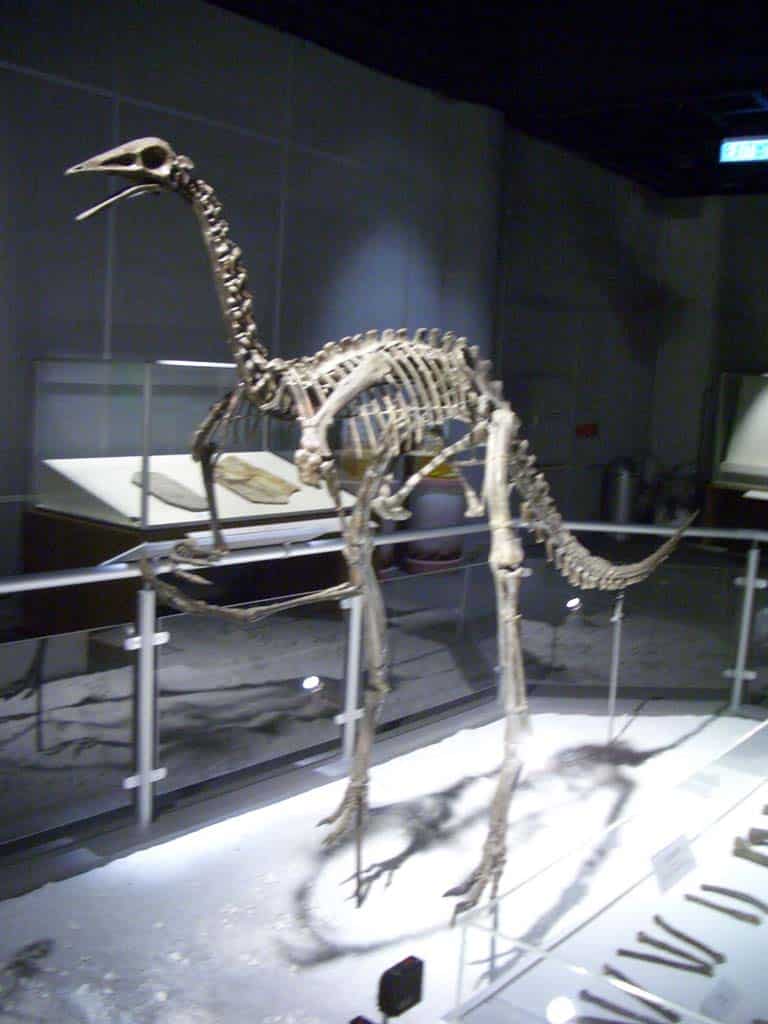

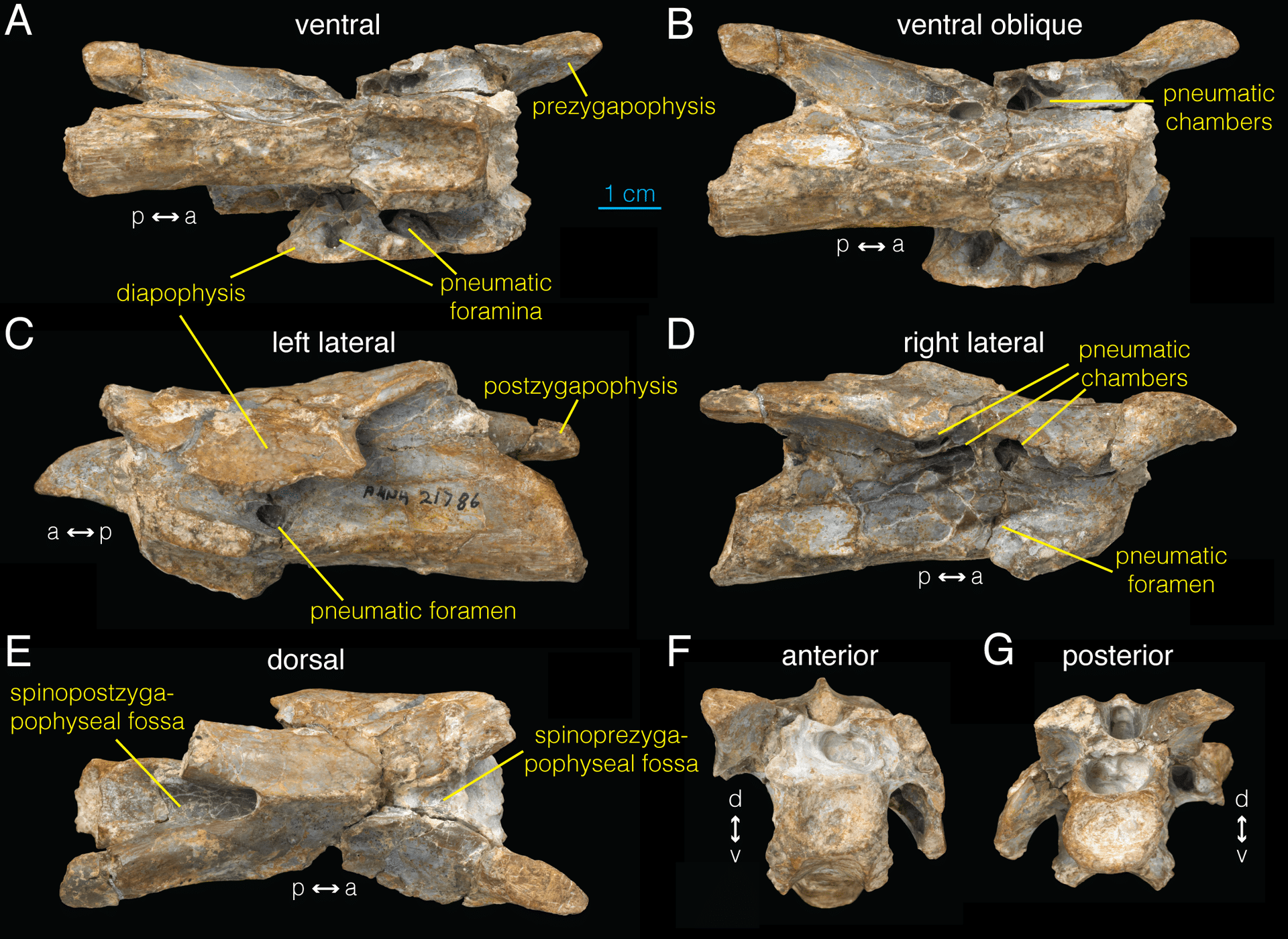
In 2003, Kobayashi and Lü, citing Smith and Galton, described the genus as based on disarticulated skeletons with partly articulated vertebral series. Later, Watanabe and colleagues CT-scanned vertebrae from several individuals in nearby quarries, re-preparing crudely prepared areas. Even so, they called the genus “known from an abundance of relatively intact, three-dimensionally preserved fossil specimens.”
Archaeornithomimus Size and Description
The skull is missing, but the rest of the skeleton sketches the animal from neck to toe.
Short description of Archaeornithomimus
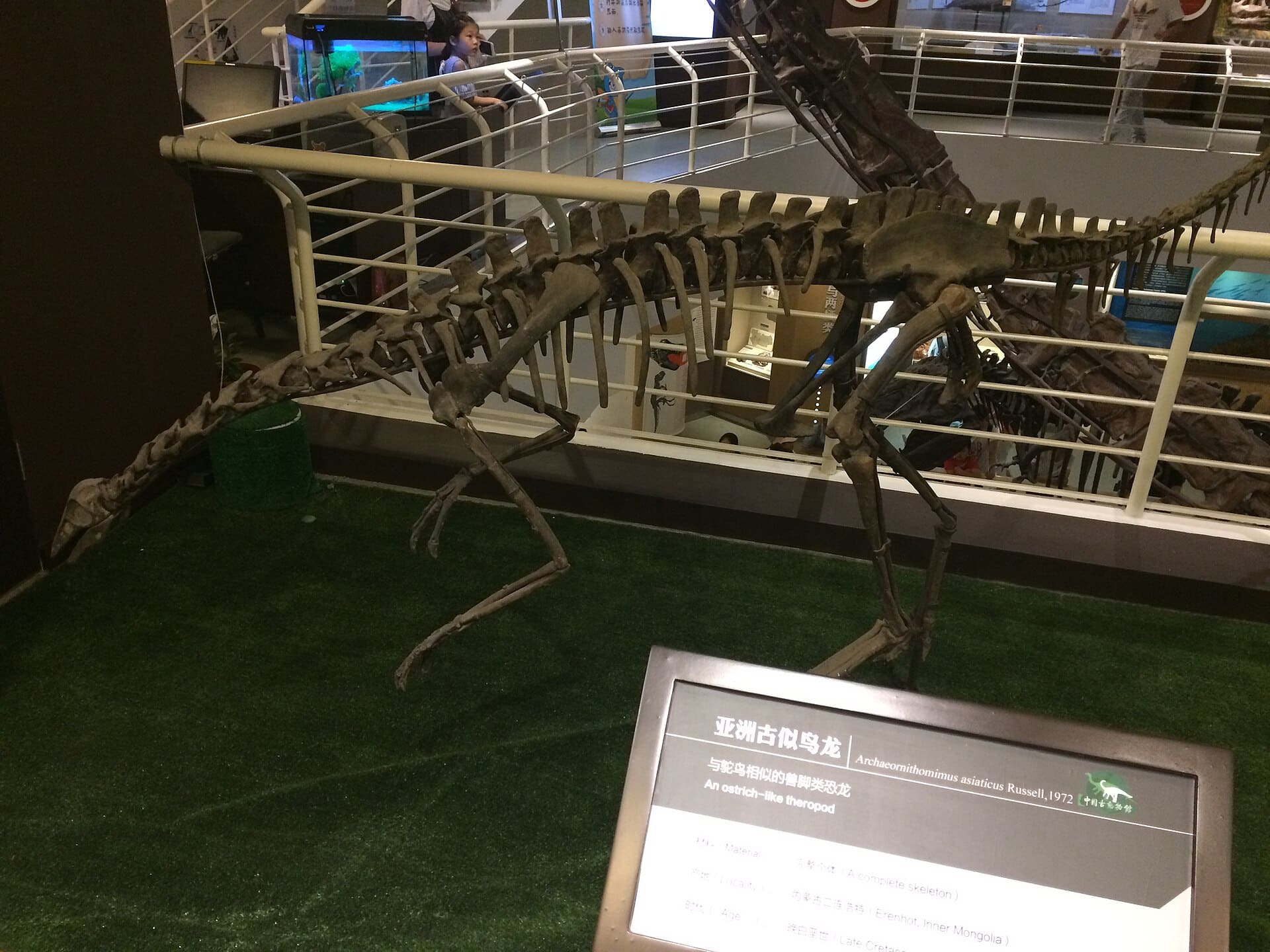
In the neck, the cervical ribs were free rather than fused. Gilmore used this trait to separate the species, although he admitted it might only reflect age. A CT-scanned neck vertebra is highly pneumatic—hollowed by air-filled chambers. The front dorsal (back) vertebrae carry air spaces in their neural arches, the bony arches over the spinal cord. Their centra (vertebral bodies), however, are spongy bone with no sign of pneumaticity. Four fused vertebrae form the sacrum, 245 millimeters (9.6 inches) long, yet the pelvic bones remained unfused.
An associated forelimb, AMNH 6566, has a humerus of 275 millimeters (10.8 inches) and an ulna of 221 millimeters (8.7 inches). In the hand, metacarpal I diverged toward its tip and was slightly shorter than the other two. At the ankle, just two flat distal tarsals capped the metatarsals, where a larger Ornithomimus altus had three. Like other ornithomimids, it walked on its hind legs.

Size and Weight of Type Species
Published size figures are scarce. Holtz lists a length of about 11.2 feet (3.4 meters) without giving a method. We found no published hip height, so the limb bones are the best guide. Femora run from 300 to 400 millimeters (11.8 to 15.7 inches) and tibiae from 305 to 440 millimeters (12.0 to 17.3 inches).
In 2014, Roger Benson and colleagues estimated a body mass of about 416 pounds (189 kilograms). That figure is indirect—it scales mass from limb robustness. Its input, however, is a measured femur, AMNH 6570, 402 millimeters (15.8 inches) long and 148 millimeters (5.8 inches) around.
Gilmore gave no size estimate, comparing the bones instead with Ornithomimus altus, then filed under the subgenus Struthiomimus. The hand is “little more than half the size” of the American animal’s, which Gilmore read as immaturity. Still, he concluded that the species “apparently never reached the stature of O. altus.”
The Dinosaur in Detail
What sets this dinosaur apart is the air inside its backbone. In 1933, Gilmore noticed that the vertebral centra had very thin walls and large internal chambers—”extreme pneumaticity,” in his words. CT scans told a subtler story in 2015, when Watanabe and colleagues found only “limited pneumatic invasion” into the neural arches of some front tail vertebrae. The sacrals and distal tail vertebrae are apneumatic—without air spaces. Still, that was the first evidence of tail pneumaticity in any ornithomimosaur other than Deinocheirus.
The scanned vertebrae also suggest what the team called “an apparent pneumatic hiatus”—a gap between the air-filled back and tail vertebrae. Its exact length, they noted, “cannot be determined,” and the series mixes bones from several individuals. Even so, the team argued that it refutes the idea that such gaps never occur in non-avian theropods. Apart from the tail, they read its pattern as plesiomorphic—an inherited ancestral state.

Kobayashi and Lü found that its hand shares near-equal first and second metacarpals and hinge-like joints with Sinornithomimus. Both they and Watanabe’s team treat the foot as arctometatarsalian—with the middle metatarsal pinched between its neighbors. In 2023, Hattori and colleagues also noted that its cnemial crest (the ridge at the front of the shin) rises above the rear condyles.
Its family placement is less settled. In 2003, Kobayashi and Lü recovered it as a basal ornithomimid, less derived than Sinornithomimus. Makovicky and colleagues later found it in a polytomy—an unresolved branching—with other ornithomimids. In 2017, the study that named Aepyornithomimus paired it with a Bissekty ornithomimid, but that pair sat in a polytomy with the deinocheirids and more derived ornithomimids. Then, in 2025, Averianov and Sues placed it at the very base of Ornithomimidae, below Dzharacursor. For now, it remains an early ornithomimid without a fixed branch.
Interesting Points about Archaeornithomimus
- Holtz renders the name as “ancient Ornithomimus,” after the genus Gilmore first used.
- Gilmore never designated a holotype, instead naming two cotypes, a partial hind foot and a nearly complete hand.
- Its fossils come from “the first known dinosaur locality in Central Asia,” first worked in 1922.
- In 2015, its tail vertebrae gave the first evidence of tail pneumaticity in any ornithomimosaur other than Deinocheirus.
Contemporary Dinosaurs
Sharing the same bone deposit was Bactrosaurus, a hadrosauroid—part of the lineage that includes the duck-billed hadrosaurs. Gilmore named it in the same 1933 monograph as a lambeosaurine, though Van Itterbeeck and colleagues later called it a non-hadrosaurid hadrosauroid. A plate caption records that the type of Bactrosaurus johnsoni and cotypes of Ornithomimus asiaticus came from the Johnson Quarry. Gilmore’s text places the hand cotype in the Kaisen Quarry, though, so the deposit holds at least one cotype. Gilmore also described juvenile hadrosaur bones from the same deposit, which he took to be young Bactrosaurus. Coming from one deposit, the two shared a landscape and an age. No evidence records how they interacted.
Archaeornithomimus in its Natural Habitat
A braided river crossed the world Archaeornithomimus roamed. Its broad, vegetated floodplain was “populated by a diverse dinosaur fauna,” as Van Itterbeeck and colleagues put it. Calcisols—lime-rich soils—point to a semi-arid climate with annual rainfall limited to about 30 inches (760 millimeters). According to Funston and colleagues, plesiosaurs and hybodont sharks indicate “a river system with a marine connection.” One red sandy clay bed held “numberless fragments of egg-shells,” and eggs in nests have also been found.
No study has described its own diet directly. In 1972, Russell suggested that ornithomimids “probably subsisted on small, soft-bodied animals.” Later finds point elsewhere. Kobayashi and Lü noted gastrolith masses—stomach stones—in its relative Sinornithomimus, which they called “probably an herbivorous dinosaur.” Hattori and colleagues likewise say ornithomimosaurs “often exhibit features indicative of herbivory.” Russell also judged them “extremely fleet,” though lacking the agility of modern large ground birds. How closely Archaeornithomimus followed these family patterns is unknown.
Other dinosaurs from the formation come from different quarries. About a kilometer from the Bactrosaurus site lay the hadrosauroid Gilmoreosaurus, in what Prieto-Márquez and Norell call “the same Iren Dabasu strata.” The tyrannosauroid Alectrosaurus turned up 200 yards (180 meters) south of the telegraph-station camp. The formation also yielded the giant oviraptorosaur Gigantoraptor, at about 3,100 pounds (1,400 kilograms). Finds there also include an avimimid bonebed, a nodosaurid (an armored dinosaur), and foot bones of a large carnivore.
While there is no direct evidence of how Archaeornithomimus behaved, Gilmore’s collection held individuals ranging from young to adult.
Frequently Asked Questions
Holtz renders it as “ancient Ornithomimus,” after the genus Gilmore first used.
It lived in the Late Cretaceous, but estimates of the exact stage run from the Cenomanian to the Maastrichtian.
Holtz lists a length of about 11.2 feet. A 2014 study estimated about 416 pounds from a measured thigh bone.
It was an ornithomimosaur, usually placed in Ornithomimidae, although its exact position is unstable.
Its own diet is unknown. Russell thought ornithomimids ate small animals, but gastroliths in close relatives suggest some ate plants.
Its type fossils come from the Iren Dabasu Formation, eight miles east of the Iren Dabasu telegraph station in Inner Mongolia, China.
Sources
The information in this article is based on various sources, drawing on scientific research, fossil evidence, and expert analysis. The aim is to provide a comprehensive and accurate overview of Archaeornithomimus. However, please be aware that our understanding of dinosaurs and their world is constantly evolving as new discoveries are made.
- https://digitallibrary.amnh.org/items/3a3cb337-56fc-4c67-abaa-ae1ecb7f69ce
- https://doi.org/10.1139/e72-031
- https://doi.org/10.1371/journal.pone.0145168
- https://www.app.pan.pl/archive/published/app48/app48-235.pdf
- https://doi.org/10.1038/s41598-017-05272-6
- https://doi.org/10.1371/journal.pbio.1001853
- https://doi.org/10.1038/s41598-023-40804-3
- https://doi.org/10.1080/02724634.2024.2433759
- https://doi.org/10.7717/peerj.3110
- https://doi.org/10.11646/zootaxa.5448.1.4
- https://doi.org/10.1016/j.cretres.2005.03.004
- https://doi.org/10.1038/s41598-019-55038-5
- https://digitallibrary.amnh.org/items/ad60ee42-08a4-47ce-9f49-e62ba5b8ea64
- https://doi.org/10.1038/nature05849
- https://www.geol.umd.edu/~tholtz/dinoappendix/HoltzappendixWinter2011.pdf
- https://paleobiodb.org/data1.2/taxa/list.json?name=Archaeornithomimus
- https://data.library.amnh.org/archives/agents/amnhc_2000167
This article was last fact checked: TheDinosaurs Team, 13-11-2026
Featured Image Credit: Audrey.m.horn, CC BY-SA 4.0, via Wikimedia Commons
