
Near El Rosario in Baja California, Mexico, river-laid rocks of the La Bocana Roja Formation gave up the first carnivorous dinosaur described from Mexico. Named Labocania anomala in 1974, this large-bodied theropod usually sits in the Campanian stage of the Late Cretaceous—though even that age is now disputed. Only a scattering of skull and skeleton fragments survives. Yet experts have read those bones as a tyrannosaur, a carcharodontosaur, and a theropod of no settled family.
According to the Paleobiology Database, collector H. Garbani picked the bones up from the surface in 1970 or 1971. The find came from Los Angeles County Museum and Occidental College expeditions that prospected around El Rosario in the 1960s and 1970s. Paleontologist Ralph Molnar described the animal alone in 1974, but later accounts differ on how far he committed. Most say he left it as Theropoda incertae sedis (“of uncertain placement”), while one says he suggested tyrannosaurid ties. Half a century later, paleontologists Héctor Rivera-Sylva and Nicholas Longrich restudied the type material firsthand and named a second species. Other studies have since backed parts of their verdict and rejected others.
Labocania Key Facts
| Keyword | Fact |
|---|---|
| Pronunciation | Not specified |
| Meaning of name | Not specified |
| Group | Theropoda |
| Type Species | Labocania anomala |
| Diet | Carnivore |
| When it Lived | Around 76 MYA or older, or possibly c. 76–72 MYA (age disputed) |
| Period | Cretaceous |
| Epoch | Late Cretaceous (Campanian stage, or Turonian stage in a 2022 study) |
| Length | Not specified |
| Height | Not specified |
| Weight | Not specified |
| Mobility | Not specified |
| First Discovery | 1970 to 1971 by H. Garbani |
| Described by | 1974 by R.E. Molnar |
| Holotype | IGM 5307 (formerly LACM 20877) |
| Location of first find | Arroyo del Rosario, near El Rosario, La Bocana Roja Formation (disputed), Baja California, Mexico |
Labocania Origins, Taxonomy and Timeline
We could not consult Molnar’s 1974 paper, and none of the later studies we checked explains Labocania or anomala, so we leave the meaning unstated.
Classification is harder still. In 2004, paleontologist Thomas Holtz Jr. noted that its tyrannosaur-like traits also occur in other coelurosaurs, a group including birds. He judged even its broad placement uncertain—abelisaurid, coelurosaur, or something else. In 2024, Rivera-Sylva and Longrich ran a 517-character analysis that, in their words, “strongly supported” it as a tyrannosaurid. Forcing it into allosauroids or ceratosaurs cost 14–15 extra steps, but the paper reports no other support measures. They placed it in Teratophoneini, a tribe of southern tyrannosaurs that also holds Bistahieversor and Teratophoneus. In contrast, a 2024 tree by paleontologist Andrea Cau placed it beside Shaochilong in Carcharodontosauridae, the family of Carcharodontosaurus and Giganotosaurus.
Its age is just as contested, although most reviews placed it in the early to middle Campanian. Ash beds in the overlying El Gallo Formation—dated by Renne and colleagues in 1991 and recalibrated in 2014—suggest a minimum age of about 75.84 million years.
However, in 2022, geologist Ian Kane and colleagues argued for a Turonian age. Their detrital zircons—tiny mineral grains washed in from older rocks—gave a maximum age of 93.6 million years. They also dated the Punta Baja Formation, a submarine-canyon fill cut into the La Bocana Roja, to the Coniacian. That date rests on zircons of 87.1 to 84.9 million years and on dinoflagellate microfossils. In 2024, Rivera-Sylva and Longrich replied that zircons give only a maximum age. Bivalves and ammonites from the canyon fill suggest a late middle Campanian age, they noted, and the dinosaurs a mid- or late Campanian one. The bones, they added, might even have been assigned to the wrong formation. Even so, they concede its age remains uncertain.
Discovery & Fossil Evidence
The holotype comes from LACM locality 7257, beside a dirt road running from El Rosario toward Punta Baja. The Paleobiology Database records a surface find in mudstone, collected as loose “float.” However, museum records conflict. LACM notes say an older site, 6755, was merged into this locality, and that site is recorded as El Gallo Formation, El Disecado Member. If the bones came from there, Rivera-Sylva and Longrich noted, the animal would be roughly 75.84 to 71.9 million years old.
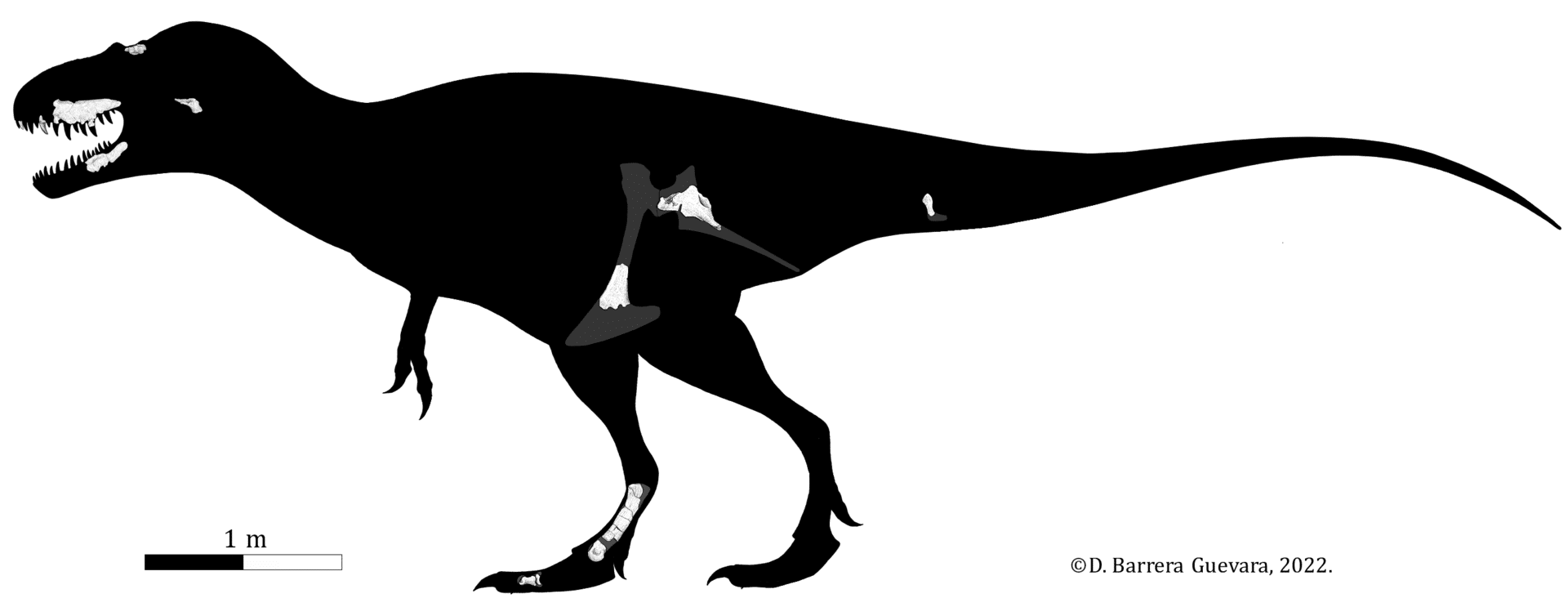

Today the Instituto de Geología of UNAM in Mexico City holds the holotype, IGM 5307, once numbered LACM 20877. Holtz’s 2004 list starts with a frontal (skull-roof bone) and a quadrate (the bone forming the jaw joint). Next come an incomplete maxilla (upper jaw bone) and dentary (lower jaw bone). Behind the head are a hemal process, part of the ischium (a hip bone), and metatarsal II (a foot bone). Paleontologists Brandon Peecook and Christian Sidor also listed parts of the pubis in 2015, all from a single individual. Later, the 2024 restudy reinterpreted the supposed dentary as part of the maxilla.
In 2024, Rivera-Sylva and Longrich named a second species, Labocania aguillonae, from the upper Cerro del Pueblo Formation of Coahuila. They also tentatively referred a partial dentary and isolated teeth to the species. None of these overlap with the holotype, CPC 2974, and they come from larger individuals. In 2025, paleontologist Jared Voris and colleagues declared L. aguillonae a nomen dubium, or “doubtful name.” By their reading, its holotype lacks features that set it apart from other southern tyrannosaurids. No one has confirmed further specimens of L. anomala.
Labocania Size and Description
With so few bones, any portrait of Labocania rests on comparisons with better-known relatives.
Short description of Labocania
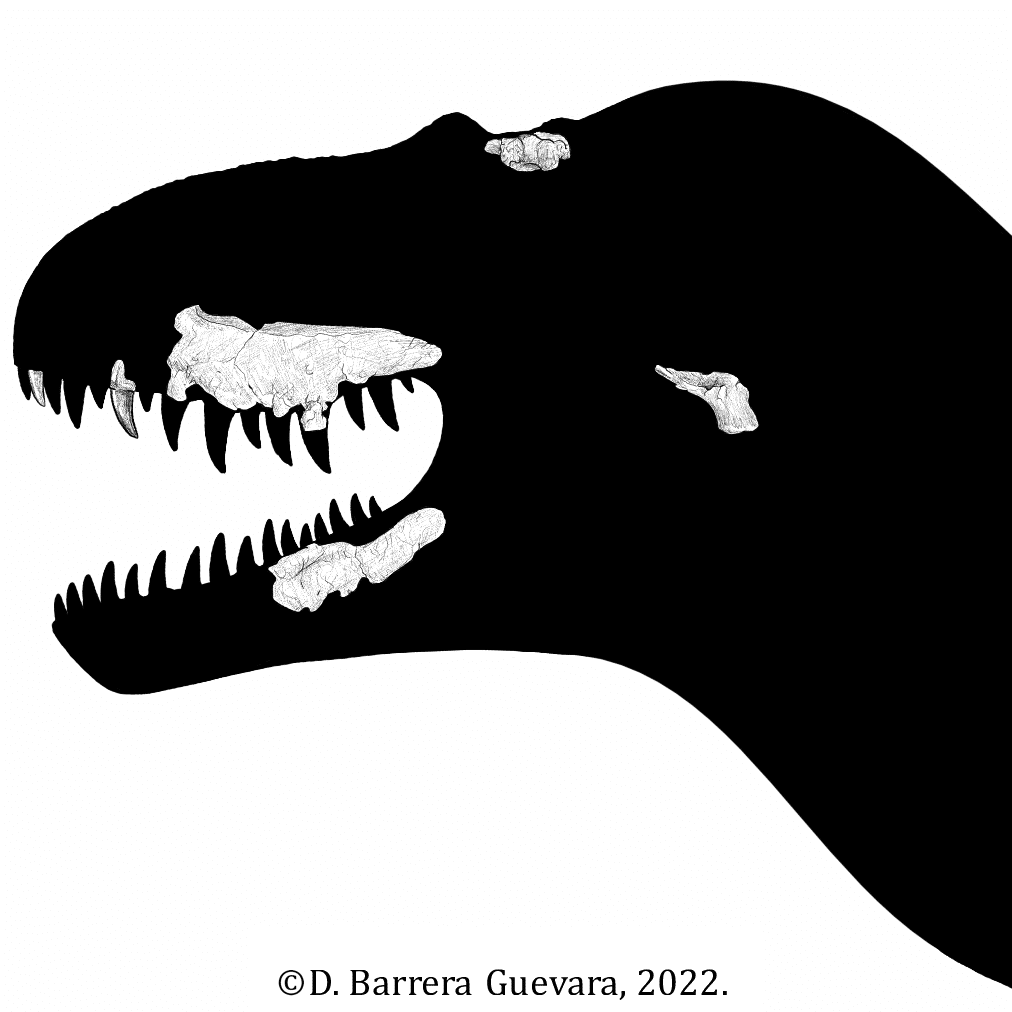
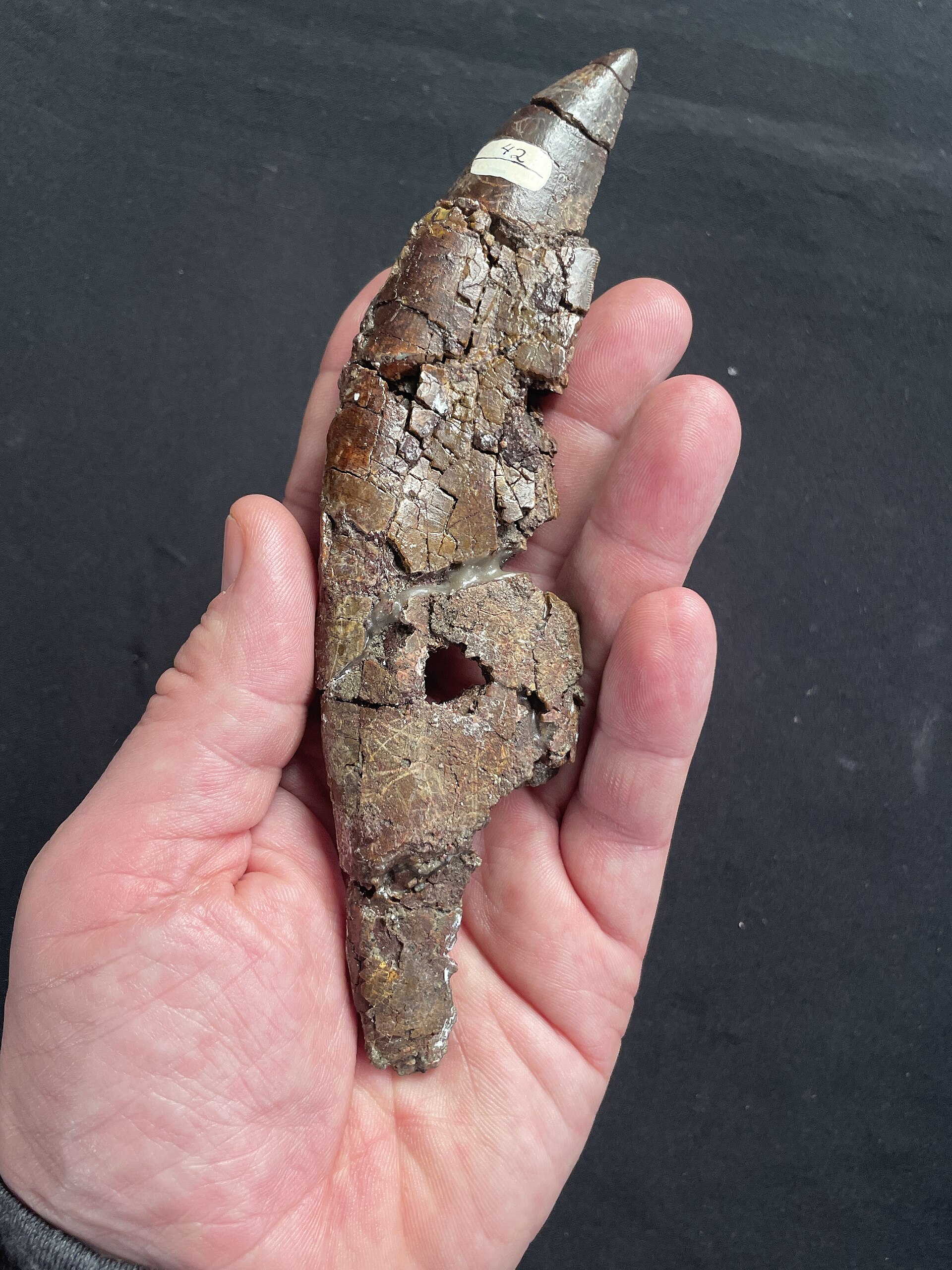
According to the 2024 restudy, the frontal met the lacrimal, the bone in front of the eye socket, along a broad, oblique contact. Later accounts report that Molnar described a quadrate hollowed by air spaces. Holtz added that this bone sloped back and down instead of standing vertical as in tyrannosaurids. The 2024 restudy, however, found the quadrate broad, as in tyrannosaurids. Holtz also described the maxillary teeth as ziphodont—flattened, serrated blades unlike those of tyrannosaurids. In his reading, the snout-tip teeth lacked the U-shaped cross-section typical of the family. By contrast, the 2024 restudy called the teeth typical of tyrannosaurids. The largest preserved tooth measures 1.5 inches (37 millimeters) in fore-aft length at its base.
Behind the skull, the ischium bore a triangular flange called the obturator process and, according to the 2024 study, an upturned upper margin. A hemal process—a chevron bone from beneath the tail—was L-shaped, and metatarsal II had a flattened outer face. In 2015, paleontologists Ramírez-Velasco and Hernández-Rivera noted that this metatarsal suggested a robust theropod, compared with tyrannosaurids such as Albertosaurus. The 2024 restudy instead called it gracile and typical of tyrannosaurids. No skin or soft tissue survives, so its outward appearance is speculative.

Size and Weight of Type Species
No peer-reviewed study we found gives a length or body mass for Labocania anomala. Several authors simply call it large-bodied—a description, not a measurement.
In 2024, Rivera-Sylva and Longrich suggested from tooth size that it may have been comparable to Bistahieversor. The same study cites about 26 feet (8 meters) and 5,500 pounds (2.5 metric tons) for that relative, not for Labocania itself. In 2026, Longrich and colleagues added that related taxa such as Labocania are not known to have grown larger than Bistahieversor.
The contested second species offers the only published body length for the genus—with a catch. Using Teratophoneus proportions, the 2024 authors scaled up from an estimated femur, or thigh bone, about 27.6 inches (700 millimeters) long. They concluded that the holotype, a subadult or young adult, was probably about 20.7 feet (6.3 meters) long at death. Because Voris and colleagues now consider L. aguillonae doubtful, that estimate cannot simply transfer to L. anomala.
The Dinosaur in Detail
What sets this dinosaur apart is how differently experts read the same handful of bones. Holtz described thick frontals that recall abelisaurids, and Peecook and colleagues wrote in 2014 of “a few massive skull bones.” Rivera-Sylva and Longrich accepted that the frontals are massive but argued they “are not unusually thick” for a large tyrannosaurine. Holtz also found no trace of the supratemporal fossa, a muscle scar on the skull roof of all tyrannosaurids. However, the 2024 team countered that the fossa is there and the bone’s upper surface is simply eroded.
The teeth tell a similar story. According to the 2024 study, only L. anomala and the Coahuila material share pinched tooth bases and deep grooves called fullers. Voris and colleagues replied that these features are widespread among tyrannosaurid teeth. They added that every proposed diagnostic trait of L. aguillonae varies or turns up in other tyrannosaurids, such as Teratophoneus and Lythronax.

Holtz linked the hollow quadrate and the ischium’s obturator process and scar to tyrannosauroids, the wider tyrannosaur lineage. Yet the flattened metatarsal, he observed, fits either tyrannosaurid bracing or the general pattern of tetanurans (“stiff-tailed” theropods). Rivera-Sylva and Longrich, by contrast, called the tyrannosaur evidence definitive. Voris and colleagues accepted that affinity in 2025, although they left the specimen out of their own analysis.
Taken together, Labocania sits at a crossroads of interpretation. The 2024 restudy and Voris and colleagues see a tyrannosaurid, one tree finds a carcharodontosaurid, and older reviews saw a mystery. Its exact branch is unsettled too—a 2025 conference abstract by Durrant and colleagues, not peer-reviewed, placed it beside Teratophoneini or outside Tyrannosaurinae.
Interesting Points about Labocania
- Labocania anomala was the first carnivorous dinosaur described from Mexico, and the first theropod named from the country.
- Estimates of its rock’s age run from a 93.6-million-year maximum to a 75.84-million-year minimum, and some museum records hint at a younger bed.
- One 2024 study grouped it with tyrannosaurs such as Bistahieversor, while another analysis that year placed it among carcharodontosaurids.
- Its second species, L. aguillonae, was named in 2024 and declared a nomen dubium only a year later.
Labocania in its Natural Habitat
The world Labocania roamed lay within the Rosario embayment of the Late Cretaceous Peninsular Range forearc basin complex. A forearc basin lies between an ocean trench and a chain of volcanoes. Its traditional home unit, the La Bocana Roja Formation, is a non-marine succession about 2,215 feet (675 meters) thick. Kane and colleagues describe river channel fills, overbank deposits, and fossil soils, or paleosols.
Together, the La Bocana Roja and El Gallo formations have yielded amphibians, lizards, turtles, mammals, crocodilians, and dinosaurs, with hadrosaurids the most abundant. The La Bocana Roja itself has produced an indeterminate lambeosaurine, or hollow-crested duck-billed dinosaur, and a second lambeosaurine specimen. Hadrosaurid remains also appear in the same collection as Labocania. Birds were present too—the enantiornithine Alexornis antecedens, from an extinct bird group, comes from the same formation. In addition, Rivera-Sylva and Longrich suggested that a lambeosaur ischium from these beds, possibly the same indeterminate specimen, may belong to Magnapaulia.
Every source we checked treats Labocania as a carnivore, but none describes its prey, hunting style, or social life. Its wider setting is better known. Rivera-Sylva and Longrich argue that the southern tyrannosaur group they place it in dominated southern Laramidia, the western landmass of North America. If that placement holds, Labocania belongs to that story too.
Frequently Asked Questions
The sources we could check do not explain it, and the original 1974 paper was not available to us.
Most studies place it in the Campanian stage of the Late Cretaceous, around 76 million years ago or earlier. It could be a little younger if it came from the El Gallo Formation, and its age is disputed.
We found no published length or weight, but one 2024 study suggested it may have matched Bistahieversor in size.
It was a carnivorous theropod that two recent studies treat as a tyrannosaurid, although one 2024 analysis placed it among carcharodontosaurids.
Its fossils were found near El Rosario in Baja California, Mexico, traditionally credited to the La Bocana Roja Formation.
It was the first carnivorous dinosaur described from Mexico, and experts still disagree about its family and age.
Sources
The information in this article is based on various sources, drawing on scientific research, fossil evidence, and expert analysis. The aim is to provide a comprehensive and accurate overview of Labocania. However, please be aware that our understanding of dinosaurs and their world is constantly evolving as new discoveries are made.
- Molnar, R.E. 1974. A distinctive theropod dinosaur from the Upper Cretaceous of Baja California (Mexico). Journal of Paleontology 48(5): 1009–1017 (original description, not consulted directly)
- https://www.mdpi.com/2813-6284/2/4/12
- https://doi.org/10.1038/s41586-025-08964-6
- https://static-content.springer.com/esm/art%3A10.1038%2Fs41586-025-08964-6/MediaObjects/41586_2025_8964_MOESM1_ESM.docx
- https://tb.plazi.org/GgServer/html/012B87EDFF8CD81D4DBE2297D87CB100
- https://www.paleoitalia.it/wp-content/uploads/2024/05/01_Cau_2024_BSPI_631_SOM-1.pdf
- https://doi.org/10.4435/BSPI.2024.08
- https://journals.plos.org/plosone/article?id=10.1371/journal.pone.0127792
- https://app.pan.pl/archive/published/app59/app20120003.pdf
- https://info.igme.es/media/boletin/2015/126_1/Articulo_4.pdf
- https://doi.org/10.2110/001c.37652
- https://doi.org/10.1371/journal.pone.0038207
- https://doi.org/10.1038/s41598-026-38600-w
- https://peerj.com/articles/5749/
- https://paleobiodb.org/data1.2/colls/single.json?id=54079&show=loc,strat,lith,methods,ref
- https://gsa.confex.com/gsa/2025RM/webprogram/Paper409871.html
This article was last fact checked: TheDinosaurs Team, 13-11-2026
Featured Image Credit: Alexis Uriostegui Acosta, CC BY-SA 4.0, via Wikimedia Commons
