
In Patagonia’s Chubut Province, river and lake deposits of the Cañadón Calcáreo Formation hold one of the Jurassic’s oddest sauropods. Named Brachytrachelopan mesai in 2005, this herbivore carried a neck about 40% shorter than in other known dicraeosaurs. Its describers placed it in the latest Jurassic, while a 2013 study placed its beds in the Kimmeridgian stage, possibly early Tithonian. Either way, it belongs to the Late Jurassic—and its neck runs against the trend seen in most sauropods.
Its story, as the Argentine newspaper Página/12 told it in 2005, began with a lost sheep. While searching for it in 1992, sheep breeder Daniel Mesa spotted an exposed backbone, later guiding paleontologists to the site. In 2005, paleontologist Oliver Rauhut and four colleagues described the skeleton in Nature and named the species after Mesa. From that single, partly eroded skeleton, the team drew a far bigger conclusion. Dicraeosaurids, they argued, radiated and dispersed rapidly across the Southern Hemisphere after Gondwana separated from the northern continents.
Brachytrachelopan Key Facts
| Keyword | Fact |
|---|---|
| Pronunciation | Not specified |
| Meaning of name | Short-Necked Pan (after the Greek God of Shepherds) |
| Group | Sauropoda (Dicraeosauridae) |
| Type Species | Brachytrachelopan mesai |
| Diet | Herbivore |
| When it Lived | Late Jurassic, probably Kimmeridgian (Cúneo et al. 2013) |
| Period | Jurassic |
| Epoch | Late Jurassic (Kimmeridgian–early Tithonian stages) |
| Length | Not specified |
| Height | Not specified |
| Weight | Not specified |
| Mobility | Moved on all four legs (quadrupedal) |
| First Discovery | 1992 by Daniel Mesa (credited in the 2005 Nature paper and a 2005 news report), though a 2026 account credits Leonide Mesa |
| Described by | 2005 by O.W.M. Rauhut, K. Remes, R. Fechner, G. Cladera, and P. Puerta |
| Holotype | MPEF PV 1716 |
| Location of first find | Cañadón Calcáreo Formation, Chubut Province, Patagonia, Argentina |
Brachytrachelopan Origins, Taxonomy and Timeline
Co-author Pablo Puerta told Página/12 in 2005 that “brachytrachelo” means “short neck,” while “pan” refers to the Greek god of shepherds. The species name mesai honors Daniel Mesa, on whose land the bones appeared—fittingly, a man who bred sheep. Together, the name pairs the animal’s defining trait with a double nod to shepherds—one divine, one of this world.
Brachytrachelopan belongs to Sauropoda, the great four-legged plant-eaters, and more specifically to Diplodocoidea and its subgroup Dicraeosauridae. The original analysis compared 27 sauropod taxa using 154 anatomical characters. It recovered Brachytrachelopan as the sister taxon—closest relative—of Dicraeosaurus from Tanzania, with Amargasaurus branching just outside that pair. In contrast, Tehuelchesaurus, then the only other sauropod described from the same formation, fell among macronarians beside Camarasaurus and Brachiosaurus. Brachytrachelopan mesai is the type and only known species.
Rauhut’s team assigned the skeleton to the latest Jurassic, which Windholz and colleagues (2022) cite as the Tithonian stage. However, studies of the rock unit itself give a possibly earlier range—Oxfordian–Kimmeridgian, according to Rauhut and colleagues in 2015. Deposition began before about 158 million years ago. A tuff, or volcanic ash layer, just above the lower lake beds dates to 157.4 million years. In 2013, Cúneo and colleagues correlated the Brachytrachelopan beds with a level about 330 feet (100 meters) above that ash. They judged them essentially Kimmeridgian, though an early Tithonian age could not be ruled out. Its exact age therefore remains open—though every estimate falls within the Late Jurassic.
Discovery & Fossil Evidence
The skeleton came from Mesa’s land, which Página/12 placed in the Cerro Chivo area, 236 miles (380 kilometers) from Trelew. Accounts of the find differ, however. The 2005 report, quoting Puerta, credits Daniel Mesa, who stumbled on the exposed vertebral column in 1992. The Nature paper itself thanks “D. Mesa, who found the specimen.” By contrast, a 2026 La Nación story says Leonide Mesa, who works the neighboring land, reported it years earlier.
The holotype, MPEF PV 1716, resides at the Museo Paleontológico Egidio Feruglio in Trelew. The original figure shows the backbone from the fifth cervical (neck) to the twelfth dorsal (back) vertebra, plus parts of the hip and hind leg. Close-up panels show parts of the fifth, eighth, and tenth neck vertebrae, plus the second, seventh, and eleventh dorsals. Several right dorsal ribs remain articulated—still joined as in life—and later histology work also sampled a femur (thigh bone). Rauhut told Nature News that it was “a really well-preserved specimen.” Still, he added, “we found it a few thousand years too late after erosion had already begun to have an impact.”
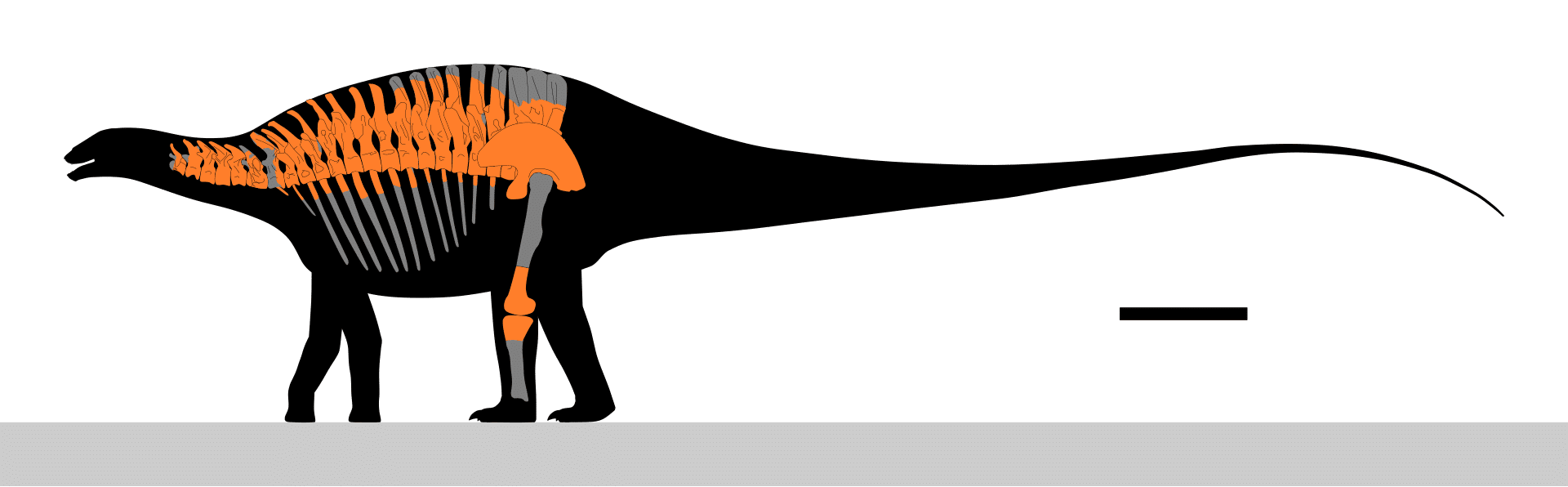

According to Página/12, the museum planned to exhibit the bones toward the end of 2005. The supplementary data of the 2005 study coded only this one specimen, and the Paleobiology Database lists a single occurrence. As a result, everything known about the animal rests on one partial skeleton, and no additional specimens of Brachytrachelopan have been reported.
Brachytrachelopan Size and Description
Known from a single partial skeleton, Brachytrachelopan still shows how far a sauropod could stray from the long-necked body plan.
Short description of Brachytrachelopan
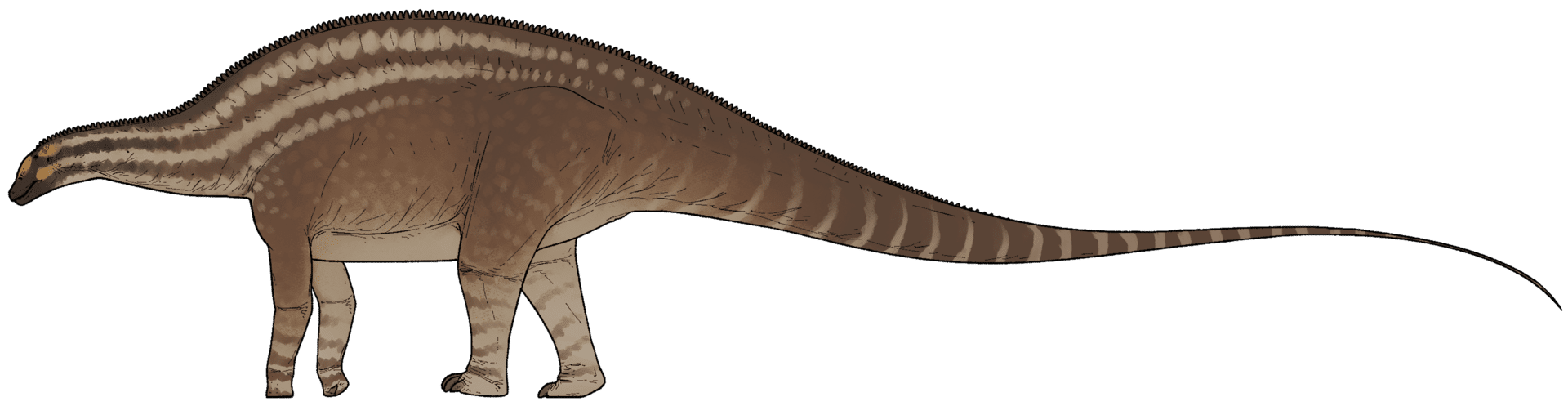
The figured bones include neither skull nor tail, so any reconstruction borrows its head and tail from relatives. By Taylor and Wedel’s 2013 estimate, the standout neck measured about 3.6 feet (1.1 meters), possibly with 12 vertebrae. They cautioned, though, that such figures are indicative rather than reliable. In 2020, Vidal and colleagues, citing the original paper, described a neck about 3.3 feet (1 meter) long. That is less than a quarter of the length of its axial skeleton—the skull, backbone, and tail combined.
Its neck vertebrae bore pleurocoels—hollows on their sides—that were simple depressions, while short cervical ribs ran beneath. The neural spines atop each back vertebra were at least three times as long as the centrum (vertebral body). In the middle of the neck, the spines rose much higher than the arches beneath them. Its back spines were petal-shaped, and the rear dorsal vertebrae lacked pleurocoels altogether.
The original skeletal reconstruction shows the animal standing on all four legs. No skin or other soft tissue survives, so any discussion of its outward appearance is speculative.

Size and Weight of Type Species
None of the peer-reviewed studies consulted here gives a length or weight estimate for Brachytrachelopan. In 2005, Nature News reported that it measured less than 33 feet (10 meters), even after reaching adulthood. Página/12 gave the same limit, though neither report, nor any of those studies, gives its height at the hips.
Instead, the original paper’s third figure sets the animal beside Dicraeosaurus hansemanni and Diplodocus carnegii, drawing it as the smallest of the three.
Bone tissue complicates the picture, however, since in 2022 Windholz and colleagues found no external fundamental system in the holotype. That dense outer layer forms once growth stops, so the animal died before reaching full body size. The data also suggest, though not conclusively, that it was sexually immature. Its femur showed fibrolamellar bone—a fast-forming tissue—with just one growth mark in the outer cortex. To the authors, this pointed to the sustained, accelerated growth typical of neosauropods. Neurocentral sutures, the seams between the vertebral bodies and their arches, also remained visible in the presacral (pre-hip) vertebrae. Even so, its body size was already comparable with fully grown individuals of other dicraeosaurid species.
The Dinosaur in Detail
What sets this dinosaur apart is a neck about 40% shorter than in other known dicraeosaurs—the opposite of the trend in most sauropods. Several neck features tie it to Dicraeosaurus, notably forward-leaning spines in the mid-neck. Like other flagellicaudatans (dicraeosaurids and diplodocids), it had bifid, or split, spines at the base of the neck and front of the back.
Later comparisons sharpened the picture. In 2022, Windholz and colleagues noted that its split neck spines project upward and forward, as in Bajadasaurus and Dicraeosaurus. Those of Amargasaurus, by contrast, point upward and backward. Like Amargasaurus and Dicraeosaurus, it lacks small openings, or foramina, in its cervical ribs. In 2023, Bajpai’s team noted a pillar-like lamina, or bony strut, in the neck vertebrae of the newly named Indian Tharosaurus. Brachytrachelopan, Lingwulong, and Pilmatueia share it, they added.
Inside the bone, a separate 2022 CT study found a “procamerate” pattern. In it, deep air-filled hollows reach the vertebra’s central wall but are not enclosed as chambers. It confirmed that dicraeosaurid vertebrae were less air-filled than those of other eusauropods (“true sauropods”). Meanwhile, the histology study found no support for horn cores or a ligament system between the neck spines.
Its position within the family remains debated. Xu and colleagues kept it beside Dicraeosaurus in 2018, with Amargasaurus next and Lingwulong outside them. In 2019, Gallina and colleagues left the three in an unresolved group. Bajpai’s 2023 majority-rule tree instead paired Dicraeosaurus with Amargasaurus, leaving Brachytrachelopan just outside, though their strict consensus left the family poorly resolved. Windholz’s 2022 team offered two hypotheses—one uniting South American dicraeosaurids such as Amargatitanis, the other splitting them. Taken together, these studies agree on the family but not on the branches within it.
Interesting Points about Brachytrachelopan
- Co-author Pablo Puerta explained that its name combines “short neck” with Pan, the Greek god of shepherds.
- Its neck was about 40% shorter than in other known dicraeosaurs, running against the trend seen in most sauropods.
- Rauhut told Nature News that the team found the well-preserved skeleton “a few thousand years too late,” after erosion had already begun.
- Bone histology shows that the only known individual was still growing, yet already comparable in size to fully grown members of other dicraeosaurid species.
- In the original analysis, its closest relative was Dicraeosaurus, a dicraeosaurid from the Upper Jurassic Tendaguru Beds of Tanzania.
Brachytrachelopan in its Natural Habitat
The world Brachytrachelopan roamed lay in the Cañadón Asfalto Basin, where lake sediments built up first, then river and floodplain deposits. In 2015, Volkheimer and colleagues described Late Jurassic rocks of the area as a palustrine (marshy) wetland within an arid landscape. They assigned these rocks to the Puesto Almada Member of the Cañadón Asfalto Formation. For the wider region, they inferred a warm, seasonally dry climate. Yet Brachytrachelopan itself came from fluvial (river-laid) sandstone higher in the sequence. Fish such as Condorlepis and Luisiella swam in the early lakes, while the crocodile relative Almadasuchus appears higher up.
As a herbivore, Brachytrachelopan likely fed close to the ground. According to Página/12, Rauhut said it could reach only plants about 6.6 feet (2 meters) above the soil. He told Nature News that a long neck is unnecessary when food is readily available on the ground. In the same report, paleontologist Paul Barrett, not an author, noted that Patagonia, as then known, lacked ornithopods—the bird-footed grazers of other continents. The describers wrote more cautiously that dicraeosaurid ecology might have differed considerably from that of other sauropods.
Also known from the formation, though from different localities, are the sauropods Tehuelchesaurus and Bicharracosaurus, named in 2026, and the theropod Pandoravenator. Unnamed remains add a possible brachiosaurid, a stegosaur, and probable abelisaurid theropods. As of 2021, Pandoravenator and Chilesaurus were the only named Late Jurassic theropods from South America. In 2015, Rauhut and colleagues likened the formation’s sauropod fauna to that of Tanzania’s Tendaguru Formation, and to roughly contemporaneous faunas in North America and Europe. In 2026, however, Reutter and colleagues tentatively reassigned that comparison’s supposed diplodocid vertebrae to Bicharracosaurus. While there is no direct evidence of its social life, its short neck may have suited a low-browsing ecological niche.
Frequently Asked Questions
Co-author Pablo Puerta explained it as “short neck” plus Pan, Greek god of shepherds, while mesai honors landowner Daniel Mesa.
It lived in the Late Jurassic—latest Jurassic to its describers, while a 2013 dating study placed its beds in the Kimmeridgian, possibly early Tithonian.
No peer-reviewed estimate was found, though 2005 news reports put its length at less than 33 feet (10 meters).
It was a herbivore that, Rauhut said in a 2005 news report, reached only plants about 6.6 feet (2 meters) above the ground.
Its only known skeleton comes from the Cañadón Calcáreo Formation in Chubut Province, Patagonia, Argentina.
Its neck was about 40% shorter than in other known dicraeosaurs, the opposite of the trend seen in most sauropods.
Sources
The information in this article is based on various sources, drawing on scientific research, fossil evidence, and expert analysis. The aim is to provide a comprehensive and accurate overview of Brachytrachelopan. However, please be aware that our understanding of dinosaurs and their world is constantly evolving as new discoveries are made.
- https://doi.org/10.1038/nature03623
- https://www.nature.com/articles/nature03623/figures/1
- https://www.nature.com/articles/nature03623/figures/2
- https://www.nature.com/articles/nature03623/figures/3
- https://static-content.springer.com/esm/art%3A10.1038%2Fnature03623/MediaObjects/41586_2005_BFnature03623_MOESM1_ESM.rtf
- https://doi.org/10.1080/08912963.2022.2124373
- https://doi.org/10.1093/biolinnean/blac131
- https://doi.org/10.5852/cr-palevol2022v21a45
- https://doi.org/10.7717/peerj.20945
- https://doi.org/10.5710/AMGH.12.10.2017.3105
- https://doi.org/10.1080/02724634.2015.982798
- https://doi.org/10.1016/j.gr.2013.01.010
- https://doi.org/10.4072/RBP.2015.1.04
- https://doi.org/10.1016/j.jsames.2021.103434
- https://doi.org/10.1038/s41598-018-37943-3
- https://doi.org/10.1038/s41467-018-05128-1
- https://doi.org/10.1038/s41598-023-39759-2
- https://doi.org/10.7717/peerj.36
- https://doi.org/10.1371/journal.pone.0227537
- https://doi.org/10.1080/02724634.2020.1862133
- https://arxiv.org/abs/1302.3267
- https://paleobiodb.org/data1.2/colls/single.json?id=51287
- https://www.nature.com/news/2005/050531/full/news050531-5.html
- https://www.pagina12.com.ar/diario/sociedad/3-51839-2005-06-02.html
- https://www.lanacion.com.ar/revista-lugares/encontre-un-bicharraco-el-puestero-de-la-patagonia-que-hallo-un-dinosaurio-de-160-millones-de-anos-y-nid26042026/
This article was last fact checked: TheDinosaurs Team, 13-11-2026
Featured Image Credit: Jl FilpoC, CC BY-SA 4.0, via Wikimedia Commons
