
In the Panoche and Tumey Hills of central California, the Moreno Formation holds a land animal entombed in rocks laid down at sea. Named Augustynolophus morrisi, it was a hadrosaurid—a duck-billed dinosaur—from the Maastrichtian, the final stage of the Cretaceous. The authors who named the genus placed it in the upper part of that stage, calling it “late-surviving.” Only two specimens are known, and both belong to the Natural History Museum of Los Angeles County.
A team from the California Institute of Technology began uncovering its bones in 1939. For decades, however, the skeletons sat under the name of a better-known crested relative, Saurolophus. In 2013, paleontologists Albert Prieto-Márquez and Jonathan Wagner named the species Saurolophus morrisi. A year later, they and two colleagues gave it a genus of its own. Then, in 2017, California made it the official state dinosaur. Its story shows how fuller preparation can reveal a distinct animal under a familiar name.
Augustynolophus Key Facts
| Keyword | Fact |
|---|---|
| Pronunciation | au-gus-tine-o-LOAF-us MORE-iss-ee, per the California State Capitol Museum |
| Meaning of name | Augustyn’s crest (Greek lophos, crest), honoring Gretchen Augustyn, with the species honoring William J. Morris |
| Group | Hadrosauridae, Saurolophini |
| Type Species | Augustynolophus morrisi |
| Diet | Herbivore |
| When it Lived | 72.2 to 66 MYA, the span of the Maastrichtian stage |
| Period | Cretaceous |
| Epoch | Late Cretaceous (Maastrichtian stage) |
| Length | About 26 feet (7.9 meters) per the California State Capitol Museum, no peer-reviewed estimate |
| Height | About 10 feet (3 meters) per Hilton and Medeiros of Sierra College, no peer-reviewed estimate |
| Weight | About 3 tons per the California State Capitol Museum, no peer-reviewed estimate |
| Mobility | Not specified |
| First Discovery | 1939 by a California Institute of Technology team |
| Described by | 2013 by A. Prieto-Márquez and J.R. Wagner (as Saurolophus morrisi), genus 2014 by A. Prieto-Márquez, J.R. Wagner, P.R. Bell, and L.M. Chiappe |
| Holotype | LACM/CIT 2852, from locality CIT 357, Tumey Hills |
| Location of first find | LACM locality CIT 336, Panoche Hills, Moreno Formation, Fresno County, California, USA (referred specimen LACM/CIT 2760) |
Augustynolophus Origins, Taxonomy and Timeline
The genus name honors Gretchen Augustyn, a philanthropist and longtime supporter of the Natural History Museum of Los Angeles County. Meanwhile, the species name morrisi honors paleontologist William J. Morris, who lived from 1923 to 2000. In 1973, Morris tentatively referred the Moreno skeletons to Saurolophus, so his name now sits on bones he once studied. Together, the name pairs a patron of science with a scientist—”two Californians,” as the State Capitol Museum puts it.
Augustynolophus belongs to Hadrosauridae and, within it, to the subfamily Saurolophinae. In 2014, Prieto-Márquez and colleagues formally established a narrower tribe, Saurolophini, made up of Prosaurolophus, Augustynolophus, and Saurolophus. However, Madzia and colleagues in 2021 credited the name to Glut in 1997 and called the 2014 definition informal. Their own version makes Saurolophini the largest clade—an ancestor and all its descendants—that contains Saurolophus osborni but not Brachylophosaurus, Edmontosaurus, Hadrosaurus, or Kritosaurus. Augustynolophus morrisi is the type and only known species.
According to the 2014 paper, the fossils come from the upper Maastrichtian. That study appeared online in July 2014, although its print issue is dated March 2015. Likewise, the species paper had appeared online in September 2011, before its 2013 print issue. Bell and Evans had called the Moreno Formation late Maastrichtian in 2010, whereas the 2013 paper said lower Maastrichtian. The stage spans roughly 72.2 to 66 million years ago, yet none of these studies gives a numeric age for the specimens. For the 2014 authors, Augustynolophus was the second described genus of North American late Maastrichtian hadrosaurids.
Discovery & Fossil Evidence
In 1939, Chester Stock reported a hadrosaur found that summer by Caltech field parties in the Panoche Hills of Fresno County. The State Capitol Museum dates the second specimen, from San Benito County, to 1941, but Hilton and Medeiros of Sierra College give 1943. Decades later, Morris tentatively referred three partial skeletons to Saurolophus, though Peecook and Sidor in 2015 mention two.
In 2010, Bell and Evans described the holotype skull as incomplete, poorly preserved, and crushed or plastically deformed. It also lacked the braincase and much of the nasals (snout-roof bones), and they saw no compelling evidence for Saurolophus over Edmontosaurus. Their phylogeny—a family tree built from anatomical traits—placed it beside Saurolophus or beside Edmontosaurus and Anatotitan. Still, they raised the possibility that it represented a separate taxon.
The holotype, LACM/CIT 2852, is a partial skull and skeleton from Caltech’s collection, now kept in Los Angeles. The 2013 paper puts its type locality, CIT 357 in the Tumey Hills, in San Benito County, whereas the Paleobiology Database says Fresno. Its skull includes parts of both premaxillae (front upper jaw bones), both maxillae (main upper jaw bones), and the right jugal (cheek bone). Behind the head come neck, back, and tail vertebrae, part of the right scapula (shoulder blade), and both ulnae (forearm bones). The 2013 paper calls its right ulna robust and moderately elongate.
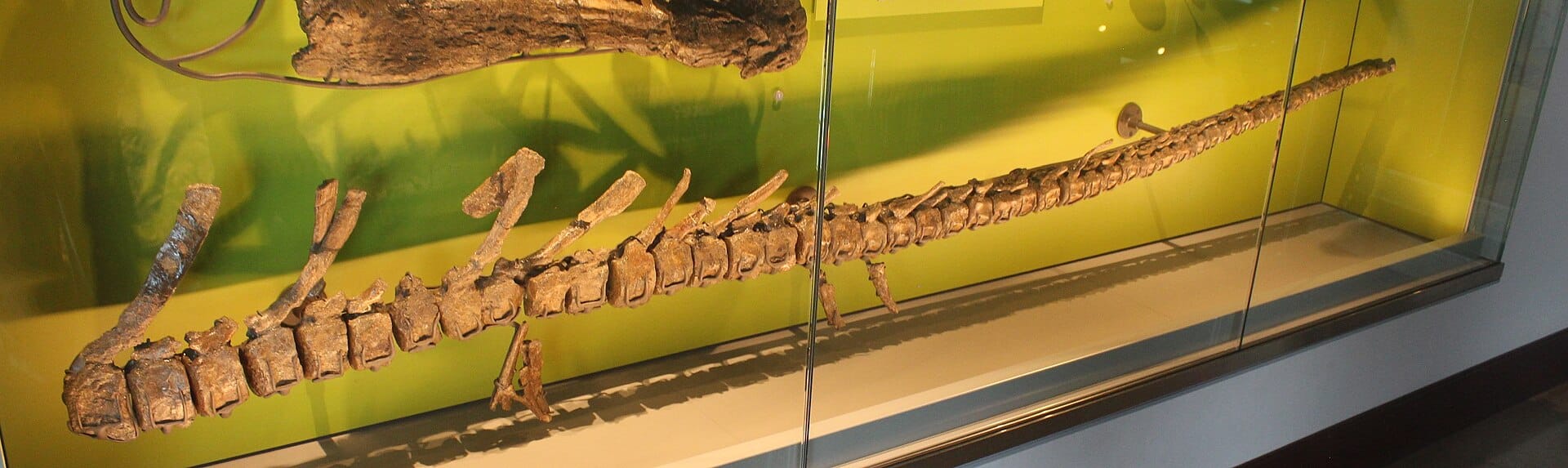

The 1939 find is the referred skeleton LACM/CIT 2760, from locality CIT 336. It preserves the back of the skull roof, the lower jaws with teeth, and parts of the shoulder, arms, and legs. Prieto-Márquez and Wagner identified it as a subadult about 30 percent smaller than the holotype. No other specimens are known, and the Los Angeles museum displays Augustynolophus on the upper deck of its Dinosaur Hall.
Augustynolophus Size and Description
With only two incomplete skeletons to work from, most of what we know about Augustynolophus comes from its skull.
Short description of Augustynolophus
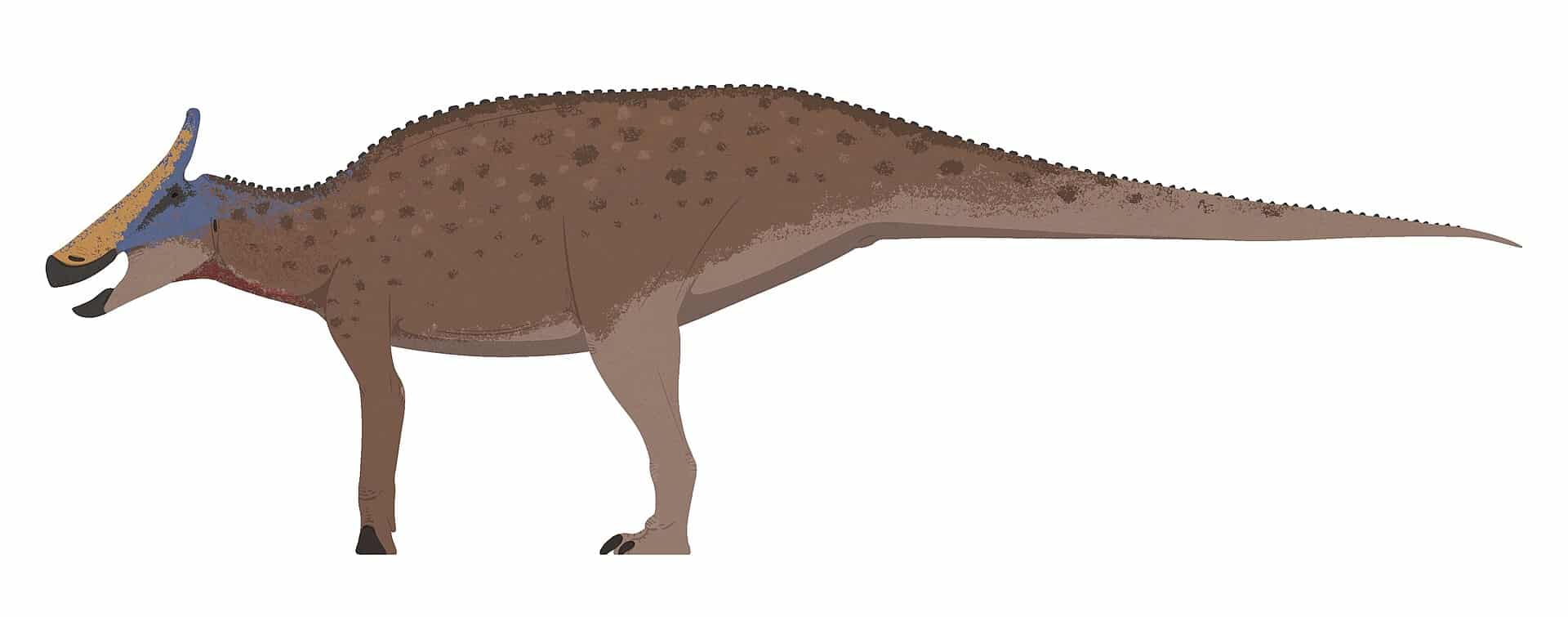
At the top of the head rose a solid nasal crest that ended in an elongate triangular plate above the skull roof. The 2014 authors inferred this crest from the nasals and surrounding bones. In doing so, they went beyond the 2010 view that the nature of any crest was impossible to determine with certainty. Even so, Bell and Evans had already noted a nasal fragment suggesting no Gryposaurus-like “Roman nose.”
Lower on the face, the edge of the premaxilla flared outward in a thin, broad arc, much as in Prosaurolophus and Saurolophus. As preserved, the nostril opening looks broader than in Saurolophus, more like that of Edmontosaurus, though crushing may exaggerate this. Its front end formed a tight V. Behind the eye, the postorbital was T-shaped, whereas S. osborni and large S. angustirostris had a Y-shaped one.

Farther back, the jaws held a dental battery—columns of teeth with replacements stacked below. The subadult’s left dentary (tooth-bearing lower jaw bone) measures 350 millimeters (13.8 inches) and holds at least 32 tooth families. At mid-row, at least four crowns sit stacked within a single socket. Each crown was diamond-shaped, with a single median ridge and tiny or absent denticles (edge serrations).
No skin impressions have been reported, so any discussion of its soft tissue is speculative. Likewise, no study of this taxon addresses whether it walked on two legs or four.
Size and Weight of Type Species
None of the peer-reviewed studies consulted gives a body length or mass for Augustynolophus. Instead, the best hard figure is the holotype skull, which Prieto-Márquez and Wagner put at about 1,000 millimeters (3.3 feet), though crushing makes even this figure uncertain.
Museum and government sources fill the gap with rounder numbers. The California State Capitol Museum describes an animal about 26 feet (7.9 meters) long that weighed about 3 tons. For its part, the Los Angeles museum says it was about as long as a school bus. In 2018, Hilton and Medeiros described it as about 30 feet (9.1 meters) long and 10 feet (3 meters) tall.
None of these sources explains its figure, so until more bones turn up, any full-body size remains an informed guess.
The Dinosaur in Detail
One of the most distinctive features of Augustynolophus lies at the top of its head. In its abstract, the 2014 study lists four autapomorphies—traits found in no other species. First, the rear upper process of the frontal (a skull-roof bone) has a crescent-shaped base and extends behind its “dome.” Second, the tip of the nasal crest carries a knob-like process bent forward. Third, a lightly incised circumnarial depression—the hollow around the nostril—spans two-thirds of the width of the crest tip’s side. Finally, the rear surface of that crest tip is subrectangular.
The 2014 team also identified features shared across Saurolophini. These include a broadly arched margin on the premaxilla and a flat, steeply inclined chewing surface on the dentary. As the tribe evolved, its crests grew longer toward the back of the head, while the nostril hollow spread rearward.
In 2013, Prieto-Márquez and Wagner diagnosed Saurolophus morrisi by a wide oblique groove on the postorbital. Their analysis of 49 hadrosauroid species (duck-bills and close kin) placed it outside S. osborni and S. angustirostris. As a result, they called the referral to Saurolophus arbitrary but declined to erect a new genus. Full preparation of the referred skull roof then changed the picture, and the 2014 matrix scored 35 taxa for 272 characters.
Later studies have kept the genus. In 2015, Dewaele and colleagues linked a domed frontal to juvenile S. angustirostris and to Augustynolophus. The 2013 paper had already seen that trait in the subadult. Then, in 2021, Gates, Evans, and Sertich recovered Augustynolophus and Saurolophus as a pair, with Bremer decay values—a measure of branch support—above four. Taken together, these studies show a crested hadrosaurid whose closest ties run to Saurolophus and Prosaurolophus.
Interesting Points about Augustynolophus
- California named Augustynolophus morrisi its official state dinosaur through Assembly Bill 1540, which the governor approved on September 23, 2017.
- Assemblymember Richard Bloom introduced the bill that gave California its state dinosaur.
- Only two specimens of Augustynolophus are known anywhere, and both belong to the Natural History Museum of Los Angeles County.
- The species first appeared as Saurolophus morrisi in 2013 and received its own genus a year later.
- Kobayashi and colleagues list Augustynolophus, along with Hadrosaurus, among the few hadrosaurids reported from marine deposits.
Augustynolophus in its Natural Habitat
The Moreno Formation rocks that hold Augustynolophus formed on the seafloor, spanning the Maastrichtian and the following Danian stage of the Paleocene. Mostly shale, they include the Marca Shale Member, a diatomaceous shale rich in the silica shells of microscopic algae. Following Bell and Evans, the Paleobiology Database places both sites in this laminated member, laid down offshore in oxygen-poor water. Even so, it notes that the Moreno–Panoche boundary here is uncertain, and Stock put the first find about 100 feet above the Moreno base. These sediments gathered in the Great Valley, then a forearc basin—a trough beside a volcanic arc.
On land, Augustynolophus lived west of the Sierra Nevada magmatic arc, where, as Bell and Evans noted, Maastrichtian dinosaur diversity is poorly known. Its 2013 describers called it an endemic Californian hadrosaurid, and the 2014 team tied it to Late Cretaceous provinciality—distinct regional faunas. As a herbivore, it fed on plants, although no study records which ones. Meanwhile, unnamed hadrosaurid remains also come from the Marca Member.
Offshore, the Moreno Formation has yielded the mosasaur Plesiotylosaurus crassidens, a marine lizard, and plesiosaurs such as Morenosaurus stocki. In the Panoche Hills, Stock found such marine reptiles higher in the section than the hadrosaur. How hadrosaurid carcasses reached these waters is an open question. In 2018, Hilton and Medeiros suggested that the animals died inland, perhaps by drowning, and washed out to sea. Similarly, the Los Angeles museum says some settled to the ocean floor after death, where their bones became dinosaur fossils. Another Californian dinosaur, the armored nodosaurid Aletopelta of the Point Loma Formation, also comes from coastal or marine rock. While there is no direct evidence of its social life, two skeletons cannot show whether Augustynolophus lived alone or in herds.
Frequently Asked Questions
It means “Augustyn’s crest,” joining philanthropist Gretchen Augustyn’s name to the Greek lophos (crest). The species name morrisi honors paleontologist William J. Morris.
It lived in the Maastrichtian stage of the Late Cretaceous, which spans roughly 72.2 to 66 million years ago.
No peer-reviewed estimate exists, but the California State Capitol Museum gives about 26 feet and 3 tons. Its holotype skull was about 3.3 feet long.
It was a herbivore, with a dental battery of at least 32 tooth families in the subadult’s lower jaw.
Its fossils come from the Moreno Formation in the Tumey and Panoche Hills of central California.
Its nasal crest ended in a knob-like tip bent forward, one of four features found in no other species.
Sources
The information in this article is based on various sources, drawing on scientific research, fossil evidence, and expert analysis. The aim is to provide a comprehensive and accurate overview of Augustynolophus. However, please be aware that our understanding of dinosaurs and their world is constantly evolving as new discoveries are made.
- https://doi.org/10.1017/S0016756814000284
- https://www.app.pan.pl/archive/published/app58/app20110049.pdf
- https://doi.org/10.4202/app.2011.0049
- https://www.app.pan.pl/archive/published/SOM/app58-PrietoMarquez_Wagner_SOM.pdf
- https://static.cambridge.org/content/id/urn:cambridge.org:id:article:S0016756814000284/resource/name/S0016756814000284sup001.doc
- https://rune.une.edu.au/web/handle/1959.11/14853
- https://doi.org/10.1371/journal.pone.0127792
- https://doi.org/10.7717/peerj.12362
- https://doi.org/10.7717/peerj.10669
- https://www.nature.com/articles/s41598-019-48607-1
- https://doi.org/10.1371/journal.pone.0138806
- https://archives.datapages.com/data/bulletns/2017/08aug/BLTN16021/bltn16021.html
- https://paleobiodb.org/classic/basicCollectionSearch?collection_no=55358
- https://paleobiodb.org/classic/basicCollectionSearch?collection_no=55359
- https://capitolmuseum.ca.gov/state-symbols/dinosaur-augustynolophus-morrisi
- https://nhm.org/stories/dino-mite-we-struck-gold
- https://ejournals.sierracollege.edu/jscnhm/v6n2/dinosaur.html
- https://legiscan.com/CA/text/AB1540/2017
- https://www.smithsonianmag.com/smart-news/meet-augustynolophus-morrisi-californias-new-state-dinosaur-180965038/
- https://ngmdb.usgs.gov/Geolex/UnitRefs/MorenoRefs_11379.html
- https://authors.library.caltech.edu/records/1f635-fvb51
This article was last fact checked: TheDinosaurs Team, 13-11-2026
Featured Image Credit: Jonathan Chen, CC BY-SA 4.0, via Wikimedia Commons
