
Along the Red Deer River in Alberta, Canada, the Dinosaur Park Formation preserves the bones of a lanky, toothless theropod. Named Struthiomimus altus, it belonged to the Ornithomimidae, the family nicknamed “ostrich dinosaurs.” Most of its fossils date to the Campanian stage of the Late Cretaceous—roughly 76.5 to 74.4 million years ago. Yet younger Alberta skeletons referred to the species suggest it lasted until near the end of the Campanian. A nearly complete skeleton found in 1914 gave paleontologists their first full picture of the animal.
Lawrence M. Lambe of the Geological Survey of Canada collected the type bones below Berry Creek in 1901 and named them Ornithomimus altus a year later. Henry Fairfield Osborn then used the 1914 skeleton to coin the genus Struthiomimus in 1917. More than a century on, its diet and even its type specimen’s standing remain open—proof that a famous fossil can hold unfinished business.
Struthiomimus Key Facts
| Keyword | Fact |
|---|---|
| Pronunciation | Not specified |
| Meaning of name | Ostrich Mimic |
| Group | Theropoda (Ornithomimidae) |
| Type Species | Struthiomimus altus |
| Diet | Debated: herbivore, omnivore or small-animal eater |
| When it Lived | About 76.5 to 74.4 MYA for most fossils, possibly somewhat later |
| Period | Cretaceous |
| Epoch | Late Cretaceous (Campanian stage, possibly earliest Maastrichtian) |
| Length | About 13.4 feet (4.1 meters), vertebral column of skeleton AMNH 5339 |
| Height | Not specified |
| Weight | About 330 to 515 pounds (150 to 234 kilograms) for large individuals, estimates vary by specimen and method |
| Mobility | Moved on two legs (bipedal) |
| First Discovery | 1901 (holotype) by Lawrence M. Lambe, referred bones collected from 1880 |
| Described by | 1902 by Lawrence M. Lambe as Ornithomimus altus, genus named 1917 by Henry Fairfield Osborn |
| Holotype | CMN 930 |
| Location of first find | Below Berry Creek, Red Deer River, Alberta, Canada (formation uncertain, often listed as Dinosaur Park Formation) |
Struthiomimus Origins, Taxonomy and Timeline
The name Struthiomimus means “ostrich mimic.” Osborn chose it because the skull, neck, and foot resembled those of the ostrich, whose scientific name is Struthio. Lambe’s 1902 paper gives no explanation for the species name altus.
Lambe originally placed the species in Marsh’s genus Ornithomimus, within the family Ornithomimidae. However, Osborn argued that the Alberta animal came from a much older rock layer than the type of Ornithomimus. He therefore offered Struthiomimus as either a full genus or a subgenus. His key distinction was a splint of metatarsal V (the fifth long bone of the foot), which he said Ornithomimus had lost. In a 2015 thesis, paleontologist Bradley McFeeters called that absence only “supposed.”
Most Struthiomimus altus fossils come from the Dinosaur Park Formation, which spans the middle to upper Campanian. In 2022, uranium–lead dating by Ramezani and colleagues put the formation’s base at 76.47 million years ago and its top at 74.44 million. By contrast, an older argon-based estimate cited by Jordan Mallon in 2019 gave about 77 to 75.5 million years. Meanwhile, skeletons referred to S. altus also come from Alberta’s younger Horseshoe Canyon Formation. One is the skull TMP 1990.026.0001, from its Drumheller Member. Another, AMNH 5257, comes from the Morrin Member, whose uppermost part contains the Campanian–Maastrichtian boundary. As a result, the species as currently used may reach the end of the Campanian, possibly the earliest Maastrichtian.
Discovery & Fossil Evidence
Lambe found the type material in 1901 during survey fieldwork, and he also referred bones gathered as early as 1880. Because no one has reliably relocated the original quarry, its formation is uncertain. Glut assigned it to the Oldman Formation in 1997, whereas Currie listed the holotype among Dinosaur Park Formation types in 2005.
The holotype, CMN 930, belongs to the Canadian Museum of Nature in Ottawa. It consists of a complete right hind limb with its foot, plus the toe bones of the left foot. A pubis and an ischium—two of the hip bones—complete the set, all from one individual. Lambe also provisionally included a back vertebra, tail vertebrae, hand bones, and “a number of teeth of peculiar shape.” In 1972, paleontologist D.A. Russell called the holotype “virtually undeterminable,” although he thought it most likely belonged to the same species as AMNH 5339. Later, McFeeters could not confirm any trait of the core S. altus group in CMN 930.
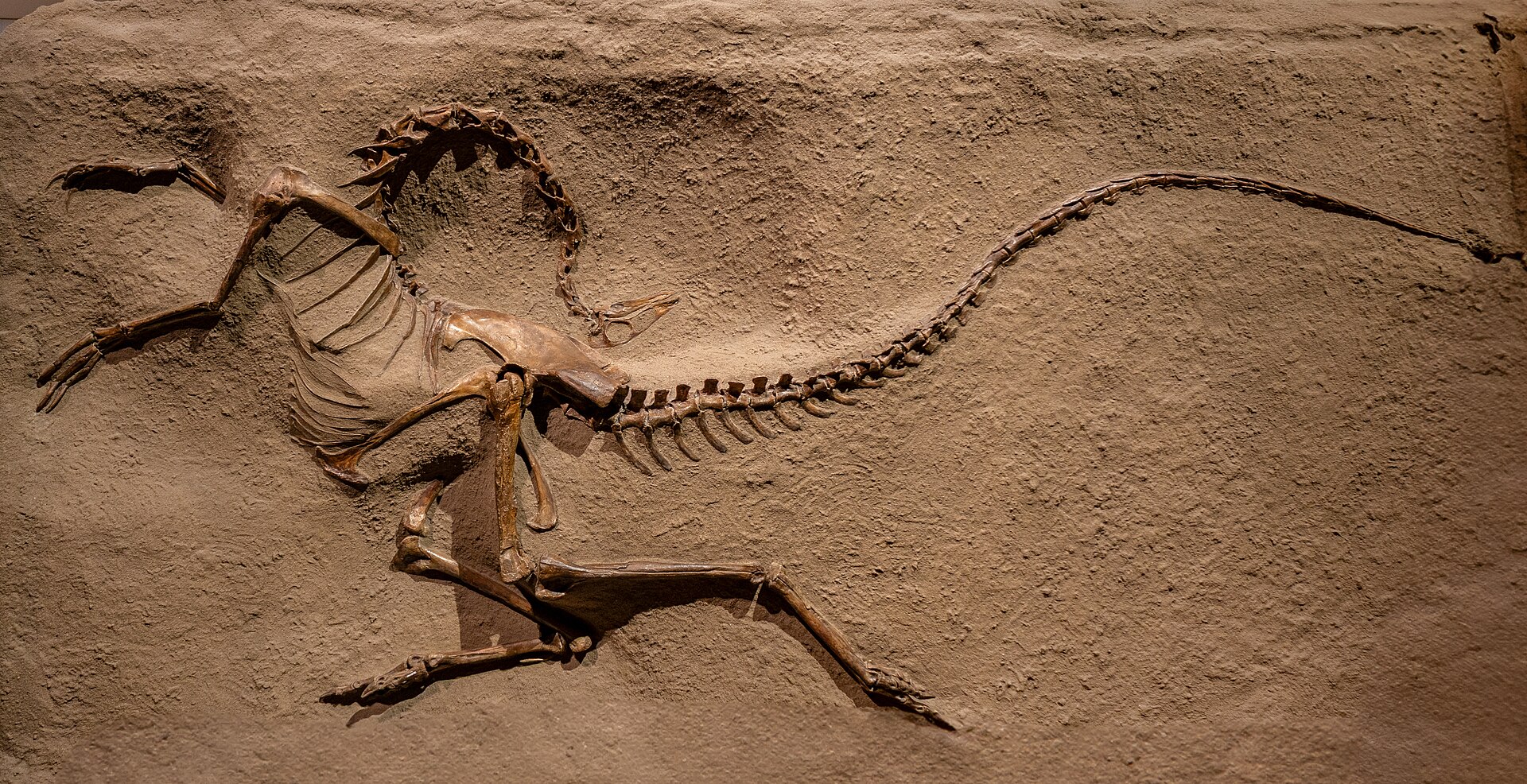

Instead, the skeleton Barnum Brown found in 1914, AMNH 5339, became the working reference. Osborn completed its tail with bones from AMNH 5355 and 5262. McFeeters’ thesis called AMNH 5339 an unofficial “proxy holotype” and potential neotype—a replacement type specimen—yet judged a formal neotype proposal premature. Another skeleton, UCMZ 1980.1, probably comes from the lowest 5 to 10 meters of the Dinosaur Park Formation.
Struthiomimus Size and Description
Thanks to AMNH 5339, paleontologists can follow Struthiomimus from beak to tail.
Short description of Struthiomimus
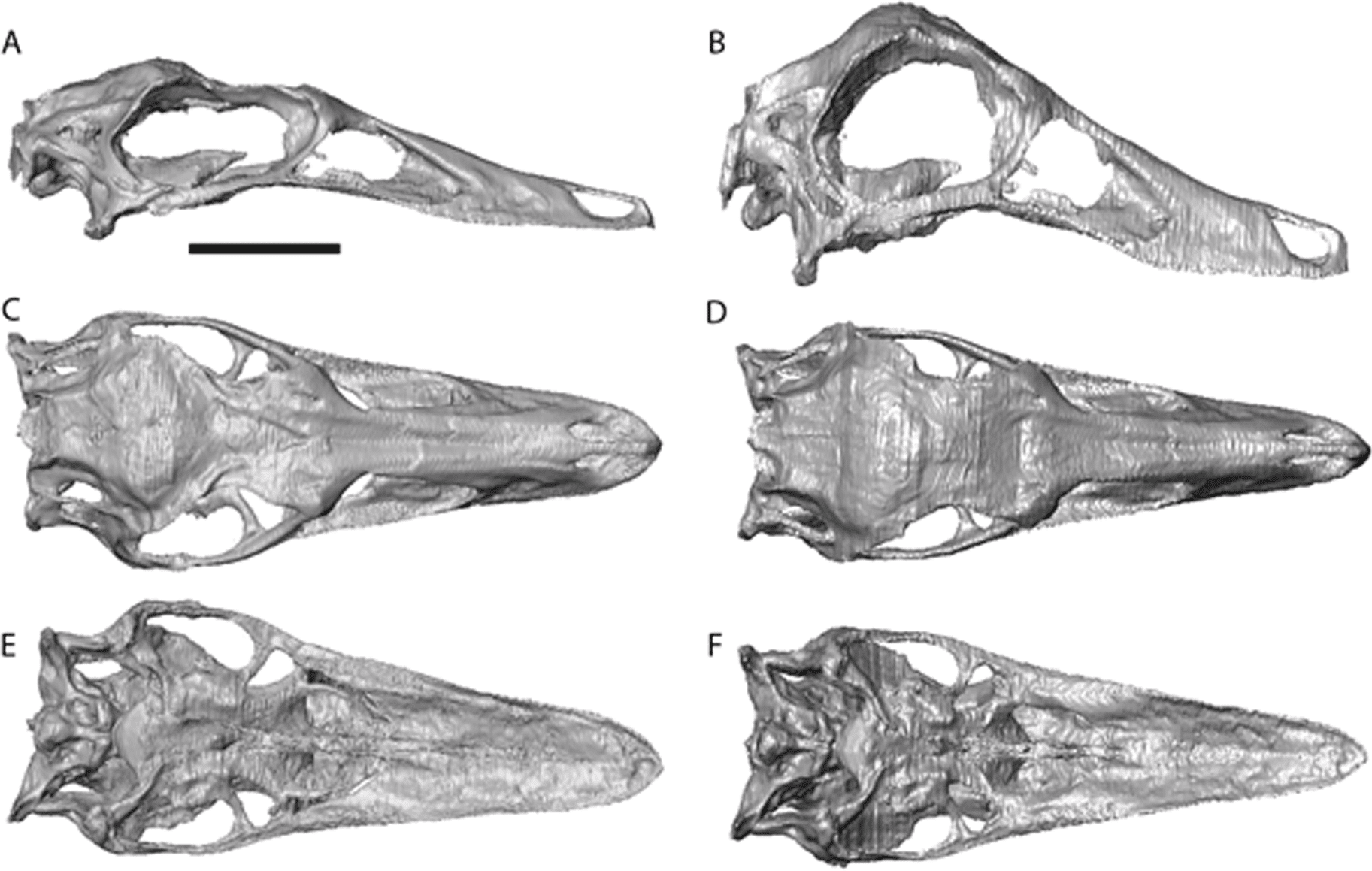
The skull was small, only one-third longer than an ostrich’s, and measured about 9.4 inches (24 centimeters). Its eye sockets were relatively as large as an ostrich’s, and its jaws held no teeth at all. Osborn inferred that narrow horny beaks, somewhat like an ostrich’s, sheathed the jaw tips. Behind the head ran ten neck vertebrae, then an estimated 13 back and 39 tail vertebrae, with 17 of the tail bones surviving in series.
The arms were long, reaching 55 percent of the length of the hind limb. Each hand bore three fingers of nearly equal length, tipped with long, slender, slightly recurved claws. Meanwhile, the legs suited a runner, with hollow bones and a shin longer than the thigh. The back half of the tail was stiff and rod-like, which Osborn read as a counterbalance during a run. No skin or feathers are known for Struthiomimus itself. However, its close relative Ornithomimus has left feathered specimens in the same Alberta rocks. They include a juvenile and an adult from the Horseshoe Canyon Formation and a Dinosaur Park skeleton with traces of feather shafts.
Size and Weight of Type Species
In 1902, Lambe estimated Ornithomimus altus at 22 feet (6.7 meters), working only from a hind limb and associated bones. Osborn’s assembled skeleton told a different story—its vertebral column measured 13.4 feet (4.085 meters), or “over thirteen feet in length,” in his words. Other specimens supplied parts of the tail, so even that figure is partly estimated.
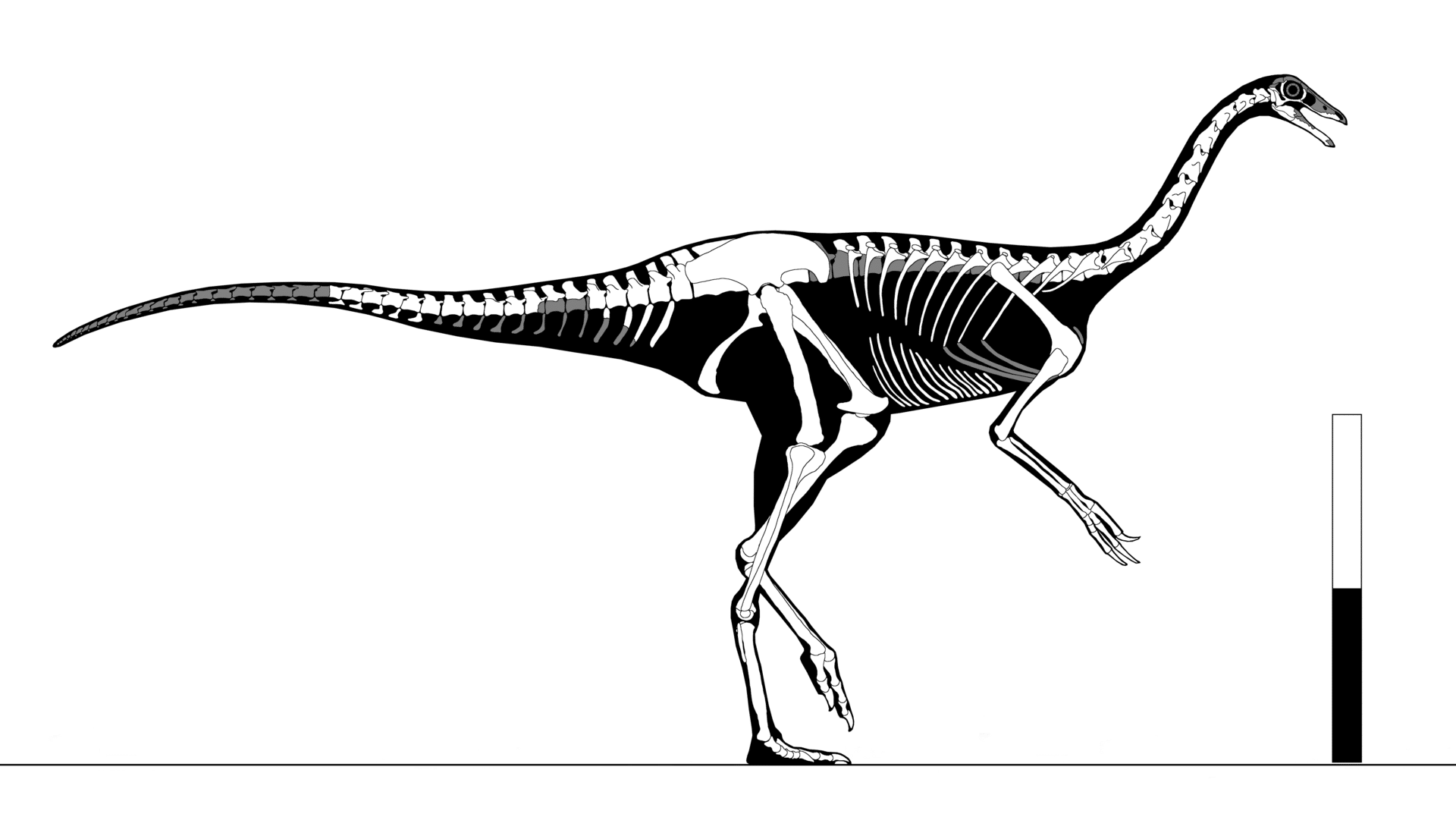

No source consulted gives a hip height, but the hind limb of AMNH 5339 measured about 5 feet (1.53 meters).
Christiansen and Fariña built a physical model of AMNH 5339 that gave about 386 pounds (175 kilograms), as Bates and colleagues reported in 2009. In 2022, Tsogtbaatar and colleagues used thighbone circumference to estimate about 330 pounds (149.6 kilograms) for UCMZ 1980.1, within about 245 to 414 pounds. The same method gave about 515 pounds (234 kilograms) for AMNH 5257, a larger Horseshoe Canyon animal. Taken together, these figures place Struthiomimus among what Tsogtbaatar’s team called medium-bodied ornithomimosaurs.
The Dinosaur in Detail
What sets this dinosaur apart is its hand. Osborn described three nearly equal fingers and a divergent thumb with “indications of … grasping power.” Anatomist W.K. Gregory, quoted there, judged the claws “larger than those of a grizzly bear.” In 1985, however, Elizabeth Nicholls and Anthony Russell found the first finger rotated outward, while digits II and III functioned as a unit. In their view, the hand worked as a hook and clamp rather than a grasping or raking tool.
The torso holds its own revisions. Osborn described the gastralia (belly ribs) as a triple series on each side. However, in 1981, Nicholls and Russell found two overlapping segments instead of three. Their specimen also preserved bony xiphisternal structures (at the rear of the breastbone), similar to breastbone processes in some birds.

Telling Struthiomimus from its relatives is hard. In 1981, Nicholls and Russell recognized four Late Cretaceous ornithomimid genera—Struthiomimus, Ornithomimus, Dromiceiomimus, and Gallimimus. They accepted Dromiceiomimus only tentatively—many researchers now fold it into Ornithomimus—and called the hand the most reliable way to separate them. Decades later, Cullen and colleagues scored 14 characters in a bonebed sample, and 13 occur in both Struthiomimus and Ornithomimus. Their 2013 analysis grouped the pair in an unresolved cluster, sister to Qiupalong henanensis.
Beyond the enlarged hand noted by earlier authors, McFeeters proposed further traits of the core S. altus group, such as a more sinuous metatarsal III, the middle long bone of the foot. Another is a pubic boot—the expanded lower end of the pubis—that sits ahead of the ilium’s front blade rather than beneath it. The thesis also found the referred material mixed. In 2016, McFeeters and colleagues made one such specimen, ROM 1790, the holotype of Rativates evadens. Taken together, Struthiomimus pairs a well-known skeleton with a surprisingly blurry name.
Interesting Points about Struthiomimus
- Osborn named Struthiomimus in a paper whose title also featured Tyrannosaurus and Ornitholestes, issued in 1917 within a museum Bulletin volume dated 1916.
- Lambe’s original description included teeth found near the bones, but Osborn’s toothless skull later showed they could not belong to the animal.
- Brown’s skeleton went on display as a panel mount, prepared by Peter Kaisen, that shows the bones “approximately as found.”
- Parks named a second species, “Struthiomimus” samueli, in 1928. Russell moved it to Dromiceiomimus in 1972, though many now place it in Ornithomimus.
- Osborn himself admitted it was “very difficult to form a consistent hypothesis of the habits of this remarkable animal.”
Contemporary Dinosaurs
Sharing the lower Dinosaur Park floodplain was Centrosaurus, a horned ceratopsid and one of the formation’s megaherbivores, or very large plant-eaters. Mallon placed it in Megaherbivore Assemblage Zone 1a, the low interval that probably also holds the Struthiomimus skeleton UCMZ 1980.1. No fossil links the two directly.
Adding a crest to the skyline was Corythosaurus, a lambeosaurine hadrosaurid, or crested duck-billed dinosaur. In fact, McFeeters placed UCMZ 1980.1 in the Centrosaurus–Corythosaurus faunal zone, which carries its name. As with its horned neighbor, no fossil links the two directly.
Lower to the ground moved Euoplocephalus, an armored ankylosaurid that Mallon interpreted as a feeder on low-growing ferns. It appears in Zone 1a and later zones, though Mallon rated it rare (5 to 10 specimens). Nothing ties it to Struthiomimus beyond a shared formation and interval.
Among the formation’s large predators was Gorgosaurus, an albertosaurine tyrannosaurid. One juvenile from the Dinosaur Park Formation, about 75.3 million years old, preserves two small caenagnathid theropods—oviraptorosaurs—in its gut. Still, no source ties Gorgosaurus to the level of a dated Struthiomimus specimen.
Struthiomimus in its Natural Habitat
Struthiomimus roamed a coastal plain beside the Western Interior Seaway, which split North America and isolated a narrow landmass called Laramidia. River channels dominate the lower half of the Dinosaur Park Formation, and their deposits hold unusually rich bonebeds and skeletons. Later, as the Bearpaw Sea advanced, the rocks record river and near-shore settings. Swampy coastal plains supported aquatic plants, while flowering plants were abundant on the floodplains. Osborn had read the ornithomimid sites as shore deposits with mollusks, ripple marks, and plant remains.
Diet remains its most debated trait, with no direct evidence such as gut contents. Osborn favored a herbivorous browser that cropped leaves and buds with its beak and pulled down branches with its arms. He also reported, and rejected, two rival ideas—ornithologist C. William Beebe’s anthill raider and Barnum Brown’s shore wader eating crustaceans and mollusks. Russell suggested in 1972 that ornithomimids subsisted on small, soft-bodied animals. By contrast, paleontologist Paul Barrett argued in 2005 that a horny beak and a gastric mill (a stone-filled gizzard) signal herbivory in advanced ostrich dinosaurs.
No direct evidence shows that Struthiomimus lived in groups, though a bonebed at Dry Island points to gregarious behavior in close relatives. Yet Cullen and colleagues could not narrow those bones to Struthiomimus itself. D.A. Russell’s thigh-muscle reconstruction indicated that ornithomimids were extremely fleet, though less agile than large ground birds. Osborn himself thought that alert vision and rapid locomotion made up for its lack of defenses.
Frequently Asked Questions
It means “ostrich mimic,” a nod to how its skull, neck, and foot resembled those of an ostrich.
It lived in the Campanian stage of the Late Cretaceous. Most fossils date to roughly 76.5 to 74.4 million years ago, though some referred skeletons are younger.
The backbone of its most complete skeleton measured about 13.4 feet (4.1 meters). Mass estimates for large individuals range from about 330 to 515 pounds (150 to 234 kilograms).
Its diet is debated, with proposals ranging from browsing on plants to eating small, soft-bodied animals.
Its type specimen was found in 1901 below Berry Creek on the Red Deer River in Alberta, Canada.
It combined a toothless, beaked skull with long, three-fingered hands that may have worked as hooks and clamps.
Sources
The information in this article is based on various sources, drawing on scientific research, fossil evidence, and expert analysis. The aim is to provide a comprehensive and accurate overview of Struthiomimus. However, please be aware that our understanding of dinosaurs and their world is constantly evolving as new discoveries are made.
- https://doi.org/10.5281/zenodo.3233762
- https://doi.org/10.5281/zenodo.1040385
- https://digitallibrary.amnh.org/items/4af1909b-3dbf-4e5c-90a2-fd0f0cc5f742
- https://doi.org/10.1139/e72-031
- https://doi.org/10.1139/e81-045
- https://palass.org/node/1786
- https://doi.org/10.22215/etd/2015-11213
- https://doi.org/10.1371/journal.pone.0058853
- https://doi.org/10.1371/journal.pone.0266648
- https://doi.org/10.1371/journal.pone.0004532
- https://doi.org/10.7717/peerj.1093
- https://palass.org/node/2789
- https://doi.org/10.1038/s41598-022-19896-w
- https://doi.org/10.1038/s41598-019-51709-5
- https://doi.org/10.1371/journal.pone.0292318
- https://doi.org/10.1126/sciadv.adi0505
- https://doi.org/10.1038/s41598-019-53591-7
- https://paleobiodb.org/data1.2/occs/list.txt?base_name=Struthiomimus&show=strat,loc
- https://doi.org/10.1080/02724634.2016.1221415
- https://www.lindahall.org/experience/digital-exhibitions/paper-dinosaurs/35-innovative-mounts-and-monographs/
This article was last fact checked: TheDinosaurs Team, 31-10-2026
Featured Image Credit: Ján Sokoly, CC BY 2.0, via Wikimedia Commons
