
Deep in Mongolia’s Gobi Desert, canyons called sayrs slice up to 148 feet (45 meters) into the Nemegt locality—home of the Nemegt Formation. From one of these canyons came the partial skeleton of a flat-headed dinosaur. In 1974, Polish paleontologists Teresa Maryańska and Halszka Osmólska named it Homalocephale calathocercos. It lived during the Late Cretaceous, sometime in the late Campanian to early Maastrichtian stages. Its skull roof is completely flat—a striking contrast to the high dome of Prenocephale, named in the same paper.
The Polish-Mongolian Palaeontological Expeditions ran from 1963 to 1971 and collected the skeleton. Their 1965, 1970, and 1971 seasons supplied the 1974 paper’s material. That paper also created Pachycephalosauria, a new suborder of ornithischian (bird-hipped) dinosaurs. The only known individual was not fully grown, yet a 2018 study still supports keeping it apart from Prenocephale. As a result, this one young skeleton is a key case in the debate over how pachycephalosaur heads grew.
Homalocephale Key Facts
| Keyword | Fact |
|---|---|
| Pronunciation | Not specified |
| Meaning of name | Even Head |
| Group | Pachycephalosauria |
| Type Species | Homalocephale calathocercos |
| Diet | Plants and insects (inferred for the family Pachycephalosauridae) |
| When it Lived | Late Campanian to early Maastrichtian (no reliable radiometric date) |
| Period | Cretaceous |
| Epoch | Late Cretaceous (late Campanian to early Maastrichtian stages) |
| Length | Not specified |
| Height | Not specified |
| Weight | About 85 pounds (38.5 kilograms), estimated from the femur of the immature holotype (Benson et al. 2014) |
| Mobility | Moved on two legs (bipedal), inferred for the family |
| First Discovery | Polish-Mongolian Palaeontological Expeditions, between 1965 and 1971 (exact year not published) |
| Described by | 1974 by T. Maryańska and H. Osmólska |
| Holotype | MPC-D 100/1201 (formerly GI SPS 100/51) |
| Location of first find | Nemegt locality, Nemegt Basin, Nemegt Formation, Ömnögovi, Gobi Desert, Mongolia |
Homalocephale Origins, Taxonomy and Timeline
The name Homalocephale comes from the Greek homalos, meaning “even,” and cephale, meaning “head.” The describers chose it for the flat skull roof. Meanwhile, the species name calathocercos joins the Greek kalathos, “basket,” with kerkos, “tail,” for the basket of ossified tendons around the tail. Together, the name captures its level head and latticed tail.
At first, Maryańska and Osmólska placed Homalocephale in the family Pachycephalosauridae, within their new suborder. It was one of three new genera in that paper, alongside the domed Prenocephale prenes and Tylocephale gilmorei from the Barun Goyot Formation. In 1982, Mongolian paleontologist Altangerel Perle joined the two describers to move it into Homalocephalidae. Chinese paleontologist Dong Zhiming had named this flat-headed family in 1978, spelling it Homalocephaleridae. In 2021, however, Madzia and colleagues listed it within Pachycephalosaurinae. Homalocephale calathocercos is the type and only known species.
The 1974 paper gave its age simply as “Upper Cretaceous.” Later studies place the Nemegt Formation in the late Campanian to early Maastrichtian, although they word the boundary differently. However, no reliable radiometric date has been published for the formation. In 2024, Aoki and colleagues dated Tarbosaurus teeth from Bugin Tsav, but only as minimum ages. A Paleobiology Database bin of roughly 72 to 66 million years ago is an interval label, not a measured age. Either way, these flat-headed Asian forms came later than the fully domed Acrotholus from the late Santonian of Alberta, Canada.
Discovery & Fossil Evidence
The type locality is Nemegt, in the Nemegt Basin of the Gobi Desert. In the Paleobiology Database, the site sits in Ömnögovi as “Nemegt, Western Sayr, site 8.” That record dates the collection to 1965—although another gives 1970. The 1974 paper itself gives no year for this specimen. When found, the skeleton lay articulated on a shelf above the bottom of the sayr, belly down.
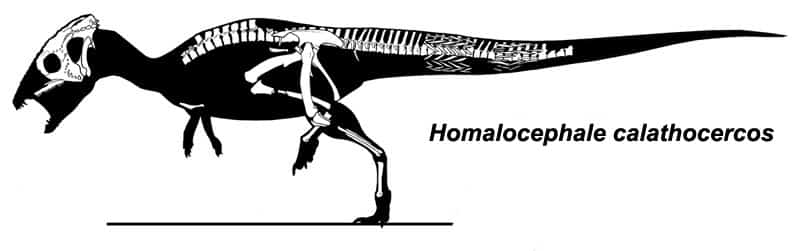
The holotype first carried the number G.I. No. SPS 100/51 at the Geological Institute of the Mongolian Academy of Sciences in Ulaanbaatar. In 1982, it became GI SPS 100/1201, and today studies cite it as MPC-D 100/1201. As described in 1974, it includes a skull without the lower jaws, missing the nasals, front frontals, supraorbitals, prefrontals, and right cheek arch. Behind the head come two sternal plates (breastbone elements), ten rear back vertebrae with ribs, and six sacral (hip) vertebrae. Next come 29 vertebrae behind the hips with caudal ribs, pelvic bones, partial hind limbs, and many free tail tendons. In fact, apart from the skull, only those two sternal bones represent the front half of the body.
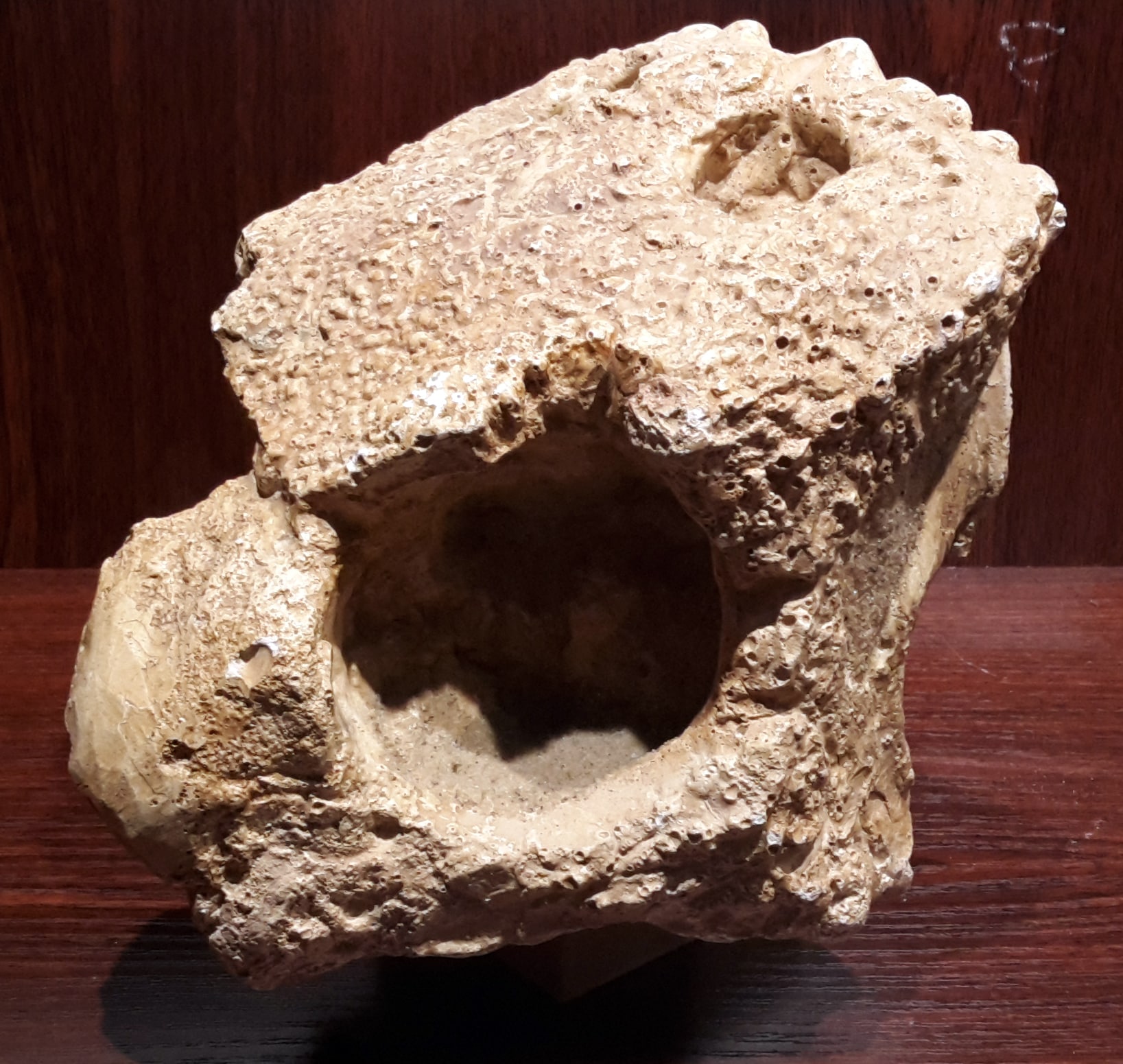

Even so, its describers called the preserved vertebral column the most complete then known in Pachycephalosauridae. By 1982, it still preserved the most complete sacropelvic (sacrum and hip) region known for these animals. As of 2018, it remained the only described specimen of Homalocephale, and none has been described since.
Homalocephale Size and Description
Homalocephale is known from a single partial skeleton, so its portrait rests on one animal—and an immature one at that.
Short description of Homalocephale
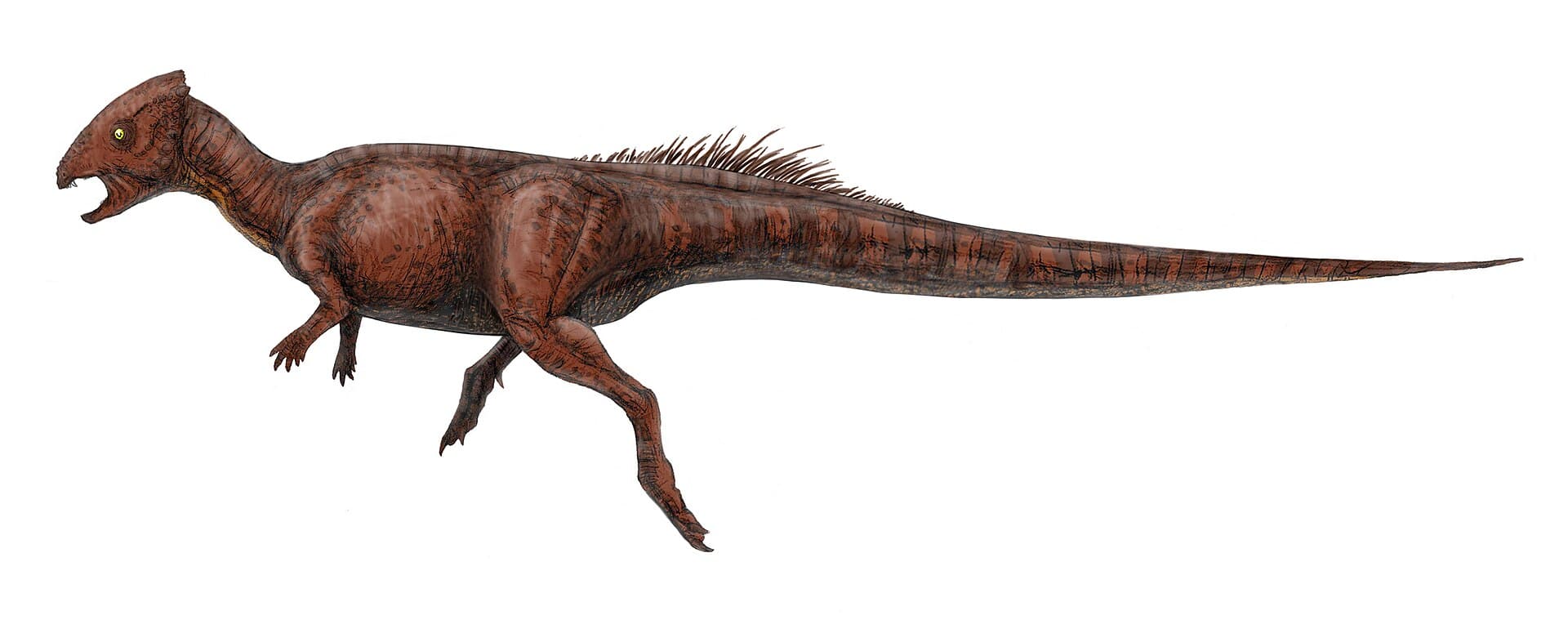
The skull roof is completely flat, built from thick parietal and frontal bones, and it slopes forward. Distinct sutures, or seams between bones, divide the frontals from each other and from the parietals, although the parietals themselves have fused. The supratemporal fenestrae—openings on the skull roof behind the eyes—are large, and the orbits (eye sockets) are large and nearly round. A rough, pitted ornament covers the roof. Its describers found it most like that of Yaverlandia bitholus from England—a fossil later work has removed from the pachycephalosaurs. The upper teeth sit in a single row with small crowns. Because the lower jaws and premaxillae (front upper jaw bones) are missing, the front of the mouth remains unknown.
Farther back, the 1974 authors saw the sternum as further evidence that pachycephalosaurids walked on two legs. They also concluded that the family held the back horizontal while moving. In the hips, the ilium and ischium completely closed the acetabulum (hip socket). As in Pachycephalosaurus, the pubis itself was small and reduced. Like other pachycephalosaurs, it had an extremely broad pelvis for a bipedal dinosaur. No skin impressions survive, so any discussion of its outer covering is speculative.
Behind the hips, a basket of ossified tendons surrounded the rear of the tail. In 2012, paleontologists C.M. Brown and A.P. Russell studied an articulated set on its left side, from the 14th to the 20th tail vertebra. There, the elements form six parallel rows of spindle-shaped “tendons.” Brown and Russell reinterpreted them as myorhabdoid ossifications—bony tendons from the sheets between muscle blocks—and the first recognized in any tetrapod (four-limbed vertebrate). In their view, these elements may have helped stiffen the tail.

Size and Weight of Type Species
Only one peer-reviewed study gives a body size. In 2014, Benson and colleagues estimated about 85 pounds (38.5 kilograms) from the girth of the holotype’s femur (thigh bone). Because that individual was immature, a full-grown adult was probably heavier. No peer-reviewed length or hip height exists, however. The 1974 paper tabulates measurements of individual bones, but not of the whole animal.
Maryańska and Osmólska found its skull about the same size as that of Prenocephale prenes. It was also larger than any then-known skull of Stegoceras validum, a domed relative. Its ilium, the main hip bone, matched that of Prenocephale as well.
In 1982, Perle and colleagues described Goyocephale as almost the same size as the Homalocephale and Prenocephale specimens. They also gave the flat-headed family a range of about 2 to 4.9 feet (60 to 150 centimeters) in total length. That range covers the family as a whole, though, not Homalocephale itself.
The Dinosaur in Detail
What sets this dinosaur apart is a thick yet completely flat skull roof with open sutures. Its describers said this combination distinguished it from every pachycephalosaur then known. Compared with Prenocephale, its roof is narrower in rear view and does not overhang the back of the skull. Its upper teeth also carry fewer ridges on their crowns. In 1982, Perle and colleagues added a sacrum of six fused vertebrae and an ilium whose rear blade curves downward. They judged Goyocephale more primitive than Homalocephale—a possible clue that the Goyocephale beds are older.

Its growth stage has drawn the most debate. In 1974, Maryańska and Osmólska argued that these features were not signs of youth, since the skull outsized any known Stegoceras. Later reviews credit paleontologists Jack Horner and Mark Goodwin with proposing in 2009 that flat-headed forms could be juveniles of domed species. According to Evans and colleagues (2018), Longrich, Sankey, and Tanke suggested in 2010 that H. calathocercos was a juvenile or female form of Prenocephale prenes. Yet in 2011, Schott and colleagues noted that open sutures and skull-roof openings also fit an adult of a primitive, undomed species.
Also in 2011, paleontologist David Evans and colleagues found the holotype immature. As their later work reports, they cautioned against merging the two genera until cranial variation and bone tissue were better understood. Their 2013 phylogeny placed Homalocephale closer to fully domed taxa than to Stegoceras, which they said supports the juvenile hypothesis. In 2018, however, new Prenocephale skulls showed squamosal (rear-corner skull bone) ornament that stayed consistent across sizes. Evans and colleagues concluded that this reinforces the split, and studies in 2021 and 2025 treat the genera as separate. Taken together, recent work keeps it a distinct genus—one known from a single growing individual.
Interesting Points about Homalocephale
- Among pachycephalosaurs studied in 2012, its holotype showed the most extensive set of articulated tail ossifications still in place.
- A 2013 survey of skull injuries checked its frontoparietal, the fused skull-roof bone, and found no sign of damage.
- In 1982, Perle and the two original describers suggested it may have had caniniform (canine-like) teeth, like the related Goyocephale.
- Its species name means “basket tail,” after the woven-looking network of tendons around its tail.
Dinosaurs from the Same Formation
Also known from the Nemegt Formation (exact level relative to Homalocephale not known): the domed pachycephalosaurid Prenocephale, the large tyrannosaurid Tarbosaurus, the hadrosaurids Saurolophus and Barsboldia, the giant ornithomimosaur Deinocheirus and the therizinosaur Therizinosaurus. Prenocephale prenes comes from the same locality, and Maryańska and Osmólska placed both pachycephalosaurs in a zone named for Tarbosaurus bataar and Saurolophus angustirostris, but no bed is recorded. Tarbosaurus has its type locality at Nemegt, and tyrannosaurid remains rank among the formation’s most common dinosaur fossils. The Gobi rocks are hard to date, so these animals may not all have lived at the same time.
Homalocephale in its Natural Habitat
The world Homalocephale roamed was a land of rivers—with drier, wind-swept country not far behind in time. A 2012 study summarizes the Nemegt Formation as a mainly fluvial (river) setting laid down under more humid conditions. Most of its fossils come from channel fills, point bars (sandbanks on river bends), and some overbank deposits. Beneath it lies the Baruungoyot Formation, which records semi-arid to arid conditions with recurring wind-blown beds. At the Nemegt locality, the two formations interfinger over about 82 feet (25 meters), so wind-blown and river settings coexisted when Nemegt deposition began.
While there is no direct evidence of what Homalocephale ate, it may have fed on plants and insects, as its describers proposed for the family. Its upper teeth show extensive wear on their inner surfaces. The 1974 authors also credited the family with keen vision and a good sense of smell.
In 2018, Evans and colleagues doubled the known pachycephalosaur specimens from the Nemegt Formation. Even so, no fossil yet shows whether Homalocephale lived alone or in groups.
Frequently Asked Questions
It means “even head,” for its flat skull roof, and the species name calathocercos means “basket tail.”
It lived in the Late Cretaceous, during the late Campanian to early Maastrichtian stages. No reliable radiometric date has been published for its rocks.
No peer-reviewed length exists. A 2014 study estimated its immature skeleton at about 85 pounds (38.5 kilograms), and its skull matched Prenocephale in size.
It may have eaten plants and insects, as its describers proposed for its family.
Its skeleton came from the Nemegt locality in the Nemegt Formation of Mongolia’s Gobi Desert.
Its thick but completely flat skull roof with open sutures set it apart from the pachycephalosaurs known in 1974.
Sources
The information in this article is based on various sources, drawing on scientific research, fossil evidence, and expert analysis. The aim is to provide a comprehensive and accurate overview of Homalocephale. However, please be aware that our understanding of dinosaurs and their world is constantly evolving as new discoveries are made.
- https://www.palaeontologia.pan.pl/Archive/1974_30_45-102_22-31.pdf
- https://app.pan.pl/archive/published/app27/app27-115.pdf
- https://pmc.ncbi.nlm.nih.gov/articles/PMC3260247/
- https://pmc.ncbi.nlm.nih.gov/articles/PMC3126802/
- https://www.nature.com/articles/ncomms2749
- https://www.sciencedirect.com/science/article/abs/pii/S0031018217306685
- https://pmc.ncbi.nlm.nih.gov/articles/PMC8667728/
- https://pmc.ncbi.nlm.nih.gov/articles/PMC3712952/
- https://pmc.ncbi.nlm.nih.gov/articles/PMC9436104/
- https://pmc.ncbi.nlm.nih.gov/articles/PMC12397203/
- https://www.app.pan.pl/archive/published/app48/app48-161.pdf
- https://pmc.ncbi.nlm.nih.gov/articles/PMC3275628/
- https://pmc.ncbi.nlm.nih.gov/articles/PMC4605499/
- https://pmc.ncbi.nlm.nih.gov/articles/PMC3272031/
- https://journals.plos.org/plosbiology/article?id=10.1371/journal.pbio.1001853
- https://www1.ous.ac.jp/garden/kenkyuhoukoku/28/Naturalistae_No28_p7-13.pdf
- https://app.pan.pl/archive/published/app54/app54-021.pdf
- https://paleobiodb.org/data1.2/occs/list.json?base_name=Homalocephale&show=full
- https://paleobiodb.org/data1.2/colls/single.json?id=180473&show=full
This article was last fact checked: TheDinosaurs Team, 13-11-2026
Featured Image Credit: J. Spencer, CC BY 4.0, via Wikimedia Commons
