
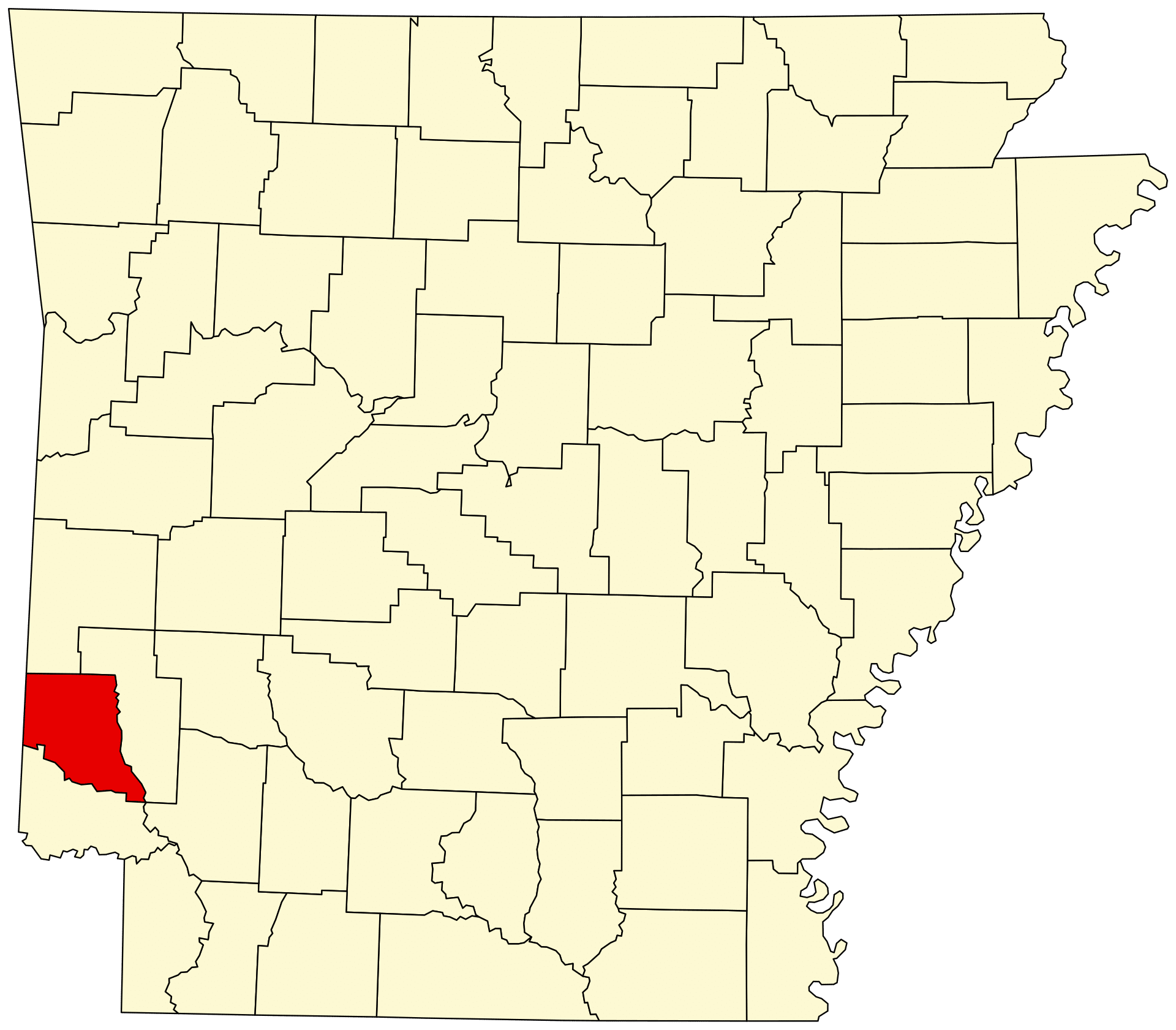
In southwestern Arkansas, near the small community of Lockesburg, a gravel pit cut into the Lower Cretaceous Trinity Group. Those beds yielded Arkansaurus fridayi, an ornithomimosaur—one of the “ostrich-mimic” dinosaurs—formally named in 2018. Its describers placed it in the Aptian and Albian stages. Because the fossil bed lies above the Albian De Queen Formation, it is probably Albian in age. Known from a single foot, it was also the first dinosaur fossil found in Arkansas. In 2017, the state made it its official dinosaur.
The story began in August 1972, when Joe B. Friday found the bones on his land. Paleontologist James H. Quinn reported them a year later, but he died in 1977, long before the animal had a formal name. Decades afterward, ReBecca K. Hunt (now Hunt-Foster) took up the fossils as a University of Arkansas undergraduate. In 2018, she named the species with Quinn as a posthumous co-author. That is a long road for one foot—but it still matters, because early ostrich-mimics are scarce in North America.
Arkansaurus Key Facts
| Keyword | Fact |
|---|---|
| Pronunciation | Not specified |
| Meaning of name | Arkansas Reptile |
| Group | Ornithomimosauria |
| Type Species | Arkansaurus fridayi |
| Diet | Herbivore or omnivore (Paleobiology Database coding) |
| When it Lived | Probably Albian, roughly 113–100 MYA (fossil bed lies above the Albian De Queen Formation) |
| Period | Cretaceous |
| Epoch | Early Cretaceous (Aptian to Albian stages) |
| Length | Not specified |
| Height | Not specified |
| Weight | About 839 pounds (380 kilograms), 2022 model estimate (no femur known) |
| Mobility | Moved on two legs (bipedal) |
| First Discovery | 1972 by Joe B. Friday |
| Described by | 2018 by R.K. Hunt and J.H. Quinn |
| Holotype | UAM 74-16 |
| Location of first find | Gravel pit near Lockesburg, Trinity Group, Sevier County, Arkansas, USA |
Arkansaurus Origins, Taxonomy and Timeline
EARTH Magazine renders Arkansaurus as “Arkansas’ Reptile,” after the state where the bones surfaced. The species name fridayi honors their finder, Joe Friday. Quinn was already using the informal name by 1973, and the university museum credits him with coining it before his death. Together, the name ties a lone fossil foot to both a state and the man who found it.
In 2018, Hunt and Quinn described Arkansaurus as a new ornithomimosaur, naming both a new genus and a new species. Based on its third metatarsal (a long foot bone), they judged it “more basal”—closer to the group’s root—than Asian ornithomimosaurs of similar age. It was, however, consistent with older North American forms. ZooBank’s record, as mirrored by Plazi, files it under the family Ornithomimidae, although Chinzorig and colleagues (2022) later called it “an early-diverging ornithomimosaur.” Arkansaurus fridayi is the type and only known species.
Its describers placed the fossil in the Aptian to Albian stages of the Early Cretaceous. Recent University of Arkansas articles give an age of about 113 million years, while an older university story said about 120 million. However, the bed lies above the De Queen Formation, whose ammonite Douvilleiceras supports an Albian age. That makes an age somewhat younger than 113 million years more likely. The original authors framed it within a poorly understood radiation of ornithomimosaurs in Appalachia. Chinzorig’s team, by contrast, noted that it predates the isolation of Appalachia and Laramidia—the two landmasses that North America later split into.
Discovery & Fossil Evidence
The bones came from a road-construction gravel pit on Friday’s farm near Lockesburg, in east-central Sevier County, in August 1972. Doy L. Zachry, then a geology student at the University of Arkansas, brought them to Professor James Quinn. In 1973, Quinn presented the find in an abstract titled “Arkansas dinosaur” and identified it as an ornithomimid foot. Friday then donated the fossils to the University of Arkansas Museum in 1974.

The museum says early work placed it close to Ornithomimus velox. Hunt’s 2002 abstract, by contrast, linked it closely with the Late Jurassic Ornitholestes. Accounts differ on whether she began studying the fossils in 2001, 2002, or 2003. She wrote them up in a 2003 undergraduate conference paper, and the formal name finally appeared online on March 19, 2018.
The specimen is catalogued as UAM 74-16 by both the Paleobiology Database and Chinzorig and colleagues (2022), whose tables cite individual elements as “74-16-3 – 5.” The original abstract describes a single specimen of pedal (foot) elements—”a nearly complete right foot.” Later comparisons discuss its second, third, and fourth metatarsals, several phalanges (toe bones), and the pedal unguals, or toe claws.
When it was named, the foot was the only known saurischian (lizard-hipped) dinosaur fossil from Arkansas. That changed in 2021, when Suarez and colleagues described more dinosaur bones and teeth from Howard County’s Holly Creek Formation. None of those finds belongs to Arkansaurus, and no additional specimens have been confirmed outside Friday’s pit. Besides the dinosaur, the Paleobiology Database records only one other animal from that pit, the turtle Naomichelys.
Arkansaurus Size and Description
Short description of Arkansaurus
Arkansaurus is known from the foot alone, so its skull, neck, arms, and tail remain unknown. The original diagnosis highlights differentiated pedal unguals and a laterally compressed third metatarsal that looks ovoid when viewed from its upper end. One toe claw (a distal ungual) had a very weak flexor tubercle—the bump where a toe-bending tendon attaches—and it lacked spurs.
University accounts call it bipedal, and one pictures it with strong hind legs, long forearms, a long neck, and feathers. However, those traits are general ornithomimosaur features rather than anything preserved in this fossil. Skin, feathers, and other soft tissues are not preserved, so any discussion of its outer covering is speculative.
Size and Weight of Type Species
No source reviewed gives a length or hip height for Arkansaurus, so both remain unspecified. Without a femur (thigh bone), the usual starting point for body-mass formulas is missing.
In 2022, Chinzorig and colleagues nonetheless estimated about 839 pounds (380 kilograms). Their range runs from roughly 624 to 1,054 pounds (283 to 478 kilograms). They applied a 2014 method by Campione and colleagues to a femoral circumference of 191 millimeters (7.5 inches). That circumference cannot come from a measured bone, and the table does not explain its source. The figure is therefore best read as a model estimate rather than a weighed fact.
Even so, the estimate places Arkansaurus among the earliest large-bodied ornithomimosaurs. Chinzorig’s team grouped it with the Chinese Beishanlong, both exceeding 350 kilograms (about 770 pounds).
The Dinosaur in Detail
What we know of this dinosaur comes entirely from the shape of its foot bones. In 2022, Chinzorig and colleagues noted that the upper part of the shaft of its second metatarsal had a relatively convex back surface. Its fourth metatarsal shared a subrectangular midshaft and a forward-expanded lower end with Garudimimus. Its third metatarsal ended in shallow intercondylar sulci (grooves between the joint knobs), while its toe bones bore a relatively deep ligament pit. It shares many of these traits with other early ostrich-mimics.
The foot also records a hard life. In 2019, Rothschild and Lambert reported greenstick fractures—breaks in which the bone cracks but stays connected, like a bent green twig. Such fractures, tied here to avulsion (a tendon or ligament tearing away from bone), had not been reported in dinosaurs before. They also found a spherical defect characteristic of gout—if confirmed, the first case known in an ornithomimid. A museum article adds that the greenstick fracture indicates a juvenile, a claim the paper’s abstract does not make.
According to EARTH Magazine, Hunt-Foster’s restudy compared it with Harpymimus, Beishanlong, Kinnareemimus, and Nedcolbertia, placing it on an early branch of the family tree. Her 2018 conference abstract named Nedcolbertia, “the oldest known North American ornithomimosaur,” as one older form it matched. It tied both animals more strongly to Europe’s Wealden fauna and proposed a dispersal event from Laurasia (the northern supercontinent) before or during the Barremian. During the Aptian, she argued, the Skull Creek Seaway—an inland sea—had not yet split southern North America. Taken together, the foot points to a large-bodied ostrich-mimic near the base of its lineage—one whose exact family ties await more bone.
Interesting Points about Arkansaurus
- Friday’s 1972 find was the first dinosaur fossil discovered in Arkansas, more than four decades before the species received its formal name.
- In 2017, Arkansas designated Arkansaurus fridayi its official state dinosaur, joining what the resolution counted as nine other states with one.
- The 2017 resolution noted that the name “remains, for now, the unofficial name”—the formal description followed in 2018.
- According to EARTH Magazine, the push for a state dinosaur came from a student, Mason Cypress Oury, who lobbied lawmakers for years.
- In 2002, Hunt proposed the foot as a possible maker of smaller tracks in Texas’s Glen Rose Formation, citing their size and shape.
Arkansaurus in its Natural Habitat
The world Arkansaurus roamed lay close to the sea. The Paleobiology Database codes its locality as marginal marine, in silty fine sands near the top of the Trinity Group. Meanwhile, much of Texas lay underwater, with a shoreline within 100 miles (about 160 kilometers) of southern Arkansas, according to the university. Nearby De Queen rocks preserve extensive sauropod trackways along the ancient Gulf of Mexico shore, plus theropod tracks found more recently. Later, as Suarez’s team summarizes Andrzejewski and Tabor (2020), the shift into the Cenomanian coincided with a change from cool, dry to warm, wet conditions.
No study of Arkansaurus itself addresses its diet, but the Paleobiology Database codes it as a herbivore or omnivore. A 2018 University of Arkansas article did call it “a fast runner and a fearsome predator.” That is a press description, however, and ornithomimosaurs are generally interpreted as plant-eaters or omnivores.
Other Trinity Group animals in Arkansas come from a lower level. Suarez and colleagues place the Holly Creek Formation below the De Queen, whereas Hunt’s 2002 abstract puts the Lockesburg find above it. At Howard County’s Briar Site, they described juvenile Acrocanthosaurus material, Deinonychus teeth, possible Richardoestesia and Sauroposeidon, and a nodosaurid. Frogs, lizards, crocodyliforms, mammals, and Naomichelys lived there too, among pollen cones (Classostrobus arkansensis) attached to shoots of the conifer Pseudofrenelopsis parceramosa. That Gulf Coast community, dominated by semi-aquatic animals, belonged to a low-diversity fauna stretching from Montana to Maryland.
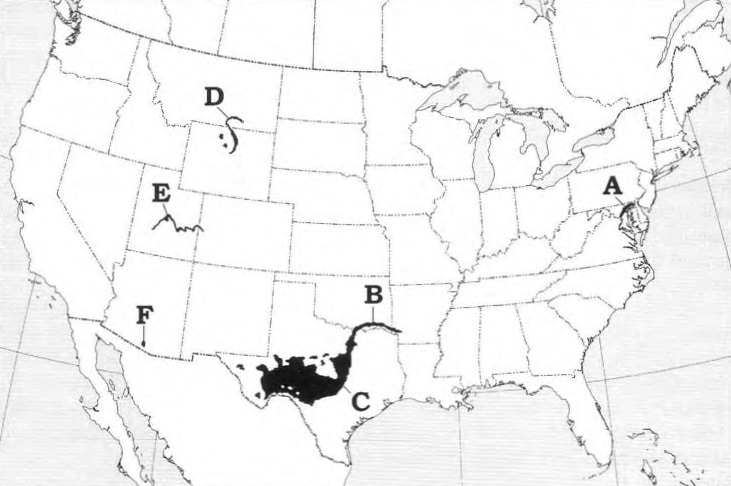

Acrocanthosaurus, Deinonychus, Tenontosaurus, and Sauroposeidon are also known from the broadly coeval Antlers Formation of Oklahoma. Suarez’s team considers that formation likely equivalent to the lower Holly Creek. No study ties its sites to the Lockesburg bed. While there is no direct evidence of how Arkansaurus lived, its injured foot shows that it survived at least one traumatic injury.
Frequently Asked Questions
EARTH Magazine renders it “Arkansas’ Reptile,” and the species name fridayi honors the finder, Joe B. Friday.
Its describers say the Aptian–Albian of the Early Cretaceous, but its rock layer points to the Albian, roughly 113 to 100 million years ago.
Its length is not specified. A 2022 model estimated about 839 pounds, although no thigh bone is known.
It was an ornithomimosaur, or ostrich-mimic, which later work describes as an early-diverging member of the group.
Joe B. Friday found it in 1972 in a gravel pit near Lockesburg, in Sevier County, Arkansas.
It was the first dinosaur fossil found in Arkansas, and since 2017 it has been the official state dinosaur.
Sources
The information in this article is based on various sources, drawing on scientific research, fossil evidence, and expert analysis. The aim is to provide a comprehensive and accurate overview of Arkansaurus. However, please be aware that our understanding of dinosaurs and their world is constantly evolving as new discoveries are made.
- https://doi.org/10.1080/02724634.2017.1421209
- https://api.openalex.org/works/doi:10.1080/02724634.2017.1421209
- https://tb.plazi.org/GgServer/xhtml/FEBC501F05FA945D24023A267BEE78C2
- https://studio.m-anage.com/gsa/2002AM/webprogram/Paper35925.html
- https://studio.m-anage.com/gsa/2018SC/webprogram/Paper310439.html
- https://doi.org/10.1371/journal.pone.0266648
- https://doi.org/10.7717/peerj.12242
- https://doi.org/10.1080/08912963.2019.1693558
- https://arkleg.state.ar.us/Bills/Detail?id=HCR1003&ddBienniumSession=2017%2F2017R
- https://arkleg.state.ar.us/Home/FTPDocument?path=%2FBills%2F2017R%2FPublic%2FHCR1003.pdf
- https://paleobiodb.org/data1.2/colls/single.json?id=55531&show=full
- https://paleobiodb.org/data1.2/occs/list.json?coll_id=55531&show=full
- https://paleobiodb.org/data1.2/refs/single.json?id=55606&show=both
- https://www.geology.arkansas.gov/docs/pdf/geology/Dinosaur-remains.pdf
- https://arkansasresearch.uark.edu/alum-confirms-state-dino-is-a-new-species
- https://fulbrightreview.uark.edu/?p=31546
- https://news.uark.edu/articles/11746/tracking-down-clues-to-the-origin-of-arkansasrsquo-only-dinosaur-fossils
- https://www.earthmagazine.org/article/benchmarks-february-17-2017-arkansas-gets-state-dinosaur
This article was last fact checked: TheDinosaurs Team, 16-11-2026
Featured Image Credit: Nobu Tamura, CC BY-SA 4.0, via Wikimedia Commons
