
On Marathon Station, east of Richmond in north-western Queensland, Australia, buff-gray limestone concretions weather out of a rock unit called the Allaru Mudstone. These mudstones settled in an inland sea, yet one concretion held a land animal—the armored dinosaur Kunbarrasaurus ieversi. It lived in the late Albian stage of the Early Cretaceous, or possibly the early Cenomanian. When it was named in 2015, its describers called it the most complete ankylosaurian fossil from Gondwana, the southern supercontinent. Its skull is also one of only a few among ankylosaurs in which most of the sutures remain visible.
In November 1989, Ian Ievers noticed fossil bone in the concretions while resting on an outcrop, then contacted the Queensland Museum. The museum collected the skeleton in January 1990. In 1996, paleontologist Ralph E. Molnar described it as Minmi sp., a referral that later authors said rested solely on its paravertebrae—bony elements lying alongside the backbone. Nearly two decades later, paleontologist Lucy G. Leahey and four colleagues gave the animal a genus of its own. It became only the second ankylosaurian genus named from Australia.
Kunbarrasaurus Key Facts
| Keyword | Fact |
|---|---|
| Pronunciation | koon-ba-rah-sore-rus (as given in a 2015 University of Queensland release) |
| Meaning of name | Ievers’ Shield Lizard |
| Group | Ankylosauria (Parankylosauria in some later analyses, an early-diverging ankylosaurid in others) |
| Type Species | Kunbarrasaurus ieversi |
| Diet | Herbivore |
| When it Lived | Late Albian, possibly early Cenomanian (no numeric age given in the naming paper) |
| Period | Cretaceous |
| Epoch | Early Cretaceous (late Albian stage) |
| Length | 8.2 to 11.5 feet (2.5 to 3.5 meters), 1996 estimate |
| Height | Not specified |
| Weight | Not specified |
| Mobility | Moved on all four legs (quadrupedal) |
| First Discovery | 1989 by Ian Ievers |
| Described by | 2015 by L.G. Leahey, R.E. Molnar, K. Carpenter, L.M. Witmer, and S.W. Salisbury |
| Holotype | QM F18101 |
| Location of first find | Allaru Mudstone, Marathon Station near Richmond, north-western Queensland, Australia |
Kunbarrasaurus Origins, Taxonomy and Timeline
The name Kunbarrasaurus draws on two languages. “Kunbarra” is the word for “shield” in the Mayi (Wunumara) language, while the Greek “sauros” means “lizard.” The shield refers to its heavily ossified skin—skin reinforced with bone. The species name ieversi honors Ian Ievers, who found the skeleton. Together, the name means “Ievers’ shield-lizard.”
In the 2015 scheme, Kunbarrasaurus sits within Ornithischia and Thyreophora, the armored ornithischians. It then falls within Eurypoda, which unites ankylosaurs with their sister group, the stegosaurs, and finally within Ankylosauria. Earlier studies treated QM F18101 and Minmi together but split between two placements. Some recovered the pair outside the two main ankylosaur clades, Nodosauridae and Ankylosauridae, whereas others found a basal ankylosaurid. Leahey and colleagues supported a basal ankylosaurian position but left a new phylogenetic analysis for the postcranial description. Kunbarrasaurus ieversi is the type and only known species.
The Allaru Mudstone is dated mainly by fossil pollen and spores, which place it in the late Albian and possibly the early Cenomanian. Leahey’s team kept that cautious range, though they noted that 2013 zircon dating by Tucker and colleagues pointed to a late Albian age only. In either case, Kunbarrasaurus lived at or near the close of the Early Cretaceous. At that time, eastern Queensland formed a peninsula on a map Molnar redrew from Dettmann and colleagues (1992).
Discovery & Fossil Evidence
Ievers later found blocks with parts of the neck and shoulder girdle, sent them in, and donated the specimen. In 1996, Molnar called it the most complete dinosaurian specimen yet found in Australia. He saw paravertebrae as a defining trait of Minmi. That genus’s type species, Minmi paravertebra, comes from the older Bungil Formation near Roma.
However, the 2015 team found many diagnostic differences between this skull and those of other ankylosaurians. Preliminary work on the rest of the skeleton revealed significant differences from the M. paravertebra holotype. The status of Minmi itself is debated—paleontologists Victoria Arbour and Philip Currie treated M. paravertebra as a nomen dubium, a name of doubtful validity. Leahey’s team, however, still considered it a distinct genus. In 2022, paleontologist Timothy G. Frauenfelder and colleagues also wrote that comparisons support their differentiation.
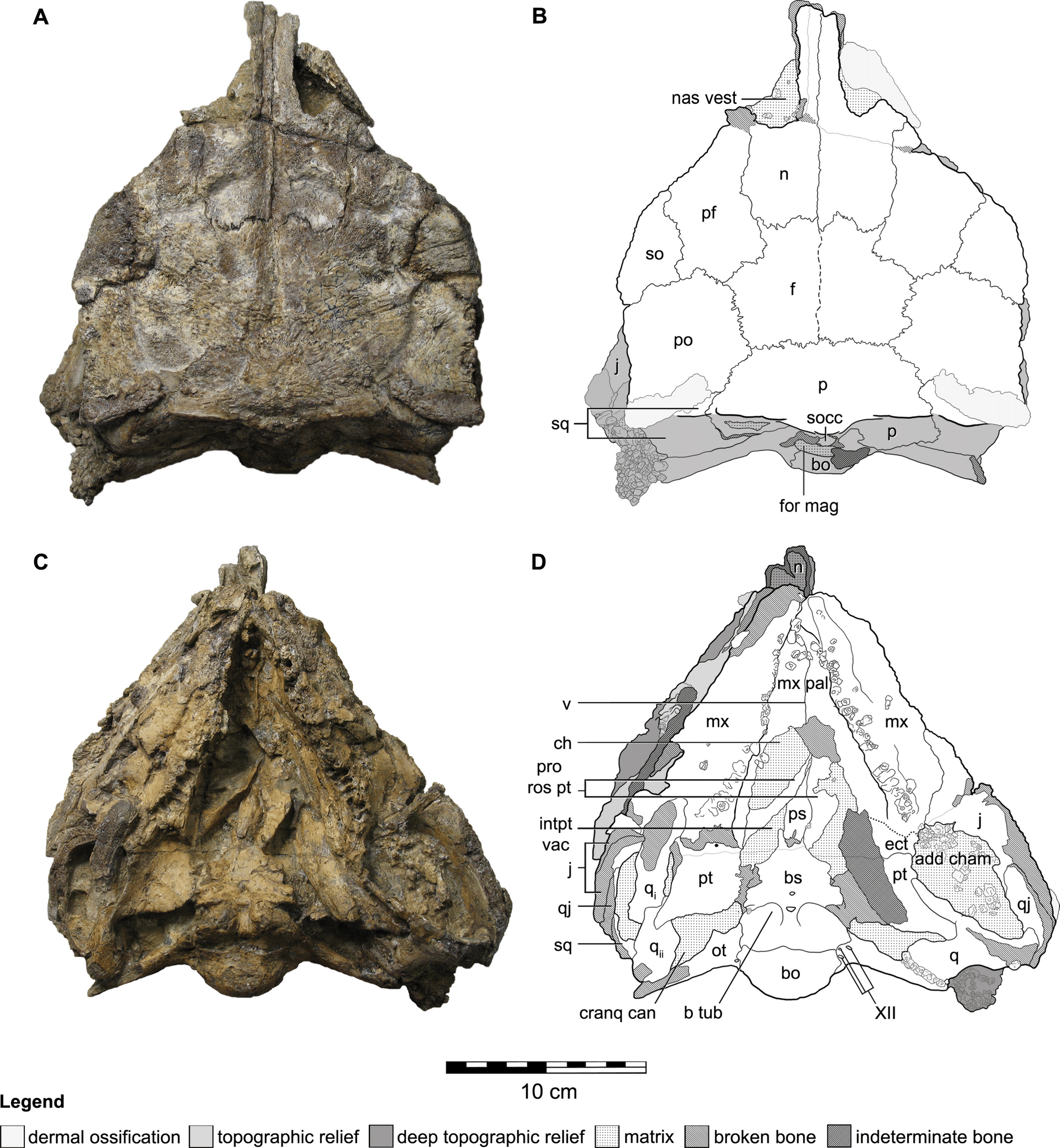

The holotype, QM F18101, includes most of the skull and mandible (lower jaw), plus an articulated postcranium—the skeleton behind the head, still joined. According to Molnar, the backbone survives back to probably the ninth caudal (tail) vertebra. The tail end and lower parts of both left limbs are missing, but both femora (thigh bones) are essentially complete. Sediment and calcite inside one neural canal (the channel for the spinal cord) show that the trunk lay upside down.
The 2015 paper listed five other Queensland specimens earlier referred, mostly tentatively, to Minmi. None has been assigned to Kunbarrasaurus. In 2022, Frauenfelder’s team assigned a partial skull, SAMA P40536, from the Toolebuc Formation near Boulia to cf. Kunbarrasaurus sp.—”cf.” marking a provisional match. They admitted the referral is not unambiguous, since the two skulls share little overlapping anatomy. If correct, it extends the genus about 550 kilometers (340 miles) southwest and into older rock.
Kunbarrasaurus Size and Description
The skeleton shows a small, armored quadruped, while CT scans of the skull reveal much of its inner anatomy.
Short description of Kunbarrasaurus
The skull was about 30 percent longer than wide and pentagonal from above, widest just behind the eye sockets. It is about 90 percent complete, though the snout tip is not preserved. The antorbital, supratemporal, and lateral temporal fenestrae (openings in the skull) were closed. Leahey’s team found no horn- or boss-like plates on the cheek (quadratojugal) or rear skull corner (squamosal). The skull’s bony plates were flat or only shallowly keeled. Its upper teeth carry a cingulum—a raised collar near the crown base—on both sides. With only seven marginal denticles (edge serrations), they struck the authors as more nodosaurid-like than ankylosaurid-like.
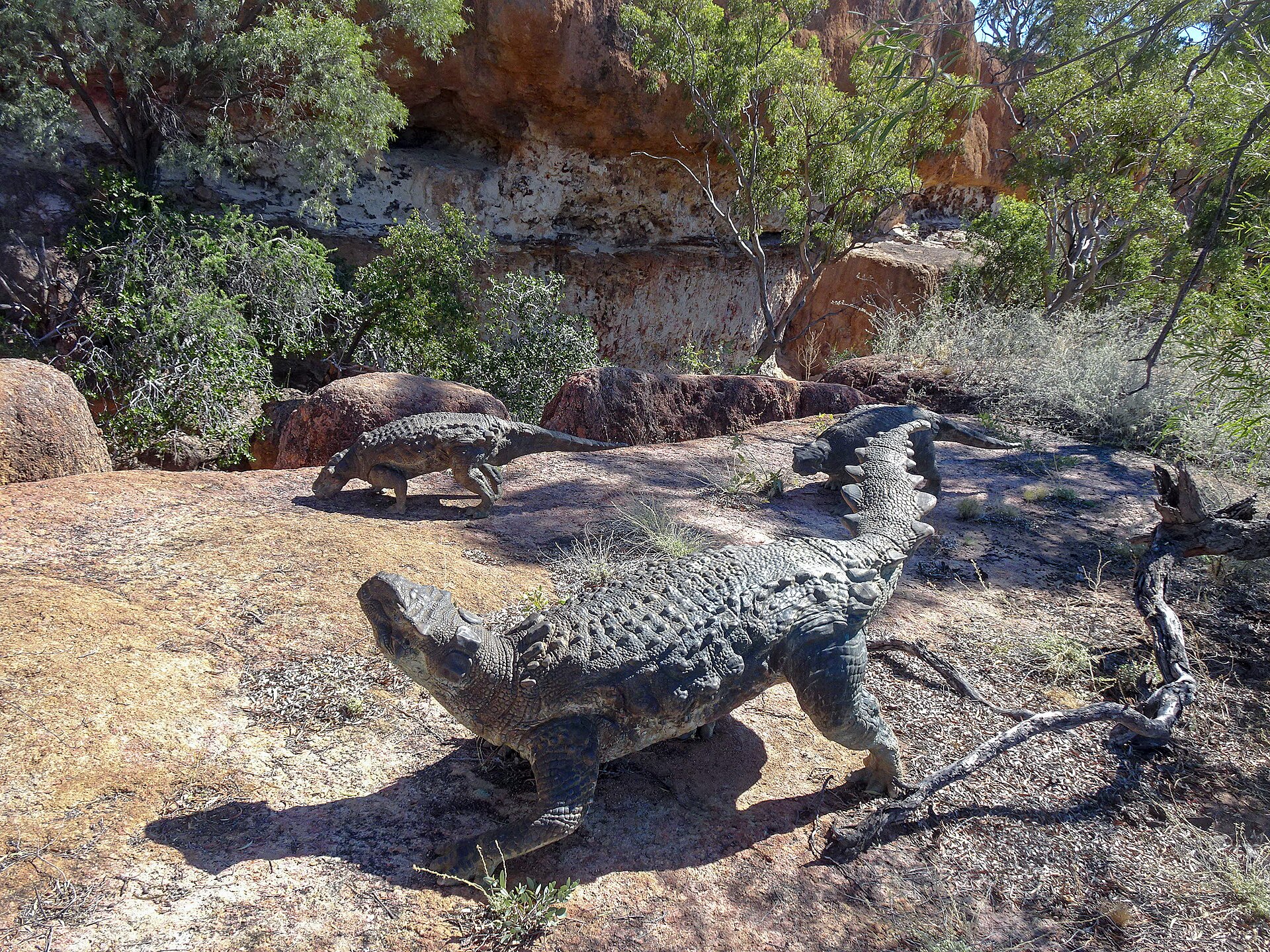
Behind the head, Molnar described armor over the neck, trunk, tail, and limbs. Large scutes guarded the neck, shoulders, and hips. Along the left ilium (hip bone) ran three tear-drop plates up to 10.5 by 7 centimeters (4.1 by 2.8 inches). He inferred that small ossicles (tiny bony nodules), each about 4 by 6 millimeters, probably covered the neck, back, and limbs. In his view, a “chain-mail” of ossicles protected the belly. He saw no indication of a tail club, and the preserved tail suggests some flexibility.

Size and Weight of Type Species
In 1996, Molnar estimated that the animal was probably 8.2 to 11.5 feet (2.5 to 3.5 meters) long when complete. He did not state his method, and the tail tip is missing. Leahey’s team later noted that the other specimens then assigned to “Minmi” were all roughly 8.2 to 9.8 feet (2.5 to 3 meters) long. A 2021 preprint by paleontologist Sergio Soto-Acuña and colleagues called it small-sized, at about 8.2 feet (2.5 meters).
We found no published estimate of its hip height or body mass. However, a 2015 University of Queensland release described it as a “sheep-sized herbivore.” Leahey’s team, agreeing with Molnar, treated the holotype as an almost mature or newly mature individual. Molnar also suggested that Minmi, as then understood, may have evolved on an Aptian island in eastern Queensland. If so, he added, a small adult size is plausible.
The skull gives firmer numbers. In 2015, electronic calipers put the cranium at 251 millimeters (9.9 inches) long and about 195 millimeters (7.7 inches) wide. Molnar had measured it at 240 millimeters as preserved.
The Dinosaur in Detail
What sets this dinosaur apart is how readable its skull remains. In most ankylosaurs, armor or remodeling has obliterated the sutures, but Kunbarrasaurus keeps most visible. This let Leahey’s team conclude that its antorbital and supratemporal openings most likely closed as the surrounding bones expanded, not because osteoderms grew over them. Its diagnosis also lists a single supraorbital (above-the-eye) bone, a maxilla (upper jawbone) spanning the full skull height, and a very pronounced coronoid process on the lower jaw.
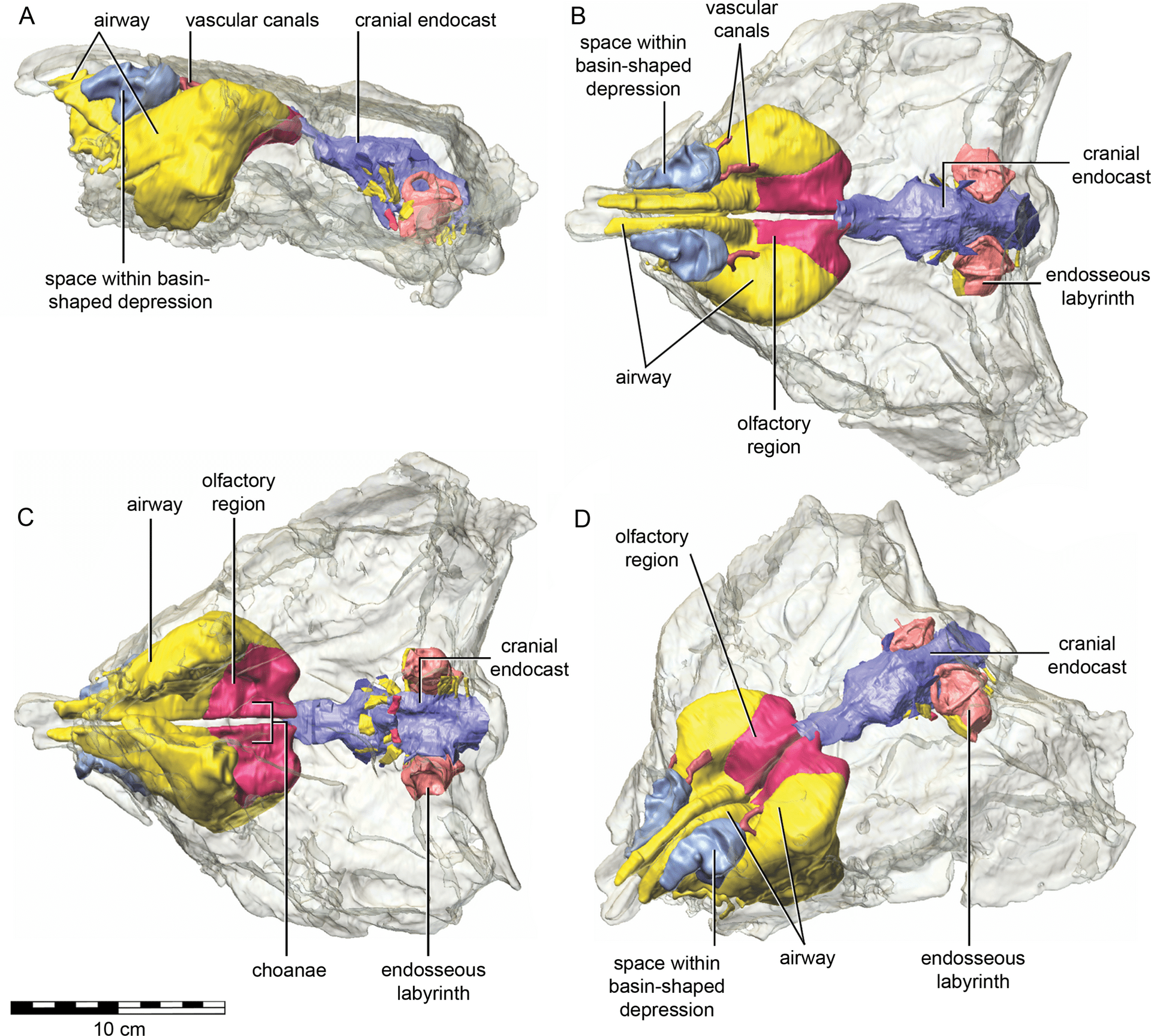

Inside the skull, CT scans showed airways more complicated than in non-ankylosaurian dinosaurs, yet simpler than in derived ankylosaurs. The endocast spans about 40 percent of skull length, compared with about 25 percent in Euoplocephalus. Most striking is the inner ear. Despite a shorter skull, it is roughly twice the length and width of those in Euoplocephalus and Stegosaurus. Its vestibule, the balance chamber, is spherical and more like that of turtles and Sphenodon (the tuatara). It also opens to the braincase cavity—a condition previously unreported in dinosaurs. The authors call its functional consequences obscure.
The describers saw an unusual melange of primitive and derived characters. Overall, the skull is shaped more like those of Scelidosaurus and Cedarpelta than that of Pinacosaurus. Its almost “embryonic” braincase and inner ear even led them not to rule out paedomorphosis—keeping juvenile traits into adulthood. In 2021, Soto-Acuña and colleagues grouped it with Chile’s Stegouros and Antarctica’s Antarctopelta in Parankylosauria, a Gondwanan clade that split earliest from all other ankylosaurs. A year later, Frauenfelder’s team also recovered K. ieversi within Parankylosauria, though not the exact 2021 tree. However, in 2023, Thomas J. Raven and colleagues recovered it as an early-diverging ankylosaurid in a broader armored-dinosaur analysis. They also found Antarctopelta not closely related to it, so its placement remains debated.
Interesting Points about Kunbarrasaurus
- Its name pairs the Mayi word “kunbarra,” meaning shield, with the Greek “sauros,” and its species name honors the finder, Ian Ievers.
- In 2015, its describers ranked it the most complete dinosaurian fossil from eastern Gondwana and one of the world’s most complete ankylosaurians.
- Its inner ear is proportionally enormous, with a spherical vestibule open to the braincase that its describers called previously unreported in dinosaurs.
- For nearly two decades after Molnar’s 1996 study, it carried the label Minmi sp., until gaining its own genus in 2015.
Dinosaurs from the Same Formation
Also known from the Allaru Mudstone (exact level relative to Kunbarrasaurus not known): the ornithopod Muttaburrasaurus sp. and the sauropod Austrosaurus mckillopi, both from other localities. Leahey and colleagues date the formation to the late Albian, possibly reaching into the early Cenomanian, so these animals may not all have lived at the same time.
Kunbarrasaurus in its Natural Habitat
Though a land animal, Kunbarrasaurus was buried in an inland sea. Its bones lay in a silty limestone concretion, within a formation of blue-gray, partly pyritic mudstones interbedded with calcareous siltstones and cone-in-cone limestone. Marine fossils and fine mud suggest low-energy, shallow marine waters. Alongside the skeleton lay abundant shell plates of the bivalve Inoceramus, a few teeth of the shark Echinorhinus, and part of an ammonite. Elsewhere, the formation preserves belemnites, bony fish, the ichthyosaur Platypterygius australis, elasmosaurid plesiosaurs, and possibly the marine reptile Notochelone costata. At other Allaru localities, finds include pterosaurs and two ankylosaur specimens near Hughenden.
This herbivore may also preserve traces of what it ate. In 2020, paleontologist Caleb M. Brown and colleagues reported that Molnar and Clifford had described a cololite—fossilized gut contents—with vascular plant tissue, seed-bearing bodies, and possible sporangia (spore cases). Brown’s team judged it well supported, meeting 10 of 16 criteria, but cautioned that it does little to inform on diet. It sat near the front of the hips, left of the midline—almost the same position as in the armored Borealopelta.
How it reached the sea remains a matter of inference. Molnar reasoned that the body presumably washed out to sea and floated awhile before sinking. He saw no tooth marks, though he thought the shark teeth might mean a little scavenging after it sank. Instead of bloating and rupture, he favored mummification, because the back armor had sunk in between the ribs. Mummification, he noted, implies an extended, perhaps seasonal, dry period followed by rains. Afterward, carbonate formed directly around the skeleton, possibly preserving the body’s rough outline—a vivid case of how dinosaur fossils form.
Frequently Asked Questions
It means “Ievers’ shield-lizard,” combining the Mayi word for shield, the Greek “sauros,” and the name of finder Ian Ievers.
It lived in the late Albian stage of the Early Cretaceous, or possibly the early Cenomanian.
In 1996, Molnar estimated a length of 8.2 to 11.5 feet (2.5 to 3.5 meters). We found no published estimate of its height or weight.
It was a herbivore, and its abdomen preserves gut contents with plant tissue and seed-bearing bodies.
It was found on Marathon Station near Richmond, north-western Queensland, Australia, in rocks of the Allaru Mudstone.
Its skull keeps most sutures visible, and its enormous inner ear has a spherical vestibule open to the braincase.
Sources
The information in this article is based on various sources, drawing on scientific research, fossil evidence, and expert analysis. The aim is to provide a comprehensive and accurate overview of Kunbarrasaurus. However, please be aware that our understanding of dinosaurs and their world is constantly evolving as new discoveries are made.
- https://doi.org/10.7717/peerj.1475
- https://pmc.ncbi.nlm.nih.gov/articles/PMC4675105/
- https://www.biodiversitylibrary.org/part/303873
- https://www.frontiersin.org/articles/10.3389/feart.2022.803505/full
- https://www.nature.com/articles/s41586-021-04147-1
- https://www.researchsquare.com/article/rs-821192/v1
- https://pmc.ncbi.nlm.nih.gov/articles/PMC7353971/
- https://spiral.imperial.ac.uk/handle/10044/1/48659
- https://news.uq.edu.au/2015-12-08-australias-new-armoured-dinosaur-unveiled
- https://doi.org/10.1080/14772019.2023.2205433
- https://research.brighton.ac.uk/en/publications/the-phylogenetic-relationships-and-evolutionary-history-of-the-ar/
- https://doi.org/10.1080/03115511003663939
This article was last fact checked: TheDinosaurs Team, 16-11-2026
Featured Image Credit: Lucy G. Leahey, Ralph E. Molnar, Kenneth Carpenter, Lawrence M. Witmer, Steven W. Salisbury, CC BY 4.0, via Wikimedia Commons
