
Deep in the Nemegt Basin of Mongolia’s Gobi Desert, a canyon called Central Sayr cuts through the red beds of the Nemegt Formation. On its west side, those rocks once held a nearly complete sauropod skull. In 1971, it became the holotype of Nemegtosaurus mongoliensis, a herbivore of the Late Cretaceous. Geologists usually place these rocks early in the Maastrichtian stage, about 72 million years ago, though no one has dated them directly. Because few titanosaur skulls exist, this one is all the more valuable. Yet the rest of its body remains uncertain—a gap at the heart of a long-running debate over its identity.
The skull turned up in June 1965, when Kuczyński of the Polish-Mongolian Palaeontological Expedition spotted it during a short side trip. Paleontologist Aleksander Nowiński named the animal six years later. In 2005, paleontologist J.A. Wilson published a full redescription. It firmly supported a view first put forward in the 1990s—that this was a titanosaur, not a relative of Dicraeosaurus. Then, in 2016, a team relocated the long-lost quarry and found leg and tail bones that may belong to the same animal. Its story shows how much one skull can reveal—and how much it leaves unsaid.
Nemegtosaurus Key Facts
| Keyword | Fact |
|---|---|
| Pronunciation | Not specified |
| Meaning of name | Nemegt Lizard (after the Nemegt Basin) |
| Group | Sauropoda (Titanosauria, Nemegtosauridae) |
| Type Species | Nemegtosaurus mongoliensis |
| Diet | Herbivore |
| When it Lived | Around 72 MYA (probably early Maastrichtian, not directly dated) |
| Period | Cretaceous |
| Epoch | Late Cretaceous (Maastrichtian stage) |
| Length | Not specified |
| Height | Not specified |
| Weight | Not specified |
| Mobility | Not specified |
| First Discovery | 1965 by Kuczyński (Polish-Mongolian Palaeontological Expedition) |
| Described by | 1971 by A. Nowiński |
| Holotype | ZPAL MgD-I/9 (skull and lower jaws), augmented in 2018 with postcranial bones MPC-D 100/413 |
| Location of first find | Central Sayr, Nemegt locality, Nemegt Formation, Nemegt Basin, Ömnögovi Province, Mongolia |
Nemegtosaurus Origins, Taxonomy and Timeline
The genus takes its name from the Nemegt Basin, the stretch of the Gobi where its skull came to light. Adding the Greek sauros (“lizard”) gives “Nemegt lizard,” while the species name mongoliensis points to Mongolia. Together, the name ties the animal to its place of discovery.
Although Nowiński saw a general resemblance to Diplodocus, he gave more weight to likenesses with Dicraeosaurus and placed the genus in the Dicraeosaurinae. Kurzanov and Bannikov (1983) and McIntosh (1990) kept it there. From the 1990s, cladistic studies split—Upchurch and colleagues linked it with the diplodocoids, while others, among them Calvo in 1994, treated it as a titanosaur. Wilson’s 2005 redescription backed the titanosaur view, citing features of the quadrate (jaw-joint bone) and palate.
Wilson also redefined the family Nemegtosauridae as all titanosaurs closer to Nemegtosaurus than to Saltasaurus. In the analyses he followed, that group included at least Quaesitosaurus and Rapetosaurus, although later analyses have not always grouped them this way. Nemegtosaurus mongoliensis is the type and only valid species. Dong’s N. pachi, a Chinese tooth named in 1977, is now a nomen dubium—a name without diagnostic material.
Researchers conventionally treat the Nemegt beds as early Maastrichtian, although Wilson listed them as mid-Maastrichtian. In 2024, however, Fanti and colleagues noted that no one has ever provided biostratigraphic or radioisotopic evidence for that age. The close relative Quaesitosaurus comes from the Baruungoyot Formation at Shar Tsav, and its age is disputed too. Although Wilson had once suspected the two were one species, in 2005 he judged that “perhaps the most conservative decision is to retain both genera.”
Discovery & Fossil Evidence
In June 1965, the expedition was working at Altan Uul IV, where the headless skeleton later named Opisthocoelicaudia had just been found. On the 15th, a small party left for Nemegt, and the next day Kuczyński found the skull encased in a canyon wall. Lacking the tools to remove more than a meter of dense sandstone above it, the team left it. Kuczyński and Skarżyński later went back for it, returning after three days with the skull cushioned in wood shavings.
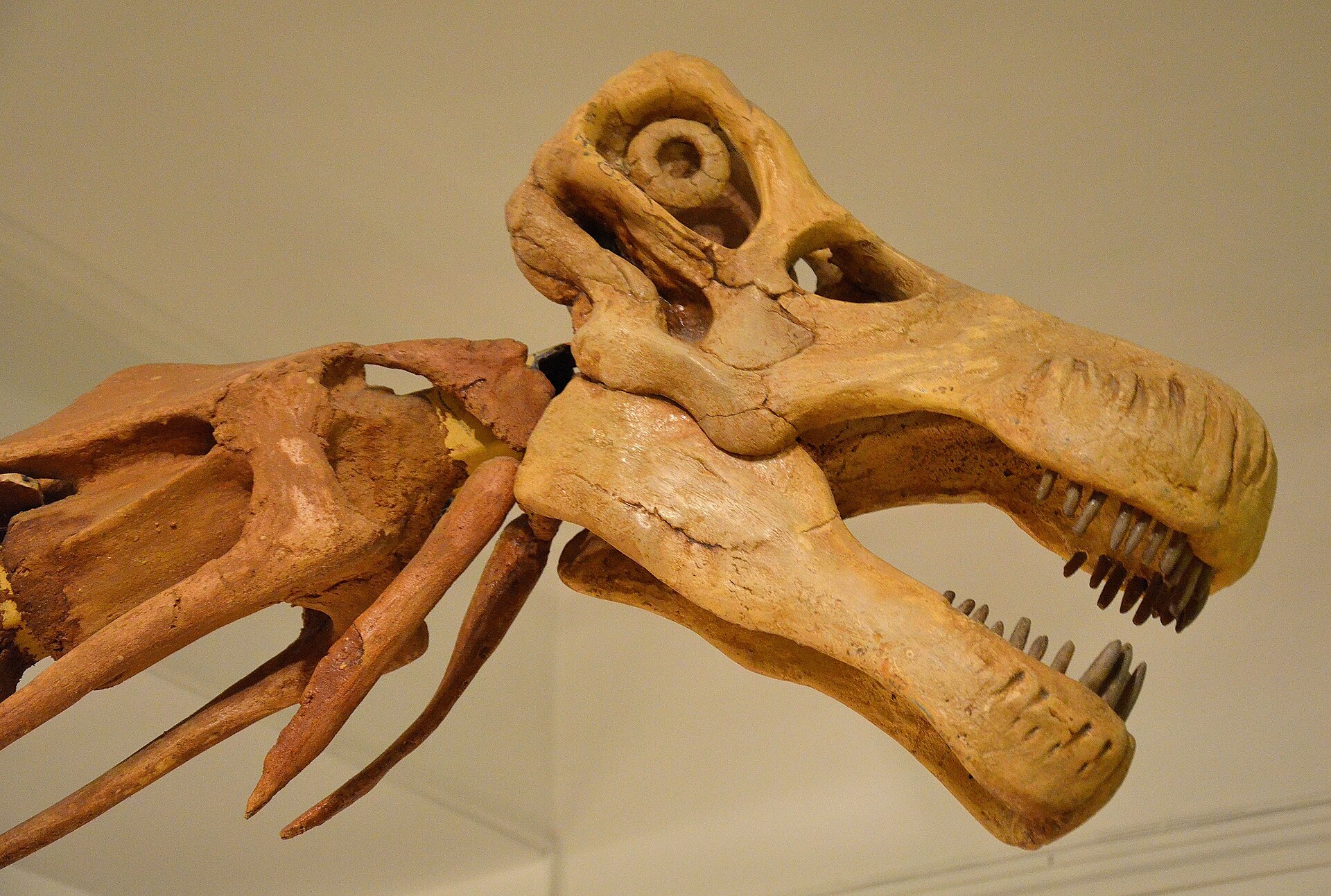
The Institute of Paleobiology of the Polish Academy of Sciences in Warsaw houses the holotype, ZPAL MgD-I/9. This nearly complete skull lacks only the top edge of the nostril region and parts of the mid-palate (roof of the mouth). It was found with its almost complete lower jaws in place. Since preparation, it has come in four pieces—snout, rear skull, and two jaw halves. Deformation squeezed it from side to side and sheared its right side forward.

The quarry then went missing for decades. In 2016, after more than eight years of searching in the wrong canyon, paleontologist P.J. Currie and colleagues found bones about 82 feet (25 meters) from the spot marked “number 6” on a 1969 map. Old plaster, wood-shaving packing, a Polish cairn, and a tin can matching those from the 1965 camp confirmed the site. The team recovered a tail (or sacral) centrum, a right femur, lower-leg bones, and a pedal ungual (toe claw). Registered as MPC-D 100/413, these “presumably belong to the same individual” as the skull. Currie’s team formally added them to the holotype in 2018. A second skull from Khadat Tolgoi, MPC-D 100/402, “appears morphologically to be Nemegtosaurus” but remains undescribed.
Nemegtosaurus Size and Description
Only the skull of Nemegtosaurus is certain, so any portrait of the whole animal is partly guesswork.
Short description of Nemegtosaurus
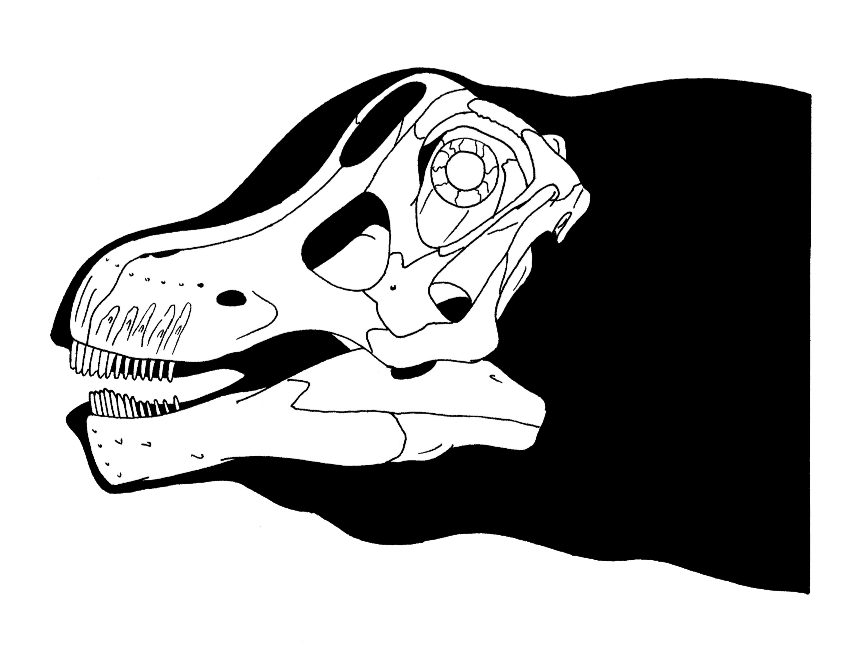
In Wilson’s reconstruction, the skull tips back so the jaw joint sits ahead of the occiput (rear of the skull). Its snout is elongate, “as in Brachiosaurus, Rapetosaurus and Diplodocus.” The enlarged nostrils lie just in front of teardrop-shaped orbits (eye sockets), and heavy ornamentation lines the upper rim of each orbit. Sclerotic plates—small bones that ringed the eye—survive on the right side, still held in place by rock. Seen from above, the lower jaws form a near U-shape.
Narrow tooth crowns lined the mouth, probably 13 on each side of both the upper and lower jaws. Nowiński originally counted eight teeth in the maxilla (the main upper tooth-bearing bone), while Wilson allows for a ninth. The crowns did not overlap, one of the shared traits Wilson listed for its family, although Brachiosaurus and Diplodocus have it too. The longest complete upper crown measures about 2.0 inches (51 millimeters).

If the 2016 leg bones belong to the same animal, its ankle had no calcaneum (heel bone). Any restoration of its neck, body, and tail is therefore conjectural.
Size and Weight of Type Species
No peer-reviewed estimate of length, hip height, or body mass exists for Nemegtosaurus. A 1969 expedition map caption puts the skull at about 2.1 feet (65 centimeters).
The best clue is the referred right femur, which measures about 4.1 feet (124 centimeters). That is roughly 11 percent shorter than the Opisthocoelicaudia holotype femur and almost 20 percent shorter than an isolated Nemegt femur. Currie’s team called the specimen “relatively small.” An unfused neural arch on its tail vertebra would suggest a not fully mature animal, but damage leaves that reading uncertain.
Footprints at Nemegt tell a different story, suggesting sauropods “much larger than the holotypes of Nemegtosaurus and Opisthocoelicaudia.” In 2025, Bell and colleagues estimated that the maker of the largest hind-foot print there, about 35 inches (90 centimeters) long, stood about 13.5 feet (4.1 meters) tall at the hips. Still, Wilson noted that the Nemegt trackways do not reveal which sauropod subgroup made them.
The Dinosaur in Detail
What sets this dinosaur apart from other titanosaurs lies in small details of the skull. Wilson’s diagnosis rests on a spur at the back of the squamosal (a rear skull bone) and a conspicuous hollow around the preantorbital fenestra—an opening in the snout. Among titanosaurs, it shares other features only with Quaesitosaurus, such as dentary (lower) teeth slimmer than the upper ones, a trait also seen in Diplodocus. Still, Wilson cautioned that most traits linking both with Rapetosaurus are ambiguous because so few titanosaur skulls exist.
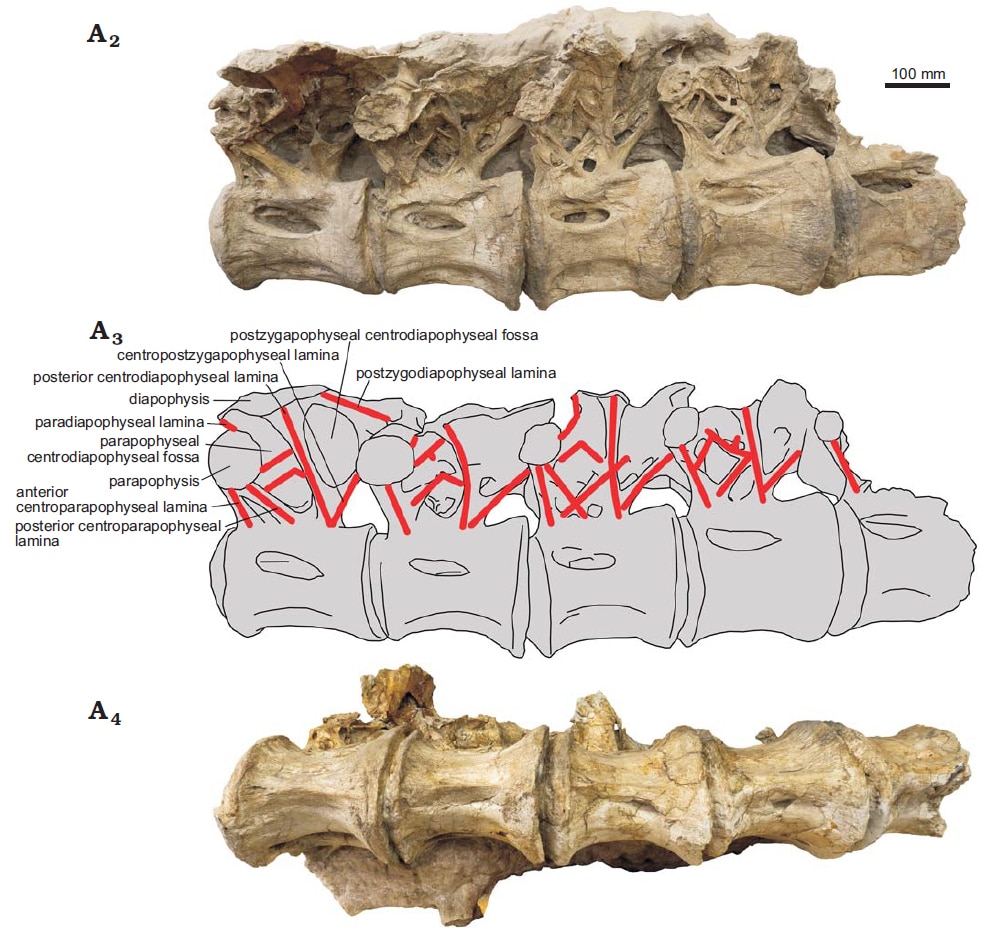

The bigger question is which body the skull belonged to. Although Opisthocoelicaudia shared no bones with Nemegtosaurus until 2016, their “coincident spatiotemporal distribution” fed a “persistent suspicion” that they are one species. In 1977, Borsuk-Białynicka kept the genera separate, pointing to the many sauropod genera found within single formations elsewhere in the world. A 2014 conference abstract by Madzia and Borsuk-Białynicka, however, argued for conspecificity. In 2018, Currie and colleagues’ preliminary comparisons found no “significant differences in size or morphology.” Their opisthocoelous (front-ball, rear-cup) tail centrum made the two “possibly even synonymous,” though “caution leads us to wait.”
That same year, Funston and colleagues called the status of Opisthocoelicaudia “questionable” and filed all Nemegt sauropod material under N. mongoliensis. Averianov and Lopatin disagreed in 2019—five back vertebrae and several femora differ from Opisthocoelicaudia, which “unequivocally indicates” two sauropods. They added that one femur Currie’s team compared was not from the Opisthocoelicaudia holotype at all. The tail centrum, they argued, could equally be procoelous, with its cup at the front. Mannion and colleagues also sided with distinct taxa in 2019, but the question remains open.
Interesting Points about Nemegtosaurus
- Nowiński first placed Nemegtosaurus near Dicraeosaurus, but researchers have called it a titanosaur since the 1990s, a view Wilson’s 2005 redescription supported.
- Kuczyński found the skull on 16 June 1965 and returned days later with Skarżyński to dig it out.
- Searchers relocated its lost quarry in 2016, helped by a tin can, a Polish cairn, and a 1965 home-movie clip.
- Wilson’s 2005 study included the first reconstructed titanosaur palate, the bony roof of the mouth.
- By the time his Nemegtosaurus paper appeared, Nowiński had already turned to studying tabulate corals.
Contemporary Dinosaurs
Sharing the landscape at Nemegt was Nemegtomaia barsboldi, an oviraptorid theropod that Fanti and colleagues recovered as “one of the most derived ingeniine oviraptorids.” One specimen, a skeleton lying on a nest of eggs, came from Northern Sayr at the Nemegt locality. It lay in red Baruungoyot sandstones just below the Nemegt tongues of the interfingering interval—where layers of two formations alternate. In 2018, Currie and colleagues added Nemegtosaurus to the list of taxa that “co-existed at the time of deposition of the Baruungoyot-Nemegt transition,” a list that includes Nemegtomaia.
That same list also names the birdlike theropod Avimimus. In 2016, Funston and colleagues described an Avimimus bonebed at the Nemegt locality. It sits in the lowest Nemegt beds, about 34 feet (10.5 meters) above an interfingered contact, and in 2019 the same team named that material Avimimus nemegtensis. No source records any interaction between Nemegtosaurus and either theropod.
Also known from the Nemegt Formation (exact level relative to Nemegtosaurus not known): Tarbosaurus, Gallimimus, the hadrosaurid Saurolophus, and the large plant-eating theropods Deinocheirus and Therizinosaurus. The formation is usually considered early Maastrichtian, but it has never been directly dated and its time span is unknown, so these animals may not all have lived at the same time.
Nemegtosaurus in its Natural Habitat
The world Nemegtosaurus roamed sat on a boundary between two landscapes. The Baruungoyot Formation records “red and red-brown eolian sandstones”—windblown deposits—while the Nemegt Formation records light-colored river sandstones and mudstones. At Nemegt, the two interfinger over about 82 feet (25 meters), suggesting that “aeolian and fluvial environments coexisted” as Nemegt deposition began. The quarry’s red sandstones and siltstones mark a splay washover area left by river floods.
As a herbivore, Nemegtosaurus left its best feeding evidence in its teeth. All but the freshest show tooth-to-tooth contact, and both V-shaped and tip wear facets occur—”an uncommon condition” in sauropods. In 1994, Calvo read microwear on one tooth as an up-and-down bite. Upchurch and Barrett later suggested a “shearing bite,” and Wilson concluded that more work is “required to interpret chewing function.”
While there is no direct evidence of how Nemegtosaurus lived, its fauna offers context. Here, sauropod remains are “less common than those of theropods and hadrosaurs,” though numerous footprint sites exist. Currie’s team links the few species per large-animal family to “a stressed environment.” Researchers also report Tarchia and the oviraptorid Heyuannia yanshini, listed in older studies as Ingenia, from the same transition interval.
Frequently Asked Questions
It means “Nemegt lizard,” after the Nemegt Basin in Mongolia’s Gobi Desert, where Kuczyński found its skull in 1965.
It probably lived in the early Maastrichtian, around 72 million years ago, though its rocks are not directly dated.
No peer-reviewed length or weight estimate exists. Its skull was about 2.1 feet long, and a referred femur measures about 4.1 feet.
It was a titanosaurian sauropod in the family Nemegtosauridae, although its describer first placed it among the dicraeosaurines.
Its skull came from Central Sayr at the Nemegt locality, in the Nemegt Formation of Ömnögovi Province, Mongolia.
Possibly, but researchers remain divided. Some suspect a single species, while a 2019 study argued for two distinct sauropods.
Sources
The information in this article is based on various sources, drawing on scientific research, fossil evidence, and expert analysis. The aim is to provide a comprehensive and accurate overview of Nemegtosaurus. However, please be aware that our understanding of dinosaurs and their world is constantly evolving as new discoveries are made.
- https://public.websites.umich.edu/~wilsonja/JAW/Publications_files/Wilson2005a.pdf
- https://doi.org/10.1017/S1477201905001628
- https://doi.org/10.1016/j.palaeo.2017.10.035
- https://hdl.handle.net/11585/622592
- https://doi.org/10.4202/app.00596.2019
- https://doi.org/10.1098/rsos.191057
- https://doi.org/10.1016/j.dib.2017.11.086
- https://doi.org/10.1371/journal.pone.0031330
- https://doi.org/10.1038/srep35782
- https://doi.org/10.1038/s41598-019-55038-5
- https://cris.unibo.it/retrieve/handle/11585/977255/d7461530-70b7-4c26-af05-70e3d7332b6d/1-s2.0-S0195667124000892-main.pdf
- https://doi.org/10.4202/app.01137.2024
- https://stratigraphy.org/ICSchart/ChronostratChart2024-12.pdf
- https://paleobiodb.org/data1.2/taxa/single.json?name=Nemegtosaurus&show=attr,app,ecospace,class,parent
- https://doi.org/10.1093/zoolinnean/zlaf053
- https://doi.org/10.1371/journal.pone.0254564
This article was last fact checked: TheDinosaurs Team, 16-11-2026
Featured Image Credit: Josep Asensi (Durbed), CC BY-SA 4.0, via Wikimedia Commons. Life restoration of Nemegtosaurus. Only the skull is known with certainty, so the body shown is conjectural.
