
Among the volcanic rocks near Lujiatun village, in China’s Liaoning Province, lies the lowest part of the Yixian Formation. From it came the skull of what a 2009 study called one of “the more bizarre theropods ever to be described.” Named Incisivosaurus gauthieri in 2002, this oviraptorosaur lived roughly 125.9 to 125.5 million years ago, early in the Cretaceous. Its upper jaw carried a pair of front teeth resembling rodent incisors—a feature its describers knew from no other theropod. Those teeth, along with the worn cheek teeth behind them, led the team to suggest a herbivorous diet.
Four researchers from Beijing and Taichung—Xing Xu, Yen-Nien Cheng, Xiao-Lin Wang, and Chun-Hsiang Chang—named the animal in Nature. However, the sources we could access do not record who collected the skull or when. In 2009, a team led by A.M. Balanoff, with Xu as a co-author, used CT scans to describe the skull in full. Since then, bite-force, skull-strength, and phylogenetic studies have shown how much a single head can reveal about a dinosaur known from almost nothing else.
Incisivosaurus Key Facts
| Keyword | Fact |
|---|---|
| Pronunciation | Not specified |
| Meaning of name | Refers to its prominent front teeth |
| Group | Theropoda (Oviraptorosauria) |
| Type Species | Incisivosaurus gauthieri |
| Diet | Herbivore (possibly omnivore) |
| When it Lived | About 125.9 to 125.5 MYA |
| Period | Cretaceous |
| Epoch | Early Cretaceous (Hauterivian–Barremian stages) |
| Length | Not specified |
| Height | Not specified |
| Weight | About 19 pounds (8.5 kilograms), indirect estimate |
| Mobility | Not specified |
| First Discovery | Year not specified (described in 2002) |
| Described by | 2002 by X. Xu, Y.-N. Cheng, X.-L. Wang, and C.-H. Chang |
| Holotype | IVPP V13326 |
| Location of first find | Lujiatun Unit, lowermost Yixian Formation, Lujiatun, Shangyuan, Beipiao City, Liaoning, China |
Incisivosaurus Origins, Taxonomy and Timeline
According to a 2002 Science News report, the genus name Incisivosaurus refers to its prominent front teeth. The describers compared that front pair to the incisors of rodents. Meanwhile, an Associated Press report called them “two large buck teeth.” According to geologist Joshua Smith of Washington University in St. Louis, they appeared two to three times longer than the teeth farther back. Together, the name points straight at the feature that made this dinosaur famous.
The 2002 paper introduced Incisivosaurus as a new oviraptorosaur. Across 205 characters and 45 taxa, its analysis found the animal less derived than all other oviraptorosaurs. Only Caudipteryx also fell outside the clade formed by the rest. In 2009, Balanoff and colleagues called it “the basalmost member” of the lineage. In 2020, however, Pittman and colleagues noted that early oviraptorosaurs collapse into a polytomy—an unresolved branching point—once poorly preserved taxa join the analysis. Senter and colleagues suggested in 2004 that one of those, Protarchaeopteryx robusta, was the same animal. Later studies have not adopted the idea. Incisivosaurus gauthieri is the type and only known species.
Radiometric dates from the Lujiatun beds that yielded Incisivosaurus fall roughly 125.9 to 125.5 million years ago. In 2022, Li and colleagues argon-dated the Lujiatun fossil bed to about 125.5 and 125.8 million years. Two years later, MacLennan’s team dated a Lujiatun Member outcrop at Sanbaoyingcun to about 125.9 million years with uranium–lead methods. Because the international time scale puts the base of the Barremian stage at 125.77 million years ago, the animal probably lived near the Hauterivian–Barremian boundary. Older estimates, by contrast, ranged from more than 128 to about 123 million years ago.
Discovery & Fossil Evidence
The skull came from Lujiatun, in the Shangyuan area of Beipiao City. While its describers placed it in “the lowest part” of the Yixian Formation, later work assigned it to the Lujiatun Unit at the very base.
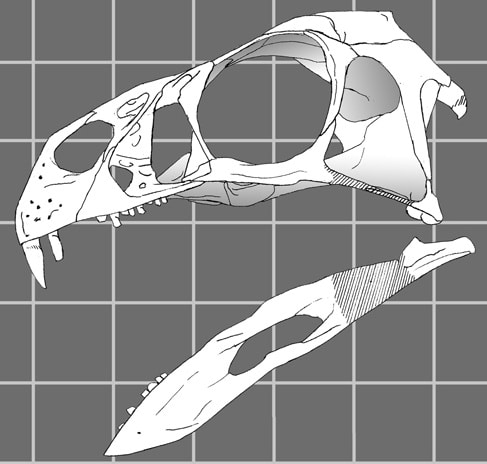
The holotype, IVPP V13326, belongs to the Institute of Vertebrate Paleontology and Paleoanthropology in Beijing. It consists of a skull with the front of the mandibles (lower jaws), and Meade and Ma also list a partial cervical (neck) vertebra. The 2002 team reported a postdentary bone—one of the rear lower-jaw bones—but Balanoff’s team could not locate it in the collections. Overall, the cranium is well preserved, although its left side has shifted forward and the skull shows some sideways compression. Part of it still sits in rock, because removing that matrix “would seriously endanger the specimen.”

To see inside, Balanoff’s study drew on 404 CT images made at Stony Brook University’s medical scanning facility. The slice data and brain-cast movies are also online through DigiMorph. In 2009, the team described the animal as “known only from a unique specimen,” the Lujiatun skull. Later, Pittman and colleagues reported Xu’s 2020 suggestion that two specimens referred to Similicaudipteryx might belong to Incisivosaurus, so the count could yet grow.
Incisivosaurus Size and Description
Because only the head is known, any portrait of Incisivosaurus starts at the snout and stops at the neck.
Short description of Incisivosaurus
The skull was low in profile, with a distinctly rounded roof, and its nostrils sat high and set back on the snout. Very large, nearly circular orbits (eye sockets) took up 48 percent of its length, while the rostrum (snout) made up 44 percent. At the front, each premaxilla—the bone at the tip of the upper jaw—held four teeth, and the first pair were large and incisor-like. Next came a thin tooth with a 7-millimeter (0.28-inch) crown ending in a blunt chisel point.
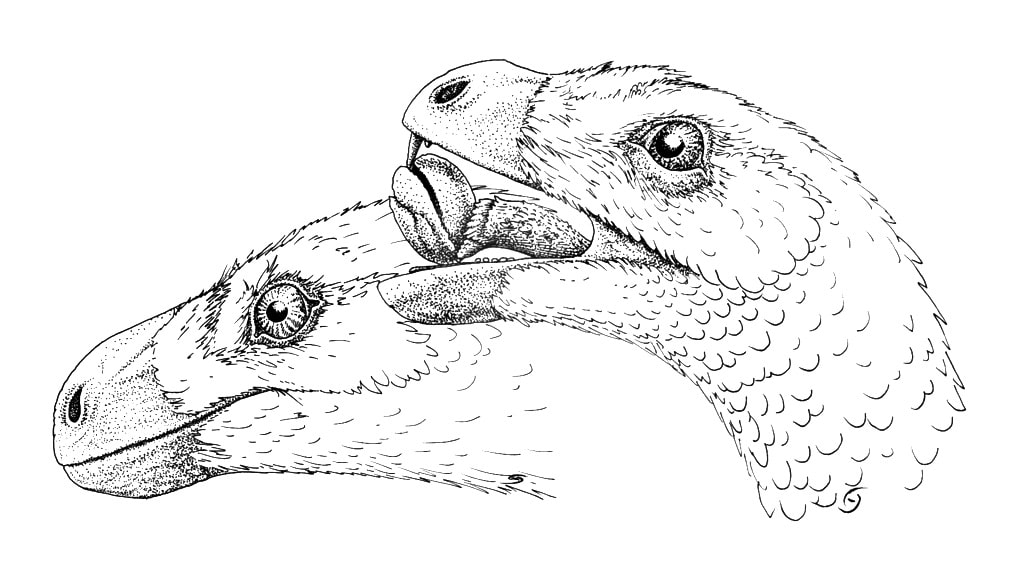
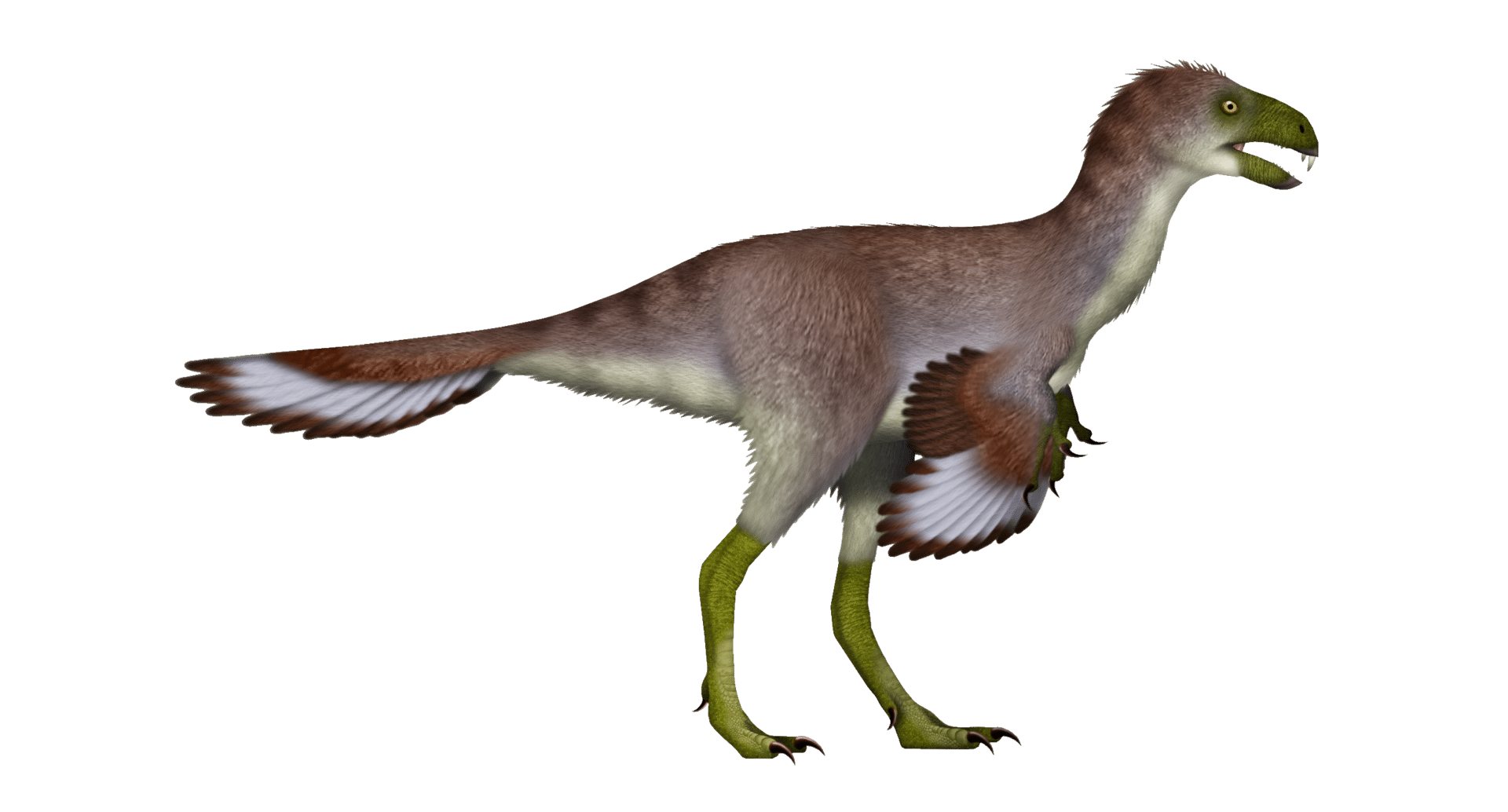
Behind them, each maxilla carried nine teeth without serrations, with extensive wear on their inner faces. The lower jaw had positions for about nine small teeth, and its front likely bore a keratinous beak—a horny sheath like a bird’s. With no skeleton below the neck, its posture and body covering remain unknown. Feathered bodies in artwork are therefore not drawn from its own fossils.
Size and Weight of Type Species
We found no peer-reviewed body length or hip height for Incisivosaurus, so both stay unspecified here.
The only mass we found is about 19 pounds (8.5 kilograms). That figure comes from Zanno and Makovicky (2013), as tabulated by Meade and Ma in 2022. Since no femur (thigh bone) is known, the figure is indirect. For such specimens, the 2013 study’s general method was to scale femur length from close, similarly sized relatives.
Its bite, in contrast, has drawn closer study. Meade and Ma modeled upper-limit forces of 53 to 83 newtons from the front of the jaws to the back teeth. By their reckoning, those values roughly equal the bite of ornithomimids about 33 times its body mass.
The Dinosaur in Detail
What sets this dinosaur apart is its dentition. Flat wear surfaces on the incisors span nearly half the tooth’s length and expose the dentine. Balanoff’s team read these teeth as meeting a troughlike shelf at the front of the lower jaw. In 2024, however, Meade, Pittman, Balanoff, and Lautenschlager found it “unclear what these teeth were wearing against,” since the toothless jaw tip sits behind them. Their models found the front teeth “not unsuitable for feeding,” perhaps as a tool. Unlike rodent incisors, these teeth did not grow nonstop. Instead, CT scans reveal a large replacement tooth just behind the exposed one, swapped “in typical archosaurian fashion.”

The skull also blends old and new. Its teeth ran along the premaxilla, maxilla, and dentary, and its palate and snout were longer than in later oviraptorids. For Balanoff’s team, these traits show that bird-like features in oviraptorids are convergences—traits evolved independently—rather than shared inheritance. Pittman and colleagues likewise list it among six early-diverging oviraptorosaurs that are the group’s only known toothed forms. Even so, a low-set jaw joint and pendant-shaped paroccipital processes (bony flanges at the back of the skull) place it firmly in Oviraptorosauria.
Inside, the braincase enclosed 5.69 cubic centimeters, with cerebral hemispheres of about 2.56 cubic centimeters. That endocast—a cast of the brain cavity—combines primitive theropod traits with bird-like ones, such as reduced olfactory tracts. However, Balanoff’s team cautioned that the smaller smell tracts may simply reflect the short snout.
In Balanoff’s view, including Incisivosaurus breaks up the long branch leading to oviraptorids and caenagnathids. Overall, they wrote, the morphological evidence suggests oviraptorosaurs belong among non-avian maniraptorans rather than within birds. Taken together, these findings describe an animal near the root of its lineage that nonetheless carried one of its most specialized mouths.
Interesting Points about Incisivosaurus
- Its front teeth resemble rodent incisors, yet CT scans show that it replaced them like other archosaurs rather than growing them continuously.
- In 2002, Makovicky told Science News, “It’s hard to imagine that this creature isn’t largely, if not wholly, herbivorous.”
- In 2022, Meade and Ma estimated a maximum gape of 49.5 degrees, the highest of the four oviraptorosaurs they studied.
- Pittman and colleagues regard Jehol oviraptorosaurs such as Incisivosaurus as the oldest unequivocal records of the whole group.
Contemporary Dinosaurs
Sharing the Lujiatun landscape in great numbers was Psittacosaurus, an early ceratopsian. According to Han and colleagues in 2023, its uncorrected relative abundance locally nears 90 percent. Li’s team lists Psittacosaurus from the same fossil bed as Incisivosaurus, while Yang’s team names P. lujiatunensis from the Lujiatun beds. No fossil records any contact between the two.
Adding further diversity was Jeholosaurus, which Li and colleagues identify as an ornithopod. Jeholosaurus shangyuanensis appears in both their 2022 list and Yang’s 2020 roster of the Lujiatun beds. Nothing links the two directly.
Also present was Dilong, an early tyrannosauroid. Li’s and Yang’s teams both place it in the Lujiatun beds, but no fossil ties it to Incisivosaurus.
Curled up in the same beds was Mei, the troodontid Mei long, whose holotype lies in a sleeping or resting posture. Li and colleagues list it beside Incisivosaurus in the Lujiatun fossil bed, and Yang’s team includes it too. No recorded contact links them.
Also known from the Yixian Formation (exact level relative to Incisivosaurus not known): the therizinosaur Kayrasaurus, the giant tyrannosauroid Yutyrannus, and the compsognathid Huaxiagnathus. Their describers do not say which member of the formation they came from. Zhong and colleagues put the span of the whole formation at about 1.6 million years, so these animals may not all have lived at the same time.
Incisivosaurus in its Natural Habitat
The world Incisivosaurus inhabited was shaped by volcanoes. Its bed consists of river-laid conglomerates, tuffaceous sandstones, and tuffs (rocks of compacted volcanic ash) that lack bedding planes. Near Lujiatun village, these tuffs run 16 to 66 feet (5–20 meters) thick and hold thousands of well-preserved vertebrate fossils. Because these 3-D skeletons were long thought buried by volcanic catastrophe, the bed was dubbed the “Chinese Pompeii.” Amiot and colleagues estimated regional mean air temperatures of about 50 °F (10 °C), comparable to today’s cool temperate zones.

Not everyone accepted the describers’ herbivore verdict in 2002—according to the AP, other paleontologists said buck teeth alone don’t prove a plant diet. Later, Meade and Ma found it had the weakest jaw leverage and relative bite force of the oviraptorosaurs they modeled. As a result, they suggested it may have retained some ancestral leaning toward omnivory or non-plant foods. Meade’s 2024 team, however, found its skull already resisted stress much like later oviraptorids’—strength came before the group’s specialized skull shape.
While there is no direct evidence of how Incisivosaurus lived day to day, its bed held a crowded community. Other named dinosaurs include the troodontid Sinovenator, Liaoceratops, Graciliraptor, and Sinusonasus. How these animals were buried is still debated, with proposals ranging from volcanic flows or mudflows to burrow collapse and floods. In 2024, MacLennan and colleagues argued from two Psittacosaurus skeletons at Sanbaoyingcun that such 3-D fossils died in collapsed burrows. Meaghan Emery-Wetherell disputed this in 2025, and MacLennan’s team replied while calling for further tests. Slightly higher in the formation, the Jianshangou bed at Sihetun, about 5.6 miles (9 kilometers) away, yields Sinosauropteryx, Beipiaosaurus, and Caudipteryx. Yet Li’s team found its lower part nearly contemporaneous with the Lujiatun bed. MacLennan’s team, in turn, put the whole local sequence under about 93,000 years.
Frequently Asked Questions
The name refers to its prominent front teeth, which its describers likened to rodent incisors.
It lived in the Early Cretaceous, about 125.9 to 125.5 million years ago, near the Hauterivian–Barremian boundary.
We found no published length or height, but one indirect estimate puts its weight at about 19 pounds (8.5 kilograms).
Its describers proposed a herbivorous diet, while a 2022 bite study suggested it may have kept some omnivorous habits.
Its only known skull came from the lowermost Yixian Formation at Lujiatun, near Beipiao City in Liaoning, China.
Its large, incisor-like front teeth are unknown in any other theropod dinosaur.
Sources
The information in this article is based on various sources, drawing on scientific research, fossil evidence, and expert analysis. The aim is to provide a comprehensive and accurate overview of Incisivosaurus. However, please be aware that our understanding of dinosaurs and their world is constantly evolving as new discoveries are made.
- https://doi.org/10.1038/nature00966
- https://pubmed.ncbi.nlm.nih.gov/12239565/
- https://www.nature.com/articles/nature00966/figures/1
- https://static-content.springer.com/esm/art%3A10.1038%2Fnature00966/MediaObjects/41586_2002_BFnature00966_MOESM1_ESM.doc
- https://doi.org/10.1206/644.1
- http://hdl.handle.net/2246/5970
- https://pmc.ncbi.nlm.nih.gov/articles/PMC8863891/
- http://hdl.handle.net/2246/7237
- https://pmc.ncbi.nlm.nih.gov/articles/PMC3574415/
- https://par.nsf.gov/servlets/purl/10347257
- https://pmc.ncbi.nlm.nih.gov/articles/PMC7485509/
- https://pmc.ncbi.nlm.nih.gov/articles/PMC11588062/
- https://pmc.ncbi.nlm.nih.gov/articles/PMC10354204/
- https://pubmed.ncbi.nlm.nih.gov/21393569/
- https://stratigraphy.org/ICSchart/ChronostratChart2024-12.pdf
- https://www.sciencenews.org/article/veggie-bites-fossil-suggests-carnivorous-dinosaurs-begat-vegetarian-kin
- https://www.deseret.com/2002/9/18/19678106/buck-toothed-dino-fossil-shakes-up-theory/
- https://pmc.ncbi.nlm.nih.gov/articles/PMC11006937/
- https://pmc.ncbi.nlm.nih.gov/articles/PMC11761333/
- https://pmc.ncbi.nlm.nih.gov/articles/PMC11759893/
- https://www2.geo.utexas.edu/specimens/Incisivosaurus_gauthieri/
- https://pmc.ncbi.nlm.nih.gov/articles/PMC8288181/
This article was last fact checked: TheDinosaurs Team, 16-11-2026
Featured Image Credit: Petr Menshikov, CC BY 4.0, via Wikimedia Commons
