
Near Medicine Bow, Wyoming, Bone Cabin Quarry lies in the Morrison Formation—a broad spread of Late Jurassic river, floodplain and lake deposits. From this quarry came Ornitholestes hermanni, a slender theropod that paleontologist Henry Fairfield Osborn named in 1903. Its rocks date to the Late Jurassic, roughly 156 to 147 million years ago. Named early in the 1900s and known from a nearly complete skeleton, it has long been a key animal for understanding coelurosaur evolution.
An American Museum of Natural History expedition found the skeleton in 1900. Head preparator Adam Hermann then oversaw the work of restoring and mounting it. Osborn gave the animal a vivid name and a bold idea—that it may have hunted the earliest birds. Fourteen years later, however, he stepped back from that idea himself. That reversal—and an unsettled debate over its family tree—shows how a famous fossil keeps changing as scientists return to it.
Ornitholestes Key Facts
| Keyword | Fact |
|---|---|
| Pronunciation | Not specified |
| Meaning of name | Bird Robber |
| Group | Theropoda |
| Type Species | Ornitholestes hermanni |
| Diet | Carnivore |
| When it Lived | About 156 to 147 MYA (Morrison Formation) |
| Period | Jurassic |
| Epoch | Late Jurassic (Kimmeridgian to Tithonian stages) |
| Length | About 6.6 feet (2 meters) in a 2023 study. Osborn’s 1903 restoration, later judged too long, gave 7.3 feet (2.22 meters) |
| Height | About 22 inches (0.56 meters) at the hips, as restored in 1903 |
| Weight | About 31 pounds (14 kilograms), 2014 estimate |
| Mobility | Moved on two legs (bipedal) |
| First Discovery | 1900 by the American Museum of Natural History expedition |
| Described by | 1903 by H.F. Osborn |
| Holotype | AMNH 619 (now AMNH FARB 619) |
| Location of first find | Bone Cabin Quarry, Morrison Formation, near Medicine Bow, Albany County, Wyoming, USA |
Ornitholestes Origins, Taxonomy and Timeline
Ornitholestes means “bird robber,” a name that Osborn said Dr. Theodore Gill had suggested. In 1917, Osborn also traced it to the Greek ornithos, “bird,” and lestes, “robber.” The name alludes to a supposed habit of chasing Jurassic birds—a habit Osborn proposed rather than observed. Meanwhile, the species name hermanni honors Adam Hermann, the museum’s head preparator, who restored and mounted the type skeleton. Together, the name records both a bold hypothesis and the hands that readied the fossil for display.
Osborn first described Ornitholestes as a “compsognathoid” dinosaur, grouping it with the light-limbed, slender-jawed theropods around Compsognathus rather than with the large megalosaurs. By 1917, however, he considered it related at the family level to Struthiomimus. Modern studies place it within Coelurosauria, near the base of Maniraptora, although its exact branch is still debated. Osborn named the genus and species together, so Ornitholestes hermanni remains the type species.
The Paleobiology Database places the Bone Cabin Quarry fauna in the Kimmeridgian to Tithonian stages, roughly 154.8 to 143.1 million years ago. Those figures mark stage boundaries rather than a radiometric date for the quarry itself. In 2019, Maidment and Muxworthy built an age framework for the whole Morrison Formation. By their account, it formed between about 156 and 147 million years ago, in the late Kimmeridgian and Tithonian. It also grows younger toward the north.
Discovery & Fossil Evidence
The American Museum Expedition of 1900 found the skeleton at Bone Cabin Quarry, near Medicine Bow in Albany County, Wyoming, within the Morrison Formation. The original paper names no individual finder. According to Osborn, the crew removed and transported the bones “with the greatest care.” He then published the description alone, and a later footnote dates it to July 23, 1903.
The holotype, AMNH 619, now bears the number AMNH FARB 619 at the American Museum of Natural History in New York. Osborn listed a skull, 45 vertebrae, a complete pelvic girdle (hip bones), and parts of both fore- and hind limbs, “all belonging to one individual.” The vertebrae comprised three cervicals (neck), eleven dorsals (back), a complete sacrum (fused hip vertebrae), and 27 caudals (tail). In a 2021 conference abstract, Chapelle and colleagues described a nearly complete skull—intensely crushed from side to side—and most of the skeleton.
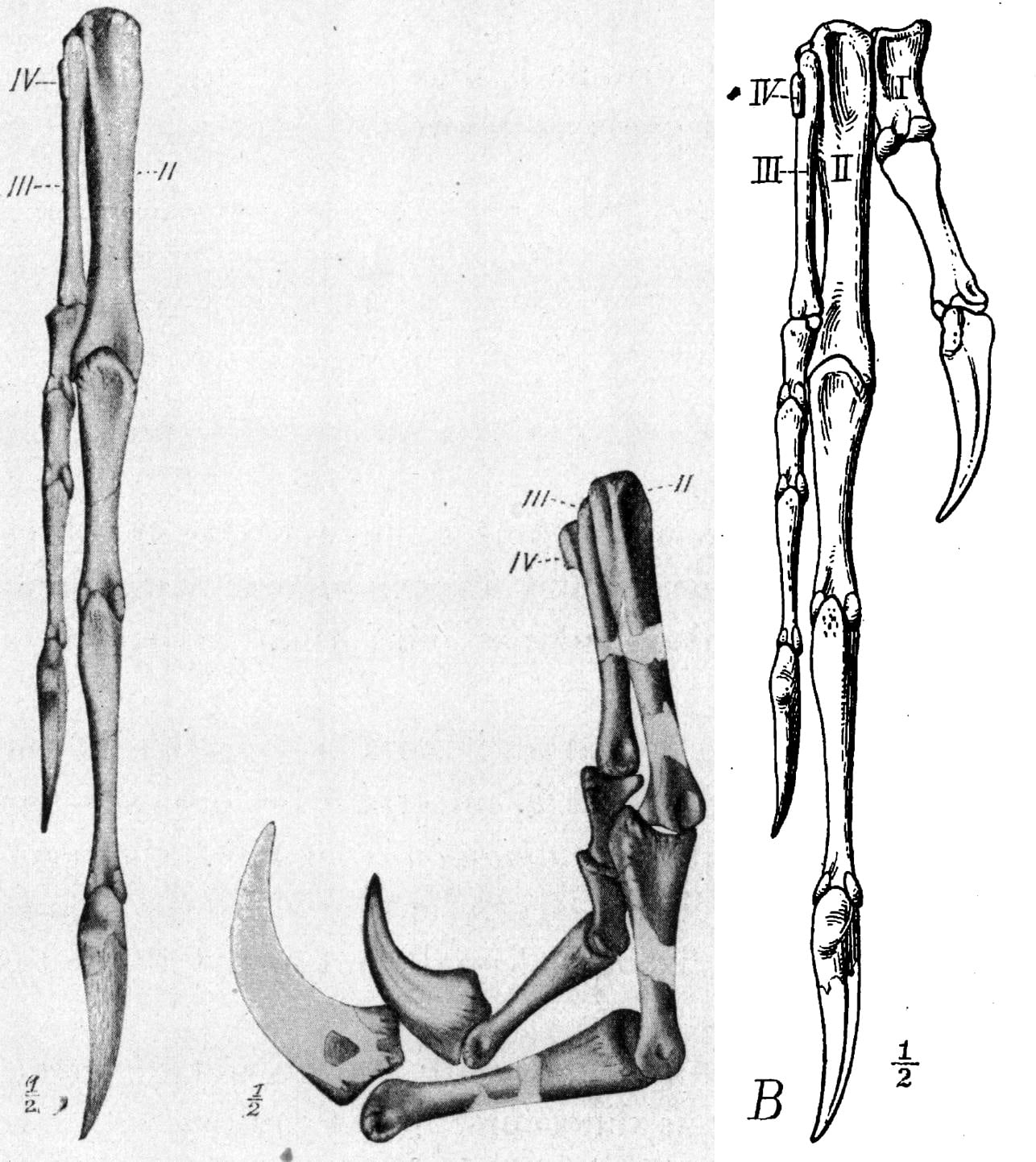

Osborn drew much of his account of the hand from a second specimen, AMNH 587, from a different individual. That link is no longer secure. In 2018, Barta and colleagues reported Brusatte’s view that AMNH 587 may belong to either Ornitholestes or Tanycolagreus topwilsoni. Chapelle’s team, for their part, described Ornitholestes as known from a single specimen. The Paleobiology Database also lists possible finds from Colorado and other Wyoming quarries, but these remain unconfirmed. No additional specimens outside Bone Cabin Quarry have been firmly confirmed.
Ornitholestes Size and Description
Ornitholestes was a small, lightly built runner, known mostly from one skeleton with a nearly complete but crushed skull.
Short description of Ornitholestes
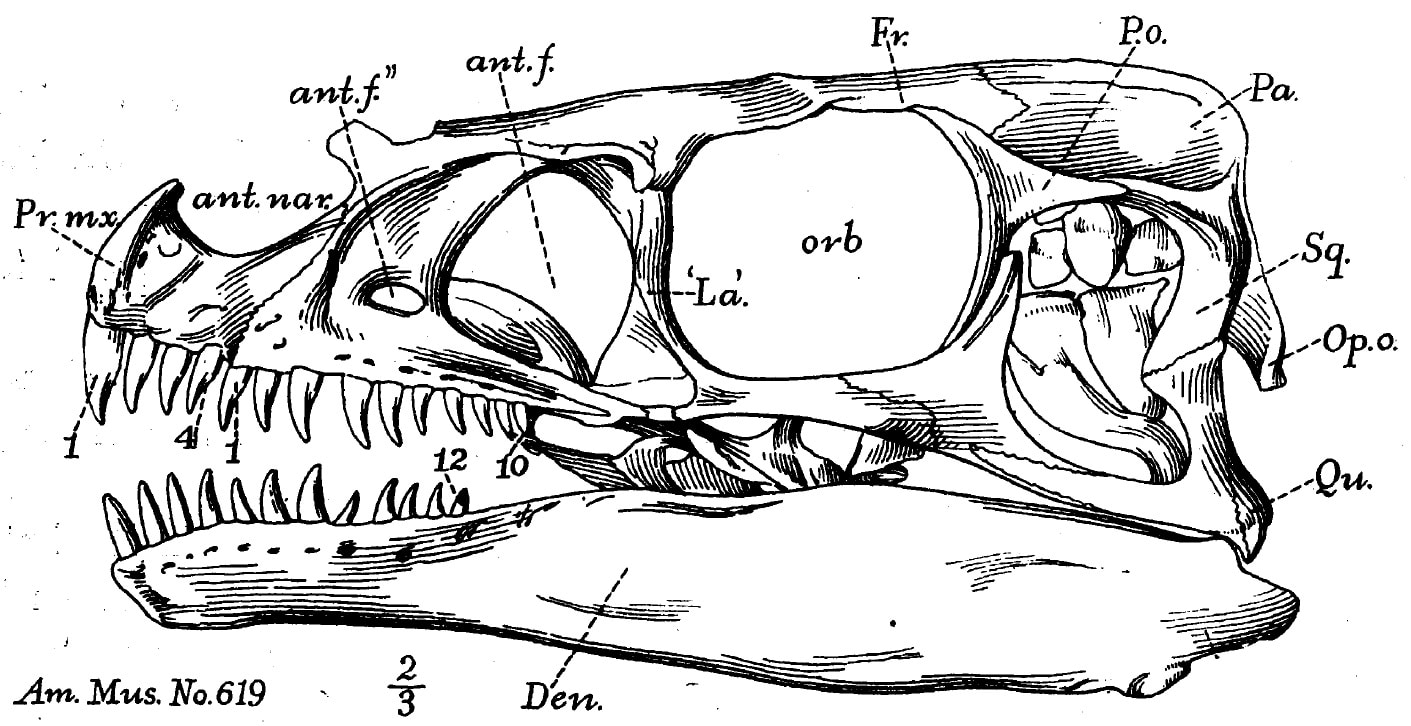
The skull had two antorbital openings (gaps in front of the eye socket) and “very large” orbits, while the lower jaw was relatively long and slender. Osborn counted four premaxillary teeth at the snout tip, ten maxillary behind them, and twelve in the dentary (lower jaw). In 2026, however, Freimuth and colleagues gave a dentary count of eleven. Osborn described the teeth as non-serrated, and together they filled a little over one third of the skull’s length. In 2023, Lei and colleagues figured one crown just 6.6 millimeters tall.
Behind the head, Osborn described gently opisthocoelous neck vertebrae—concave at the rear—and four firmly fused sacral vertebrae. From about the 13th tail vertebra, the zygapophyses (interlocking joint processes) grew longer, and the front pair partly clasped the joints of the vertebra ahead. Osborn also counted the “balancing power of the tail” among the animal’s agile traits. Finally, each hind foot had three toes, and the hind limbs showed what he called a cursorial (running) build.
Size and Weight of Type Species
Osborn gave the restored skull and backbone a combined length of about 7.3 feet (2.22 meters). However, that figure came from his reconstruction, which he later criticized for including too many vertebrae ahead of the hips. In 2023, Lei and colleagues gave a body length of about 6.6 feet (2 meters), without stating their method.
Height, too, comes only from the same restoration, which stood about 22 inches (0.56 meters) at the pelvis. Osborn also measured the femur, or thigh bone, directly at 0.207 meters (8.1 inches), although it is “somewhat crushed.”
In 2014, Benson and colleagues estimated a body mass of about 31 pounds (14 kilograms)—an indirect figure scaled from limb-bone shaft circumference. Taken together, the best modern figures suggest an animal about 6.6 feet long and around 31 pounds.

The Dinosaur in Detail
What sets this dinosaur apart, in Osborn’s view, was its hand. He singled out a narrow manus (hand) and a greatly elongated second finger, whose metacarpal and finger bones together measured 0.172 meters (6.8 inches). Working from AMNH 587, he described a slender third finger, a vestigial fourth and no fifth. Its claws were long, recurved and flattened sideways—and Osborn likened the palm to a two-toed sloth’s.
Revisiting the hand in 1917, Osborn read the second and third fingers as closely pressed together. He also called the hand “subraptorial” and compared its long digits to those of the aye-aye. In 2006, Phil Senter found little or no hyperextension in the finger joints but strong flexion. The elbow, too, bent well beyond a right angle. He argued that such elbow flexion, shared with maniraptoriform coelurosaurs, may have allowed behaviors like holding objects to the chest. In 2025, Mead and colleagues, citing earlier work, noted its fourth metacarpal is reduced to a “featureless” vestige.
Its identity has been questioned, too. In 1980, John Ostrom asked whether Ornitholestes and Coelurus were the same animal. Then, in 2005, Carpenter and colleagues—Ostrom among them—published a redescription of both.
Its placement remains unsettled. In 2015, Hendrickx and colleagues summed up the split—analyses recover it either as the basalmost maniraptoran or as a basal coelurosaur close to some compsognathids. Foth and Rauhut (2017) treated it as Maniraptora’s basal taxon, while Hartman’s team (2019) called it the most basal well-supported maniraptoromorph. A 2021 CT study, published only as an abstract, found “robust evidence” that it was the earliest-branching oviraptorosaur—the group named for Oviraptor. In contrast, Freimuth’s 2026 parsimony analysis placed it stemward of compsognathids and maniraptoriforms—a position that “will likely change,” its authors warned. Their Bayesian analysis, meanwhile, weakly placed it as the earliest compsognathid.
Interesting Points about Ornitholestes
- Osborn suggested in 1903 that Ornitholestes pursued Jurassic birds, but in 1917 he wrote that its hand was not adapted to seizing struggling live prey.
- Osborn’s first skeletal reconstruction was partly modeled on Anchisaurus, and in 1917 he judged it “very inaccurate.”
- The long second finger, Osborn noted, resembled that of Archaeopteryx but “was evidently for a different purpose.”
- In its original description, the rod-like tail joint processes “strongly” suggested to Osborn a kinship with Ornithomimus.
- Benson and colleagues cited Ornitholestes, at about 14 kilograms, as an example of the origin of small body size in coelurosaurs.
Contemporary Dinosaurs
Prowling the same quarry was Allosaurus, a Late Jurassic theropod. Early descriptions of its skull drew partly on two Bone Cabin Quarry specimens. In 2020, Chure and Loewen also listed further Allosaurus material from the site. Both animals therefore come from the same Morrison quarry and the same broad age window. Since no fossil records any encounter between them, they are best pictured as sharing the landscape.
Among the long-necked sauropods, meanwhile, was Diplodocus. In 1904, Osborn studied three unusually complete sauropod specimens from Bone Cabin Quarry, including a young Diplodocus, AMNH 516. The Paleobiology Database also lists Diplodocus from the quarry, under the old name D. longus. In 2015, however, Tschopp and colleagues judged that species doubtful. Any contact between the two goes unrecorded.
Adding further diversity was Camarasaurus, although Osborn recorded it under the name Morosaurus. He figured the sacrum and ilium (upper hip bone) of AMNH 690 from the same quarry. The Paleobiology Database treats Morosaurus as a synonym of Camarasaurus, and Tschopp and colleagues also cited AMNH 690 as a Camarasaurus specimen in 2015. Again, no interaction is known.
Another long-necked neighbor was Galeamopus hayi, a diplodocid sauropod. In 2017, Tschopp and Mateus listed Bone Cabin Quarry among just two quarries for this species. Its specimen there, AMNH 969, is a skull with the first two neck vertebrae. Like the others, it simply shared the quarry’s broad time window.
Ornitholestes in its Natural Habitat
The world Ornitholestes roamed was built by rivers, floodplains and lakes in the Western Interior of North America. The Morrison’s rocks, which today crop out from Montana to New Mexico, formed when the climate was “significantly warmer than today.” At Bone Cabin Quarry, the fossil-bearing rock is coarse sandstone filling an old river channel on a moderately drained floodplain.
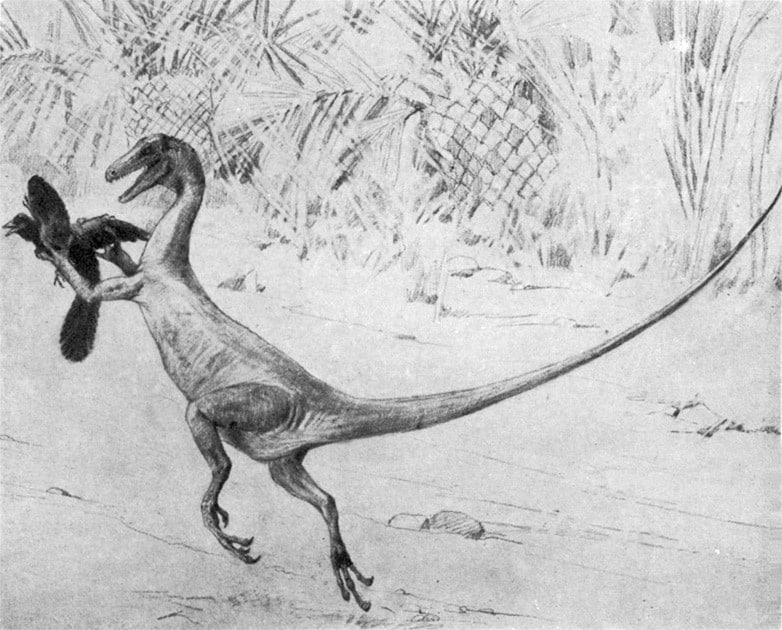

Osborn read the grasping hand, prehensile front teeth, light skeleton, running legs and balancing tail as clues to a bird hunter. Even in 1903, he admitted the teeth were less serrated than those of Coelurus—yet still as sharp as in lizards that catch small birds. By 1917, however, he considered them “small and feeble” and called the animal “subcarnivorous.” In 2015, Hendrickx and colleagues named dromaeosaurids as the only definitively carnivorous maniraptoriforms, “with perhaps the exception of Ornitholestes.”
Ornitholestes probably hunted small animals, though no direct evidence of its prey is known. Lei’s team noted that its crowns were under 30 millimeters tall and judged its jaw power too limited for deep bites on sauropod bone. That matters at Bone Cabin Quarry, which “clearly stands out” among the AMNH-collected sites Lei’s team surveyed for bite-marked sauropod bones. Those marks likely point to larger predators instead.
Frequently Asked Questions
It means “bird robber,” and the species name hermanni honors preparator Adam Hermann.
It lived in the Late Jurassic, roughly 156 to 147 million years ago, when the Morrison Formation was laid down.
A 2023 study gave about 6.6 feet, while Osborn’s 1903 restoration, which he later judged too long, gave 7.3 feet. A 2014 estimate put its weight at about 31 pounds.
It was probably a small carnivore. Osborn first imagined it chasing birds but later called it “subcarnivorous.”
An expedition found it in 1900 at Bone Cabin Quarry, in the Morrison Formation near Medicine Bow, Wyoming.
It was a small coelurosaurian theropod, and studies disagree on whether it sits at the base of Maniraptora, among early oviraptorosaurs or nearer compsognathids.
Sources
The information in this article is based on various sources, drawing on scientific research, fossil evidence, and expert analysis. The aim is to provide a comprehensive and accurate overview of Ornitholestes. However, please be aware that our understanding of dinosaurs and their world is constantly evolving as new discoveries are made.
- https://hdl.handle.net/2246/1502
- https://hdl.handle.net/2246/1334
- https://hdl.handle.net/2246/1516
- https://docentes.fct.unl.pt/omateus/files/hendrickx_etal_2015_non_avian_theropods_pjvp12_11.pdf
- https://pmc.ncbi.nlm.nih.gov/articles/PMC6626525/
- https://pmc.ncbi.nlm.nih.gov/articles/PMC5712154/
- https://pmc.ncbi.nlm.nih.gov/articles/PMC13626363/
- http://hdl.handle.net/11336/202364
- https://palass.org/publications/palaeontology-journal/archive/49/5/article_pp1029-1034
- https://pmc.ncbi.nlm.nih.gov/articles/PMC4011683/
- https://pmc.ncbi.nlm.nih.gov/articles/PMC10655710/
- https://pmc.ncbi.nlm.nih.gov/articles/PMC11937923/
- https://pmc.ncbi.nlm.nih.gov/articles/PMC5735062/
- https://pmc.ncbi.nlm.nih.gov/articles/PMC7008823/
- https://pmc.ncbi.nlm.nih.gov/articles/PMC6984342/
- https://pmc.ncbi.nlm.nih.gov/articles/PMC5417106/
- https://spiral.imperial.ac.uk/handle/10044/1/73346
- https://paleobiodb.org/classic/basicCollectionSearch?collection_no=22648
- https://paleobiodb.org/classic/basicTaxonInfo?taxon_no=38529
- https://peerj.com/articles/857/
- https://www.gutenberg.org/ebooks/19302
This article was last fact checked: TheDinosaurs Team, 01-11-2026
Featured Image Credit: Jonathan Chen, CC BY-SA 4.0, via Wikimedia Commons
