
In the Beaver Creek Valley near Green Mountain, in what is now Lakewood, Colorado, the Denver Formation gave up a handful of hollow, thin-walled bones in 1889. From them, paleontologist Othniel Charles Marsh named Ornithomimus velox in January 1890—a “bird mimic” whose foot looked startlingly like a bird’s. Today the genus sits among the ornithomimosaurs, a group of theropods whose later members were toothless and beaked. Its fossils span the Campanian and Maastrichtian stages of the Late Cretaceous.
Its richest record, however, lies far to the north in Alberta’s Horseshoe Canyon Formation, home of the species O. edmontonicus. One skeleton from there preserves a complete set of belly ribs. Then, in 2012, researchers reported the first fossil feathers ever found in an ornithomimosaur, on Alberta specimens. Yet the genus is still a puzzle—its type specimen is little more than a partial leg and foot. In 2013, one research team even called for a taxonomic reassessment of North American ostrich mimics. In the end, Ornithomimus shows how a name built on a few bones can carry a much larger story.
Ornithomimus Key Facts
| Keyword | Fact |
|---|---|
| Pronunciation | or-NEETH-oh-MY-mus |
| Meaning of name | Bird Mimic |
| Group | Theropoda |
| Type Species | Ornithomimus velox |
| Diet | Uncertain (plant eater and small-animal eater both proposed) |
| When it Lived | About 76.5 to 66 MYA, with the type species from the late Maastrichtian |
| Period | Cretaceous |
| Epoch | Late Cretaceous (Campanian to Maastrichtian stages) |
| Length | Up to 12.5 feet (3.8 meters) |
| Height | Not specified |
| Weight | Up to 375 pounds (170 kilograms), with specimen estimates of about 184 to 262 pounds |
| Mobility | Built for running (cursorial) |
| First Discovery | 1889 by George L. Cannon Jr. |
| Described by | 1890 by O.C. Marsh |
| Holotype | YPM 542 |
| Location of first find | Denver Formation, Lakewood, Jefferson County, Colorado, USA |
Ornithomimus Origins, Taxonomy and Timeline
The name Ornithomimus combines Greek words for “bird” and “mimic,” according to The Canadian Encyclopedia. Marsh himself offered no explanation of the name in his 1890 paper. Instead, his description dwelt on the hind foot, whose three functional metatarsals (long foot bones) sat “as in birds.” Together, the name and the bones make the same point—this animal looked strikingly avian from the shin down.
Marsh first read these bones very differently from later workers. In the same paper, he placed Ornithomimus in “a small group of typical Ornithopoda.” He also coined the family Ornithomimidae and named two further species from Montana, O. tenuis and O. grandis. The paper’s other new names included Triceratops serratus and Barosaurus lentus. Later work moved the genus to Theropoda, within the ornithomimosaurs—a clade of non-maniraptoran theropods, outside the branch that leads to birds.
Dates for O. edmontonicus vary by source, with The Canadian Encyclopedia giving 72.6 to 69.6 million years ago. However, Cullen and colleagues date the Tolman Member, which yields many of its skeletons, to 70 to 68 million years ago. Some Dinosaur Park Formation skeletons, roughly 76.5 to 75.5 million years old, have also been referred to the species, though they may be a different one. Younger still is the type species, which Claessens and Loewen placed in the late Maastrichtian Denver Formation. That formation sits in a sequence that begins about 68 million years ago and straddles the end of the Cretaceous.
Discovery & Fossil Evidence
George Cannon Jr. found the type specimen on June 19, 1889, according to Claessens and Loewen’s 2016 redescription, as quoted by the Paleobiology Database. Marsh thanked Cannon by name and placed the bones in the “Ceratops beds of Colorado.” The site lies about 7.5 miles (12 kilometers) southwest of Denver, beside West Morrison Road, where a drainage culvert now sits.
The holotype, YPM 542, consists of the lower end of a left tibia (shin bone) with the astragalus and calcaneum (ankle bones) in place. It also includes metatarsals II to IV and toe bones of the second digit. In addition, three metacarpals (hand bones), now YPM 548, lay nearby. Although Marsh never gave catalog numbers, Carpenter and Young called both specimens cotypes in 2002. Marsh allowed the hand bones might possibly come from a smaller individual, but saw no other reason to separate them.
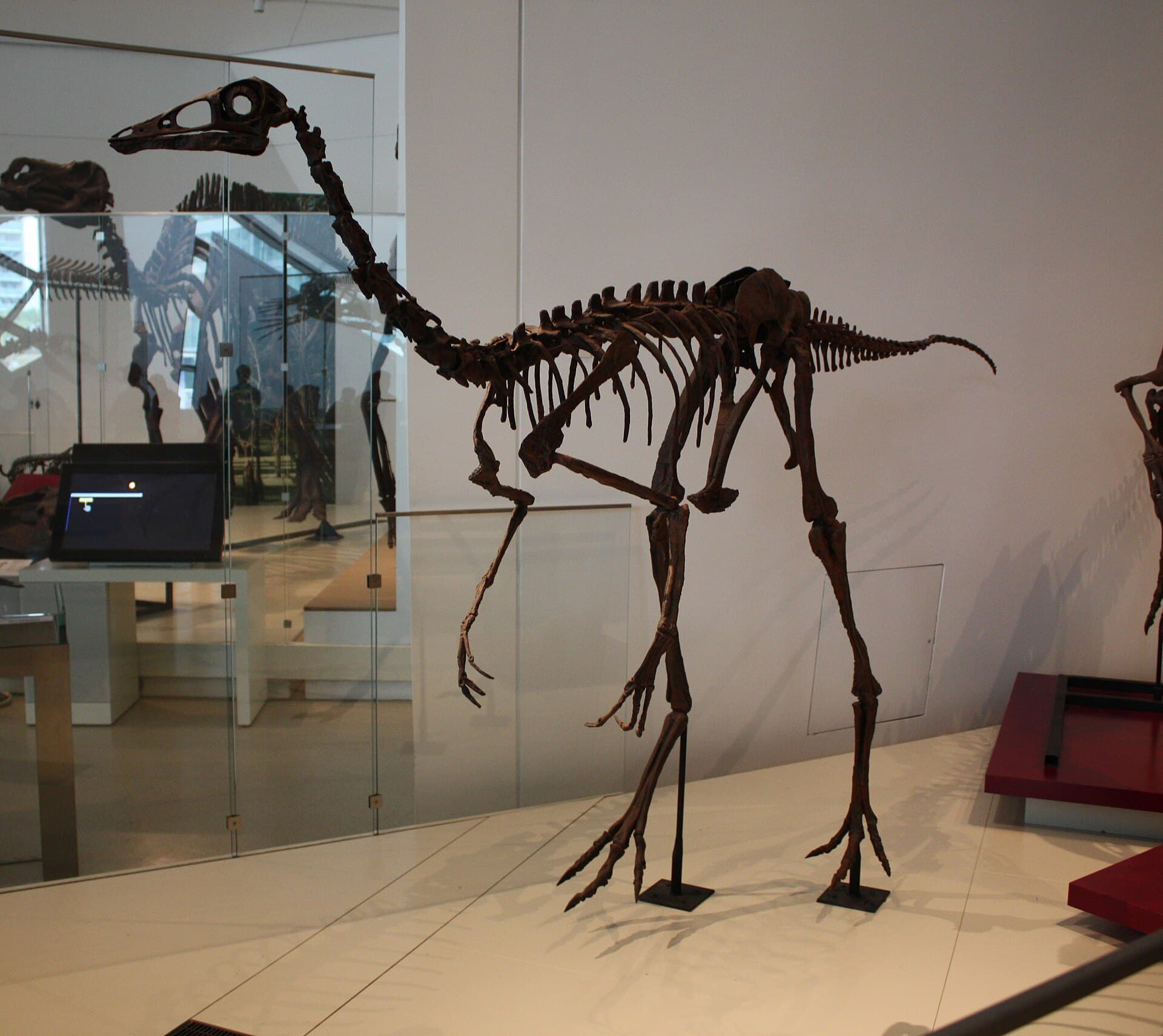

Other Denver Formation material is mostly unguals (claws), and Carpenter and Young knew O. velox only from that formation. Far richer remains came from Alberta, where George Sternberg collected a partial skeleton in 1916, 9 miles (14.5 kilometers) southwest of Morrin. Charles Sternberg named it O. edmontonicus in 1933, and researchers now cite it as CMN 8632. Later, Cullen and colleagues counted six O. edmontonicus skeletons from the higher Tolman Member. Then, in 2015, a University of Alberta release described a Dinosaur Park Formation skeleton with tail feathers and soft tissue. Undergraduate Aaron van der Reest had found it.
Ornithomimus Size and Description
Most knowledge of its body comes not from the type species but from Alberta’s O. edmontonicus.
Short description of Ornithomimus
Like other ornithomimids, Ornithomimus had no teeth and instead carried a rhamphotheca—a horny, keratin beak. In one specimen, this beak sheath survives to a depth of about 4.3 millimeters. In 1972, paleontologist Dale Russell described the family as built like ratites (ostriches and their kin). He also noted long forelimbs, enormous eyes, and a relatively highly evolved brain.
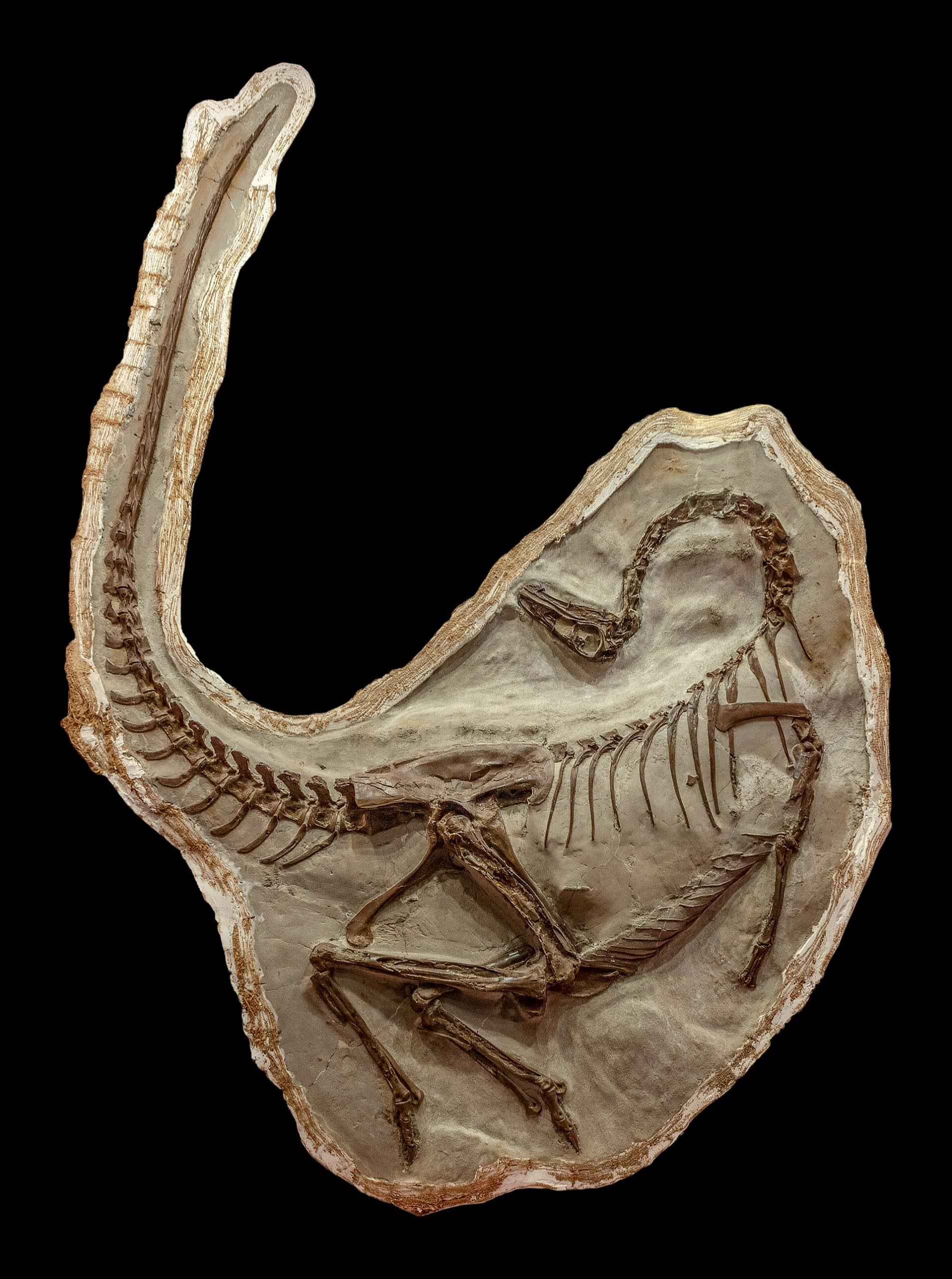
Charles Sternberg’s 1933 skeleton lacked its skull, which had eroded away before anyone found it. Its shoulder blade and coracoid (a shoulder bone) were not fused, and the coracoids were elongate. The hand was long, with three fingers of almost equal length and slender, nearly straight claws. Notably, the radius, ulna, and metacarpals were hollow, much like the thin-walled leg bones Marsh had described. Sternberg wrote that the foot “shows a highly developed cursorial type”—built for running—and was of little use for grasping.
Feathered specimens show a filamentous covering throughout life and wing-like structures on the forelimbs of adults. By contrast, the Dinosaur Park skeleton had bare skin from mid-thigh down, according to the University of Alberta. A 2022 review by Hendrickx and colleagues also lists naked, non-scaly skin in Ornithomimus.

Size and Weight of Type Species
Marsh gave no overall size for O. velox. He did note that O. tenuis had “about twice the bulk” of the type species. In 1933, Sternberg called O. velox “a much sturdier animal” than the Alberta species, with metatarsals two-thirds as long. By contrast, Carpenter and Young described its limb bones in 2002 as “proportionally more gracile” than those of other ornithomimids.
Writing in The Canadian Encyclopedia, Royal Tyrrell Museum paleontologist François Therrien gives the genus a length of up to 12.5 feet (3.8 meters). He also gives a weight of up to 375 pounds (170 kilograms). In 2022, however, Tsogtbaatar and colleagues estimated lighter masses from thigh-bone girth for three skeletons they referred to O. edmontonicus. Their central figures ran from about 184 pounds (83 kilograms) for ROM 851 to 262 pounds (119 kilograms) for TMP 95.110.1, with wide margins of error.
Sternberg estimated the femur (thigh bone) of his skeleton at about 15 inches (380 millimeters), by comparison with Struthiomimus altus. At the other end of life, a partial yearling skeleton is about 4.9 feet (1.5 meters) long, according to Therrien.
The Dinosaur in Detail
What sets Ornithomimus apart in Marsh’s account is its ankle and foot. The ascending process of the astragalus—a tongue of ankle bone rising up the shin—was, in his words, “larger than in any dinosaur hitherto known.” The third metatarsal narrowed upward and was pushed back, so the second and fourth met in front, “as in birds.” To drive the point home, his plate set the tibia beside a young ostrich’s and the metatarsals beside a young turkey’s.
Where the Alberta species belongs has long divided researchers. Sternberg kept it in Ornithomimus in 1933, although he thought O. velox and Struthiomimus would likely prove distinct with more fossils. Decades later, in 1972, Russell defined the ornithomimid family on three genera—Ornithomimus, Struthiomimus, and Dromiceiomimus, which he named in that same paper. Later, Cullen and colleagues described Dromiceiomimus brevitertius in 2013 as “now considered” a synonym of O. edmontonicus. However, Tsogtbaatar and colleagues still listed Dromiceiomimus separately in 2022, so the merger is best read as one view.
The Paleobiology Database goes further still, treating Struthiomimus samueli, S. ingens, and S. currellii as synonyms of O. edmontonicus. Cullen’s team also found Ornithomimus and Struthiomimus forming a clade, united by a convex, expanded lower edge on the pubic “boot” of the hip. For the type species, Claessens and Loewen published a full redescription of the holotype in 2016.
Taken together, these studies leave the genus unsettled. Cullen and colleagues noted weak support for ornithomimid relationships and called for a taxonomic reassessment of North American forms. Until then, Ornithomimus remains a name in motion.
Interesting Points about Ornithomimus
- Marsh coined the family name Ornithomimidae in the same 1890 paper that named the genus.
- The 2012 feathered finds included one juvenile and two adults, and only the adults had wing-like forelimb structures.
- In a 2012 press release, co-author François Therrien linked these early wings to reproductive behaviors such as display or egg brooding rather than flight.
- Sternberg’s skeleton showed no bony breastbone, which he took to suggest the animal had a cartilaginous sternum.
Contemporary Dinosaurs
Sharing the Horseshoe Canyon landscape was Edmontosaurus regalis, a flat-skulled duck-billed dinosaur. Its holotype comes from the uppermost Campanian Horsethief Member—upper Unit 1, which also yielded the O. edmontonicus holotype. Most of its specimens date from 72.5 to 71.0 million years ago, though no interaction between the two is recorded.
Prowling the same formation was Albertosaurus sarcophagus. In 2020, Mallon and colleagues called it the only tyrannosaurid definitively present in the Horseshoe Canyon Formation. Even so, no fossil records an encounter between the two.
Adding a horned profile to the scene was Anchiceratops, a horned ceratopsid. A review by Mallon and colleagues, cited by Arbour and Currie in 2013, places its specimens in the Horsethief Member and the overlying Morrin Member. Thus it overlapped with Ornithomimus in time and place, though no fossil links the two.
Rounding out the group was Anodontosaurus lambei, a tail-club ankylosaur once lumped with Euoplocephalus. Arbour and Currie found it mainly in the Horseshoe Canyon Formation, including TMP 1982.9.3 from the Horsethief Member. Like the others, it simply shared the landscape with Ornithomimus.
Ornithomimus in its Natural Habitat
The world O. edmontonicus roamed was a shifting coastal lowland. Eberth describes the Horseshoe Canyon Formation as paralic to continental—laid down along the sea’s edge and on land—spanning about 73 to 67 million years ago. Its lowest unit records the change from the marine Bearpaw to land, with many articulated dinosaurs buried in overbank (floodplain) settings. Later, a marine incursion called the Drumheller Marine Tongue came with signs of a seasonally dry climate. Far to the south, meanwhile, the Denver Basin lay under the Western Interior Seaway until about 69 million years ago. Younger Denver Formation strata then record rising mountains and volcanic debris.
What Ornithomimus ate remains unsettled. In 1972, Russell proposed that ornithomimids “probably subsisted on small, soft-bodied animals.” In contrast, Therrien notes that the toothless beak suggests a plant eater. Similarly, a 2024 skull study by Meade and colleagues treated Ornithomimus, along with Erlikosaurus, as a herbivorous theropod. For now, both readings remain on the table.
While there is no direct evidence of herds made up only of Ornithomimus, Cullen and colleagues saw a Dry Island bonebed of three ornithomimids as “further evidence of gregarious behavior.” Those animals, however, could be identified only to the Ornithomimus–Struthiomimus clade. Citing tracksites and bonebeds in Asia, The Canadian Encyclopedia also states that ornithomimids traveled in small herds. Russell, for his part, judged ornithomimids “extremely fleet,” though they lacked the agility of modern large ground birds.
Frequently Asked Questions
It means “bird mimic,” from Greek words for “bird” and “mimic.”
Fossils referred to it date from about 76.5 to 66 million years ago, and the type species is late Maastrichtian.
The Canadian Encyclopedia gives a length of up to 12.5 feet and a weight of up to 375 pounds. Specimen-based estimates from 2022 range from about 184 to 262 pounds.
Its diet is debated, with proposals ranging from small, soft-bodied animals to plants.
The type species came from the Denver Formation in Lakewood, Colorado, and O. edmontonicus from Alberta.
In 2012, researchers reported it as the first ornithomimosaur known with fossil feathers, including wing-like structures on adult forelimbs.
Sources
The information in this article is based on various sources, drawing on scientific research, fossil evidence, and expert analysis. The aim is to provide a comprehensive and accurate overview of Ornithomimus. However, please be aware that our understanding of dinosaurs and their world is constantly evolving as new discoveries are made.
- https://archive.org/details/sim_american-journal-of-science_1890-01_39_229
- https://archive.org/details/canadianfieldnat1933otta
- https://zenodo.org/records/4332697
- https://doi.org/10.1139/e72-031
- https://pubmed.ncbi.nlm.nih.gov/23112330/
- https://pmc.ncbi.nlm.nih.gov/articles/PMC3595220/
- https://pmc.ncbi.nlm.nih.gov/articles/PMC4512775/
- https://par.nsf.gov/servlets/purl/10436571
- https://journals.plos.org/plosone/article/file?type=supplementary&id=10.1371/journal.pone.0266648.s014
- https://pubmed.ncbi.nlm.nih.gov/34991180/
- https://pubmed.ncbi.nlm.nih.gov/38600295/
- https://pmc.ncbi.nlm.nih.gov/articles/PMC5383305/
- https://pmc.ncbi.nlm.nih.gov/articles/PMC3648582/
- https://pmc.ncbi.nlm.nih.gov/articles/PMC7079176/
- https://rock.geosociety.org/gsatoday/archive/17/12/pdf/i1052-5173-17-12-4.pdf
- https://old.cseg.ca/assets/files/resources/abstracts/2010/0699_GC2010_A_Revised_Stratigraphic_Architecture.pdf
- https://www.thecanadianencyclopedia.ca/en/article/ornithomimus
- https://paleobiodb.org/data1.2/colls/single.json?id=49000&show=loc,geo,ref
- https://paleobiodb.org/data1.2/taxa/list.txt?base_name=Ornithomimus&show=attr,app&rel=all_children
- https://www.ualberta.ca/en/science/news/2015/october/prehistoric-plumage-patterns.html
- https://www.sciencedaily.com/releases/2012/10/121025150357.htm
This article was last fact checked: TheDinosaurs Team, 31-10-2026
Featured Image Credit: Tom Parker, CC BY-SA 4.0, via Wikimedia Commons
