
Along the coast of Cabo Espichel, on Portugal’s Setúbal Peninsula, the Papo Seco Formation has yielded one of the world’s most complete spinosaurid skeletons. Named Iberospinus natarioi in 2022, this theropod lived during the early Barremian stage of the Early Cretaceous. Its describers call it a medium-sized spinosaurid—a member of the same family as Spinosaurus and Baryonyx. For more than a decade, however, its bones carried another name.
Amateur collector Carlos Natário found the first fragments in 1999, and field crews excavated the site from 2004 to 2008. In 2011, paleontologist Octávio Mateus and colleagues described the skeleton as a new specimen of Baryonyx. After a fresh excavation in June 2020, Mateus and Darío Estraviz-López named it a new genus in PLOS ONE. In their words, the find reinforces Iberia as a hotspot for spinosaur diversity.
Iberospinus Key Facts
| Keyword | Fact |
|---|---|
| Pronunciation | Not specified |
| Meaning of name | Iberian Spine |
| Group | Theropoda (Spinosauridae) |
| Type Species | Iberospinus natarioi |
| Diet | Carnivore (fish likely important, by analogy with other spinosaurids) |
| When it Lived | Early Barremian (no MYA figure given in the original description) |
| Period | Cretaceous |
| Epoch | Early Cretaceous (Barremian stage) |
| Length | Not specified |
| Height | Not specified |
| Weight | Not specified |
| Mobility | Not specified |
| First Discovery | 1999 by Carlos Natário |
| Described by | 2022 by O. Mateus and D. Estraviz-López |
| Holotype | ML 1190 |
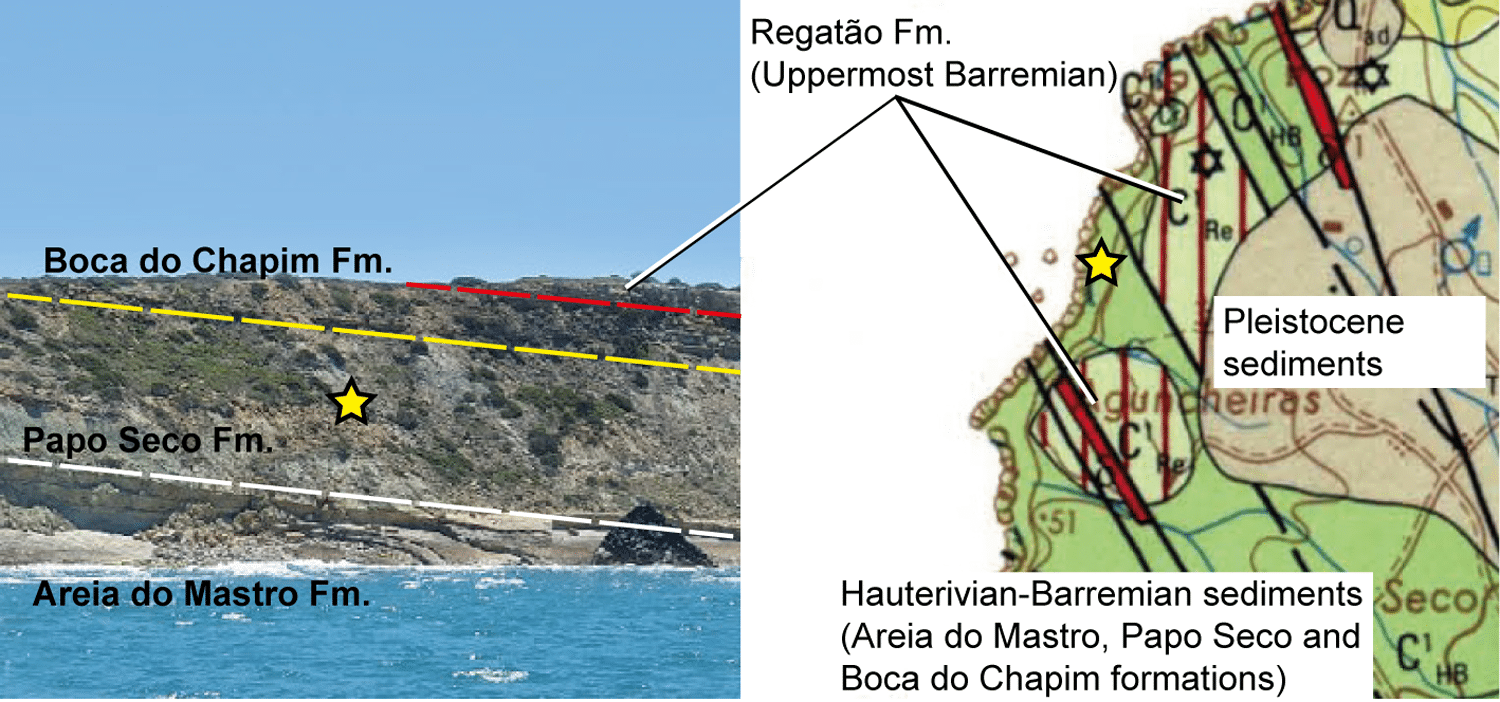
| Location of first find | Praia de Aguncheiras (Praia do Guincho), Papo Seco Formation, Cabo Espichel, Sesimbra, Setúbal district, Portugal |
Iberospinus Origins, Taxonomy and Timeline
The name Iberospinus pairs a place with a piece of anatomy. According to its describers, “Ibero-” comes from the Roman name for the Iberian Peninsula, while “-spinus” is their Latin for “spine.” It refers to the long neural spines—tall bony blades above the vertebrae—a key feature of the spinosaurid clade. The species name natarioi honors Carlos Natário, who discovered the holotype. Together, the name honors both homeland and finder.
Iberospinus is a theropod within Megalosauroidea, the larger group that contains the family Spinosauridae. Iberospinus natarioi is the type and only known species. Within the family, however, it has landed on both sides of the split between the two subfamilies, baryonychines and spinosaurines. Mateus and Estraviz-López favored baryonychine ties because of its small tooth serrations and back vertebrae longer than tall. Yet their full tree left the spinosaurids unresolved, with ties to Baryonyx and Suchomimus only in a reduced subset of taxa. In 2025, by contrast, Rauhut and colleagues recovered it as the earliest-branching spinosaurine—but only after pruning five unstable taxa. Their full tree, too, left most spinosaurids in a large polytomy (an unresolved cluster).
Its describers gave no age in millions of years, and published figures vary by timescale. Mateus and Estraviz-López argued that Iberospinus makes a European origin for spinosaurids even more likely. Even so, they cautioned that no one can confirm this until undisputed Jurassic spinosaurids turn up in the region.
Discovery & Fossil Evidence
The type locality is Praia de Aguncheiras—a beach also called Praia do Guincho—in Sesimbra municipality. There, the bones lay in layers 36 to 38 of Choffat’s 1904–1907 stratigraphic section. Mateus’s team first referred it to Baryonyx walkeri based on its teeth. In 2019, however, Arden and colleagues placed it outside the Baryonyx–Suchomimus group, for lacking an upturned jaw front, the 2022 paper reports. In 2021, by contrast, Barker and colleagues weakly grouped it with the Baryonyx type specimen in a Bayesian analysis, but not in parsimony, where it proved a rogue (unstable) taxon.

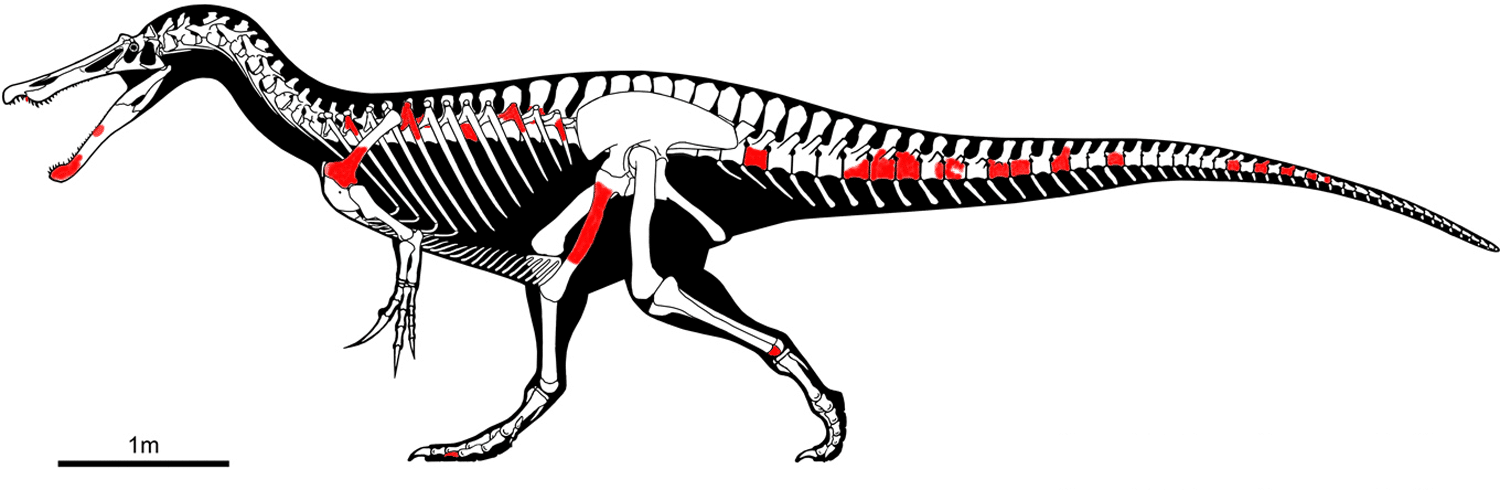
The Museu da Lourinhã in Portugal houses the holotype, ML 1190. It includes part of the left dentary (lower jaw bone), a jaw fragment with at least four teeth, and three isolated teeth. Also preserved are part of the right scapula (shoulder blade), pieces of back vertebrae, rib fragments, parts of the pubis (a forward-pointing hip bone), and two partial calcanea (ankle bones). A single pedal ungual (toe claw) and fifteen caudal (tail) vertebrae complete the list. All of it came from a patch just 5 by 2 meters (16 by 6.6 feet), with one size class and no duplicates—strong signs of a single individual. Its describers rank the tail among the most complete caudal series of any known spinosaurid.
The site also yielded ornithopod, turtle, pterosaur, and fish remains, plus snails and plant material. In 2011, Mateus’s team suggested that scratches on the bones may come from small scavengers. The 2022 describers read parallel scratches on the pubis as fish tooth marks. Other spinosaurid teeth come from the formation, yet the genus rests on ML 1190 alone.
Iberospinus Size and Description
Jaw, shoulder, hip, ankle, and tail bones build a partial picture of Iberospinus—one well documented with CT scans and 3D files.
Short description of Iberospinus
At the front of the jaw, the left dentary preserves 12 alveoli (tooth sockets). Its outer face bears 28 foramina—small openings for nerves and blood vessels. Its lower edge runs straight for the preserved 90 millimeters (3.5 inches)—unlike the strongly upturned dentary of the Baryonyx holotype. The one complete tooth has a conical crown about 3.7 centimeters (1.5 inches) high. More than 250 denticles (tiny serrations) line each carina (cutting edge), while flutes and veins mark the enamel.
Moving back, one dorsal (back) vertebra has a body about 160 millimeters (6.3 inches) long and longer than tall, with no pleurocoels (air-sac hollows). Its missing neural arch probably came loose along an unfused suture. The shoulder blade shows only a weak acromion—the flange at its front end—unlike in Suchomimus. Meanwhile, a thick bony sheet, the pubic apron, runs the whole preserved length of the pubis. In Baryonyx and Suchomimus, by comparison, it covers only the first third.
The ankle bone is much more robust than any other theropod calcaneum its describers examined. No skin or soft tissue survives, so any reconstruction of its appearance is speculative.

Size and Weight of Type Species
No study we found gives a length, height, or weight for Iberospinus. Mateus and Estraviz-López describe it only as a “medium sized spinosaurid.” In 2011, Mateus’s team inferred a body size like the Baryonyx holotype’s from similar bone dimensions, but gave no figure.
As preserved, the left dentary is 162 millimeters (6.4 inches) long, and the pubic shaft reaches 295 millimeters (11.6 inches).
By average jaw height, however, its dentary is smaller than those of the Baryonyx holotype and a Spinosaurus specimen. That result measures one bone, so its overall size remains unknown.
The Dinosaur in Detail
What sets this dinosaur apart lies partly hidden inside its jaw. The original diagnosis lists eight autapomorphies—traits unique to the genus—including a single opening in the groove on the inner face of the dentary. A CT scan confirmed that the usual upper opening in that groove is missing. Citing a 2010 study by Benson, its describers report no other megalosauroid with this condition. The same scan revealed a densely vascular jaw, with canals forming a braided network near the tip. Compared with Tyrannosaurus, Iberospinus has more foramina and channels running straight to the outer surface.
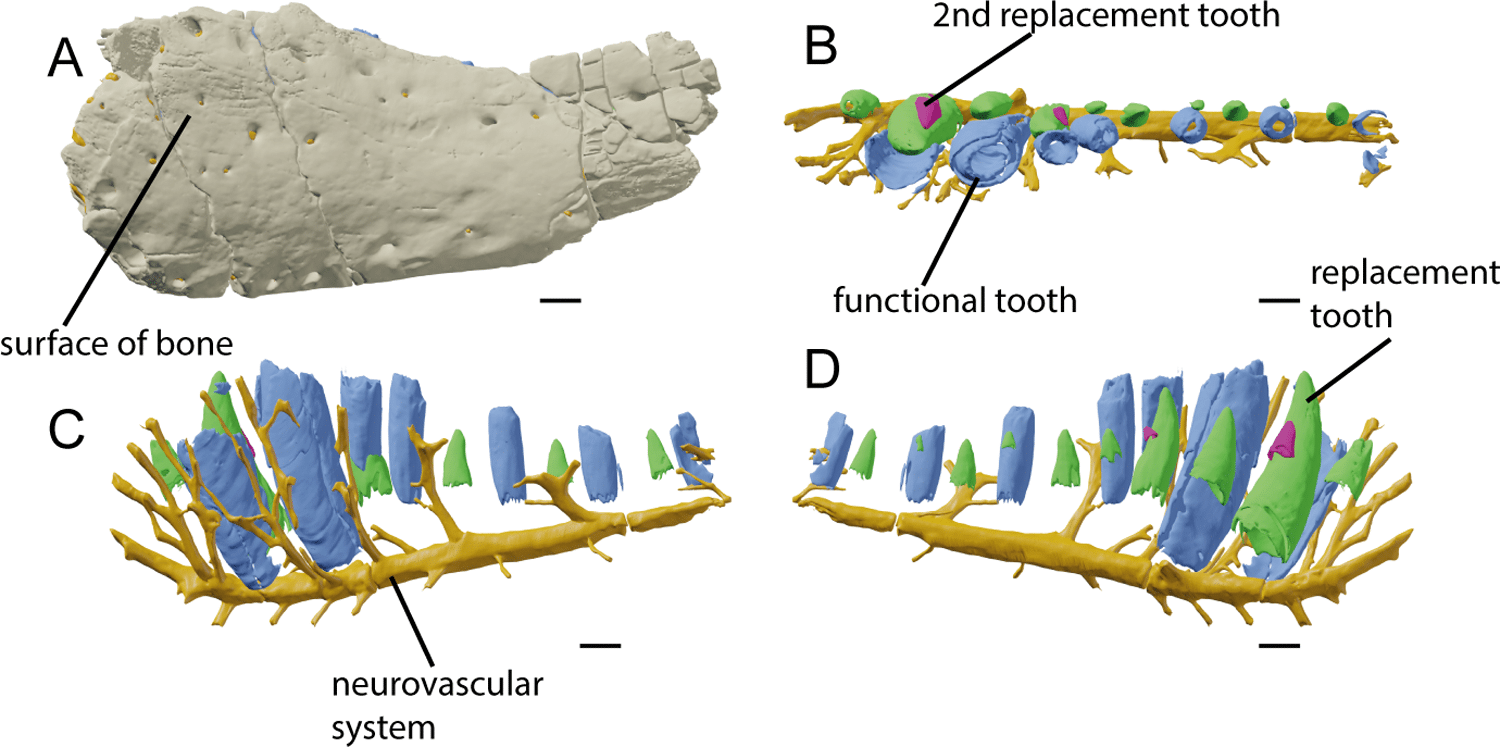

Replacement teeth crowd the jaw as well. Each of the first five sockets holds one or two developing teeth, as in the premaxilla of Oxalaia and the maxilla of Torvosaurus gurneyi. So many replacements point to faster tooth replacement, as in Spinosaurus, the authors argue.
The tail tells a mixed story. Laminae (thin bony ridges) line the side hollows of one vertebra from the rear half of the tail, a trait its describers know in no other spinosaurid. The area of their front faces, relative to their length, changes along the tail much as in Spinosaurus. Their lengths, however, follow the pattern of more generic theropod tails.
In 2024, Isasmendi and colleagues still listed it among several equally unstable taxa. A year later, Rauhut and colleagues called the baryonychine evidence weak, since serrated teeth are an ancestral theropod trait that only rules out the serration-less spinosaurines near Spinosaurus. They also suggested the long dorsal vertebra came from the front or middle of the back, which might even support spinosaurine ties. Taken together, Iberospinus remains a mosaic of features that pulls in two directions.
Interesting Points about Iberospinus
- In 2011, the skeleton counted as the most complete dinosaur from Portugal’s Early Cretaceous.
- Its 2022 describers credit it with more material than the holotypes of Oxalaia and Cristatusaurus.
- In 2023, Santos-Cubedo and colleagues wondered, without testing it, whether Iberospinus and the Spanish Camarillasaurus might be the same animal.
- Mateus’s team linked a 21 by 11 millimeter (0.8 by 0.4 inch) oval tail mark to predation or scavenging, though the 2022 describers noted that taphonomy (damage after death) might explain similar spinosaurid tail marks.
Contemporary Dinosaurs
No named dinosaur yet comes from the same beach and beds as Iberospinus. The four animals below come from neighboring regions of similar early Barremian age. In 2015, Figueiredo and colleagues judged the Papo Seco fauna very comparable with early Barremian faunas from Spain and England, naming the Vectis Formation and Upper Weald Clay as English examples. No evidence places any of them alongside Iberospinus.
From the Upper Weald Clay of Surrey, England, comes Baryonyx walkeri, the spinosaurid to which Mateus’s team first referred the Portuguese skeleton. In 2011, they placed its holotype at the base of the Barremian.
On the Isle of Wight, the Wessex Formation of England produced Neovenator salerii. In 2021, Barker and colleagues called it a 7 to 8 meter (23 to 26 foot) allosauroid. That same year, Lockwood and colleagues reported its skeleton beside a Brighstoneus in bed L9 of this early Barremian formation. Figueiredo’s examples omit the Wessex Formation, so its Portuguese link rests on “England” broadly and on the clade below.
That bed yielded Brighstoneus simmondsi, a hadrosauriform ornithopod—an early relative of the duck-billed dinosaurs. In 2025, Bertozzo and colleagues placed the Papo Seco hadrosauroid Cariocecus in a clade with Brighstoneus and Comptonatus.
In Teruel province, Spain, the Camarillas Formation holds Camarillasaurus cirugedae, another spinosaurid. Isasmendi and colleagues place both Camarillasaurus and Iberospinus in lower Barremian deposits from different basins. Rauhut and colleagues, however, give the Camarillas Formation a wider range, from the early to the early late Barremian. Their revision found Camarillasaurus to be a spinosaurine close to Spinosaurus and distinct in form from Iberospinus.
Still, these faunas differed—Rauhut and colleagues found the Iberian spinosaurids to be spinosaurines, unlike the diverse contemporaneous baryonychines in England.
Also known from the Papo Seco Formation (exact level relative to Iberospinus not known): Cariocecus bocagei, a basal hadrosauroid known from Portugal’s first iguanodontian skull, found at Praia do Areia do Mastro. Bertozzo and colleagues date the formation only to the early Barremian, so the two may not have lived at the same time.
Iberospinus in its Natural Habitat
The world Iberospinus roamed was mostly lagoonal, with continental influences and limited marine reach. Freshwater bivalves alongside marine snails suggest the setting was partly estuarine. These rocks, about 18.5 meters (61 feet) thick, are mainly silty mud and green clays with lignite and gypsum, cut by ribbon-shaped sandstones. Fishes resembling Lepidotes, plesiochelyid turtles, goniopholidid crocodylomorphs, and two kinds of pterosaurs shared these waters and shores. Other finds include ornithopod teeth and bones, sauropod teeth, and tooth fragments of a large non-spinosaurid theropod.
Its describers note that spinosaurid diets mainly included fish, and that rapid tooth replacement could relate to piscivory (fish-eating), but state no diet for Iberospinus itself. Its toe-claw proportions fall between those of land-based theropods and Spinosaurus. In their view, it lacked the extreme wading or pursuit adaptations of some spinosaurines, while showing a tendency toward them. Rauhut and colleagues, by contrast, suggested that Iberian spinosaurids in general may have been less aquatic than later spinosaurs.
While there is no direct evidence of how Iberospinus behaved, a 2017 rib study by Waskow and Mateus suggests it lived about 23 to 25 years. By their estimate, it reached sexual maturity at 13 to 15 years, despite unfused back vertebrae. The authors linked those unfused sutures to paedomorphosis—the retention of juvenile traits—possibly tied to aquatic locomotion.
Frequently Asked Questions
It means “Iberian spine,” after the long neural spines of spinosaurids, and natarioi honors discoverer Carlos Natário.
It lived in the early Barremian stage of the Early Cretaceous, according to its 2022 description.
Its describers call it medium-sized, but no study we found gives a length or weight.
It was a carnivore, and fish were likely important, by analogy with other spinosaurids.
Carlos Natário found it at Praia de Aguncheiras, in the Papo Seco Formation of Cabo Espichel, Portugal.
It was a spinosaurid theropod, and scientists still debate whether it sits with the baryonychines or the spinosaurines.
Sources
The information in this article is based on various sources, drawing on scientific research, fossil evidence, and expert analysis. The aim is to provide a comprehensive and accurate overview of Iberospinus. However, please be aware that our understanding of dinosaurs and their world is constantly evolving as new discoveries are made.
- https://doi.org/10.1371/journal.pone.0262614
- https://doi.org/10.11646/zootaxa.2827.1.3
- https://doi.org/10.1038/s41598-021-97870-8
- https://doi.org/10.7717/peerj.13543
- https://doi.org/10.7717/peerj.15453
- https://doi.org/10.1038/s41598-023-33418-2
- https://doi.org/10.1093/zoolinnean/zlad193
- https://doi.org/10.26879/1543
- https://doi.org/10.1016/j.crpv.2017.01.003
- https://revistas.ucm.es/index.php/JIGE/article/view/47828
- https://doi.org/10.1080/14772019.2025.2536347
- https://doi.org/10.1080/14772019.2021.1978005
- https://doi.org/10.1098/rsos.260994
- https://paleobiodb.org/data1.2/occs/list.txt?base_name=Iberospinus&show=strat,loc,time
- https://www.fct.unl.pt/en/news/2025/09/new-dinosaur-skull-identified-first-iguanodont-portuguese-cretaceous
This article was last fact checked: TheDinosaurs Team, 16-11-2026
Featured Image Credit: Victor Feijó de Carvalho, CC BY 2.5, via Wikimedia Commons
