
In northeastern Neuquén Province, Argentina, the Anacleto Formation at Auca Mahuevo is famous for its titanosaur eggs, many still holding embryos. Yet in rocks above those nesting layers lay the partial skeleton of a very different animal. Named Aucasaurus garridoi in 2002, it was an abelisaurid—a member of a family of theropods within the ceratosaur lineage. It probably lived early in the Campanian stage of the Late Cretaceous, although its exact age is uncertain. Its describers introduced it as a new close relative of Carnotaurus.
Geologist Alberto Garrido discovered the holotype, and paleontologists Rodolfo A. Coria, Luis M. Chiappe, and Lowell Dingus described it. The skeleton preserves skull material, parts of the neck and back, the whole hip region, much of the tail, and almost complete fore- and hind limbs. Later restudies added a brain cast, a growth record, and a rare tail malformation. They also showed that its tail is the most complete yet known in its abelisaurid subgroup. Together, these studies have turned one skeleton into a detailed portrait of an abelisaurid—from brain to tail.
Aucasaurus Key Facts
| Keyword | Fact |
|---|---|
| Pronunciation | Not specified |
| Meaning of name | Auca Mahuevo Lizard |
| Group | Theropoda |
| Type Species | Aucasaurus garridoi |
| Diet | Carnivore |
| When it Lived | Early Campanian (exact MYA not specified) |
| Period | Cretaceous |
| Epoch | Late Cretaceous (Campanian stage) |
| Length | About 20.0 feet (6.1 meters) |
| Height | Not specified |
| Weight | Not specified |
| Mobility | Not specified |
| First Discovery | Year not specified, by Alberto Garrido |
| Described by | 2002 by R.A. Coria, L.M. Chiappe, and L. Dingus |
| Holotype | MCF-PVPH-236 |
| Location of first find | Auca Mahuevo, Anacleto Formation, near Mina La Escondida, Neuquén Province, Argentina |
Aucasaurus Origins, Taxonomy and Timeline
The genus name Aucasaurus refers to Auca Mahuevo, the fossil locality that yielded the holotype. Its ending comes from the Greek “sauros,” meaning “lizard” or “reptile.” The species name garridoi honors geologist Alberto Garrido, who discovered that holotype.
In 2002, Coria and colleagues placed Aucasaurus in Abelisauridae as a close relative of Carnotaurus sastrei. More narrowly, it belongs to Brachyrostra, an abelisaurid subgroup named by Canale and colleagues in 2009 that also includes Carnotaurus and Viavenator. In 2023, paleontologist M.A. Baiano and colleagues kept it there. Similarly, the 2024 describers of Koleken grouped that abelisaurid with Campanian–Maastrichtian South American forms such as Aucasaurus and Niebla. Ceratosaurs were, in the words of paleontologist R. Delcourt in 2018, “the dominant carnivorous dinosaurs of the southern continents” during the Late Cretaceous. Aucasaurus garridoi is the type and only known species, and recent peer-reviewed studies treat it as valid.
Baiano and colleagues placed the holotype in the lower Campanian stage. Earlier, in 2000, Dingus and colleagues combined magnetostratigraphy—the record of past flips in Earth’s magnetic field—with fossil-based age estimates. They concluded that the egg beds most likely date to about 83.5 to 79.5 million years ago. Because Aucasaurus came from higher levels, however, that window is only a guide. In 2024, paleontologist F.L. Agnolín and colleagues also cited a maximum depositional age of 78.6 million years (give or take 1.7 million) for the formation at Paso Córdoba—a figure they place in the middle Campanian. That site lies in Río Negro Province, far from Auca Mahuevo, so it does not date Aucasaurus directly. Its exact age therefore remains open—at least on current evidence.
Discovery & Fossil Evidence
Auca Mahuevo lies about 75 miles (120 kilometers) northwest of the city of Neuquén, near Mina La Escondida. Researchers discovered the nesting site in 1997. Crews returned in 1999 and 2000, with further campaigns through at least 2002. However, none of the sources consulted here gives the year Garrido found the Aucasaurus skeleton. In 2004, Coria and paleontologist A.B. Arcucci reported that it came from levels above the egg-bearing strata.
The holotype, MCF-PVPH-236, resides at the Museo Carmen Funes in Plaza Huincul, Neuquén Province. Baiano’s 2023 inventory lists the atlas (first neck vertebra), dorsals 2 to 7 (back vertebrae), a complete sacrum—the fused vertebrae of the hip—and caudals 1 to 13 plus later tail vertebrae. It also records ribs, gastralia (belly ribs), and hemal arches 1 to 13, the chevron bones beneath the tail.
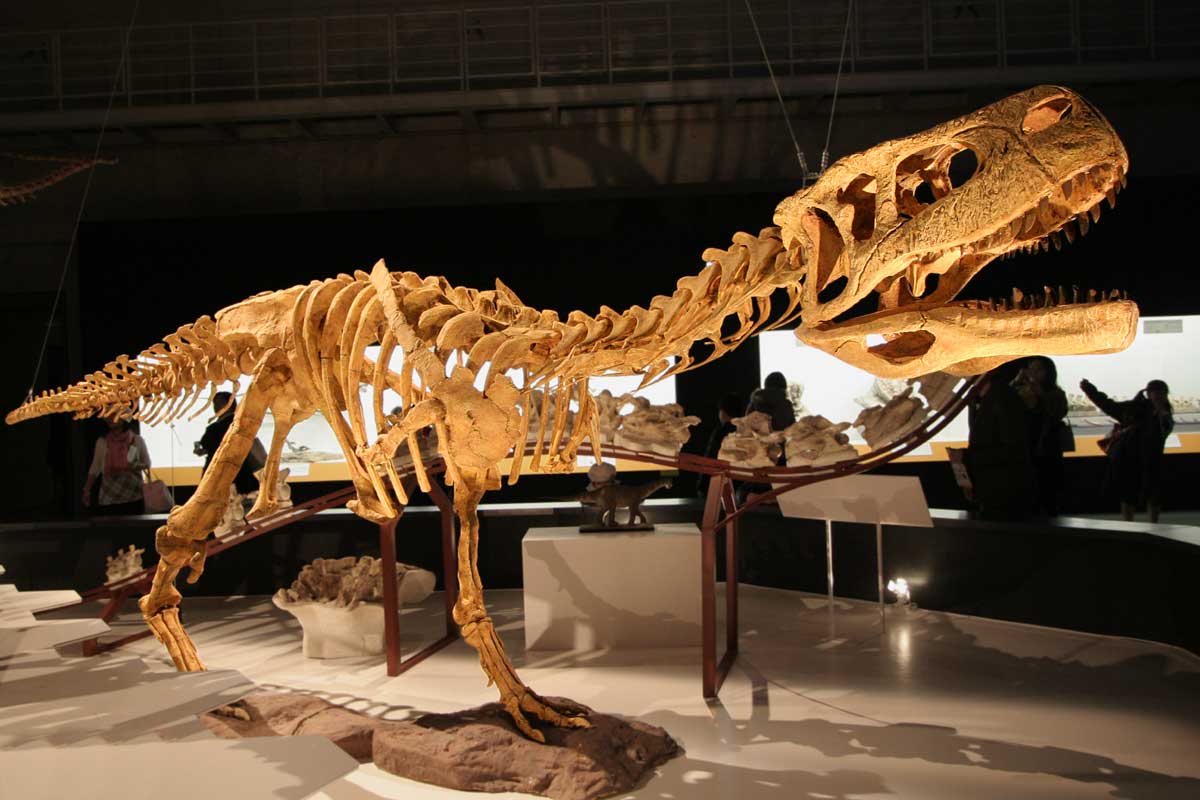

Isolated theropod teeth from egg layer 4 share several features with its upper-jaw teeth—yet Coria and Arcucci left them unassigned. These were shed, rootless crowns found with bones of adult titanosaurs. On that basis, the authors suggested that an abelisaurid, or a theropod with similar teeth, may have fed on those carcasses. No second specimen has been confirmed, so the genus still rests on a single skeleton.
Aucasaurus Size and Description
Every description of Aucasaurus draws on that one mature individual.
Short description of Aucasaurus
According to Baiano’s summary of the 2002 description, the skull had a longer, lower snout than that of Carnotaurus. In place of horns, it bore swellings on the frontal bones, and the tooth-bearing edge of the maxilla (upper jaw bone) was S-shaped. Delcourt’s 2018 study described the frontal margins as raised around the eye sockets, whereas Carnotaurus had two horns. In 2011, paleontologist Ariana Paulina-Carabajal noted that a wide sagittal crest and a low bump on the parietal bones of the skull roof set it apart from Abelisaurus, Carnotaurus, and Majungasaurus.
The same summary reports a forelimb relatively longer than in Carnotaurus, with a slender humerus (upper arm bone). Even so, abelisaurid forearms were strongly reduced and could not grasp, as Delcourt noted. He added that the fourth finger was fused to its metacarpal (palm bone)—a fusion “precluding mobility.” The first and fourth fingers may also have lost their claws. In 2011, paleontologist J. Ruiz and colleagues found that its hand shares several features with that of Carnotaurus, while keeping traits of its own.
Bony processes between the vertebral spines—possibly ossified ligaments—ran along the back, hips, and tail. Baiano’s team argued that these processes stiffened the trunk and that strong tail muscles would have made the tail extremely rigid. Inside, CT scans revealed camellate tissue—a honeycomb of small air spaces—in the tail vertebrae. Baiano’s team described this as the first such case reported for an abelisaurid. None of the sources consulted describes skin impressions, so any picture of its outer covering is speculative.
Size and Weight of Type Species
The only published length we located is about 20.0 feet (6.1 meters), which paleontologist E.E. Seculi Pereyra and colleagues tabulated in 2025 from a 2017 study by O.N. Grillo and Delcourt.
Since neither that study nor the 2002 description could be checked here, the figure is best read as an estimate. In the same compilation, Carnotaurus reaches about 25.4 feet (7.75 meters), so Aucasaurus was probably somewhat shorter. None of the sources consulted gives a hip height or body mass.
Its maturity, at least, is clear. The seams between the body and arch of each vertebra had closed, and the hip, shin, and ankle bones had fused. Growth marks in a rib tell the same story, so the 6.1-meter estimate describes an adult. These marks also point to cyclical growth, as in the abelisaurids Niebla and Quilmesaurus.
The Dinosaur in Detail
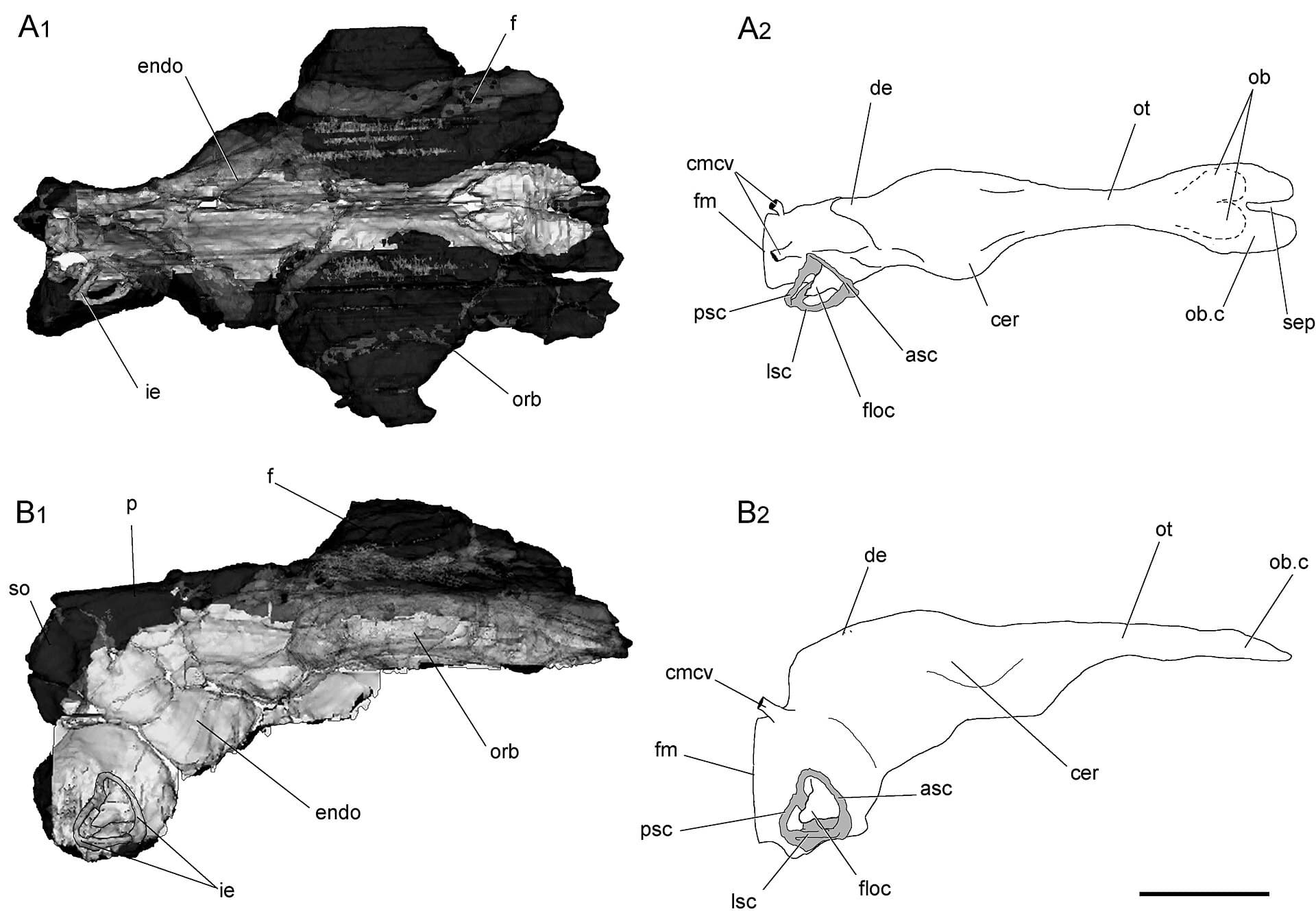
What sets this dinosaur apart is how much of its biology scientists have read from one skeleton. In 2015, Paulina-Carabajal and paleontologist Cecilia Succar described its partial endocast (a cast of the brain cavity), which runs 3.9 inches (100 millimeters) from the spinal-cord opening to the base of the olfactory tract. Its forebrain, midbrain, and hindbrain resemble those of Majungasaurus and Indosaurus. The inner ear was only the second known for any abelisaurid, with a shorter lateral semicircular canal than in Majungasaurus.
The flocculus is a brain lobe that tends to be enlarged in animals relying on quick head or body movements. In Aucasaurus, it sat in an 8-shaped recess like that of Abelisaurus, so the authors suggested a slightly wider range of head movements. However, the size of its balance canals points to relatively limited sensitivity to head acceleration.

According to Baiano’s team, the original diagnosis named one autapomorphy (a trait unique to the species): front hemal arches whose canal stays open at the top. The team upheld that trait in 2023, judging damage after death unlikely and ruling out immaturity. They also added seven more features of the axial skeleton, such as a triangular process where the rear middle gastralia meet.
Its family tree is less settled—and the debate continues. Baiano’s team notes that Coria and colleagues, like most later analyses, recovered Carnotaurus as its sister taxon (closest relative). Other studies found Abelisaurus closest, while a 2022 analysis by Baiano and colleagues favored Niebla. In 2023, the team left it in a polytomy—a branching point with no clear order—within a clade that also holds Niebla, Pycnonemosaurus, and others.

Interesting Points about Aucasaurus
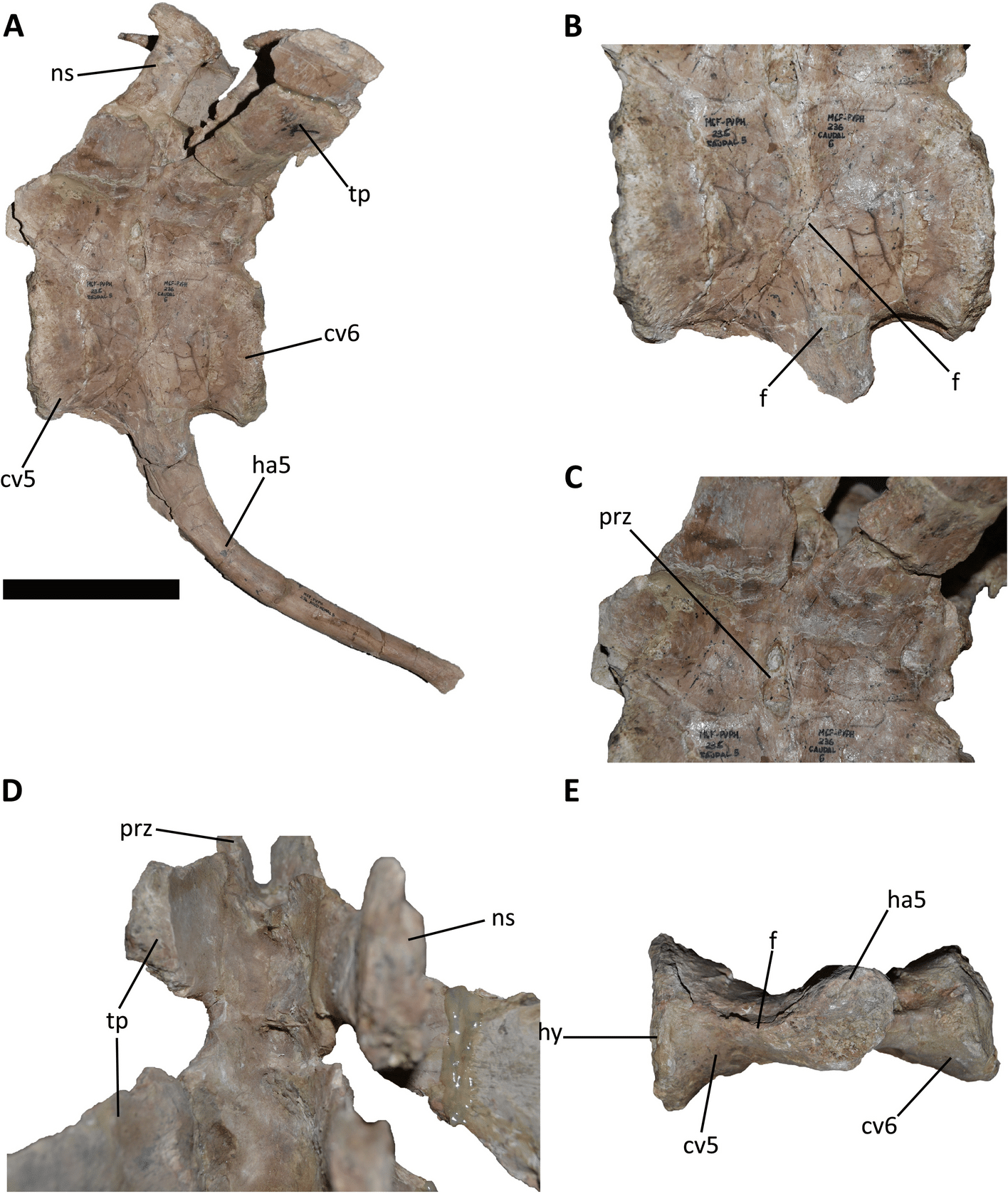
- Its fused fifth and sixth tail vertebrae show no sign of infection or injury, and a 2024 study read them as a congenital malformation, the first known among non-tetanuran theropods.
- Eleven growth marks in a rib show that the animal was at least eleven years old and fully grown when it died.
- Among ceratosaurs, only Masiakasaurus, Aucasaurus, and Majungasaurus preserve gastralia.
- In 2022, Baiano and paleontologist I.A. Cerda published the first intensive study of bone tissue in any abelisaurid, based on this skeleton.
Aucasaurus in its Natural Habitat
The rocks at Auca Mahuevo record a low floodplain crossed by rivers. According to a 2010 study, meandering rivers laid down the lower 167 feet (51 meters) of the section under semi-arid skies with marked wet and dry seasons. Above them, the upper 56 feet (17 meters) hold mudflats and lakes from even drier times. Floods from shallow channels buried titanosaur clutches of 15 to nearly 40 eggs.
Like other abelisaurids, Aucasaurus is thought to have been a carnivore, although no gut contents or bite marks tie it to any prey. Shed teeth like its own lay among adult titanosaur bones, but they remain unassigned. Several named dinosaurs are also from the Anacleto Formation, though no study places any of them at its level. Barrosasaurus, a large titanosaur, comes from the lower part of the formation at Sierra Barrosa. In Río Negro Province, finds include Gasparinisaura, a basal ornithopod and herbivore with gastroliths (stomach stones). Agnolín and colleagues also list the saltasaurine titanosaur Neuquensaurus from the formation. Near General Roca, the small titanosaur Chadititan shares its bed with abelisaurid bones similar in size to Aucasaurus.
Unnamed finds include another abelisaurid from the formation, MPCN-PV 69. Lungfish, side-necked turtles, crocodyliforms, mammals, and a pterosaur also turn up in the Anacleto Formation. While there is no direct evidence of how Aucasaurus hunted, Baiano’s team noted that its stiff tail fits earlier views of some abelisaurids as powerful sprinters. According to Agnolín and colleagues, abelisaurids dominated the top predator niches of Campanian northern Patagonia. The one exception they name is the large megaraptorid Aerosteon, also known from the Anacleto Formation but in Mendoza Province. Aucasaurus may therefore have been among the leading hunters of its landscape.
Frequently Asked Questions
It means “Auca Mahuevo lizard,” after its fossil site, and the species name honors geologist Alberto Garrido.
It probably lived in the early Campanian stage of the Late Cretaceous, but its exact age is uncertain.
The only published estimate we located puts its length at about 20.0 feet (6.1 meters). Its height and weight are not specified.
It is thought to have been a carnivore like other abelisaurids. No fossil shows directly what it ate, though shed teeth like its own were found among titanosaur bones at Auca Mahuevo.
It was found at Auca Mahuevo, in the Anacleto Formation of Neuquén Province, Argentina.
Its front hemal arches have a canal open at the top, a trait unique to it. It also had swollen brows instead of horns, air spaces in its tail bones, and probably a very stiff tail.
Sources
The information in this article is based on various sources, drawing on scientific research, fossil evidence, and expert analysis. The aim is to provide a comprehensive and accurate overview of Aucasaurus. However, please be aware that our understanding of dinosaurs and their world is constantly evolving as new discoveries are made.
- https://doi.org/10.1671/0272-4634(2002)022[0460:ANCROC]2.0.CO;2
- https://doi.org/10.7717/peerj.16236
- https://pmc.ncbi.nlm.nih.gov/articles/PMC10655716/
- https://ri.conicet.gov.ar/handle/11336/162684
- https://pmc.ncbi.nlm.nih.gov/articles/PMC10829224/
- https://ri.conicet.gov.ar/handle/11336/278261
- https://www.app.pan.pl/archive/published/app60/app20130037.pdf
- https://pmc.ncbi.nlm.nih.gov/articles/PMC6021374/
- https://palass.org/node/3313
- https://pmc.ncbi.nlm.nih.gov/articles/PMC11994025/
- https://doi.org/10.1111/cla.12583
- https://www.ameghiniana.org.ar/index.php/ameghiniana/article/view/857
- https://www.ameghiniana.org.ar/index.php/ameghiniana/article/view/856
- https://zenodo.org/record/4734717
- https://www.ameghiniana.org.ar/index.php/ameghiniana/article/view/120
- https://doi.org/10.22179/REVMACN.26.885
- https://www.app.pan.pl/archive/published/app53/app53-351.pdf
- https://zenodo.org/records/5685070
This article was last fact checked: TheDinosaurs Team, 12-11-2026
Featured Image Credit: Paleocolour, CC BY-SA 4.0, via Wikimedia Commons
