
East of the Sierra de La Colonia, in north-central Chubut Province, Argentina, the claystones of the La Colonia Formation record an ancient estuary. Low in a local section of these rocks lay the partial skeleton of Koleken inakayali, an abelisaurid from the Maastrichtian—the last stage of the Late Cretaceous. Abelisaurids were arguably among the most successful carnivorous dinosaurs of Gondwana, the southern landmasses. Yet Koleken stands out for a simpler reason—it is only the second abelisaurid known from this formation, and unlike the famous Carnotaurus, it had no horns.
Paleontologist José O’Gorman found the specimen. In 2015, paleontologist Zulma Gasparini and colleagues reported it as an unidentified abelisaurid—already noting differences in the snout and eye-region bones. According to a university press release, the team at first thought it had found a new Carnotaurus specimen. In 2024, however, paleontologist Diego Pol and five colleagues named it as a new genus in the journal Cladistics. They judged its snout, forehead and eye-region differences highly unlikely to come from age alone. As a result, the describers now recognize two closely related abelisaurid species from Maastrichtian central Patagonia.
Koleken Key Facts
| Keyword | Fact |
|---|---|
| Pronunciation | Not specified |
| Meaning of name | Coming From Clay and Water |
| Group | Theropoda |
| Type Species | Koleken inakayali |
| Diet | Carnivore |
| When it Lived | 72.2 to 66 MYA |
| Period | Cretaceous |
| Epoch | Late Cretaceous (Maastrichtian stage) |
| Length | About 16.3 feet (4.97 meters), 2025 indirect estimate for a subadult |
| Height | Not specified |
| Weight | Not specified |
| Mobility | Not specified |
| First Discovery | Year not specified, by José O’Gorman (first reported 2015 from 2011 to 2012 field projects) |
| Described by | 2024 by D. Pol, M.A. Baiano, D. Černý, F.E. Novas, I.A. Cerda, and M. Pittman |
| Holotype | MPEF-PV 10826 |
| Location of first find | Cerro Bayo Norte area, east of the Sierra de La Colonia, La Colonia Formation, Chubut Province, Argentina |
Koleken Origins, Taxonomy and Timeline
The name Koleken comes from “Kóleken,” a name in the Teushen language of central Patagonia that means “coming from clay and water.” It refers to the claystone-rich estuary rocks that held the skeleton. The species name inakayali honors Inakayal, one of the last chiefs of the Tehuelche, the native people of central Patagonia. He resisted Argentina’s Conquest of the Desert campaign and died in 1888 after his capture. His skeleton then sat in the La Plata Museum’s anthropology collection until 1994, when his people buried it near Tecka, in Chubut. Together, the name ties the animal to its muddy resting place and to the people of its homeland.
Within Theropoda, Koleken belongs to Ceratosauria and, more narrowly, to the family Abelisauridae. Its describers place it within Brachyrostra and its subgroup Furileusauria, alongside Carnotaurus. Their parsimony analysis—which favors the family tree with the fewest changes—puts it “deeply nested” among these abelisaurids, in an unresolved cluster with Carnotaurus, Aucasaurus and Niebla. Koleken inakayali is the type and only known species.
The skeleton came from close to the base of the formation’s section that crops out in this area—a section Gasparini’s team placed in the formation’s middle strata. In 2021, W.C. Clyde and colleagues dated zircon crystals from the rocks just below, showing that the formation’s base is younger than about 71.7 million years. Pol’s team took this to restrict the base to the early Maastrichtian, placing Koleken in the Maastrichtian. Their dating file gives roughly 72.2 to 66 million years ago, and press releases cite about 69 million years. The formation probably also contains the Cretaceous–Paleogene boundary—the end of the Age of Dinosaurs.
Discovery & Fossil Evidence
The site lies in the Cerro Bayo Norte area, and Pol’s team deposited its precise locality data at the Museo Paleontológico Egidio Feruglio (MPEF) in Trelew. Gasparini’s 2015 report followed three field projects in 2011 and 2012. Their section “Norte de Cerro Bayo 1” is about 98 feet (30 meters) thick. There, partially articulated theropod remains lay 26 feet (8 meters) above the base, inside a concretion—a hard, cemented lump of sediment—about 5.2 feet (1.6 meters) across. According to a CONICET press release, the rear half inside it still lay articulated in life position.
The holotype, MPEF-PV 10826, belongs to the same museum. From the skull, it preserves most of the right maxilla and part of the left—the main upper jawbones. Parts of the nasals, both squamosals, frontal fragments and the fused rear parietals also survive. So do a partial right postorbital (the bone behind the eye socket) and part of the atlas, the first neck vertebra. The rest of the skeleton adds dorsal (back) vertebrae five to 12, a complete sacrum and eight tail vertebrae. Both ilia (upper hip bones) are present, along with parts of the pubes and ischia, the lower hip bones. Most of the right leg survives, from the femur (thigh bone) and tibia down to the ankle, metatarsals and several toe bones.
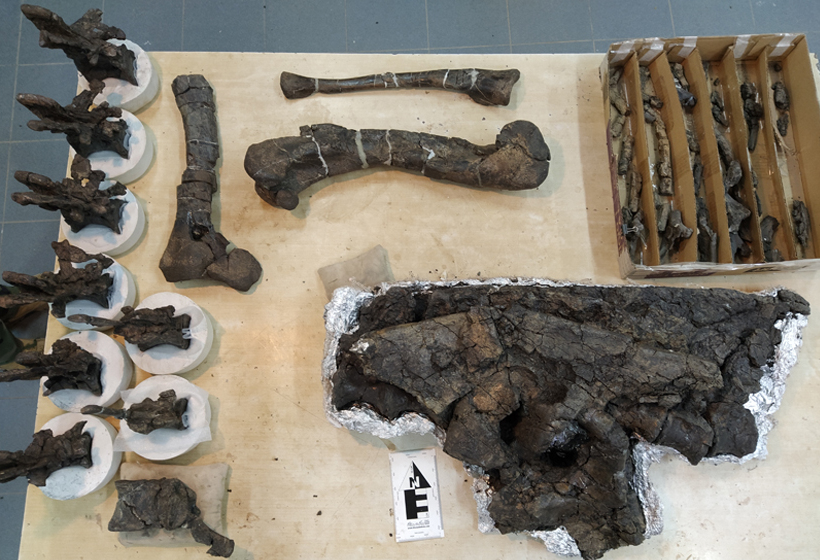

The skull bones and atlas lay close together but disarticulated, whereas the back, hips, tail and hind limbs remained articulated. No arm or shoulder bones survive. Mariano Caffa and Ariel Aresti prepared most of the material. So far, this skeleton is the only known Koleken—a limit its describers noted when comparing it with Carnotaurus.
Koleken Size and Description
Short description of Koleken
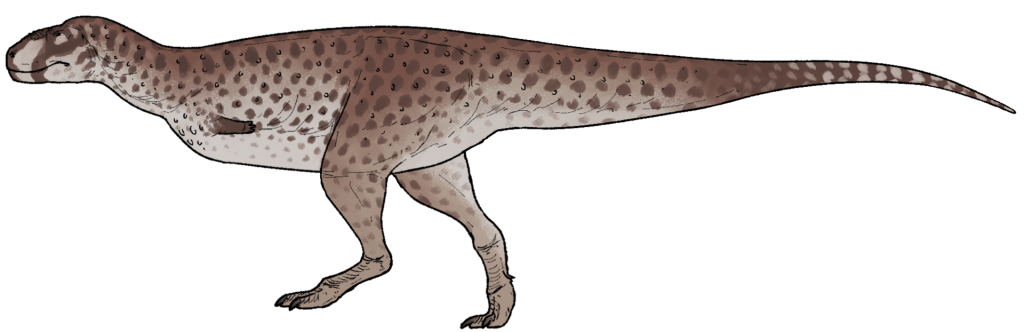
The maxilla probably held 12 teeth—the same count as in Carnotaurus. Unlike most abelisaurids, the bony plates on the inner side of the jaw were smooth rather than rough and ridged. On the snout, the unfused nasal bones show a rough crest near the outer edge and broad, circular pits on the flat inner part. Behind the eye, the front branch of the postorbital was proportionally the lowest of any known abelisaurid. Where Carnotaurus has its horns, Koleken had only a gently domed surface dotted with small bumps.
Farther back, the dorsal vertebrae had spool-shaped bodies that were concave at both ends. Their neural spines, the upright blades on top of each vertebra, carried a raised rim along the front, top and back. The ilium was 1.1 times as long as the femur, which was robust, with a strong crest near its lower end. Because no forelimbs survive, any restoration borrows its arms from relatives.

Size and Weight of Type Species
The original 2024 paper gives no total length, height or weight for Koleken. Its main size clue is a direct measurement—the right femur is 22.1 inches (56.2 centimeters) long.
In 2025, a team led by E.E. Seculi Pereyra estimated a body length of about 16.3 feet (4.97 meters). This indirect figure comes from a published femur-length regression formula. Yet their table lists a 555-millimeter femur, 7 millimeters shorter than the original measurement, and the study does not explain the gap. Press releases also called Koleken smaller than Carnotaurus, although the 2024 paper makes no such comparison.
However, bone tissue shows this individual was a still-growing subadult. The 16.3-foot estimate therefore describes this animal, not a full-grown adult.
The Dinosaur in Detail
What sets this dinosaur apart are eight diagnostic features, three of which the describers consider unique to Koleken. One is a postorbital whose front branch lacks an outer wall, so the surface over the eye socket faces downward. Another is a shallow depression on the same bone, bordered by a ridge. The third is the raised rim on the back vertebrae—a feature “not observed in other theropods in general.”
The skull also differs measurably from Carnotaurus. For example, the two front branches of the nasal diverge at 80 degrees, compared with 105 degrees in Carnotaurus. Majungasaurus and Aucasaurus fall in between, at 85 to 90 degrees. Meanwhile, the postorbital’s front branch has a height-to-length ratio of only 0.44, against more than 0.80 in Carnotaurus and Skorpiovenator.
The describers also tested whether Koleken might be a young Carnotaurus. Growth lines in the shinbone point to an animal at least six years old that had probably not reached sexual maturity. Even so, Pol’s team judged the skull differences “highly unlikely” to be the result of growth. They also weighed whether Koleken could be the hornless other sex of Carnotaurus. They note that horns have never been documented as a sex difference in archosaurs (crocodilians, dinosaurs and their kin), and the differences extend to many bones. With only two specimens, however, the team could not test this idea rigorously.
Its place in the family tree depends on the method. Some parsimony trees pair Koleken with Carnotaurus. A probability-based Bayesian analysis, by contrast, grouped it with Niebla and Aucasaurus and never recovered that pairing. Tip-dating, which also uses fossil ages, found Koleken closest to Niebla, an abelisaurid from the Allen Formation of northern Patagonia. For now, Koleken looks like a close relative of all three, although its exact branch remains unsettled.
Interesting Points about Koleken
- The genus name means “coming from clay and water” in Teushen, after the estuarine claystones that held the skeleton.
- Press reports say the team first took the bones for a new specimen of the horned Carnotaurus.
- Its describers found no other theropod with the raised rim that lines the neural spines of its back vertebrae.
- The only known individual was at least six years old and still growing when it died.
- Some parsimony trees pair it with Carnotaurus, while Bayesian tip-dating places Niebla as its closest relative.
Dinosaurs from the Same Formation
Also known from the La Colonia Formation (exact level relative to Koleken not known): Carnotaurus and Titanomachya. The very complete Carnotaurus skeleton, with frontal horns and extremely reduced forelimbs, came from another locality, Estancia Pocho Sastre, near Bajada Moreno. Titanomachya, a small titanosaur (long-necked sauropod) estimated at 5.8 to 9.8 metric tons as an adult, comes from the same Norte de Cerro Bayo area. Its describers place it in the formation’s middle section, in levels like those of other dinosaurs such as abelisaurids, hadrosaurs and ankylosaurs. Clyde’s dates put the formation’s base after about 71.7 million years ago and its top probably at the Cretaceous–Paleogene boundary. That would make its span less than about six million years, so these animals may not all have lived at the same time.
Koleken in its Natural Habitat
Imagine a brackish to freshwater estuary, where winding channels cut through muddy floodplains, marshes and ponds. That is how Gasparini and colleagues read the rocks near the find, probably in the estuary’s central zone. Others have instead described river deposits passing into tidal flats, or coastal plains with shallow seas, barrier islands and lagoons. Meanwhile, the formation’s plant record is rich in aquatic ferns and flowering plants.
While there is no direct evidence of what Koleken ate, it belongs to a group of carnivorous dinosaurs. The formation has also yielded fishes, turtles, snakes, plesiosaurs (paddle-limbed marine reptiles) and mammals, but no fossil links any of them to its diet. A 2025 study coded Koleken, like all Late Cretaceous abelisaurids, as a specialist feeder. The label came from the group’s relationships and shared anatomical and functional traits.
How Koleken behaved remains unknown. Co-author Michael Pittman said more specimens of Koleken and Carnotaurus will help show how they interacted, though whether they overlapped in time is unknown. In a correlatable section 2,300 feet (700 meters) away, Gasparini’s team found unnamed theropod, titanosaur, ankylosaur and hadrosaur bones. The formation has also yielded an enantiornithine bird, from an extinct group, and a 2023 study reported a possible modern-type (neornithine) bird. Gasparini’s team found that fossils in these fine-grained beds accumulated in place or with little transport. In contrast, Pol said a river most likely carried the Koleken carcass into the estuary, where rapid burial soon after death favored fine preservation.
Frequently Asked Questions
It means “coming from clay and water” in the Teushen language of central Patagonia.
It lived in the Maastrichtian stage of the Late Cretaceous, between 72.2 and 66 million years ago.
A 2025 indirect estimate gives about 16.3 feet (4.97 meters) for the only known individual, which was not fully grown.
It was a carnivore, judging from the group it belongs to, but no fossil evidence records its actual prey.
Its skeleton came from the Cerro Bayo Norte area of the La Colonia Formation in Chubut Province, Argentina.
Unlike its relative Carnotaurus, it lacked horns, and it shows three features unique to its genus.
Sources
The information in this article is based on various sources, drawing on scientific research, fossil evidence, and expert analysis. The aim is to provide a comprehensive and accurate overview of Koleken. However, please be aware that our understanding of dinosaurs and their world is constantly evolving as new discoveries are made.
- https://doi.org/10.1111/cla.12583
- https://ri.conicet.gov.ar/handle/11336/259744
- https://doi.org/10.48668/X53LJM
- https://doi.org/10.1016/j.cretres.2014.11.010
- https://doi.org/10.1016/j.cretres.2021.104889
- https://doi.org/10.1080/08912963.2024.2332997
- https://archive.org/details/biostor-215005
- https://doi.org/10.1016/j.jsames.2020.102915
- https://doi.org/10.1186/s12862-025-02374-y
- https://doi.org/10.1016/j.cretres.2023.105595
- https://www.oalglobal.cuhk.edu.hk/cuhkenews_202408_new_dinosaur/
- https://www.conicet.gov.ar/hallan-en-chubut-una-nueva-especie-de-dinosaurio-carnivoro-que-vivio-hace-69-de-millones-anos/?lan=en
- https://www.sci.news/paleontology/koleken-inakayali-12956.html
This article was last fact checked: TheDinosaurs Team, 17-11-2026
Featured Image Credit: TotalDino, CC BY 4.0, via Wikimedia Commons
