
On the crumbling south-west coast of the Isle of Wight, near Atherfield Point, the lagoon muds of the Vectis Formation gave up one of Britain’s most complete dinosaur skeletons. Today it carries the name Mantellisaurus atherfieldensis, a plant-eating ornithopod from the Early Cretaceous. The skeleton probably dates from the very start of the Aptian stage, roughly 121 million years ago. For decades it stood in the shadow of its bulkier relative, Iguanodon. Its lighter build, however, first prompted a genus of its own.
Amateur paleontologist Reginald Walter Hooley obtained the skeleton after a cliff fall, in 1914 according to recent accounts. His description naming it Iguanodon atherfieldensis appeared in 1925, two years after his death. Later, in a book chapter usually cited as 2007, paleontologist Gregory S. Paul moved it into the new genus Mantellisaurus. The book itself circulated in late 2006. In 2023, a redescription of the holotype backed the genus with three unique skeletal traits. Its story shows how one well-preserved animal can anchor a debate about the plant-eaters of Cretaceous Europe.
Mantellisaurus Key Facts
| Keyword | Fact |
|---|---|
| Pronunciation | Not specified |
| Meaning of name | Not specified |
| Group | Ornithopoda (Iguanodontia) |
| Type Species | Mantellisaurus atherfieldensis |
| Diet | Herbivore |
| When it Lived | Barremian to early Aptian stages (holotype about 121 MYA) |
| Period | Cretaceous |
| Epoch | Early Cretaceous (Barremian to early Aptian stages) |
| Length | 19.7 to 23.0 feet (6 to 7 meters), Hooley 1925 estimated 20.7 feet (6.3 meters) |
| Height | Not specified |
| Weight | Not specified |
| Mobility | Debated: primarily but not exclusively bipedal (Norman 1986), strongly bipedal (Paul 2008), or semi-quadrupedal (Natural History Museum) |
| First Discovery | 1914 by Reginald Walter Hooley (announced 1917, Norman 1986 gives 1912) |
| Described by | 1925 by R.W. Hooley (as Iguanodon atherfieldensis), genus named 2007 (circulated late 2006) by G.S. Paul |
| Holotype | NHMUK PV R5764 (formerly BMNH R5764) |
| Location of first find | Shepherds Chine Member, Vectis Formation, near Atherfield Point, Isle of Wight, England, UK |
Mantellisaurus Origins, Taxonomy and Timeline
The species name atherfieldensis points to Atherfield, the small village near the discovery site. The genus name is harder to pin down—Paul coined it in a chapter we could not access, and no study we consulted explains it.
In broad terms, Mantellisaurus belongs to Ornithischia, Ornithopoda, and Iguanodontia—the wider group that includes Iguanodon. More narrowly, the 2023 study by Bonsor and colleagues recovered it as an early-diverging hadrosauroid styracosternan. In other words, it sits near the base of the lineage that later produced the duck-billed dinosaurs. Its classic foil is the robust Iguanodon bernissartensis, against which Mantellisaurus looks distinctly gracile, or lightly built. M. atherfieldensis is the type species of the genus.
Norman’s 2015 monograph on Hypselospinus treats it as an upper Barremian to Lower Aptian Wealden species. The holotype itself probably comes from earliest Aptian strata, just younger than the Barremian–Aptian boundary. Citing the 2020 Geologic Time Scale of Gale and colleagues, Lockwood and colleagues date that boundary to 121.4 million years ago. The same scale puts the base of the Barremian, within the Wessex Formation, at 126.5 million years ago. Referred fossils, however, reach into the early Aptian, including the Maidstone skeleton from Kent’s Hythe Formation. The boundary between the two stages runs through the holotype’s own unit, the Shepherds Chine Member. Its lagoon muds formed before the sea flooded the region in the Aptian marine transgression.
Discovery & Fossil Evidence
Lockwood and colleagues date Hooley’s find to 1914, while Norman’s 1986 monograph gives 1912. Hooley’s own 1925 paper says he announced it in 1917 as Iguanodon bernissartensis, recognizing a new species only after freeing the bones from rock. Norman’s account adds an earlier 1912 assignment to I. mantelli, but Hooley’s 1912 papers appear to describe other remains from Brighstone Bay.
The holotype, NHMUK PV R5764, is a partial associated skeleton held at the Natural History Museum in London. In 2023, Bonsor and colleagues called it “one of the most complete British dinosaur specimens.” Staff moved it into the museum’s Hintze Hall in 2017.
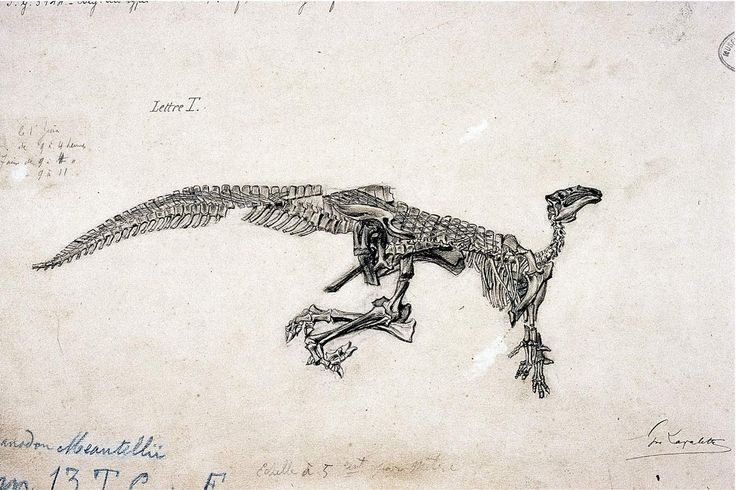

A second key skeleton lies in Belgium. IRSNB 1551, from Bernissart, is “an almost complete skeleton” found in virtually perfect articulation, with its bones still in place. Paleontologist Louis Dollo studied it in 1882. In 1986, Norman referred it to the Isle of Wight species, finding “no significant difference in morphology” from the holotype. Other referrals include the Wessex Formation skeleton NHMUK PV R11521 and the historic Maidstone specimen once described by Gideon Mantell. Researchers have referred material from elsewhere in Europe too. Yet in 2021, Lockwood and colleagues warned that Isle of Wight bones often go to Mantellisaurus or Iguanodon on “little more than the relative size and robustness” of the bones. In 2024, for instance, a Wessex Formation skeleton first thought to be Mantellisaurus became a new genus, Comptonatus.
Mantellisaurus Size and Description
Two well-preserved skeletons, in London and Belgium, reveal much of its body plan.
Short description of Mantellisaurus
In 1986, Norman described the skull as “long and low with slender lower jaw.” The Bernissart skull measures 54 centimeters (21.3 inches) long. Its jaw joint sat low, which Norman called “a typical herbivore adaptation in reptiles.” Norman’s diagnosis gives up to 23 maxillary (upper jaw) and 20 dentary (lower jaw) tooth positions.
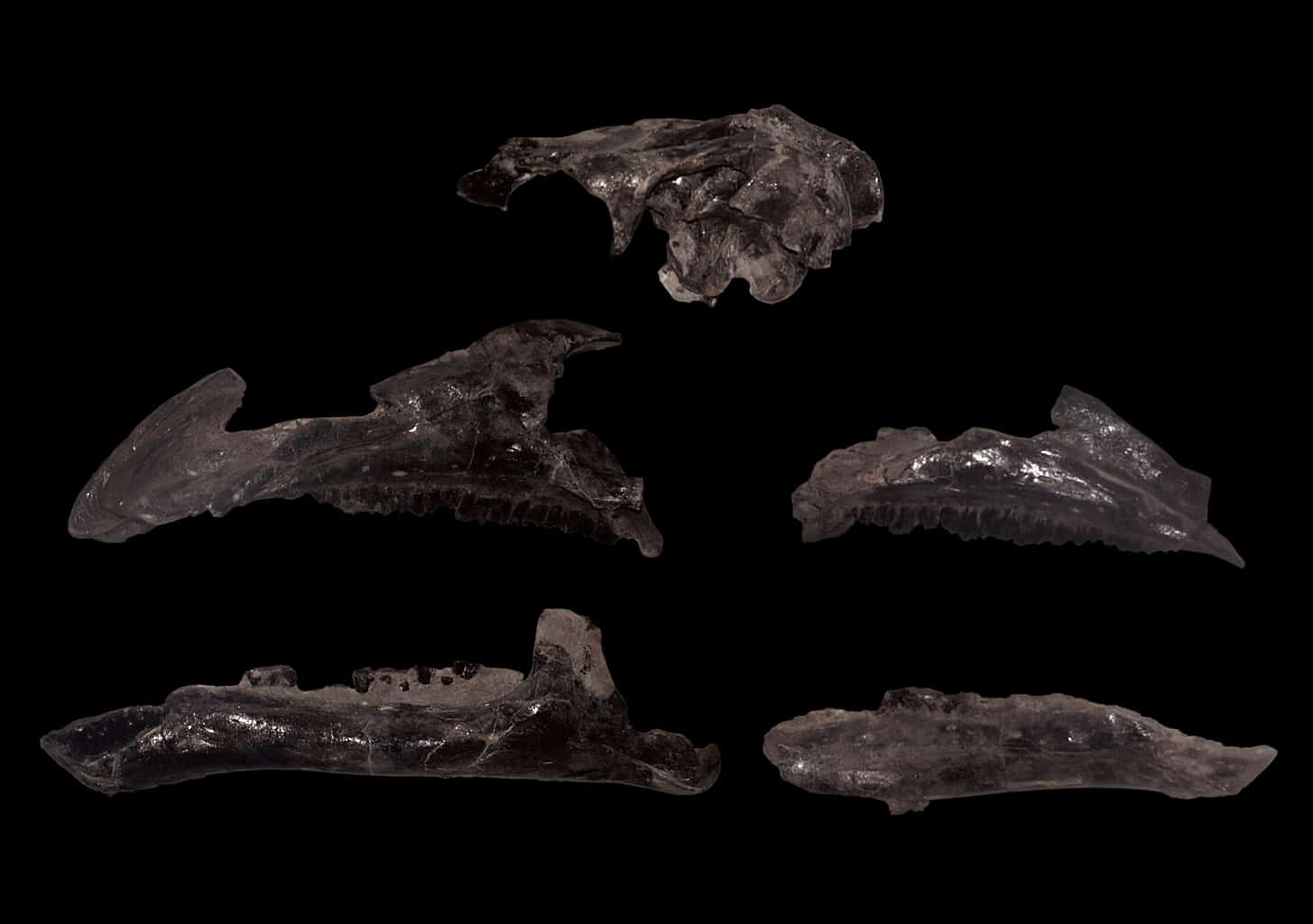

Behind the head, the neural spines (the bony blades above each vertebra) of the back and tail were tall and slender, judging from the Bernissart skeleton. Six true sacral vertebrae, plus one borrowed from the back, braced the hips. The forelimb was slender and lightly built, ending in long, thin hand bones and a “comparatively short, conical” thumb spike. In the hips, the pubis (a lower hip bone) carried a very thin prepubic process—a blade that points forward.
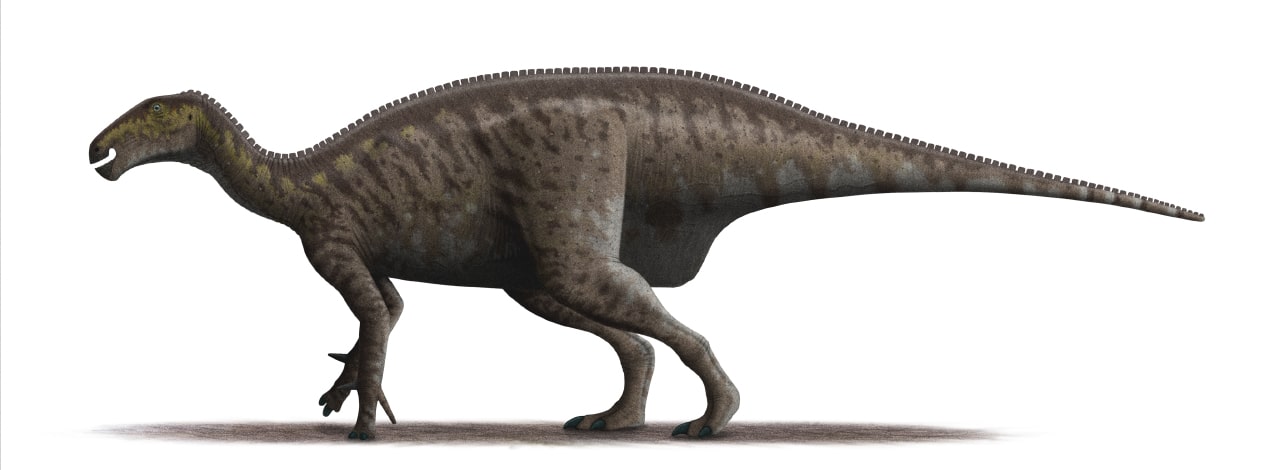
How it walked remains debated. Norman read its limb proportions as “primarily though not exclusively bipedal,” whereas Paul called it “strongly bipedal.” The Natural History Museum, in contrast, describes it as semi-quadrupedal, perhaps using all fours only at slow speeds or when standing still. Norman suggested its skin was probably thin and pliable.
Size and Weight of Type Species
Hooley’s 1925 description estimated the holotype at 20.7 feet (6.3 meters) long. Norman’s 1986 diagnosis later gave Mantellisaurus a length of 19.7 to 23.0 feet (6 to 7 meters), without explaining how he reached it. In 2015, he added that mature skeletons appear to range between 6 and 7 meters long. Paul’s original size statement was not available to us.
None of the sources we accessed gives a peer-reviewed height or weight.
Size also varies among the referred specimens. The Wessex skeleton NHMUK PV R11521 has a femur, or thigh bone, 14 percent shorter than the holotype’s. By contrast, Brighstoneus, a close relative from older Wessex rocks, has an estimated femur 10 percent longer than the holotype’s. Next to the heavier Iguanodon bernissartensis, however, Mantellisaurus remains the gracile partner.
The Dinosaur in Detail
What sets this dinosaur apart lies in its skull and shoulder. In 2023, Bonsor and colleagues identified three autapomorphies—traits unique to a single species—in the premaxilla (front of the upper jaw), maxilla, and scapula (shoulder blade). Their public abstract does not detail those traits, but Lockwood’s team published one maxilla measurement. In the holotype, the part of the upper jaw bone in front of its rising branch is just 1.4 times the length of the part behind it. By contrast, they estimate about 2 for Brighstoneus, and Ouranosaurus reaches 2.6.
Paul also noted that its ilium, the upper hip bone, had a shape like that of Camptosaurus. In the hand, the phalangeal formula was 2, 3, 3, 3, 3—the number of finger bones in each digit, from the first to the fifth. Meanwhile, the coracoid foramen, a small opening in the shoulder girdle, was completely enclosed.
Its classification has a lively history. Paul split it from Iguanodon because he saw it as more gracile than I. bernissartensis. As he wrote in 2008, it was also probably more derived—perhaps even a hadrosauroid. That same year, he named Dollodon bampingi for the Bernissart skeleton, but McDonald and Norman independently rejected that genus in 2012. Both concluded that the Bernissart animal belongs to Mantellisaurus after all, and McDonald judged Proplanicoxa a probable junior synonym—a later name for the same animal—as well.
Its exact branch on the family tree remains less settled. When Lockwood’s team scored only the holotype in 2021, Mantellisaurus fell into a polytomy—an unresolved fork—with Iguanodon, Barilium, Brighstoneus, and Ouranosaurus. The 2023 study, by contrast, placed it among early hadrosauroids. Taken together, these results point to a valid genus whose wider set of referred bones still awaits a full review.

Interesting Points about Mantellisaurus
- Hooley first identified the skeleton as Iguanodon bernissartensis when he announced it in 1917, before recognizing it as a new species.
- According to the Natural History Museum, its mounted holotype in London contains 80 to 90 percent real bone.
- The Bernissart skeleton IRSNB 1551 served as the type of Dollodon for only a few years before McDonald and Norman returned it to Mantellisaurus.
- Skin impressions found with the holotype preserve two kinds of tubercles—small irregular bumps and larger, flat polygonal ones.
- The holotype is roughly 4 million years younger than its relative Brighstoneus, assuming steady rates of sediment buildup.
Contemporary Dinosaurs
Sharing the Bernissart quarry was Iguanodon bernissartensis, a robust relative that Paul described as heavily built and semi-quadrupedal. Norman called the two “closely related sympatric” species, meaning they lived in the same area. Their Belgian fossils come from lake clays of the Sainte-Barbe Clays Formation, which pollen and spores date to between the middle Barremian and the earliest Aptian. In 2012, McDonald recognized these two as the only large early iguanodonts of the upper English and Belgian Wealden. Since then, however, researchers have named Brighstoneus, Comptonatus, and Istiorachis from the Isle of Wight’s Wessex Formation. One caution applies—the Bernissart Mantellisaurus is a referred skeleton, and Lockwood’s team has called for a reassessment of the referred material. Although the fossils record no direct interaction, Norman suggested that their difference in size most probably reflects ecological partitioning, or dividing up resources, rather than males and females of one species.
Mantellisaurus in its Natural Habitat
The world of the holotype was a shallow coastal lagoon of fluctuating salinity. Its muddy layers record low-energy mudflats, while a sandstone marks a delta pushing into the lagoon. Dinosaur bones are rare here—documented finds amount to a handful of ornithopod, ankylosaur, and theropod specimens. Even so, dinosaur tracks in the White Rock Sandstone at the base of the formation suggest large populations visited its plant-covered shoreline. A very large, unnamed spinosaurid—a gigantic theropod—also comes from that basal unit, in late Barremian rocks. In addition, the lowest Vectis beds have yielded referred material of the armored dinosaur Polacanthus, well below the holotype’s level.
Older Wessex rocks, source of the referred skeleton NHMUK PV R11521, preserve a floodplain of meandering rivers and seasonal ponds under a variable, Mediterranean-style climate. Across the island’s Wealden rocks, large iguanodontians dominated, and their remains heavily outnumber those of other four-limbed animals. The Wessex Formation also preserves the allosauroid predator Neovenator and, at its very top, the small ornithopod Hypsilophodon. No evidence ties either animal directly to Mantellisaurus. In 2024, Lockwood and colleagues called the Wessex iguanodontian Comptonatus sympatric with it—although the holotype itself comes from younger Vectis rocks. Around Bernissart, ferns such as Weichselia grew closest to the lake margin, with conifers farther away. That open plant community was probably young regrowth, burned frequently by wildfires.
As a herbivore, Mantellisaurus fed with its long, low skull and slender lower jaw. The fossils do not reveal, however, which plants it favored. According to the Natural History Museum, experts think the thumb spikes of Mantellisaurus and Iguanodon were their primary defense against predators. While there is no direct evidence of how it shared its habitat, it may have avoided competing head-on with Iguanodon, as Norman’s partitioning idea implies.
Frequently Asked Questions
The species name refers to Atherfield on the Isle of Wight. The sources we checked do not state the meaning of the genus name.
It lived in the Early Cretaceous, during the Barremian and early Aptian stages. The holotype is about 121 million years old.
Mature skeletons appear to have reached about 19.7 to 23.0 feet (6 to 7 meters) long. None of the peer-reviewed sources we consulted gives a height or weight.
It was a herbivore, with a low-set jaw joint that Norman called typical of plant-eating reptiles.
The holotype came from the Vectis Formation near Atherfield Point, Isle of Wight, England.
A 2023 study found three unique traits in its premaxilla, maxilla, and scapula that separate it from Iguanodon.
Sources
The information in this article is based on various sources, drawing on scientific research, fossil evidence, and expert analysis. The aim is to provide a comprehensive and accurate overview of Mantellisaurus. However, please be aware that our understanding of dinosaurs and their world is constantly evolving as new discoveries are made.
- https://www.gbif.org/species/4965881
- https://dml.reptilis.net/2006Nov/msg00148.html
- https://dml.reptilis.net/2007Dec/msg00069.html
- https://biblio.naturalsciences.be/rbins-publications/bulletin-of-the-royal-belgian-institute-of-natural-sciences-earth-sciences/bulletin-of-the-royal-belgian-institute-of-natural-sciences-earth-sciences/norman_anatomy_1986
- https://reptilis.net/DML/2011Mar/msg00522.html
- https://doi.org/10.1016/j.cretres.2011.03.002
- https://www.repository.cam.ac.uk/handle/1810/249306
- https://doi.org/10.5281/zenodo.6208586
- https://doi.org/10.1080/14772019.2021.1978005
- https://doi.org/10.1080/02693445.2023.2234156
- https://doi.org/10.7717/peerj.13543
- https://www.biodiversitylibrary.org/part/173868
- https://doi.org/10.1038/s41598-017-03671-3
- https://doi.org/10.1144/jgs2024-046
- https://orbi.uliege.be/handle/2268/295473
- https://www.nhm.ac.uk/discover/search-for-the-real-iguanodon.html
- https://doi.org/10.1144/GSL.JGS.1925.081.01-04.02
- https://hantsfieldclub.org.uk/ihr100/profiles-g-h/hooley.html
- https://doi.org/10.1080/14772019.2024.2346573
- https://www.nhm.ac.uk/press-office/research-reveals-the-most-complete-dinosaur-discovered-in-the-uk.html
- https://doi.org/10.1002/spp2.70034
This article was last fact checked: TheDinosaurs Team, 12-11-2026
Featured Image Credit: Ryan Hodnett, CC BY-SA 4.0, via Wikimedia Commons
