
In the Pranhita–Godavari valley of central India, the lower Kota Formation holds a well-known early sauropod, Barapasaurus tagorei. Its describers named this herbivore in 1975 and called its rocks Lower Jurassic, though some researchers argue for the Middle Jurassic. The describers also called it the earliest sauropod then known from adequate material.
Geologists from the Indian Statistical Institute (ISI) came across the first bones during a 1958 exploration of the valley. Excavations in 1960–61 then recovered about 300 bones, which lay among large fossilized tree trunks. In 1975, Jain, Kutty, Roy-Chowdhury, and Chatterjee, working on the ISI collection, named the animal in a preliminary account. A detailed osteology, or bone-by-bone study, by Bandyopadhyay and colleagues followed in 2010. Taken together, this work offers a rare glimpse of an early sauropod—though its crowded bone bed still guards open questions.
Barapasaurus Key Facts
| Keyword | Fact |
|---|---|
| Pronunciation | Not specified |
| Meaning of name | Big Leg |
| Group | Sauropoda |
| Type Species | Barapasaurus tagorei |
| Diet | Herbivore |
| When it Lived | 199.5 to 184.2 MYA (debated, with a Middle Jurassic age also argued) |
| Period | Jurassic |
| Epoch | Early Jurassic (Sinemurian–Pliensbachian stages, debated) |
| Length | Not specified |
| Height | Not specified |
| Weight | Not specified |
| Mobility | Moved on all four legs (quadrupedal) |
| First Discovery | 1958 by Indian Statistical Institute geologists, excavated 1960 to 1961 |
| Described by | 1975 by S.L. Jain, T.S. Kutty, T. Roy-Chowdhury, and S. Chatterjee |
| Holotype | Not specified |
| Location of first find | Pochampalli (Posampalli), lower Kota Formation, Gadchiroli district, Maharashtra, India |
Barapasaurus Origins, Taxonomy and Timeline
According to the ISI, which holds the fossils, “bara pa” means “big leg” in Hindi, and the genus name adds the familiar suffix saurus. We could not check this against the 1975 paper. The species name tagorei honors the poet Rabindranath Tagore—the ISI ties the find to his 1961 birth centenary, the year the excavation ended. Together, the name pairs the animal’s limbs with a literary tribute.
Barapasaurus belongs to Sauropoda, and researchers generally treat it as an early-diverging, or basal, member. As Loyal and colleagues summarized in 1996, McIntosh (1990) tentatively placed it in Vulcanodontidae, a family Cooper had erected in 1984. He pointed to a narrow sacrum (the fused hip vertebrae), deeply furrowed tail vertebrae, long forelimbs, and an apron-like pubis. Elongate metatarsals (foot bones) and teeth with coarse denticles, or serrations, completed his case. Barapasaurus tagorei is the type and only known species.
The Kota’s fishes, along with pollen, charophytes, and sphenodontians, had long suggested an Early Jurassic age. Comparing faunas in 1996 and 2006, Bandyopadhyay and coauthors placed the lower Kota in the Sinemurian to Pliensbachian stages—roughly 199.5 to 184.2 million years ago. The 2010 osteology kept that age.
Others have argued for a Middle Jurassic age from ostracods (tiny crustaceans), pollen and spores, and dinosaur teeth. In 2015, McPhee and colleagues called the putative Early Jurassic age poorly supported. Its dinosaurs and mammals, they added, suggest “a late Early Jurassic age at the oldest.” Lacking marine layers, ash beds, or a reliable dating marker, a 2023 study concluded that the age “cannot be known with confidence.” Because of that uncertainty, a 2021 study counted Barapasaurus in more than one time bin. Even so, Bajpai and colleagues listed the formation as Sinemurian–Pliensbachian in 2023.
Discovery & Fossil Evidence
According to the Paleobiology Database, the type locality lies near Pochampalli, or Posampalli, in Gadchiroli district. The same database records surface finds in 1958 and 1959, excavation in 1960–61, and further work with E. Colbert in 1964. Bandyopadhyay and colleagues later reported that the bones lay where sandstone meets mudstone, across about 2,970 square feet (276 square meters).
The 1975 paper established a holotype, but we could not verify its specimen number. The 2010 restudy therefore carries most of the weight. Its authors identified one partial skeleton, while most other bones lay disarticulated—scattered rather than joined. Taphonomy, the study of how remains came to be buried, then let them recognize several individuals. The bones include several teeth, vertebrae from the rear neck to the tail tip, and most limb and girdle bones. Apart from teeth, the 2010 study lists no skull material.

Citing the 2010 study, the Paleobiology Database also lists material from north of Krishnapur village, Adilabad district, in the lower Kota. Today a mounted skeleton stands in the ISI’s Geology Museum in Kolkata, which first opened to the public in 1977. In 2016, however, McPhee and colleagues noted that the genus rests largely on a heavily reconstructed composite mount. The bone bed’s single-species status, they added, “is yet to be fully demonstrated.”
Barapasaurus Size and Description
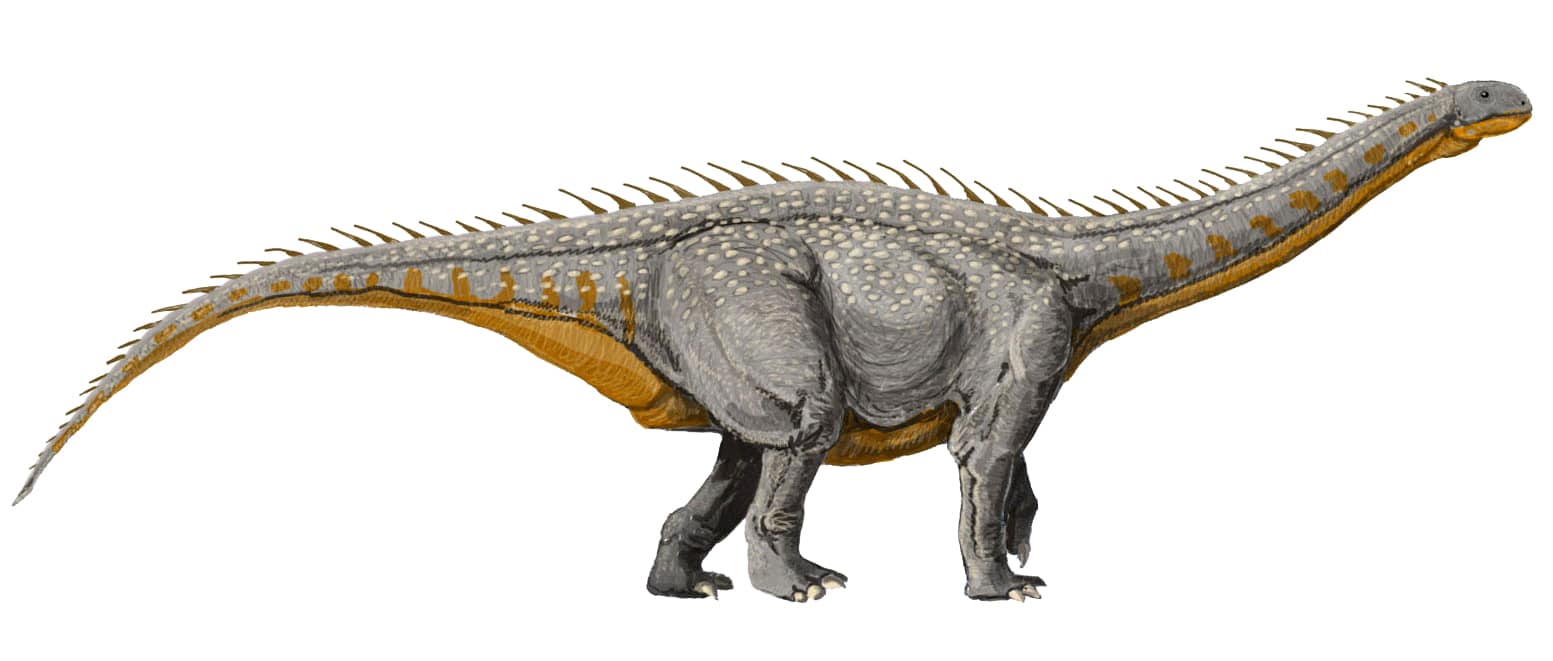
Bones from much of the body survive—so its build is clearer than its face.
Short description of Barapasaurus
The 2010 diagnosis rests on its teeth, details of its vertebrae, and a sacrum of four fused vertebrae. Its teeth were spoon-shaped, with bulbous bases, grooved crowns, and coarse tubercles—small bumps—along the carina, or cutting edge. In 2015, McPhee and colleagues described them as semi-spatulate, like those of most basal sauropods, Shunosaurus among them.
According to Loyal and colleagues, the neck and front back vertebrae were opisthocoelous—ball in front, socket behind—while the rest were flat-ended, or platycoelous. None of the neural spines, the blades atop each vertebra, split in two. Meanwhile, four vertebrae fused to form the sacrum. In 2020, Vidal and colleagues noted that it shows little or no wedging, unlike that of eusauropods (“true sauropods”). At the hips, the ilium (main hip blade) had a well-developed front process, while the ischium was slender and rod-like toward its tip.
In 1979, Jain and colleagues described the limbs as graviportal—built to bear weight—yet slender. Vidal’s team also called them columnar, marking Barapasaurus as an obligate quadruped that always walked on all fours. The listed remains include no skin impressions, so any picture of its outer covering is speculative.

Size and Weight of Type Species
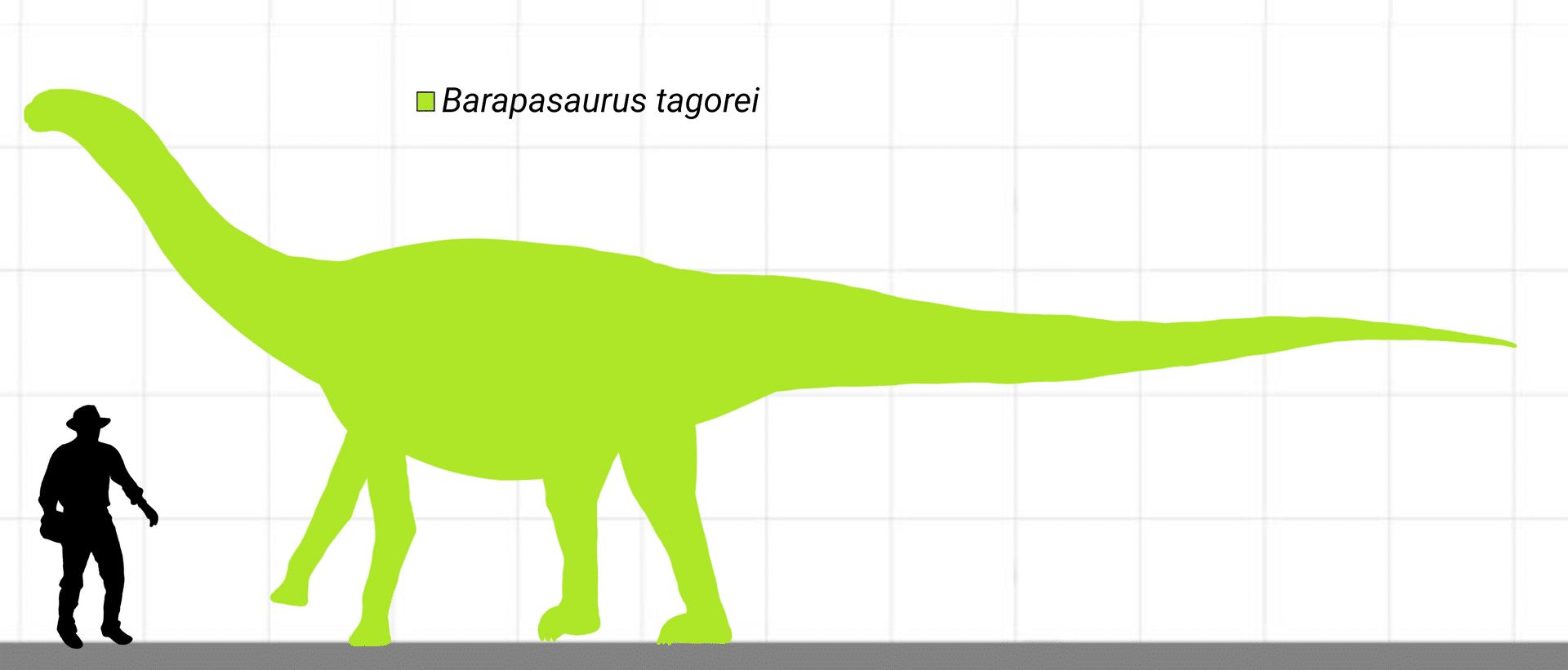
We could verify no peer-reviewed length or weight estimate for Barapasaurus. The firmest number is its femur (thighbone), about 4.5 feet (1.37 meters) long. Benson and colleagues listed it in a 2014 dataset, as did Apaldetti and colleagues in 2021. Both studies, however, left its mass blank as “NA,” and its hip height is likewise not specified.
The only lengths we found are not peer-reviewed—the Natural History Museum’s Dino Directory gives 14 meters (about 46 feet). The ISI calls its mount “an almost complete fossil skeleton of a 47 feet long sauropod.” In 2016, however, McPhee and colleagues described that mount as a heavily reconstructed composite. The scale diagram above follows Gregory Paul’s 2010 field guide, whose figure we could not check.
Still, in 1996 Loyal and colleagues called it “a large sauropod with slender limbs.” Sander and colleagues, in 2011, grouped it with Kotasaurus as early Indian sauropods that “represent large forms.” Until a peer-reviewed estimate appears, the 47-foot mount is best treated as an exhibit rather than a measurement.
The Dinosaur in Detail
What sets this dinosaur apart is the build of its vertebrae. According to the 2010 diagnosis, its “cranial and dorsal vertebrae” were acamerate—not divided into internal chambers. In the mid-back, the neural canal (the spinal cord’s channel) opened upward through a narrow slit into a large cavity. Work since 1979 has also described a cavity inside the neural arch of the back vertebrae, opening outward through a side hole. Yet in 2026, Beeston and colleagues noted no outward sign of air-sac hollowing in its tail vertebrae.
The scapula (shoulder blade) is straight, only weakly expanded at its far end, and lacks a rear flange. Remes and colleagues noted that combination in Vulcanodon and Patagosaurus as well. They also grouped it with Patagosaurus and Volkheimeria for a very slender ischium, a rear hip bone that flares only weakly at its tip. In 1979, Jain’s team had called it intermediate between the prosauropod stage and known sauropods.
In 2009, Remes and colleagues recovered it within Eusauropoda, and pairing it with the Argentine Patagosaurus cost just one extra step. They suggested a spreading Central Gondwanan Desert kept this southern pair apart from other sauropods. In 2010, by contrast, Bandyopadhyay and colleagues found Barapasaurus more basal than Vulcanodon and outside Eusauropoda.
That pairing has drawn criticism, because its only unambiguous shared trait also occurs in other taxa—as Remes’s team itself noted. In 2016, McPhee and colleagues added Sanpasaurus to that list. They likened the trait, a subdiapophyseal pneumatopore, to a hollow just below the diapophysis, the side process that meets a rib. Either it was inherited from early sauropods, they argued, or it evolved again and again. A 2025 analysis even pruned Barapasaurus as one of 13 unstable taxa. Taken together, these studies suggest an animal between stages, whose exact branch remains unsettled.

Interesting Points about Barapasaurus
- The species name honors the poet Rabindranath Tagore, whose 1961 birth centenary the Indian Statistical Institute ties to the find.
- Its 1975 describers considered it the earliest sauropod then known from adequate material, a view that doubts about the Kota’s age have since complicated.
- About 300 bones came from a bone bed covering roughly 2,970 square feet, where they lay with large fossilized tree trunks.
- A mounted skeleton stands in the Indian Statistical Institute’s Geology Museum in Kolkata, open to the public since 1977.
- Its sacrum was made of four fused vertebrae, one of the traits listed in the 2010 diagnosis of the species.
Dinosaurs from the Same Formation
Also known from the Kota Formation (exact level relative to Barapasaurus not known): Kotasaurus, another early-diverging sauropod from the lower Kota, though from a different locality. The lower Kota has been dated to the Sinemurian–Pliensbachian, but its age is debated, so the two may not have lived at the same time.
Barapasaurus in its Natural Habitat
The world Barapasaurus roamed was a landscape of rivers. In 1994, Rudra and Maulik suggested that a meandering river laid down the lower Kota, later measured at about 330 feet (100 meters) thick. The overlying upper Kota, rich in limestone, has been read as lake deposits, though accounts of the layering differ. Altogether, the formation reaches some 1,640 to 1,970 feet (500 to 600 meters). In 1982, Rudra proposed that the Kota limestones formed in freshwater playa-type lakes—shallow basins prone to drying out. Fish preserved in cracked limestone also hint at drought, Loyal and colleagues noted. On the paleoclimate map used by Remes and colleagues, southern Gondwanan sauropods of this age lived in winter-wet and warm-temperate belts.
In 1987, as Loyal’s team reported, Jain and Roychowdhury suggested that large sauropods like it fed on aquatic vegetation near the Kota lake. Large fossil tree trunks lay among its bones, although the exact plants it ate remain unknown.
In the lower Kota, theropod teeth, ankylosaur bones, and the early mammals Kotatherium haldanei and Indotherium pranhitai round out the record. The younger upper unit adds fishes, the pterosaur Campylognathoides indicus, and the turtle Indochelys. In 2020, Prasad and Parmar reported dromaeosaurid and ornithischian teeth from the formation, which they called Middle Jurassic—though we could not confirm their unit. While there is no direct evidence of its social life, the bone bed preserves several individuals, though not necessarily of one species.
Frequently Asked Questions
According to the Indian Statistical Institute, “bara pa” means “big leg” in Hindi, and tagorei honors the poet Rabindranath Tagore.
Studies by Bandyopadhyay and colleagues place it in the Early Jurassic’s Sinemurian to Pliensbachian stages, roughly 199.5 to 184.2 million years ago. Some researchers argue for a Middle Jurassic age.
We could verify no peer-reviewed length or weight, though its femur was about 4.5 feet (1.37 meters) long. The ISI calls its mount a 47-foot (about 14.3-meter) sauropod, though McPhee and colleagues describe it as a heavily reconstructed composite.
A herbivore, it may have fed on aquatic vegetation near the Kota lake, as Jain and Roychowdhury suggested in 1987.
Its type locality lies near Pochampalli in the Gadchiroli district of Maharashtra, India, in the lower Kota Formation.
It was an early-diverging sauropod, although studies disagree on whether it falls inside or outside Eusauropoda.
Sources
The information in this article is based on various sources, drawing on scientific research, fossil evidence, and expert analysis. The aim is to provide a comprehensive and accurate overview of Barapasaurus. However, please be aware that our understanding of dinosaurs and their world is constantly evolving as new discoveries are made.
- https://doi.org/10.1098/rspb.1975.0014
- https://api.crossref.org/works/10.1098/rspb.1975.0014
- https://palass.org/publications/palaeontology-journal/archive/53/3/article_pp533-569
- https://doi.org/10.7717/peerj.8542
- https://doi.org/10.1371/journal.pone.0006924
- https://doi.org/10.1038/srep13224
- https://doi.org/10.7717/peerj.2578
- https://doi.org/10.1038/s41598-020-63439-0
- https://doi.org/10.1038/s41598-021-01120-w
- https://doi.org/10.1038/s41598-023-39759-2
- https://doi.org/10.1111/j.1469-185X.2010.00137.x
- https://doi.org/10.1371/journal.pbio.1001853
- https://www.nhm.ac.uk/discover/dino-directory/barapasaurus.html
- https://doi.org/10.7717/peerj.14982
- https://europepmc.org/article/PMC/PMC13399178
- https://europepmc.org/article/PMC/PMC12397067
- https://doi.org/10.54103/2039-4942/18306
- https://link.springer.com/chapter/10.1007/978-3-030-49753-8_1
- https://archive.org/download/biostor-260395/biostor-260395.pdf
- https://www.isical.ac.in/~sdebasis/isipage/geodesc.html
- https://www.isical.ac.in/~gsu2008/index_files/About_us.htm
- https://paleobiodb.org/classic/basicCollectionSearch?collection_no=35268
This article was last fact checked: TheDinosaurs Team, 14-11-2026
Featured Image Credit: TotalDino, CC BY-SA 4.0, via Wikimedia Commons
