
Near Tendaguru Hill in southern Tanzania, the sandy marls of the Tendaguru Formation yielded one of the great giants of the Jurassic. Today it is called Giraffatitan brancai, a long-necked sauropod that lived in the Late Jurassic—roughly 155 to 143 million years ago. Its neck alone measured about 27.9 feet (8.5 meters), and its Berlin skeleton is the tallest dinosaur mount on record.
The bones came to light during the German Tendaguru Expedition, which began in 1909. In 1914, paleontologist W. Janensch described the animal as Brachiosaurus brancai, placing it in the American genus Brachiosaurus. From 1915 on, nearly every reconstruction of Brachiosaurus drew mainly on this African species. Then, in 2009, paleontologist M.P. Taylor argued that the two differ in at least 26 characters and need separate genera. Its story shows how a famous skeleton can change its name long after it goes on display.
Giraffatitan Key Facts
| Keyword | Fact |
|---|---|
| Pronunciation | Not specified |
| Meaning of name | Not specified (species name honors Professor Branca, organizer of the Tendaguru Expedition) |
| Group | Sauropoda (Brachiosauridae) |
| Type Species | Giraffatitan brancai (originally Brachiosaurus brancai) |
| Diet | Herbivore |
| When it Lived | 154.8 to 143.1 MYA |
| Period | Jurassic |
| Epoch | Late Jurassic (Kimmeridgian to Tithonian stages) |
| Length | Not specified |
| Height | 43.5 feet (13.27 meters), Berlin mount as measured in 2007 |
| Weight | About 25.6 to 41.9 short tons (23.2 to 38.0 metric tons), estimates from 2008 to 2012 |
| Mobility | Moved on all four legs (quadrupedal) |
| First Discovery | 1909 by the German Tendaguru Expedition (Site S dig began 11 October 1909) |
| Described by | 1914 by W. Janensch (as Brachiosaurus brancai), with the subgenus Giraffatitan named in 1988 by G.S. Paul |
| Holotype | Lectotype MB.R.2180 (SI), with MB.R.2181 (SII) as a paralectotype |
| Location of first find | Site S, Middle Dinosaur Member, Tendaguru Formation, near Tendaguru Hill, Lindi Region, Tanzania |
Giraffatitan Origins, Taxonomy and Timeline
The species name brancai honors Professor Branca, to whom, Janensch wrote, the organization of the whole expedition was owed. The genus name, however, has a more tangled history. Paleontologist G.S. Paul coined Giraffatitan in 1988, but only as a subgenus—Brachiosaurus (Giraffatitan). Together, the name honors the man behind the expedition and records a long argument over where the animal belongs.
Within Saurischia and Sauropoda, it belongs to Macronaria, Titanosauriformes, and finally Brachiosauridae. Taylor’s 2009 diagnosis of this family includes a long humerus (upper arm bone)—at least 0.9 times the length of the femur (thigh bone). In his analysis, Giraffatitan and Brachiosaurus came out as sister taxa (each other’s closest relatives) in all 72 most parsimonious trees. However, just one extra step moved Giraffatitan among the somphospondylians, the titanosauriform branch beside Brachiosauridae. Giraffatitan brancai is the type and only known species.
In 1914, Janensch thought the sauropod beds belonged partly to the Upper Jurassic and partly to the Lower Cretaceous. Later, Taylor placed the species in the Kimmeridgian and Tithonian stages of the latest Jurassic. On the 2024 international time scale, that span runs roughly 154.8 to 143.1 million years ago. In 2009, Bussert and colleagues tentatively dated the type horizon to the late Kimmeridgian, using dinoflagellate cysts—the resting stages of tiny marine algae.
Discovery & Fossil Evidence
Digging at Site S—the type locality—began on 11 October 1909 and continued until 1911. Janensch’s 1914 paper placed Skeleton S about 1.2 miles (2 kilometers) south of Tendaguru, in the Middle Saurian Bed. Later studies, however, put it about 0.6 mile (1.0 kilometer) south-southwest of Tendaguru Hill, in the Kitukituki stream section. The operation was vast—in 1911, about 500 African workers were digging, and with their families some 900 people lived near the hill.
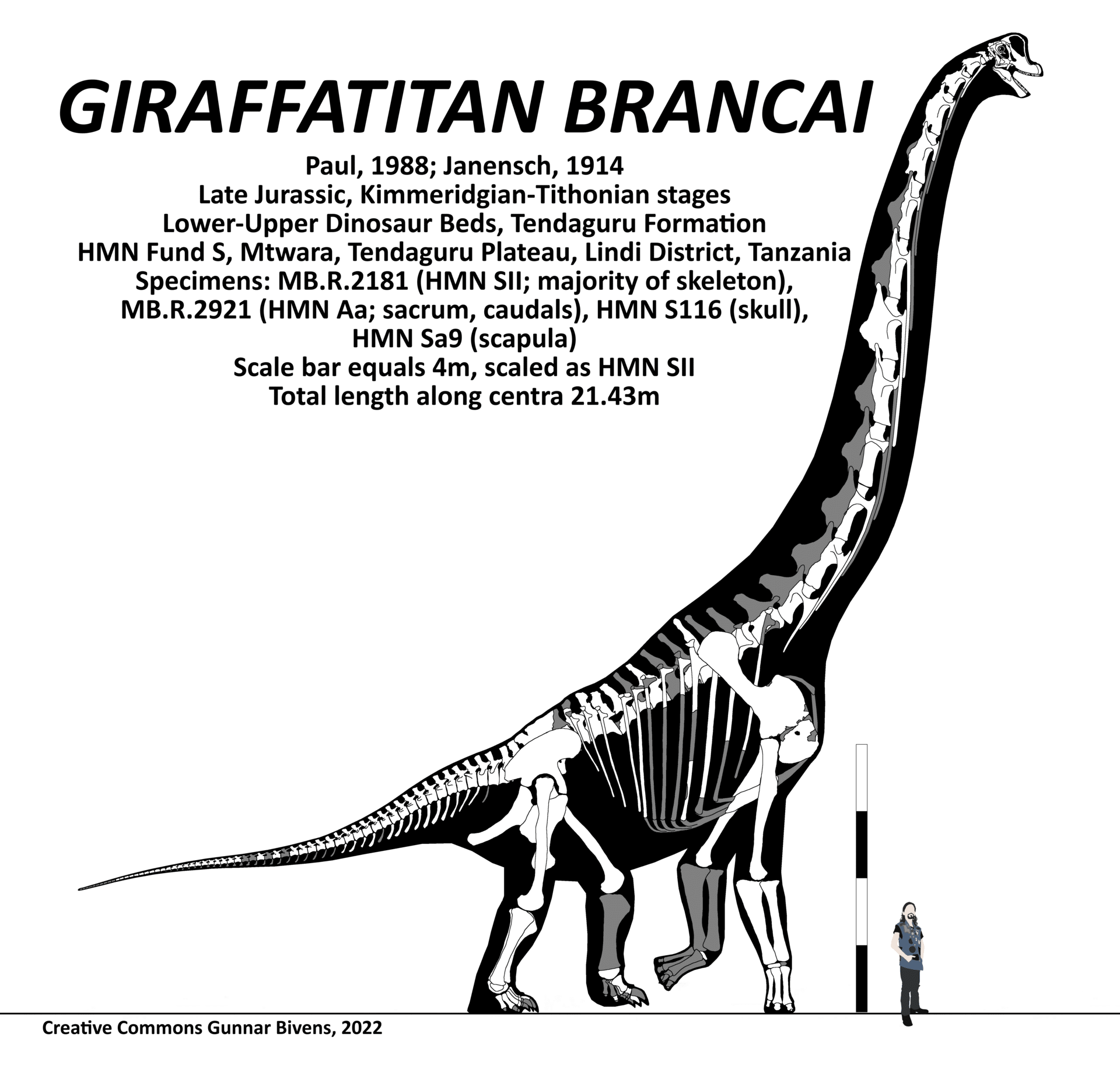
Skeleton S later proved to be two individuals, SI and SII. The smaller, SI, preserves a skull and neck vertebrae 2 to 7. Now numbered MB.R.2180, it is the lectotype—a name-bearing specimen chosen later from the original type material. Taylor proposed SII for that role in 2009, but he withdrew the idea in 2011 because Janensch had already designated the smaller individual. The larger SII, now MB.R.2181, is a paralectotype. It includes the dentaries (lower jaw bones), 11 cervical (neck) and seven dorsal (back) vertebrae, a left scapula (shoulder blade), the right forelimb, and parts of both hind limbs. According to Heinrich, its sacrum (hip vertebrae) and tail were already missing when it was found, probably lost to erosion.
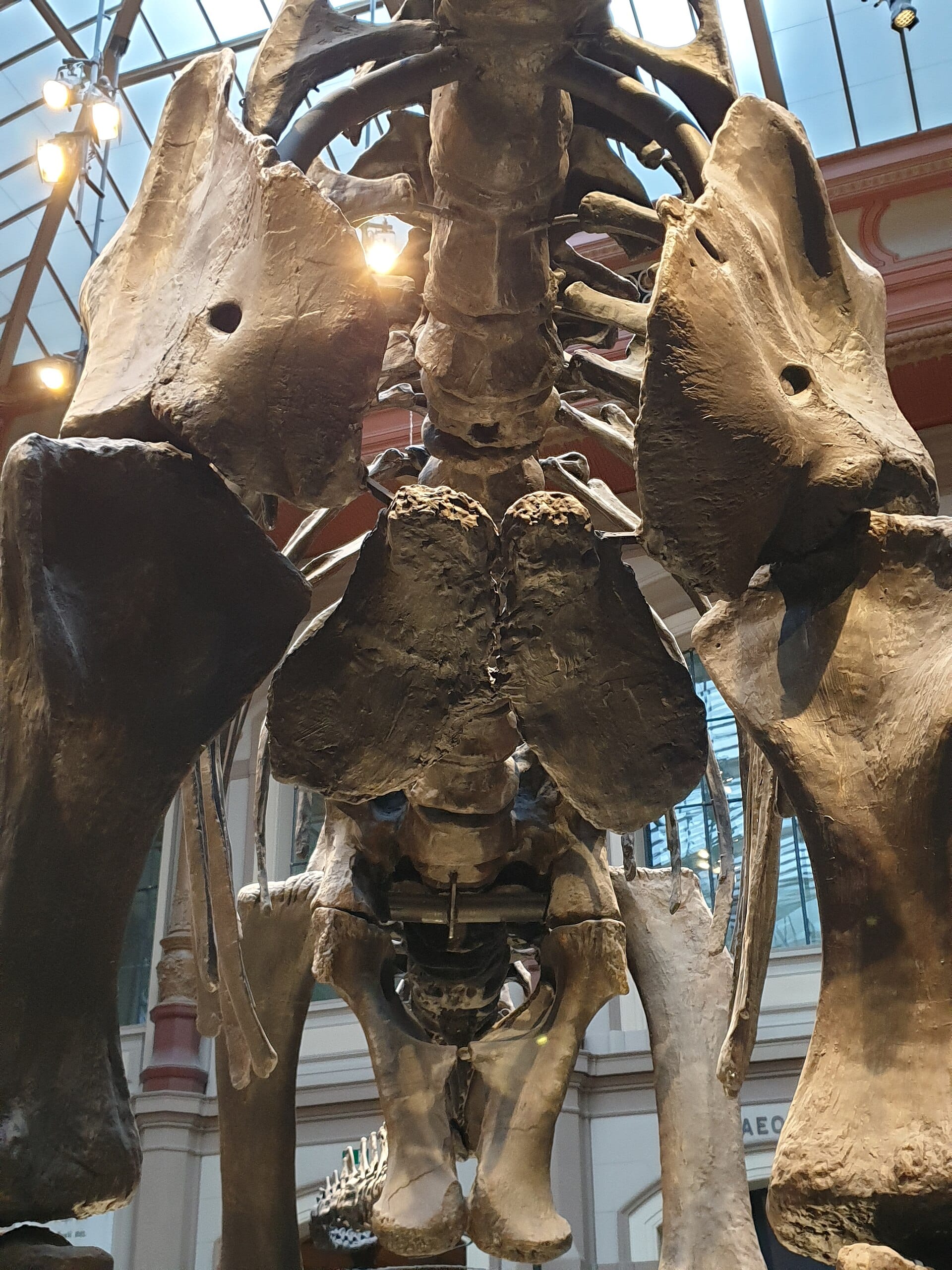

Beyond Site S, the species is known from many specimens that together include almost all skeletal elements. Janensch’s 1914 paper also named a second species, B. fraasi, from Skeleton Y near Kindope, northwest of Tendaguru. He later sank it into B. brancai. In contrast, Taylor’s initial assessment found that a specimen collected by Migeod in 1930, BMNH R5937, probably represents a second, distinct Tendaguru brachiosaur. Between 1922 and 1961, Janensch described this material in a series of comprehensive monographs.
Giraffatitan Size and Description
The Berlin skeleton dominates any discussion of this animal’s size—but it is a composite, and the weight of the living animal is still disputed.
Short description of Giraffatitan
Janensch’s 1914 diagnosis is brief. It lists an extremely long neck, humeri of 6.9 and 7.0 feet (2.10 and 2.13 meters), and a moderately long tail. Unlike in Diplodocus, its maxillae (main upper jaw bones) carried teeth along their full length. In 2009, Taylor noted that its skull, with a distinctive nasal arch, and its very long neck were known only from this species. In 2020, however, D’Emic and Carrano argued that an 1883 skull from the Morrison Formation most likely belongs to Brachiosaurus altithorax.
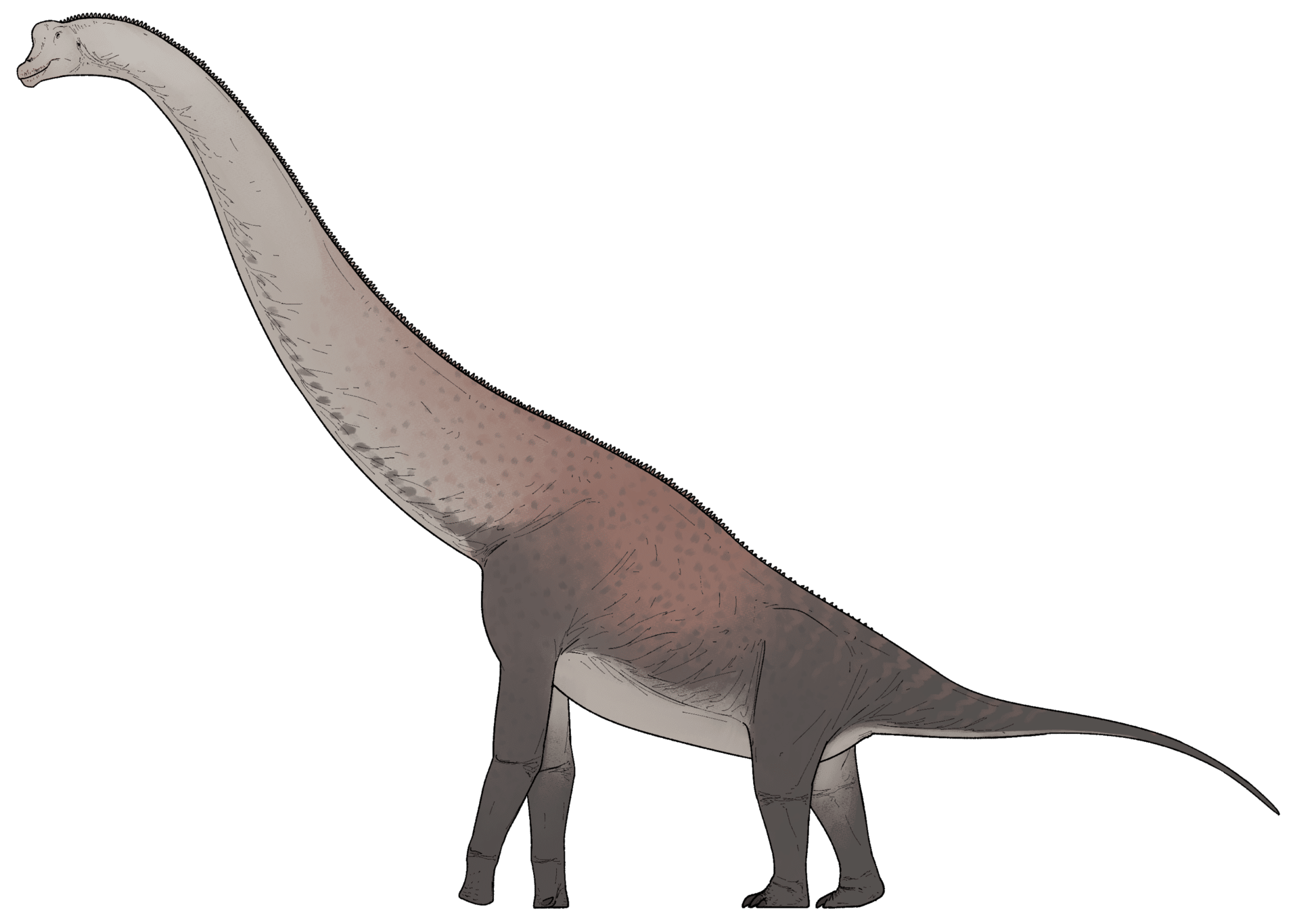
The neck held 13 vertebrae, and the longest, the tenth, reached about 3.3 feet (1 meter). Its ribs were long as well—rib 3 of SII measured 8.6 feet (2.63 meters). The forelimbs were longer than the hind limbs. Janensch, Paul, and others also reconstructed the back as strongly inclined up toward the shoulders. None of the sources used here describes skin or other soft tissue, so any discussion of its outer covering is speculative.

Size and Weight of Type Species
Height is the best-documented measurement, though only for the Berlin mount. In its old pose, the mount stood 38.4 feet (11.7 meters) from the top of the skull to the ground. After remounting, it measured 43.5 feet (13.27 meters) on 1 June 2007.
Weight estimates vary widely. In 1988, Paul arrived at about 34.7 short tons (31,500 kilograms) from sculpted models, while Henderson (2004) gave 28.4 short tons (25,789 kilograms). In 2009, Taylor calculated 25.7 short tons (23,337 kilograms) from a skeletal drawing—”surprisingly light for so large an animal,” as he put it. Gunga and colleagues estimated 82.0 short tons (74,400 kilograms) in 1995. In 2008, they revised it to 41.9 short tons (38,000 kilograms) with a slimmer chest and lower tissue density. In 2012, Sellers and colleagues fitted a convex hull to a laser scan of the mount and obtained 25.6 short tons (23,200 kilograms). Setting aside the superseded 1995 figure, these estimates range from about 23 to 38 metric tons.
Its famous relative was a close match in size. The humeri of the two type specimens differ by just 1.4 percent. Moreover, SII was probably not fully grown, and an isolated fibula (calf bone) about 13 percent longer suggests that larger individuals existed.
The Dinosaur in Detail
What sets this dinosaur apart from Brachiosaurus is a list of at least 26 differences in the backbone, shoulder girdle, hips, and limbs. In Taylor’s revised diagnosis, the back vertebrae carry postspinal laminae (thin bony ridges behind the spines), and their spines lean backward. The humerus is also very gracile, with a gracility index of 8.69 against 7.12 in Brachiosaurus. Meanwhile, Brachiosaurus had a trunk 23 percent longer and possibly a tail about 20 to 25 percent longer. Taylor even judged the two more different from each other than Diplodocus and Barosaurus.
That split took a long time. Later, Janensch cited 13 supposedly shared features to support his referral. Of these, Taylor found only four to be valid shared derived traits. As early as 1919, Lull saw no reason to include the African form in Brachiosaurus. Paul’s 1988 argument focused on the trunk. Relative to the limb bones, he found the American species’ back about 25 to 30 percent longer. While McIntosh in 1990 considered even a subgenus unwarranted, Olshevsky raised Giraffatitan to full genus rank in 1991. Paul himself still used Brachiosaurus for it in 1994 and 2000. Only after Taylor’s 2009 study did Giraffatitan come into wide use.
Other details remain open. Janensch assumed 11 dorsal vertebrae, whereas Paul and Taylor argue for 12. In 1950, Janensch also interpreted hollow rib heads as shaped by the pressure of air sacs—extensions of the lungs. Taken together, these studies describe a slender-limbed, short-bodied brachiosaurid—close to Brachiosaurus, yet distinct enough to stand alone.
Interesting Points about Giraffatitan
- The Berlin skeleton, first mounted in 1937, is a composite. Its core is SII, but the tail and several other parts come from other individuals, and some bones are plaster copies.
- In 2008, Gunga and colleagues calculated a body surface area of about 1,282 square feet (119.1 square meters) for the mounted animal.
- Janensch noted in 1914 that the East African dinosaur fauna was strikingly similar to that of North America’s Morrison beds, and roughly the same age.
- A single neck vertebra figured by Janensch in 1914 reached about 27.2 inches (69 centimeters) at its maximum length.
Contemporary Dinosaurs
Sharing the Middle Dinosaur Member was Kentrosaurus, a stegosaur that Hennig named in 1915. Bussert and colleagues list it in that member’s fauna alongside B. brancai, and also higher up, in the Upper Dinosaur Member. No fossil records any encounter between the two, so they are best pictured as neighbors.
Dicraeosaurus, another sauropod, had back vertebrae with tall, split neural spines. Its species D. hansemanni, from the same member, had a femur of 4.0 feet (1.23 meters). By comparison, SII’s is estimated at 6.4 feet (1.96 meters). Janensch described it in the same 1914 paper, and no interaction between the two is recorded.
Among the theropods of the Middle Dinosaur Member was Elaphrosaurus, long thought to be an ornithomimosaur. In 2016, however, Rauhut and Carrano placed it among the ceratosaurs, in the noasaurid subgroup Elaphrosaurinae. They described it as coming from the late Kimmeridgian of Tendaguru. It shared the landscape with Giraffatitan, but no fossil links the two directly.
Adding further diversity was Dysalotosaurus lettowvorbecki, a small ornithopod and early iguanodontian. Thousands of its bones come from a single locality and may belong to one herd. Like the others, it appears in the same member’s fauna list, with no recorded contact with Giraffatitan.
Giraffatitan in its Natural Habitat
The world Giraffatitan roamed was a coastal one, set between the sea and the land. In the Middle Dinosaur Member, lagoonal tidal flats and small tidal channels came first. Later, “sabkha-like coastal plains”—salt-crusted flats—spread out with ephemeral brackish lakes and ponds. Soils formed on these plains. In the marine beds just above, pollen suggests that drought-tolerant conifers dominated the nearby hinterland.
As a herbivore, Giraffatitan was, in the words of Gunga and colleagues, “an extremely specialized high browser.” Christian and Dzemski suggested in 2007 that its neck rose in a gentle S-curve, its middle section about 60 to 70 degrees above horizontal at rest. During walking, they argued, it was probably held about 20 degrees lower. Such a neck may have let the animal browse at great heights and widen its feeding range without moving its body. In 2008, Gunga’s team also placed its center of gravity in the middle of the chest, much as in a giraffe.
While there is no direct evidence of whether Giraffatitan lived alone or in groups, its anatomy does hint at limits. In the mount’s old pose, the heart sat about 12.5 feet (3.8 meters) above the ground and 26.2 feet (8.0 meters) below the brain. Gunga’s 1999 team argued that this gap placed very tight limits on physical exercise. More broadly, Heinrich concluded in 1999 that most Tendaguru bone accumulations probably formed through attrition—starvation, seasonal drought, disease, and old age.

Frequently Asked Questions
Janensch named the species Brachiosaurus brancai in 1914, and G.S. Paul coined Giraffatitan as a subgenus in 1988.
It lived in the Kimmeridgian and Tithonian stages of the Late Jurassic, roughly 154.8 to 143.1 million years ago.
The Berlin mount stands 43.5 feet tall, and most weight estimates fall between about 25.6 and 41.9 short tons (23 to 38 metric tons).
It was a herbivore, and researchers have described it as a specialized high browser.
Its type skeletons come from Site S near Tendaguru Hill, in the Lindi Region of southern Tanzania.
Its complete neck of 13 vertebrae measured about 27.9 feet, and Taylor listed at least 26 differences from Brachiosaurus.
Sources
The information in this article is based on various sources, drawing on scientific research, fossil evidence, and expert analysis. The aim is to provide a comprehensive and accurate overview of Giraffatitan. However, please be aware that our understanding of dinosaurs and their world is constantly evolving as new discoveries are made.
- https://people.ohio.edu/witmerl/Downloads/1914_Janensch_B._brancai_&_Dicraeosaurus.pdf
- https://www.miketaylor.org.uk/dino/out-of-copyright/Janensch1914-partial-translation.pdf
- https://doi.org/10.1671/039.029.0309
- https://www.miketaylor.org.uk/dino/pubs/taylor2009/Taylor2009-brachiosaurus-and-giraffatitan.pdf
- https://doi.org/10.1080/02724634.2011.557115
- https://doi.org/10.1002/mmng.200900004
- https://fr.copernicus.org/articles/2/25/1999/fr-2-25-1999.pdf
- https://fr.copernicus.org/articles/2/91/1999/fr-2-91-1999.pdf
- https://doi.org/10.1002/mmng.200700011
- https://doi.org/10.1002/mmng.200600017
- https://doi.org/10.7717/peerj.36
- https://doi.org/10.1098/rsos.150636
- https://doi.org/10.1111/zoj.12425
- https://doi.org/10.1371/journal.pone.0029958
- https://palaeo-electronica.org/2011_2/255/intro.htm
- https://paleobiodb.org/data1.2/taxa/single.txt?name=Giraffatitan&show=attr,app,ref
- https://stratigraphy.org/ICSchart/ChronostratChart2024-12.pdf
- https://guinnessworldrecords.com/world-records/tallest-dinosaur-skeleton-mounted
- https://artsandculture.google.com/asset/brachiosaurus-brancai-giraffatitan-brancai-a-jurassic-giant/egG3cDM8hY4dcA
- https://doi.org/10.1098/rsbl.2012.0263
- https://doi.org/10.1002/ar.24198
This article was last fact checked: TheDinosaurs Team, 31-10-2026
Featured Image Credit: Dosseman, CC BY-SA 4.0, via Wikimedia Commons
