
At Lamadong, in Jianchang County of western Liaoning, China, the Jiufotang Formation preserves a world buried in ancient lake sediments. From these rocks comes Changzhousaurus sinensis, a tiny theropod named in 2026 from the Aptian stage of the Early Cretaceous. Its nearly complete skeleton lies wrapped in plumage from head to tail. Those feathers make it remarkable—its describer reports that no other non-avialan pennaraptoran has proportionally larger feathered wings. Pennaraptorans are the group that unites oviraptorosaurs, dromaeosaurids, troodontids, and birds.
Paleontologist Xu Xing of the Institute of Vertebrate Paleontology and Paleoanthropology in Beijing described the animal as sole author. His paper appeared online in Vertebrata PalAsiatica, and the state news agency Xinhua reported the find on 18 June 2026. The specimen, probably a subadult, is only about 13.4 inches (340 millimeters) long, yet about sixteen of its tail feathers grew highly elongated. To Xu, its blend of dromaeosaurid and troodontid features adds evidence that those two families form one natural group.
Changzhousaurus Key Facts
| Keyword | Fact |
|---|---|
| Pronunciation | Not specified |
| Meaning of name | Changzhou Lizard |
| Group | Theropoda (Pennaraptora) |
| Type Species | Changzhousaurus sinensis |
| Diet | Not specified |
| When it Lived | About 122 to 119 MYA (span of the Jiufotang Formation in the Jianchang Basin) |
| Period | Cretaceous |
| Epoch | Early Cretaceous (Aptian stage) |
| Length | About 13.4 inches (340 millimeters), measured on the subadult holotype |
| Height | Not specified |
| Weight | Not specified |
| Mobility | Xu considers flight capability well supported from an evolutionary perspective, though its slender flight feathers seemingly indicate limited or absent flight and he reads its foot as modified for a more terrestrial environment |
| First Discovery | Not specified |
| Described by | 2026 by X. Xu |
| Holotype | LDNHMF 2026A and 2026B |
| Location of first find | Lamadong, Jianchang, Jiufotang Formation, western Liaoning Province, China |
Changzhousaurus Origins, Taxonomy and Timeline
The genus name honors a city rather than a person. “Changzhou” refers to the city of Changzhou in Jiangsu Province, China, while saurus is the familiar “lizard.” Xu chose it to thank the Changzhou Municipal Government for supporting dinosaur paleontology and promoting popular science. The species name sinensis, meanwhile, highlights the animal’s birthplace—China. Together, the name ties a small feathered dinosaur to a city’s support for science and to its home country.
Xu places Changzhousaurus within Theropoda, Maniraptora and Pennaraptora—in his words, it is “clearly a pennaraptoran dinosaur.” He also assigns it to Paraves, the branch that holds dromaeosaurids, troodontids, and birds. His preferred position is “most likely an early-diverging deinonychosaurian,” an early member of the lineage that unites dromaeosaurids and troodontids. However, he adds that an anchiornithine (Anchiornis-group) or avialan (bird-line) identity is “not impossible.” The paper assigns it to no family, and Changzhousaurus sinensis is the type and only known species.
Xu dates the type horizon to the Aptian, citing a 2021 study by Yu and colleagues. That study dated tuffs (volcanic ash beds) at Sanmendian and Xiaotaizi in the Jianchang Basin rather than at Lamadong itself. It found that the formation there accumulated roughly 122.0 to 118.9 million years ago—from the latest Barremian to the Aptian. This was the late phase of the Jehol Biota in the Cretaceous, when that community reached its widest distribution.
Discovery & Fossil Evidence
The fossil comes from Lamadong, in Jianchang County of western Liaoning, within the Jiufotang Formation. Xu’s paper names no finder or collection date, though he thanks Mr. Lu Jianhua for access to the specimen. After the journal received the manuscript on 8 May 2026, it appeared online as an advance publication in June 2026.
The holotype—the name-bearing specimen—consists of LDNHMF 2026A and 2026B, a slab and its matching counter slab. The Lande Museum of Natural History in Tangshan, Hebei Province, houses the original, and Xu’s institute holds casts (IVPP FV2204A and 2204B). Xu describes “a nearly complete skeleton associated with extensive plumage across the entire body.” Its sacral (hip) vertebrae had fused into a synsacrum (a single hip structure). However, its ankle bones had not fused to each other, to the shin, or to the upper foot bones—signs of a probable subadult.
Xu’s discussion of its relationships is qualitative, and he says he will present a quantitative discussion elsewhere. No later peer-reviewed study had revisited the species as of November 2026—even the September 2026 paper naming Norellraptor does not mention it.
Changzhousaurus Size and Description
Small as it was, Changzhousaurus carried far more feathered surface than its slender bones would suggest.
Short description of Changzhousaurus
The skull was relatively small and deep, with a short snout about half the skull’s length. Its premaxilla (front upper jaw bone) had a nearly vertical nasal process. Only a very small part of that bone lay in front of the nostril, and a large part beneath it. Four premaxillary teeth sat on each side, followed by about fifteen maxillary sockets—and none of the preserved upper teeth bore serrations. By contrast, the lower jaw probably had 20 tooth sockets, with slender, closely packed teeth in front and robust, strongly curved, serrated ones behind.
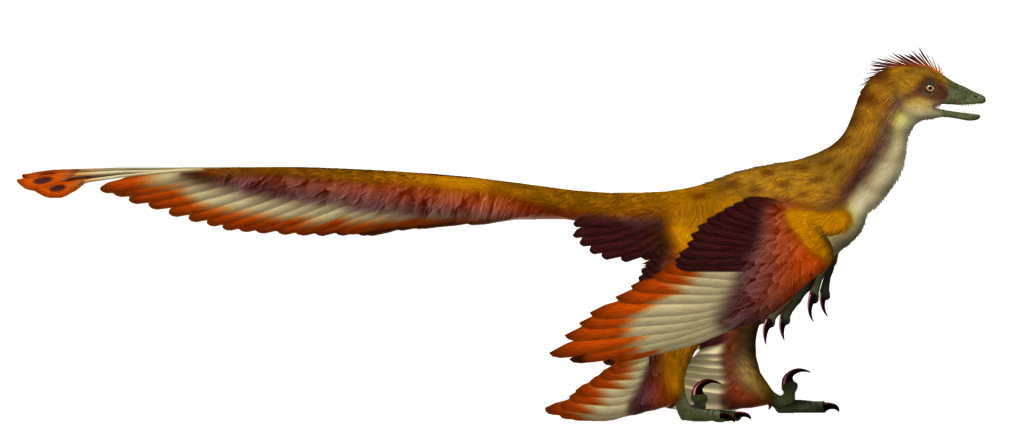
Behind the head ran probably 10 neck, 13 back, probably 6 hip, and 22 tail vertebrae—a low tail count shared with most scansoriopterygids and avialans. The tail was relatively short, just 3.4 times the length of the femur (thigh bone). Feathers of various types and sizes covered the whole body. Head feathers ranged from about 0.4 inches (10 millimeters) to more than 1.4 inches, and neck feathers also exceeded 1.4 inches.

Size and Weight of Type Species
The holotype measures about 13.4 inches (340 millimeters) in total skeletal body length. That figure is a direct measurement of the specimen rather than an estimate scaled from relatives. Because it was probably not fully grown, the length describes one young individual, not the whole species.
No one has yet published a height or weight estimate, but at about 1.1 feet long it ranks, in Xu’s words, “among the smallest known non-avialan theropods.”
Its bony forelimbs were short, with the humerus (upper arm bone) about 75 percent of femur length. The scapula (shoulder blade) was similarly modest, at 0.59 times the length of the femur. Despite this, its wings were, by Xu’s comparisons, proportionally the largest among non-avialan pennaraptorans, a pattern he reads as a “decoupling” of skeletal arm length from wing area.
The Dinosaur in Detail
A Fan-Shaped Tail and Four Wings
What sets this dinosaur apart is its tail. Near the end of the bony tail sprouted about sixteen highly elongated feathers, each roughly four times the femur’s length. The longest reach about 7.9 inches (200 millimeters) and attach to roughly the last five tail vertebrae. Xu compares them to peacock tail feathers, which form a large fan-shaped surface, and also to the fan of the early bird Jeholornis. Other animals with such plumes typically have two to four, and the elongated tail feathers of Changyuraptor are less pronounced.
The wings were just as striking. Its longest primaries (main flight feathers) reach about 4.7 inches (120 millimeters), roughly 3.2 times the humerus length. The secondaries ran to about 3.1 inches (80 millimeters). Leg feathers reached at least 1 inch (25 millimeters) on the thigh and 1.4 inches on the shin, and up to 2.4 inches (60 millimeters) on the metatarsus (upper foot). The longest of those foot feathers reach about 140 percent of metatarsus length, against roughly 320 percent in Microraptor. In Xu’s words, it is “a four-winged pennaraptoran,” and he calls it the first known early-diverging pennaraptoran to bear both large foot feathers and highly elongated tail feathers.
Skeleton and Relationships
The skeleton holds its own surprises. Its outermost finger (Xu’s digit IV) was subequal to or longer than the middle one. Xu calls this “unusual among theropod dinosaurs,” though Mei, scansoriopterygids, and halszkaraptorines share it. The second toe bore an enlarged claw, as in troodontids and dromaeosaurids, while the first toe was very small. A horny sheath added 4.5 millimeters to the innermost finger’s claw, raising its curvature from about 120 to more than 180 degrees. Traits unique to it include an ossified disc between some tail vertebrae and a furcula (wishbone) of constant width. The shoulder blade was extremely thick, with a mushroom-like tip.
Overall, the skeleton shows a mosaic of dromaeosaurid and troodontid features. It also shares a few derived traits with the anchiornithine Xiaotingia, including a forward-bowed radius (forearm bone). Xu argues that it supports deinonychosaurian monophyly—the idea that dromaeosaurids and troodontids form one natural group. Yet he notes that including it in analyses tends to lower support for Unenlagiinae and Anchiornithinae. For now, its exact branch remains an open question.
Interesting Points about Changzhousaurus
- The genus name thanks the government of Changzhou, a city in Jiangsu Province, for supporting dinosaur paleontology and popular science.
- About sixteen highly elongated feathers grew near its tail tip, where other animals with such plumes typically have two to four.
- A horny sheath raised the curvature of its innermost finger claw from about 120 to more than 180 degrees.
- Because barbules (tiny branches that hold a vane together) are not visible, Xu identifies the feathers as pennaceous (vaned) by overall similarity.
- Its outermost finger was subequal to or longer than its middle finger, a proportion Xu calls unusual among theropod dinosaurs.
Dinosaurs from the Same Formation
Also known from the Jiufotang Formation (exact level relative to Changzhousaurus not known): Norellraptor, Microraptor, Wulong and Chuanqilong. Norellraptor is a microraptorine, a member of the Microraptor branch of dromaeosaurids, from the same Lamadong Town area. Microraptor itself, a small four-winged dromaeosaurid, was first named from the formation in 2000. Wulong is another microraptorine, known from an immature, complete specimen with long tail feathers. By contrast, Chuanqilong is an early-diverging ankylosaurid—an armored ornithischian. Neither the Norellraptor paper nor Xu’s description gives a bed for its specimen. The formation was laid down over several million years—about 122 to 119 million years ago in the Jianchang Basin, with ash beds as young as about 118 million years in the Fuxin Basin. These animals come from different parts of it, so they may not all have lived at the same time.
Changzhousaurus in its Natural Habitat
The world Changzhousaurus inhabited belonged to the Jehol Biota, a volcanic-influenced ecosystem buried in lake and occasionally river sediments. Within the Jianchang Basin, dated ash beds lie between the fossil-bearing layers. In the Fuxin Basin, pollen and spores from the Pijiagou section point to coniferous forest in the middle Aptian. That record also indicates a sub-humid, warm temperate climate with seasonal change—though from another basin, not Lamadong. Besides small dinosaurs such as Microraptor, the formation also preserves abundant Mesozoic birds.
No study has yet examined what Changzhousaurus ate, so the diet of this dino remains unknown.
How it moved is just as uncertain, and Xu calls it “an especially problematic taxon” for reconstructing habitat and locomotion. Its large wings and laterally flappable forelimbs favor flight, but its slender feathers without robust shafts seemingly indicate limited or absent flight capacity. To Xu, its smaller, higher-set first toe marks a foot secondarily modified for more terrestrial life—a reversal from tree-dwelling ancestors. Nevertheless, he concludes that “from an evolutionary perspective, the presence of flight capability is well supported.” In his view, its tail and leg feathers likely aided aerial locomotion, since he finds a purely communicative role implausible. Still, he stresses that settling its locomotion and ecology will require comprehensive and rigorous analyses.

Frequently Asked Questions
It means “Changzhou lizard,” after the Chinese city, while the species name sinensis highlights its birthplace, China.
It lived in the Early Cretaceous Aptian stage, in a formation dated to about 122 to 119 million years ago in the Jianchang Basin.
The subadult holotype measures about 13.4 inches (340 millimeters) long, and no height or weight estimate exists yet.
Its diet is unknown because no study has yet examined what it ate.
It comes from Lamadong, in Jianchang County of western Liaoning Province, China, in the Jiufotang Formation.
According to its describer, it has the proportionally largest feathered wings among non-avialan pennaraptorans, plus about sixteen highly elongated tail feathers.
Sources
The information in this article is based on various sources, drawing on scientific research, fossil evidence, and expert analysis. The aim is to provide a comprehensive and accurate overview of Changzhousaurus. However, please be aware that our understanding of dinosaurs and their world is constantly evolving as new discoveries are made.
- https://doi.org/10.19615/j.cnki.2096-9899.260616
- https://www.vertpala.ac.cn/EN/10.19615/j.cnki.2096-9899.260616
- https://doi.org/10.1016/j.palaeo.2021.110657
- https://pmc.ncbi.nlm.nih.gov/articles/PMC8288181/
- https://doi.org/10.1016/j.revpalbo.2024.105270
- https://www.nature.com/articles/s41467-026-77804-6
- https://doi.org/10.1038/35047056
- https://doi.org/10.1002/ar.24343
- https://doi.org/10.1371/journal.pone.0104551
- https://www.sci.news/paleontology/changzhousaurus-sinensis-14868.html
- https://english.casad.cas.cn/newsroom/ma/202606/t20260622_1174349.html
- https://en.people.cn/n3/2026/0618/c90000-20469028.html
This article was last fact checked: TheDinosaurs Team, 18-11-2026
Featured Image Credit: Connor Ashbridge, CC BY 4.0, via Wikimedia Commons
