
Near the village of Lujiatun in western Liaoning, China, the lowest beds of the Yixian Formation hold a tiny theropod curled up like a resting bird. Named Mei long in 2004, this small troodontid lived near the boundary between the Hauterivian and Barremian stages of the Early Cretaceous. Recent high-precision dating puts its beds at about 125.9 to 125.5 million years old. Its describers, paleontologists Xu Xing and Mark Norell, reported that the skeleton lay in the stereotypical sleeping or resting posture of living birds. They also pointed to several skeletal features linked to avialan origins—the origin of the bird lineage.
The original paper appeared in the journal Nature and described a nearly complete, fully articulated skeleton. In 2012, a team led by paleontologist C. Gao added a second, smaller skeleton lying in a similar but mirrored position. That find, in their words, strengthened the hypothesis that both animals were preserved in a stereotypical life position. To Xu and Norell, seeing this behavior outside living birds showed that many bird features arose early in dinosaur evolution.
Mei Key Facts
| Keyword | Fact |
|---|---|
| Pronunciation | Not specified |
| Meaning of name | Soundly Sleeping Dragon |
| Group | Theropoda |
| Type Species | Mei long |
| Diet | Not specified |
| When it Lived | About 125.9 to 125.5 MYA |
| Period | Cretaceous |
| Epoch | Early Cretaceous (Hauterivian–Barremian stages) |
| Length | About 21 inches (53 centimeters) for the holotype, per 2004 news coverage, or roughly 18 to 24 inches (45 to 60 centimeters) as implied by Gao and colleagues’ 2012 comparison |
| Height | Not specified |
| Weight | About 1.8 pounds (0.8 kilograms) for Mei long, per Benson and colleagues’ 2014 body-mass study as cited by Sellés and colleagues in 2021, and about 0.9 pounds (420 grams) estimated for the smaller second specimen, DNHM D2154 |
| Mobility | Moved on two legs (bipedal), per 2004 news coverage |
| First Discovery | Year not specified |
| Described by | 2004 by X. Xu and M.A. Norell |
| Holotype | IVPP V12733 |
| Location of first find | Lujiatun beds (lowest Yixian Formation), Lujiatun, Shangyuan, Beipiao City, western Liaoning, China |
Mei Origins, Taxonomy and Timeline
According to the American Museum of Natural History, Norell’s institution, the name Mei long refers to the Chinese words for “soundly sleeping dragon.” Gao’s team later echoed it in their title, “A Second Soundly Sleeping Dragon.” In short, the name captures the very pose that made the fossil famous.
Within Theropoda, Mei sits in Maniraptora and, more narrowly, in Troodontidae—the family that takes its name from Troodon. The museum’s 2004 announcement called it “a very primitive troodontid.” In 2012, Gao and colleagues recovered it as a basal troodontid in a polytomy (an unresolved branching point) with Byronosaurus and Talos. In 2017, Shen and colleagues grouped it with Sinovenator, Sinusonasus, and Daliansaurus in a new subfamily, Sinovenatorinae. They read it as a localized radiation of small-bodied troodontids in Early Cretaceous eastern Asia. Still, placements among basal troodontids vary between analyses. Mei long is the only known species, and later studies all treat it as valid.
Dating Mei has proved harder than naming it. As cited by Gao’s team, the original paper placed its horizon between 139 and 128 million years old. Later estimates ranged from the Hauterivian–Valanginian to the early Aptian. In 2020, Yang and colleagues called the Lujiatun fossils Barremian, based on a date of 123.2 million years. In 2021, Zhong and colleagues used uranium–lead dating to get 125.76 to 125.68 million years. A year later, Li and colleagues dated two volcanic samples from the Lujiatun fossil bed to about 125.54 and 125.79 million years ago. Then, in 2024, MacLennan and colleagues dated a Lujiatun outcrop to about 125.88 million years ago. Since the Barremian now begins at 125.77 million years, these dates straddle the Hauterivian–Barremian boundary.
Discovery & Fossil Evidence
Both known skeletons come from the Lujiatun beds near Shangyuan in Beipiao City. No accessible source names who found the holotype or when. Xu and Norell noted that many other three-dimensionally preserved vertebrates had recently come from the same locality. Their references show that these included Psittacosaurus fossils studied for parental care.
The holotype, IVPP V12733, belongs to the Institute of Vertebrate Paleontology and Paleoanthropology in Beijing. Its skull keeps the sclerotic plates—small bones that ringed the eye—while the chest preserves a furcula (wishbone).
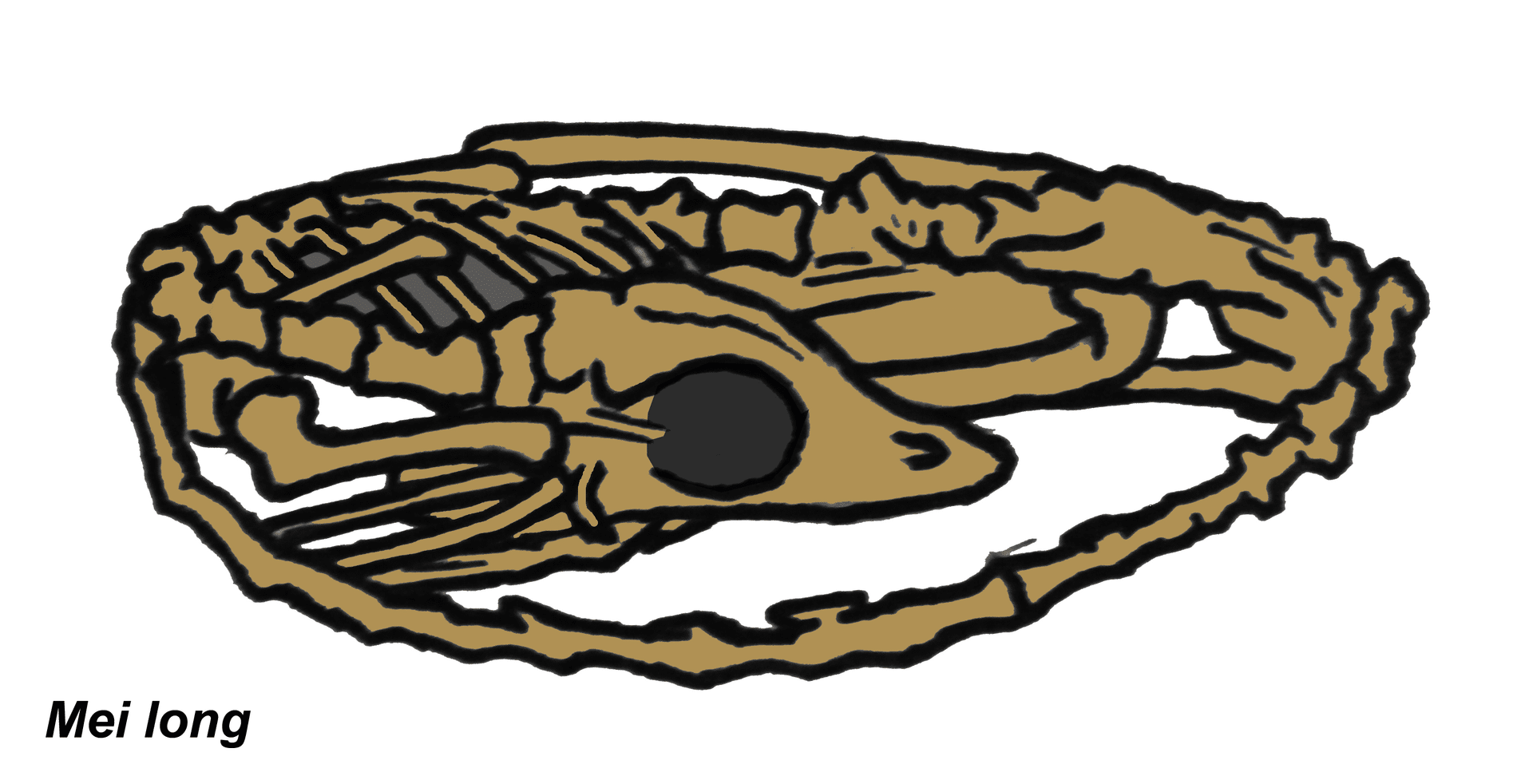

The second skeleton, DNHM D2154, belongs to the Dalian Natural History Museum and is also nearly complete and articulated. It came from Kaoshangtun, still within the Lujiatun beds, encased in green mudstone with up to fine sand-size grains. Confusingly, Gao’s figure captions print the number as “D2514″—the abstract and Shen’s 2017 study both use D2154. Both specimens also lack detailed records of rock layers and burial conditions.
Mei Size and Description
Mei ranks among the smallest non-avian dinosaurs yet found—and two articulated skeletons show its build in unusual detail.
Short description of Mei
In the original diagnosis, as cited by Gao’s team, an extremely large naris (nostril opening) reached back over half of the upper tooth row. The middle teeth of the maxilla (main upper jawbone) also sat closely packed. Gao’s team added that the teeth lacked serrations, as in Anchiornis. In the second specimen, the short snout had a steep front profile that Gao’s team found reminiscent of Archaeopteryx. The chest held a robust, roughly U-shaped wishbone, and the forearm bones reached about 90 percent or more of the upper arm’s length.
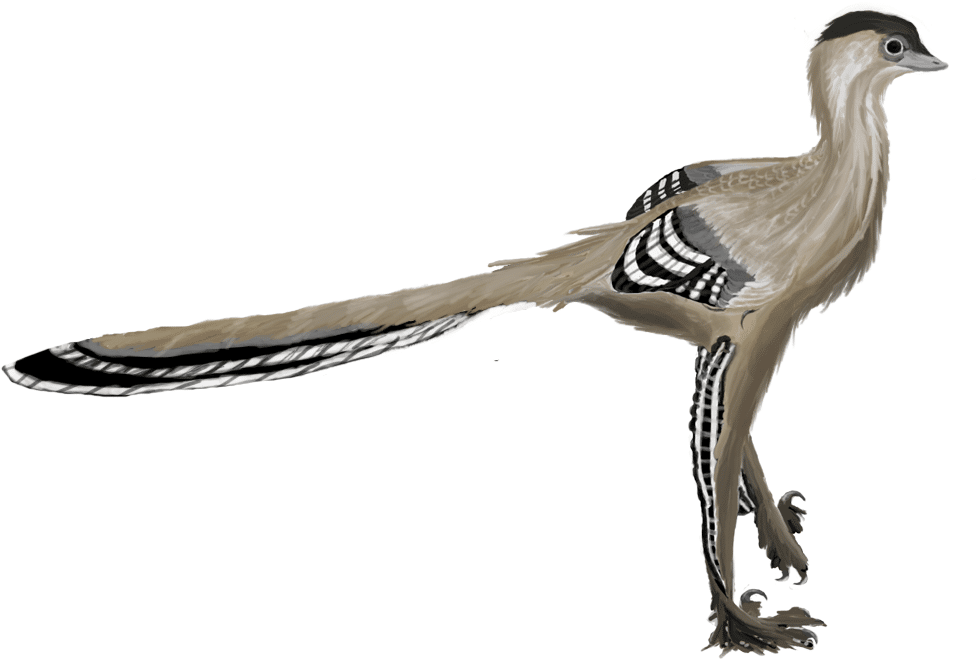
At the hips, the rear of the sacrum (fused hip vertebrae) was extremely wide, with long processes on its fourth and fifth vertebrae. In addition, the upper end of the pubis, a lower hip bone, was strongly compressed from front to back, more than in other troodontids. The fourth metatarsal (a long foot bone) also carried a flange at midshaft. Li and colleagues note that Lujiatun fossils lack any trace of soft tissue, so any feathered Mei is an artist’s interpretation.

Size and Weight of Type Species
Nature‘s 2004 news report gave the holotype a length of just 21 inches (53 centimeters). Gao’s team, comparing the two skeletons, implied a holotype length of roughly 18 to 24 inches (45 to 60 centimeters). Likewise, a 2025 study cites Mei as the low end of troodontid size—less than 3.3 feet (1 meter). A 2014 body-mass study, cited by Sellés and colleagues, put it at kiwi size—about 1.8 pounds (0.8 kilograms).
Fortunately, the supplementary data give direct measurements. The holotype’s skull measures 2.1 inches (53 millimeters), and its femur (thigh bone) about 3.2 inches (81 millimeters). Its tail series alone runs 10.1 inches (257 millimeters).
The second specimen was smaller, at about 12.8 inches (325 millimeters) long and no more than 15.7 inches (400 millimeters). On average, its bones measured 83 percent of the holotype’s. Using a published scaling equation, Gao’s team estimated its mass at about 0.9 pounds (420 grams).
The Dinosaur in Detail
The pose of its skeletons sets Mei apart. In both specimens, the tail curls forward and under the neck, and the limbs fold beneath the body. Meanwhile, the neck and head curve back between the shoulder and the folded elbow. As Gao’s team summarized them, the describers drew three implications. Burial kept the life posture, perhaps under Pompeii-like ash falls, and the pose is a behavior shared with modern birds. It may also have conserved heat for a homeothermic (warm-blooded) physiology.
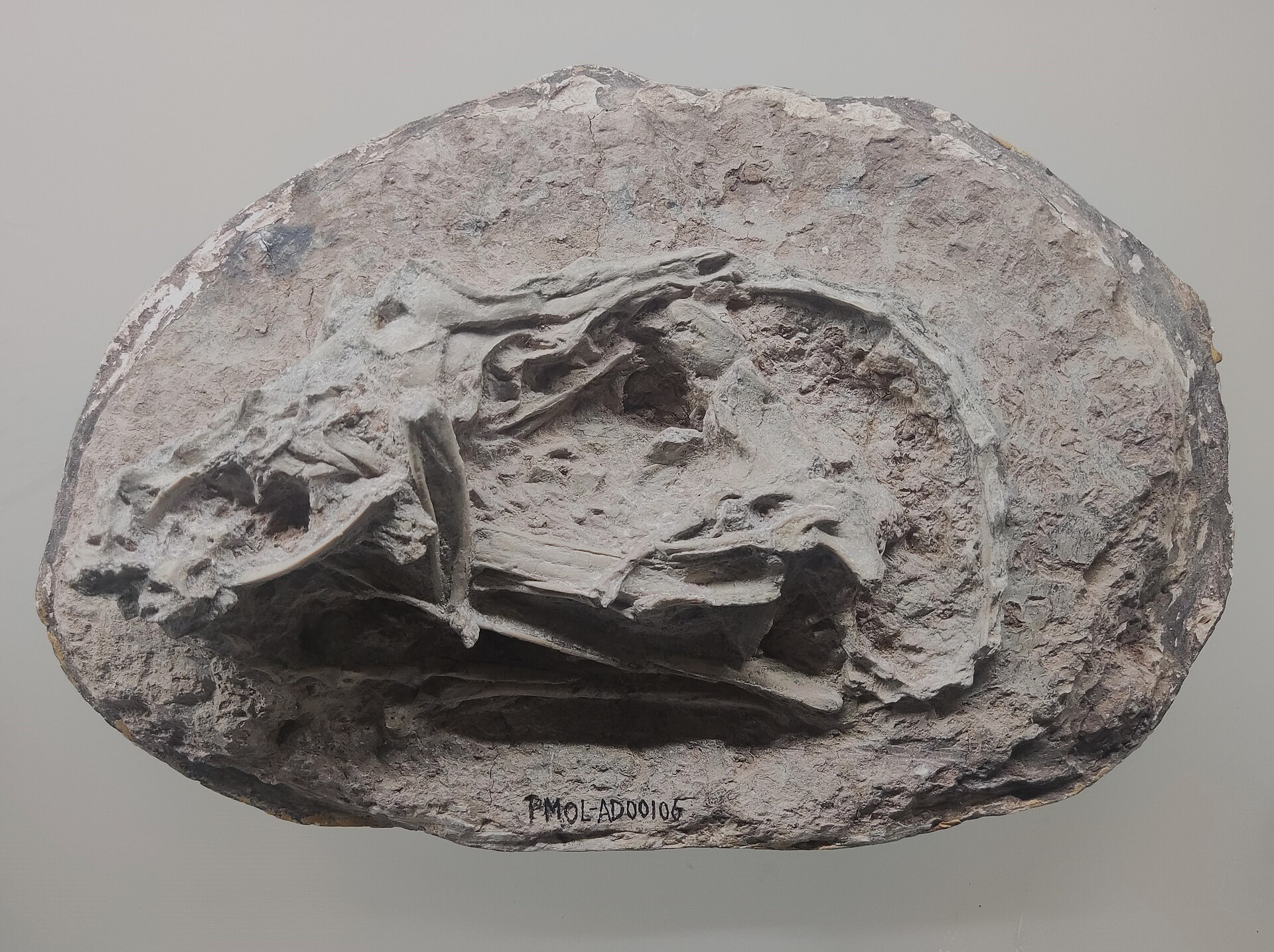

Gao and colleagues also compared the curled pose already reported in the holotype of Sinornithoides youngi from Inner Mongolia—three specimens from two troodontid species in nearly identical positions. Because both skeletons kept their life postures, they argued against burial in even a low-energy lahar (a volcanic mudflow), which would likely have moved such small animals. Neither shows the head-thrown-back (opisthotonic) or “pugilistic” poses sometimes linked to death throes, which hints at very rapid burial or a death that did not trigger them. They floated two speculative explanations—sheltering in a burrow, or a protective response to volcanic events.
Their age at death remains debated. In 2004, the museum called the holotype “a juvenile that is nearly an adult,” citing incompletely fused bones. By contrast, Gao’s team read the second specimen’s bone microstructure as mature—older than two years and possibly over four. Yet it also kept juvenile-looking traits, such as free neck ribs, unfused frontals, and possibly unfused nasals (skull roof and snout bones). As a result, they suggested Mei may be paedomorphically small—an adult that kept youthful features. Shen and colleagues, however, cautioned in 2017 that some Mei specimens may belong to very young individuals.
Gao’s team also found multi-year growth in fibro-lamellar (fast-forming) bone with growth lines, as in much larger and more basal theropods.
Interesting Points about Mei
- According to the American Museum of Natural History, Mei long refers to Chinese words for “soundly sleeping dragon.”
- Gao and colleagues described Mei long, including the type, as one of the smallest species among non-avian dinosaurs.
- According to the 2012 study, three specimens from two troodontid species, Mei long and Sinornithoides youngi, share a nearly identical bird-like resting pose.
- Dated volcanic samples from its beds range from about 125.88 to 125.54 million years old.
Contemporary Dinosaurs
Sharing the Lujiatun landscape in remarkable numbers was Psittacosaurus, an early ceratopsian. Indeed, P. lujiatunensis is so common in the Lujiatun Member that its uncorrected relative abundance locally nears 90 percent. Li and colleagues list it from Mei‘s fossil bed, though no fossil records contact between the two.
Adding further diversity was Jeholosaurus, a small ornithopod. Li’s and Yang’s faunal lists both place it in Mei‘s fossil bed, but nothing links the two directly.
Also present was Dilong, a small, gracile basal tyrannosauroid. Described in 2004, it was then hailed as the earliest known unquestionable tyrannosauroid, a title since lost to Jurassic relatives. Similarly, it appears in both the Li and Yang Lujiatun lists. A 2023 study counts Dilong among possible threats to Psittacosaurus, but no evidence connects it with Mei.
Among its closest relatives was Sinovenator changii, a basal troodontid from the lower Yixian Formation. Shen’s team placed it with Mei in Sinovenatorinae, and a 2026 study notes Yixian sections that contain both species. With no recorded interaction, they are best pictured as close relatives sharing one fossil bed.
Mei in its Natural Habitat
The world Mei inhabited was shaped by volcanoes. Its member of the Yixian Formation consists of river-laid, volcanic-rich conglomerates, tuffaceous sandstones, and tuffs (rock formed from volcanic ash). Near Lujiatun Village, thousands of vertebrate fossils lie in tuffs 5 to 20 meters (16 to 66 feet) thick. The site is nicknamed the “Chinese Pompeii,” a label recent work questions. Scientists still debate how they were buried—by pyroclastic flows, a lahar from a nearby shield volcano, or repeated floods laden with volcanic debris. Meng and colleagues raised a fourth idea, burrow collapse, in 2004, and Gao’s and Yang’s teams later discussed it. In 2024, MacLennan and colleagues made it their central conclusion, rejecting a volcanic catastrophe. In 2025, however, Emery-Wetherell countered that burrow collapse is not the only explanation for such rapid, noncatastrophic preservation.
No study has established what Mei ate—troodontid diet is contentious, and Mei is among several troodontids whose teeth lack serrations entirely. In 2026, Fan and colleagues singled out these denticle-free troodontids as “perhaps the most obvious group that likely differed ecologically.”
The fossil bed also holds frogs, lizards, and mammals—but no flying birds or pterosaurs. One fossil locks the mammal Repenomamus robustus and a Psittacosaurus in mortal combat. So do remains of an undescribed carnosaur and a sauropod compared with Euhelopus. Other dinosaurs, such as Sinosauropteryx and Caudipteryx, are also known from the Yixian Formation, but from the higher Jianshangou bed. Li’s team dated its lower part as nearly contemporaneous with Lujiatun, whereas Zhong’s team read the two as successive. In 2024, MacLennan and colleagues placed the Lujiatun beds below the Jianshangou beds, though the whole sequence there may span under about 93,000 years. While there is no direct evidence of its social life, the curled skeletons suggest Mei rested like a bird.
Frequently Asked Questions
According to the American Museum of Natural History, Mei long refers to the Chinese words for “soundly sleeping dragon.”
It lived in the Early Cretaceous, near the boundary between the Hauterivian and Barremian stages, about 125.9 to 125.5 million years ago.
News reports in 2004 gave the holotype a length of about 21 inches (53 centimeters). A 2014 study estimated about 1.8 pounds (0.8 kilograms), and a smaller second specimen about 0.9 pounds (420 grams).
Its diet has not been established, and its unserrated teeth leave the question open.
Both skeletons come from the Lujiatun beds of the Yixian Formation near Shangyuan, western Liaoning, China.
Both known skeletons lie curled in a bird-like sleeping or resting pose, with the tail wrapped forward under the neck.
Sources
The information in this article is based on various sources, drawing on scientific research, fossil evidence, and expert analysis. The aim is to provide a comprehensive and accurate overview of Mei. However, please be aware that our understanding of dinosaurs and their world is constantly evolving as new discoveries are made.
- https://doi.org/10.1038/nature02898
- https://pubmed.ncbi.nlm.nih.gov/15483610/
- https://www.nature.com/articles/nature02898/figures/1
- https://www.nature.com/articles/nature02898/figures/2
- https://static-content.springer.com/esm/art%3A10.1038%2Fnature02898/MediaObjects/41586_2004_BFnature02898_MOESM1_ESM.doc
- https://doi.org/10.1371/journal.pone.0045203
- https://doi.org/10.1111/1755-6724.13307
- https://pmc.ncbi.nlm.nih.gov/articles/PMC5418581/
- https://pmc.ncbi.nlm.nih.gov/articles/PMC7921422/
- https://doi.org/10.1002/brv.70145
- https://pmc.ncbi.nlm.nih.gov/articles/PMC12397072/
- https://par.nsf.gov/servlets/purl/10347257
- https://pmc.ncbi.nlm.nih.gov/articles/PMC8288181/
- https://pmc.ncbi.nlm.nih.gov/articles/PMC7485509/
- https://pmc.ncbi.nlm.nih.gov/articles/PMC10354204/
- https://pubmed.ncbi.nlm.nih.gov/11845206/
- https://pubmed.ncbi.nlm.nih.gov/15470426/
- https://www.amnh.org/research/science-news/2004/sleeping-dinosaur
- https://www.nature.com/news/2004/041011/full/news041011-7.html
- https://www.scientificamerican.com/article/sleeping-dino-assumed-bir/
- https://pmc.ncbi.nlm.nih.gov/articles/PMC11588062/
- https://doi.org/10.1073/pnas.2423019122
- https://stratigraphy.org/ICSchart/ChronostratChart2024-12.pdf
This article was last fact checked: TheDinosaurs Team, 13-11-2026
Featured Image Credit: 纳瓦拉的亨利, CC BY-SA 4.0, via Wikimedia Commons
