
In northeastern Arizona’s Keet Seel Canyon, the dune rocks of the Navajo Sandstone held the only known skeleton of Segisaurus. Named Segisaurus halli in 1936, this small, two-legged theropod lived in the Early Jurassic, probably during the Pliensbachian or Toarcian stage. It was a coelophysoid—a member of an early branch of small, meat-eating theropods—and possibly a close cousin of Coelophysis. In 2004, paleontologists Ronald Tykoski and Timothy Rowe called it the geologically youngest known unequivocal coelophysoid.
Student Robert Thomas and Navajo collector Max Littlesalt found the bones on July 27, 1933. Three years later, paleontologist Charles Camp described them, yet for decades the skeleton puzzled researchers. It had no skull, its bones seemed to be solid, and it appeared to carry a pair of collarbones. Later work overturned the last two of those readings. Today, this small skeleton adds a late chapter to the story of the earliest theropods.
Segisaurus Key Facts
| Keyword | Fact |
|---|---|
| Pronunciation | sayg-ee-sore-us |
| Meaning of name | Segi Canyon Lizard |
| Group | Theropoda |
| Type Species | Segisaurus halli |
| Diet | Carnivore |
| When it Lived | About 193 to 175 MYA (estimated from the formation’s stages) |
| Period | Jurassic |
| Epoch | Early Jurassic (Pliensbachian to Toarcian stages) |
| Length | 3.3 to 4.9 feet (1 to 1.5 meters) |
| Height | Not specified |
| Weight | Not specified |
| Mobility | Moved on two legs (bipedal) |
| First Discovery | 1933 by Robert Thomas and Max Littlesalt |
| Described by | 1936 by C.L. Camp |
| Holotype | UCMP 32101 |
| Location of first find | Keet Seel Canyon, Navajo Sandstone, Navajo Nation, northeastern Arizona, USA |
Segisaurus Origins, Taxonomy and Timeline
The name Segisaurus points straight to its home. The Natural History Museum in London translates it as “Segi Canyon lizard,” after the canyon system that held the bones. Paleontologist Thomas Holtz Jr. likewise ties it to Segi Canyon, Arizona, a remote corner of the Colorado Plateau.
Segisaurus halli, the type and only known species, belongs to Theropoda and, within it, to Coelophysoidea. Tykoski and Rowe suggested that it may belong to Coelophysidae, alongside Coelophysis and Syntarsus. Because that name was already in use, Syntarsus was renamed Megapnosaurus in 2001. Some researchers instead place its species S. rhodesiensis in Coelophysis. Tykoski and Rowe’s analysis produced five trees that differed only in where Segisaurus sat relative to those two genera. Given how incomplete the material is, they added, its position is likely to remain uncertain. In 1992, paleontologists Paul Sereno and Rupert Wild showed that Procompsognathus was a chimera, its skull belonging to a crocodylomorph. They described its body skeleton as that of a Segisaurus-like theropod.
Earlier studies placed the Navajo Sandstone in the Pliensbachian and Toarcian stages, about 193 to 175 million years ago. In 2019, however, Parrish and colleagues dated lake carbonates in the Navajo of southeastern Utah. Their results—about 200.5 and 195 million years ago—fall in the Hettangian and Sinemurian stages. They concluded that the age of the formation’s base varies by at least 5.5 million years. Their press release adds that the sand sea grew younger toward the south. As a result, the age of the Segisaurus site rests on the formation as a whole.
Discovery & Fossil Evidence
The skeleton came to light during the 1933 Rainbow Bridge–Monument Valley Expedition, led by Hall, VanderHoof, and Camp. It lay about 1 mile (1.6 kilometers) north of Keet Seel Ruin, on the canyon’s west side. Back then, the land was the Navajo Indian Reservation. The Paleobiology Database places the bones about 500 feet (152 meters) above the base of the Navajo Sandstone. That figure, however, was measured from the top of the underlying Wingate Sandstone. In this area, the Kayenta Formation lies between the two. According to the field record, the bones also lay “100 feet below its upper level” on Skeleton Mesa—about 30 meters.
The holotype, UCMP 32101, belongs to the University of California Museum of Paleontology (UCMP) in Berkeley. Tykoski and Rowe describe it as a small, incomplete skeleton lacking the skull and most of the neck and back vertebrae. Camp’s drawing of the skeleton as found labels the coracoid and scapula (shoulder girdle bones) and the humerus (upper arm bone). It also labels the pubis and ischium (lower hip bones), plus the femur, tibia, and fibula. All five metatarsals (foot bones) are marked too, while ribs and tail vertebrae appear unlabeled.
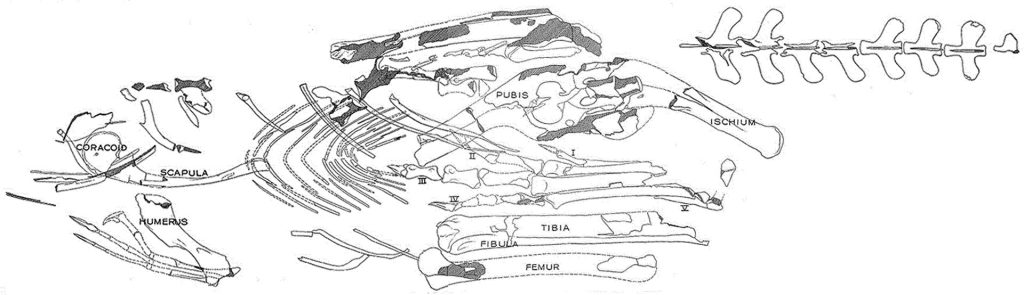

The field record notes that the animal “lay in a squatting posture with the body extended and the hind feet drawn up tightly beneath the pelvis.” It also suggests that shifting sand covered the animal before death or soon after. Around the bones, the rock shows the “long sweeping curves” of dune cross-beds, with a “supposedly freshwater” limestone lens above them. Even now, Segisaurus is known only from this holotype—no other locality has yielded a confirmed skeleton.
Segisaurus Size and Description
Even without a skull, the holotype records much of the body behind the neck—enough to sketch a lightly built animal.
Short description of Segisaurus
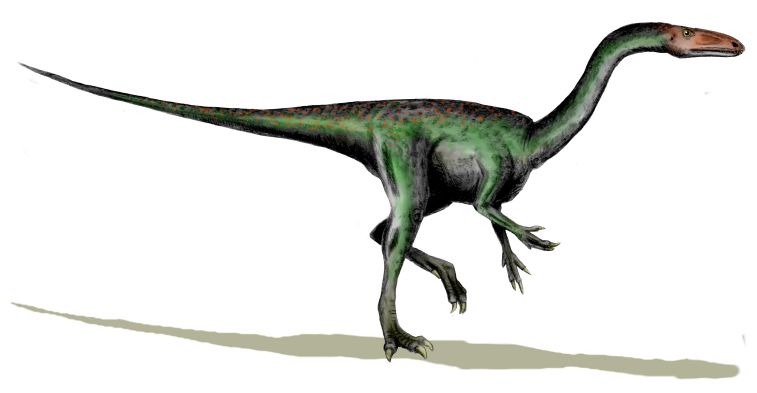
Camp’s restoration shows no skull, so any head in a life restoration comes from relatives. In the chest, a thin, slender wishbone, or furcula, lacked a hypocleideum—the bony prong that projects from the middle of some wishbones. Meanwhile, the scapula met the coracoid along a thick contact, much as in Dilophosaurus. On the humerus, the deltopectoral crest (the main muscle ridge of the upper arm) bore a nearly perpendicular flange. Paleontologist Cristiano Dal Sasso and colleagues note that only Segisaurus shows this feature.
Further down the arm, its hand claws bore a simple, unforked groove on the side, as in Coelophysis. The pubic shaft looks shorter and broader than in most relatives, though Tykoski and Rowe warn this may reflect breakage. The femur carried a “very low” fourth trochanter, a muscle-attachment ridge. At the ankle, the ascending process of the astragalus—a plate of bone rising up the front of the shin—stood lower than in Dilophosaurus. Down in the foot, the fifth metatarsal reached only about a third of the way along the fourth.

Size and Weight of Type Species
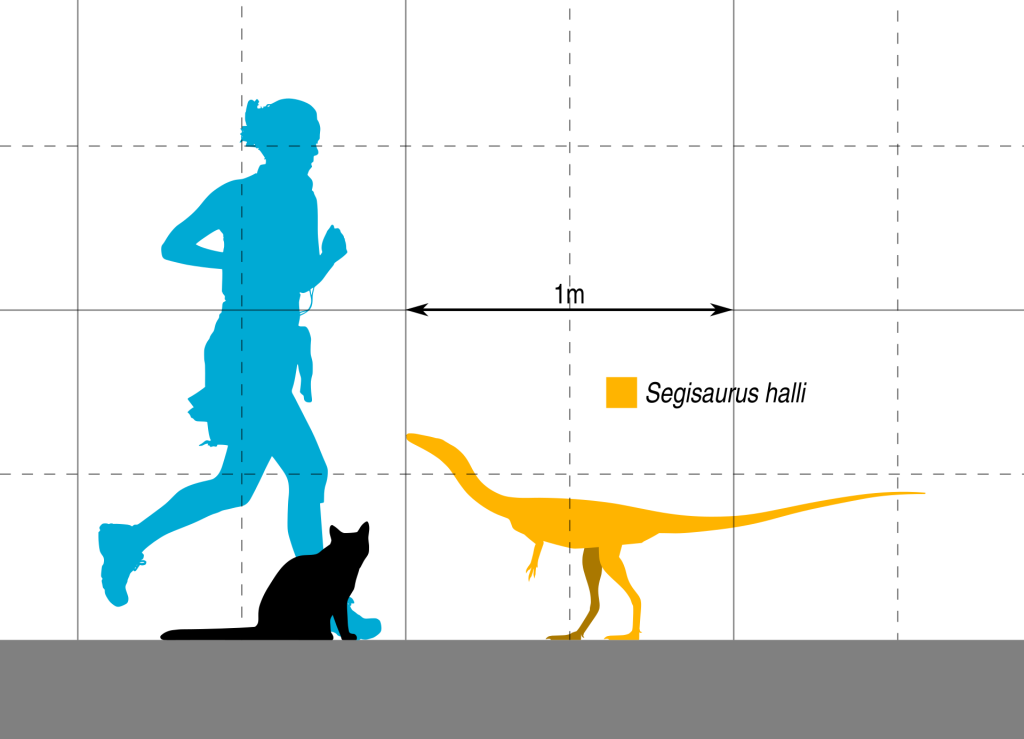
Tykoski and Rowe gave Segisaurus a length of 3.3 to 4.9 feet (1 to 1.5 meters). Museum and popular sources broadly agree—the UCMP calls it about three feet long, while the Natural History Museum and Holtz give 4.9 feet (1.5 meters).
Hip height and mass are harder to pin down, though Holtz’s genus list compares its weight to a modern turkey’s. In overall form, a 2013 National Geographic article adds, it was quite similar to the earlier Coelophysis.

That small size was not simply inherited. In 2021, paleontologist Stephan Spiekman and colleagues found that Procompsognathus, Segisaurus, and possibly Powellvenator all independently underwent a similar size reduction. They also noted that an earlier study of coelophysoid body size had left Segisaurus out.
The Dinosaur in Detail
What sets this dinosaur apart is a large hole in its hip, which Tykoski and Rowe called unique to Segisaurus. It pierces the ischial part of the puboischial plate—the sheet of bone formed by the lower hip bones. Camp named it the ischial fenestra in 1936. The ischial shaft is also uniquely flattened and expanded sideways. Even so, Tykoski and Rowe note that changes after death could explain the flattening.
Spiekman and colleagues report a second opening in Segisaurus, the pubic fenestra, below the smaller obturator foramen in the pubis. In 2020, paleontologists Adam Marsh and Timothy Rowe noted that Dilophosaurus lacks this extra opening, unlike Segisaurus, Syntarsus rhodesiensis, and Gojirasaurus.
The wishbone has the longest history—Camp first identified it as one of a pair of clavicles (collarbones). In 2001, however, Phil Senter and John Hutchinson reinterpreted it as a furcula—fused clavicles, as in Syntarsus and reportedly some Coelophysis. Paleontologist Matthew Carrano and colleagues then restudied the skeleton in 2005. According to the UCMP, they found the bones hollow, Camp’s clavicle a furcula, and Segisaurus clearly a coelophysoid.
Even so, its exact branch remains open. Where their trees placed it inside Coelophysidae, Tykoski and Rowe found fused pelvic bones and the pubic fenestra defining that group. They also noted that Procompsognathus shares traits with it and with coelophysids, such as back vertebrae with bodies twice as long as tall. Spiekman and colleagues later added that early neotheropod relationships still lack consensus, likely because of missing data and immature specimens. In short, the bones reveal a lightweight coelophysoid with a hip of its own design—and an unsettled family tree.
Interesting Points about Segisaurus
- Camp drew the skeleton as it lay, with its hind feet drawn up tightly beneath the pelvis in a squatting posture.
- The skeleton lay high in the Navajo Sandstone, about 500 feet above the top of the underlying Wingate Sandstone.
- Its wishbone, first identified by Camp as one of a pair of collarbones, is a thin, slender furcula without a hypocleideum.
- In 2004, Tykoski and Rowe described Segisaurus as the geologically youngest known unequivocal coelophysoid, a lineage of early theropods.
- Before the 2005 restudy, Tykoski and Rowe wrote that new preparation promised to reveal much more about this species.
Dinosaurs from the Same Formation
Also known from the Navajo Sandstone (exact level relative to Segisaurus not known): Seitaad. In 2010, paleontologists Joseph Sertich and Mark Loewen named this basal sauropodomorph—an early member of the long-necked plant-eater lineage. Its skeleton lay at the base of the formation at Comb Ridge in southeastern Utah, about one meter above the Kayenta Formation. In 2011, Rowe and colleagues treated it as Toarcian, but earliest Jurassic dates for the Navajo’s base there leave that uncertain. The formation spans roughly 20 million years or more, so these animals may not all have lived at the same time.
Segisaurus in its Natural Habitat
At that time, Segisaurus lived in an expansive dune system covering much of what is now the Colorado Plateau. A 2019 press release placed the Navajo Sandstone within the largest known sand sea in Earth’s history. Its rocks are mostly wind-blown sand, stacked in thick sets of steep cross-beds. At its base, the Navajo intertongues with the river deposits of the older Kayenta Formation. There, southeasterly winds blew dune sand into northwest-flowing streams. The Kayenta’s fauna includes Dilophosaurus, Scutellosaurus, and Sarahsaurus.
Yet the dune field was not always dry, as periodic and sometimes prolonged wet spells stabilized parts of it. Some interdunes—the flats between dunes—stayed wet long enough to preserve large fossil trees and giant stromatolites (layered mounds built by microbes). In 2017, researchers Frederickson and Davis reported the first Navajo fish from an interdune deposit, evidence that such oases occasionally persisted. They also note that most Navajo body fossils come from interdune deposits, which likely concentrated animals. Similarly, the 2019 press release described interdune lakes as watering holes for a variety of dinosaurs and small therapsids.
The diet of Segisaurus is known only at the level of its group. The UCMP describes coelophysoids as small, bipedal carnivores, and the London museum suggests that Segisaurus probably ate insects. Other Navajo vertebrates include crocodylomorphs and tritylodontids—mammal relatives—along with burrows possibly dug by small mammaliaforms. Researchers once referred fragmentary sauropodomorph bones from the formation to Ammosaurus, though later work questions that referral. There is no direct evidence of its social life.
Frequently Asked Questions
The Natural History Museum translates it as “Segi Canyon lizard,” after the canyon system in northeastern Arizona that yielded the skeleton.
It lived in the Early Jurassic, probably in the Pliensbachian or Toarcian stage, roughly 193 to 175 million years ago. Its age is estimated from the rock formation, not dated directly.
Tykoski and Rowe estimated a length of 3.3 to 4.9 feet (1 to 1.5 meters). Holtz compares its weight to a turkey’s.
Like other coelophysoids, it was a carnivore, and the Natural History Museum suggests that it probably ate insects.
Collectors found it in 1933 in the Navajo Sandstone of Keet Seel Canyon, on the Navajo Nation in northeastern Arizona.
A large opening in its hip, the ischial fenestra, is unique to it. Its wishbone was also once mistaken for a collarbone.
Sources
The information in this article is based on various sources, drawing on scientific research, fossil evidence, and expert analysis. The aim is to provide a comprehensive and accurate overview of Segisaurus. However, please be aware that our understanding of dinosaurs and their world is constantly evolving as new discoveries are made.
- https://babel.hathitrust.org/cgi/pt?id=mdp.39015027553059
- https://doi.org/10.1671/0272-4634(2005)025[0835:NIOSHA]2.0.CO;2
- https://www.jsg.utexas.edu/rowe/files/047-Tykoski_Rowe-20041.pdf
- https://doi.org/10.1098/rsos.210915
- https://doi.org/10.1371/journal.pone.0145713
- https://doi.org/10.7717/peerj.5976
- https://doi.org/10.1017/jpa.2020.14
- https://doi.org/10.3897/fr.28.164405
- https://doi.org/10.1371/journal.pone.0009789
- https://doi.org/10.1098/rspb.2010.1867
- https://doi.org/10.1371/journal.pone.0204007
- https://doi.org/10.1017/jpa.2017.14
- https://doi.org/10.1130/G46338.1
- https://www.geosociety.org/GSA/News/pr/2019/19-30.aspx
- https://doi.org/10.1098/rsos.201676
- https://paleobiodb.org/classic/basicCollectionSearch?collection_no=25306
- https://ucmp.berkeley.edu/taxa/verts/dinosauria/coelophysoidea.php
- https://www.nhm.ac.uk/discover/dino-directory/segisaurus.html
- https://www.geol.umd.edu/~tholtz/dinoappendix/HoltzappendixWinter2011.pdf
- https://www.nationalgeographic.com/science/article/s-is-for-segisaurus
- https://doi.org/10.1080/02724634.1992.10011473
This article was last fact checked: TheDinosaurs Team, 18-11-2026
Featured Image Credit: Camp, C. L. (1936), Public domain, via Wikimedia Commons
