
In Emery County, Utah, the Mussentuchit Member of the Cedar Mountain Formation has yielded the partial skeleton of a giant predatory dinosaur. Named Siats meekerorum in 2013, it lived during the Cenomanian stage of the Late Cretaceous—about 99.1 million years ago, according to a 2023 age model. Its describers presented it as the first evidence in North America for Neovenatoridae, a widespread group of large predators. It also helped close a near 70-million-year gap in the record of top predators from western North America.
Paleontologists Lindsay Zanno and Peter Makovicky found the skeleton in 2008, and their team finished digging it out in 2010. The pair described it in Nature Communications five years after the find. Despite its great size, the bones belonged to an immature animal. However, an incomplete skeleton leaves room for argument, and its place in the theropod family tree remains contested. Siats is a reminder that even a giant can stay a riddle when only part of it survives.
Siats Key Facts
| Keyword | Fact |
|---|---|
| Pronunciation | see-atch |
| Meaning of name | Man-Eating Monster of Ute Legend |
| Group | Theropoda |
| Type Species | Siats meekerorum |
| Diet | Carnivore |
| When it Lived | Around 99.1 MYA |
| Period | Cretaceous |
| Epoch | Late Cretaceous (Cenomanian stage) |
| Length | More than 30 feet (9.1 meters), press-release figure only |
| Height | Not specified |
| Weight | Roughly 4 metric tons (about 8,600 pounds), a binned estimate from the predicted femur length of a juvenile |
| Mobility | Moved on two legs (bipedal), inferred as for all large theropods |
| First Discovery | 2008 by Lindsay Zanno and Peter Makovicky, excavation finished in 2010 |
| Described by | 2013 by L.E. Zanno and P.J. Makovicky |
| Holotype | FMNH PR 2716 |
| Location of first find | Mussentuchit Member, Cedar Mountain Formation, Emery County, Utah, USA |
Siats Origins, Taxonomy and Timeline
The name Siats comes from the legends of the Ute, a Native American tribe of Utah. In those stories, Siats is a predatory, man-eating monster. The species name meekerorum honors the Meeker family, whose endowment supports early-career paleontologists at the Field Museum. Together, the name links a Utah legend with the Chicago museum that now houses the bones.
In 2013, Zanno and Makovicky classified Siats as an allosauroid—part of a widespread lineage of Jurassic and Cretaceous “megapredators.” Within that lineage, they placed it among the carcharodontosaurians, largely because of its air-filled bones. Narrower still, they assigned it to Neovenatoridae, the family named for Neovenator, and to Megaraptora, a subgroup that includes Megaraptor and Aerosteon. Siats meekerorum is the type and only known species. Even so, the authors admitted that Siats remained “labile”—unstable in its exact position—within Megaraptora.
The original paper dated the Mussentuchit Member to about 98 million years ago, based on earlier argon dating. In 2023, however, Tucker and colleagues built a new age model from uranium-lead dates on zircon crystals in four volcanic ash beds. Their model places the Siats holotype at about 99.1 million years ago, within the Cenomanian stage. The whole member, they found, built up between roughly 99.7 and 98.9 million years ago.
Discovery & Fossil Evidence
According to CNN, Zanno spotted the bones during the 2008 field season. In the press release, she recalled seeing “the bones of this behemoth poking out of the hillside.” The team returned the next year and, with the help of a jackhammer, finished the excavation in 2010.
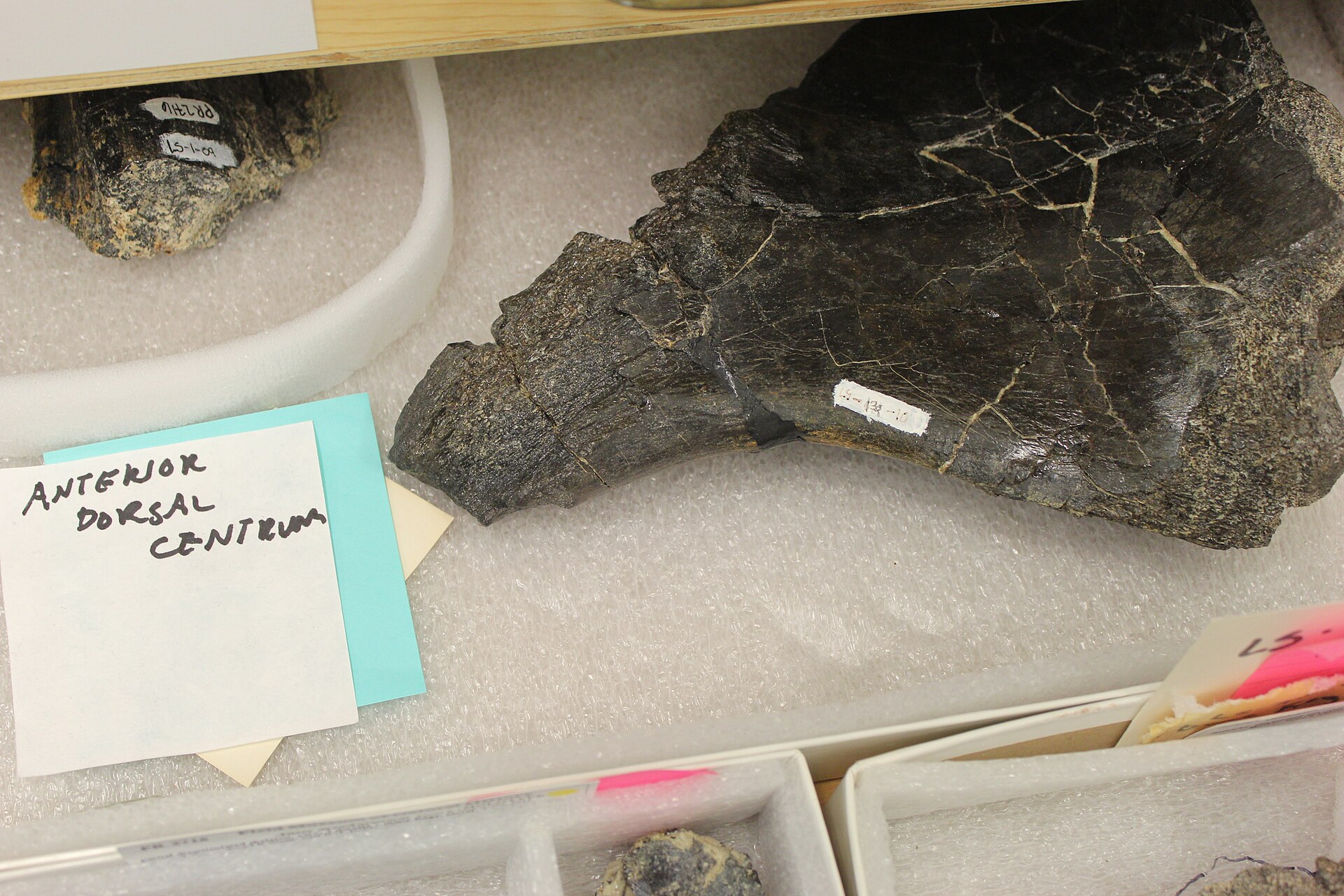
The holotype, FMNH PR 2716, now sits in the Field Museum of Natural History in Chicago. It lacks a skull but preserves parts of five dorsal (back) vertebrae and up to 13 caudal (tail) vertebrae. The hip includes a partial right ilium (the main hip bone) and the upper ends of both ischia (the rear lower hip bones). A section of fibula (calf bone) about 18 inches (460 millimeters) long also survives, along with foot bones from three toes. All of it lay disarticulated—scattered but found together—in a bone bed with small theropod remains and abundant tiny vertebrate fossils.
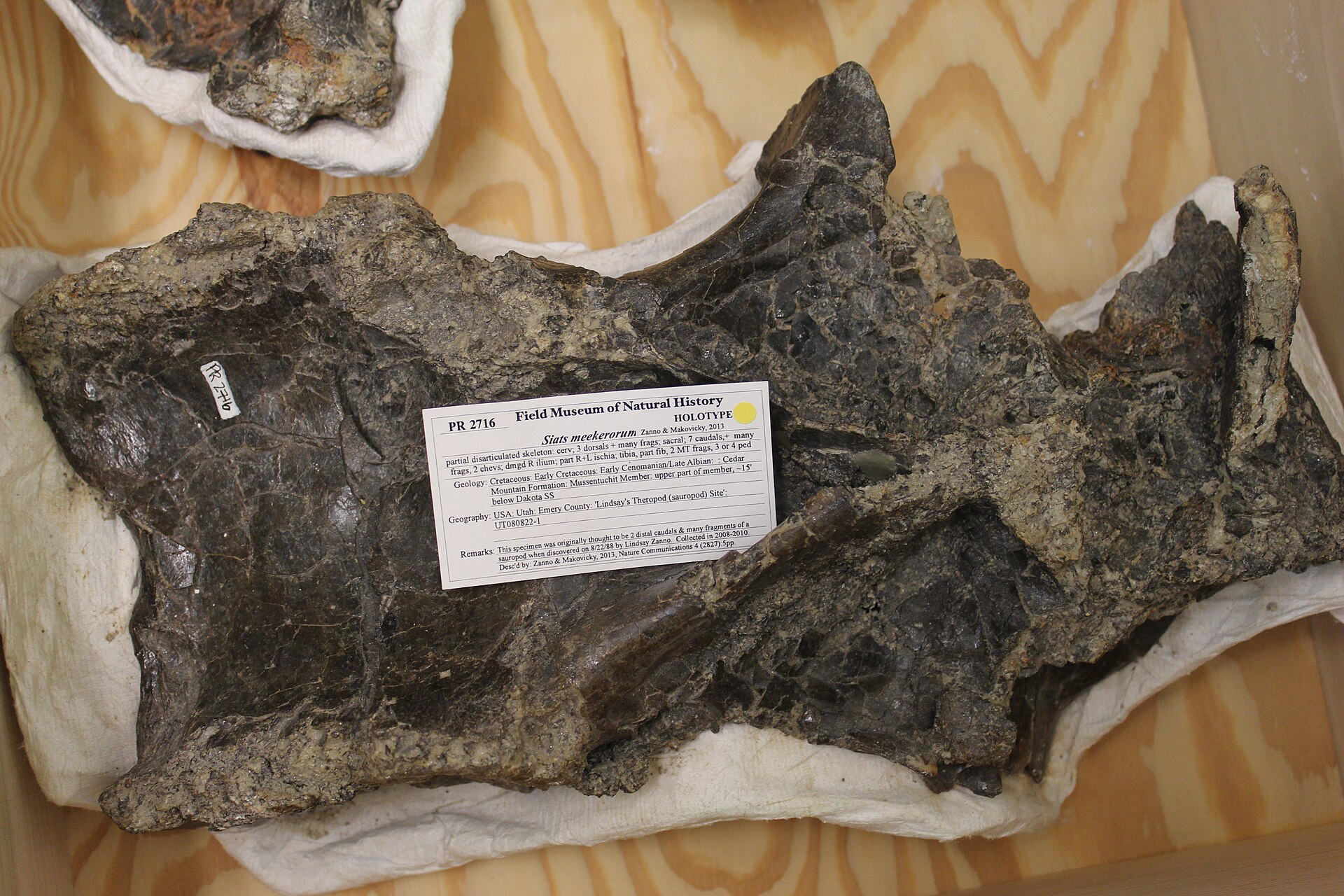

A second specimen, FMNH PR 3059, shares the diagnostic hollows beside the joints of the tail vertebrae, so the describers referred it to Siats. It includes part of a mid-tail vertebra, a chevron (a small bone beneath the tail), a toe bone, and fragments. The 2013 paper also mentions a few isolated teeth that might belong to Siats. In 2018, however, Frederickson and colleagues found none large enough for an adult among the member’s many theropod teeth. Beyond the holotype and the referred specimen, no other fossils have been firmly assigned to Siats.
Siats Size and Description
Any portrait of Siats rests on a string of partial vertebrae, a crushed hip, and pieces of the leg and foot.
Short description of Siats
Without any skull material, the head of Siats remains a blank. Air spaces honeycombed its back vertebrae—a spongy internal structure called camellate pneumaticity. Slit-like air openings pierced every preserved vertebra in front of the hips. Unlike those of Neovenator, its front back vertebrae were more than twice as long as tall. Their spines were short and broad at the base, quite unlike the tall, buttressed spines of Acrocanthosaurus.
At the hip, the ilium carried a truncated outer shelf with a notched rear end. The ischium, meanwhile, lacked the opening known as the obturator foramen. Toward the tip of the tail, the vertebrae had a flattened, concave underside that gave them a roughly triangular cross-section.
A skeletal reconstruction in the 2013 paper shows Siats on two legs, although the text never discusses how it moved. No skin impressions or soft tissue survive, so any picture of its outward appearance is speculative.
Size and Weight of Type Species
Neither the 2013 description nor later studies give a length for Siats. The only figure comes from the 2013 university press release, which put the animal at more than 30 feet (9.1 meters) long. None of these sources gives its height at the hips either.
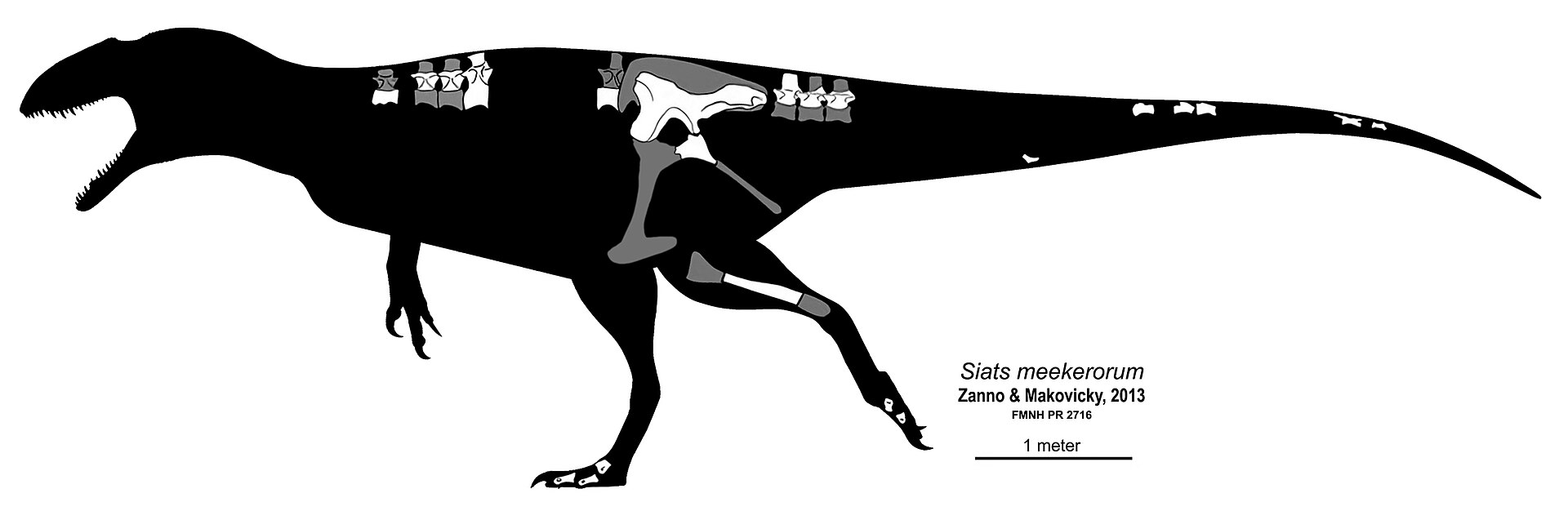

Since no femur (thigh bone) survives, Zanno and Makovicky predicted the femur’s length from the fibula. Their results ranged from about 45.9 to 55.5 inches (1,166 to 1,410 millimeters). They conservatively used the lower value, while noting it came from an immature animal. A theropod body-mass equation then gave roughly 3.9 metric tons (about 8,600 pounds). Still, the authors stressed that they do not treat such estimates as precise point values.
That femur estimate approaches the 46.9 inches (1,190 millimeters) reported for Chilantaisaurus. Its describers noted that this would make Siats one of the largest megaraptorans, if both animals do belong to that group. For comparison, the same study lists one Tyrannosaurus at about 13,598 pounds (6,168 kilograms) and an Acrocanthosaurus at about 11,574 pounds (5,250 kilograms). According to the press release, the authors theorized that an adult Siats might have reached the size of Acrocanthosaurus.
The Dinosaur in Detail
What sets this dinosaur apart are four autapomorphies—traits found in no other species—on its tail and hip. Two involve the tail, including the triangular cross-section of the vertebrae near the tip. The other two sit on the ilium—a concave rim of the hip socket and that notched shelf.
Several details echo Neovenator, including a ridge beneath a front back vertebra, flange-like joint processes, and a beveled edge on the ischium. Meanwhile, deep hollows bracketing ridges on its tail vertebrae recall Megaraptor and Aerosteon. The ilium and ischium also met in a peg-and-socket joint seen in other carcharodontosaurians, though later work notes it in tyrannosauroids and some ceratosaurs too. Zanno and Makovicky’s analysis gave strong support to a Neovenatoridae that included Siats.
Even in 2013, the authors noted the rival idea that megaraptorans were early tyrannosauroids, but did not test Siats against it. In 2014, Porfiri and colleagues argued that Siats lacks clear derived traits linking it with Megaraptora, or even with the broader group Coelurosauria. Two years later, Coria and Currie left it in an unresolved cluster within Neovenatoridae and treated it as a “wildcard.” Malafaia and colleagues instead recovered it in 2020 as an early carcharodontosaurian outside Megaraptora. In contrast, Naish and Cau in 2022 recovered it as an early-diverging megaraptoran within Tyrannosauroidea—part of a “second wave” of tyrannosauroid gigantism. In 2025, Kellermann and colleagues found it among the megaraptorans in all their analyses, though about 91 percent of its data were missing.

Taken together, paleontologists usually place Siats among the megaraptorans, a group whose own position remains contested—allosauroid relatives of Neovenator, or coelurosaurs that many now treat as early tyrannosauroids. As recently as 2026, Morrison and colleagues listed it among several disputed megaraptoran taxa. Until more bones turn up, its place will likely keep shifting.
Interesting Points about Siats
- The press release gives its pronunciation as “see-atch,” and the original paper notes See-atch as an alternative spelling of the legendary monster’s name.
- According to its describers, Acrocanthosaurus was the only large predator described from North America’s pre-Campanian Cretaceous before Siats.
- The holotype’s vertebrae had not yet fused, except near the tip of the tail, which shows it came from an immature animal.
- Zanno said that contemporary tyrannosaurs would have been no more than a nuisance to Siats, “like jackals at a lion kill.”
Contemporary Dinosaurs
From the same rock unit comes Moros, a small tyrannosauroid known from a slender, highly cursorial (running-adapted) hind limb. In the 2023 age model, its holotype dates to about 99.4 million years ago, some 300,000 years before that of Siats. No fossil records an encounter, although the 2013 and 2019 papers both argue that small tyrannosauroids ranked below giant allosauroids as predators.
Adding further diversity was Iani, an early-diverging ornithopod (a beaked plant-eater). Its holotype, from the lower Mussentuchit Member, dates to about 99.7 million years ago—roughly half a million years before Siats. No fossil links the two.
Also from the member is Fona herzogae, a small-bodied thescelosaurine (one of the bird-hipped dinosaurs) named in 2024. Its holotype comes from the Karmic locality in the Mussentuchit Member and dates to about 99.5 million years ago. As with Iani, no fossil ties it to Siats.
By far the most common was Eolambia caroljonesa, a basal hadrosauroid (an early relative of the duck-billed dinosaurs). All known Eolambia fossils come from this member. In 2023, Zanno and colleagues gave its oldest occurrence as about 99.5 million years ago. The 2013 paper’s reconstruction shows Siats preying on Eolambia, but that scene is artwork rather than fossil evidence.
Siats in its Natural Habitat
The world Siats roamed was a coastal plain. In 2022, Tucker and colleagues placed the Mussentuchit Member on the landward side of a paralic—near-shore—basin, shaped by both rivers and the coast. They likened it to the modern coastal plain of French Guiana. Conditions shifted over time, however. The lower part of the member was wet and humid, with brackish groundwater near the surface. By contrast, the upper part, where Siats was found, was better drained, with more river channels and swings in humidity. According to the 2013 press release, the landscape was lush, with water and vegetation supporting plant-eating dinosaurs, turtles, crocodiles, and giant lungfish.
While there is no direct evidence of what Siats ate, its describers treated it as an apex predator. The holotype preserves no teeth, and no gut contents or bite marks have been reported. By their estimate, it stood well above the one-ton mark that earlier researchers used to define apex predators. It was also far larger than the four or more other theropods then documented in the Mussentuchit.
Its social life, senses, and coloration remain unknown. Zanno and Makovicky suggested that carcharodontosaurians held the top predator role in North America into the Late Cretaceous. If so, they may have held back tyrannosauroid size evolution through competitive exclusion—crowding rivals out of the same niche. Today, the member preserves one of the most diverse early Late Cretaceous land faunas anywhere, with nearly 100 species identified.
Frequently Asked Questions
Siats is a predatory, man-eating monster of Ute legend, and the species name meekerorum honors the Meeker family.
It lived in the Cenomanian stage of the Late Cretaceous, around 99.1 million years ago.
Its describers’ rough estimate is close to 4 metric tons (about 8,600 pounds), based on a juvenile. The only length figure, from a press release, is more than 30 feet.
It was a carnivore, treated by its describers as an apex predator, although no direct evidence of its diet survives.
It was a large theropod, usually placed among the megaraptorans, whose exact position in the family tree remains debated.
Its bones come from the Mussentuchit Member of the Cedar Mountain Formation in Emery County, Utah.
Sources
The information in this article is based on various sources, drawing on scientific research, fossil evidence, and expert analysis. The aim is to provide a comprehensive and accurate overview of Siats. However, please be aware that our understanding of dinosaurs and their world is constantly evolving as new discoveries are made.
- https://doi.org/10.1038/ncomms3827
- https://static-content.springer.com/esm/art%3A10.1038%2Fncomms3827/MediaObjects/41467_2013_BFncomms3827_MOESM809_ESM.pdf
- https://doi.org/10.1130/G51278.1
- https://doi.org/10.1038/s42003-019-0308-7
- https://doi.org/10.1016/j.cretres.2014.04.007
- https://doi.org/10.1371/journal.pone.0157973
- https://doi.org/10.7717/peerj.12727
- https://doi.org/10.1371/journal.pone.0311096
- https://doi.org/10.1098/rsos.260937
- https://doi.org/10.1098/rsos.210923
- https://doi.org/10.1038/s41598-018-35689-6
- https://doi.org/10.1371/journal.pone.0286042
- https://doi.org/10.1002/ar.25505
- https://doi.org/10.1371/journal.pone.0353169
- https://doi.org/10.1371/journal.pone.0045712
- https://doi.org/10.2110/jsr.2021.028
- https://paleobiodb.org/data1.2/taxa/single.json?name=Siats&show=attr,app,class,parent
- https://www.newswise.com/articles/colossal-new-predatory-dino-terrorized-early-tyrannosaurs
- https://www.sciencedaily.com/releases/2013/11/131122084241.htm
- https://edition.cnn.com/2013/11/22/us/siats-meekerorum-dinosour-discovered
This article was last fact checked: TheDinosaurs Team, 03-11-2026
Featured Image Credit: PaleoNeolitic, CC BY 4.0, via Wikimedia Commons
