
In the Alashan deserts of Inner Mongolia, east of Chilantai Salt Lake, rocks once assigned to the Ulansuhai Formation yielded the skull of a puzzling predator. Named Shaochilong maortuensis, this carnivorous theropod is known mainly from a braincase, skull roof, and upper jaw. Its 2009 namers dated it to the Late Cretaceous—yet later work placed its locality in older, Early Cretaceous rocks. Even its family is contested, leaving this small predator at the center of two debates.
Chinese and Soviet paleontologists found the bones in 1960. Four years later, Hu Show-yung described them as a new species of another genus. In 2009, a team led by paleontologist Stephen Brusatte gave the animal its own name, and a full osteology—a bone-by-bone description—followed in 2010. The 2009 team called it “only a single data point.” Even so, they suggested that older lineages, not tyrannosaurids, were still the dominant large predators in the mid-Cretaceous north.
Shaochilong Key Facts
| Keyword | Fact |
|---|---|
| Pronunciation | Not specified |
| Meaning of name | Shark-Tooth Dragon |
| Group | Theropoda |
| Type Species | Shaochilong maortuensis |
| Diet | Carnivore |
| When it Lived | Debated: about 126 to 100.5 MYA, or younger than about 92 MYA |
| Period | Cretaceous |
| Epoch | Debated: Early Cretaceous (Barremian to Albian stages) or Late Cretaceous (Turonian stage or younger) |
| Length | About 16 to 20 feet (5 to 6 meters), indirect 2010 estimate |
| Height | Not specified |
| Weight | About 1,100 pounds (500 kilograms), indirect 2010 estimate |
| Mobility | Not specified |
| First Discovery | 1960 by a group of Chinese and Soviet paleontologists |
| Described by | 1964 by Hu Show-yung (as Chilantaisaurus maortuensis), genus 2009 by S.L. Brusatte, R.B.J. Benson, D.J. Chure, X. Xu, C. Sullivan, and D.W.E. Hone |
| Holotype | Lectotype IVPP V.2885.1 (braincase) and IVPP V.2885.2 (skull roof), designated 2010 |
| Location of first find | Maortu, about 60 km north of Chilantai, Alashan, Inner Mongolia, China (Ulansuhai Formation in 2009, reassigned to the Miaogou Formation in 2024) |
Shaochilong Origins, Taxonomy and Timeline
The name Shaochilong blends two Chinese words. “Shaochi” means “shark tooth,” while “long” means “dragon.” It refers to the carcharodontosaurids—the “shark-toothed” predators its describers placed it among. The species name, maortuensis, points to Maortu, the type locality. Together, the name links a famous lineage to one small corner of the Alashan desert.
The species began life under another name—in 1964, Hu described it as Chilantaisaurus maortuensis, a megalosaurid within the Carnosauria. He placed it in Chilantaisaurus because its tooth and vertebrae were “comparatively similar” to bones from nearby Tashuikou, apart from size. Still, he kept it a separate species, since most elements had no counterpart and the Maortu horizon was lower. Later authors rejected the link because the two share no overlapping bones. Since its 2009 renaming, Shaochilong maortuensis has been the type and only known species.
When Shaochilong lived depends on which geology you follow. Hu called the horizon Early Cretaceous. In contrast, the 2009 team placed it in the Ulansuhai Formation, a unit often treated as Aptian–Albian. They cited potassium–argon dates of 146 to 92 million years from basalts beneath it—a maximum age in the Turonian. However, those dates come from elsewhere in Alashan, so they constrain Maortu only if it lies in that formation. In 2024, Hao and colleagues listed Shaochilong among Maortu’s dinosaurs and placed the site in the Lower Cretaceous Miaogou Formation. They called earlier formation assignments mistaken, though the 1960 quarry was not relocated. Fossil algae called charophytes date equivalent strata to the Barremian–Albian, roughly 126 to 100.5 million years ago. Because the two readings straddle the Early–Late Cretaceous boundary, its age remains open.
Discovery & Fossil Evidence
According to Hu, the 1960 team collected carnosaur fossils at both Maortu and Tashuikou, east of Chilantai Salt Lake. Maortu lies about 60 kilometers (37 miles) north of Chilantai, also spelled Jilantai. After Hu’s report, workers argued over the bones for decades. In 2009, Brusatte’s team treated the whole series as the holotype—the name-bearing specimen—and the only known specimen.
Hu listed “a posterior part of skull, a right maxilla and a fragmental left maxilla, an axis and six caudal vertebrae” under catalog number IVPP V.2885. In 2010, Brusatte, Daniel Chure, Roger Benson, and Xu Xing chose a lectotype, a name-bearing specimen picked from an original series. It pairs the braincase (V.2885.1) with a skull-roof piece (V.2885.2) holding the frontals, parietals, and part of the right nasal. These two fit together, a safeguard in case the other bones prove to belong to another animal. The rest of the type series—the quadrates (jaw-joint bones), right maxilla (main upper jaw bone), axis (second neck vertebra), and caudal (tail) vertebrae—became paralectotypes.
The 2010 team found only the right maxilla and four of Hu’s six tail vertebrae. They considered it likely that the bones represent a single individual. Even so, Hu gave no quarry maps, and the team referred the tail vertebrae with less certainty. Hu also listed six isolated carnosaurian teeth from Maortu, but left them as indeterminate theropod remains.
Shaochilong Size and Description
Because only the head and a few vertebrae survive, nearly everything we know about Shaochilong comes from its skull.
Short description of Shaochilong
According to its 2010 describers, the snout was short for a carcharodontosaurid. The right maxilla measures 290 millimeters (11.4 inches) long and 77 millimeters (3.0 inches) deep, while Hu gave a greatest length of 293 millimeters. Unlike the rough-textured maxillae of derived carcharodontosaurids, its outer face is mostly smooth. It held 12 tooth sockets, a low number among basal tetanurans (early members of the stiff-tailed theropod group). Only one partly erupted tooth survives, which Hu described as curved backward and finely serrated. However, the 2010 team found it relatively thick from side to side—unlike the thin, blade-like teeth of derived carcharodontosaurids.
On top of the head, the frontals (skull-roof bones above the eyes) had fused to each other and to the parietals. A tall, sharp sagittal crest—a ridge along the midline—rises 10 millimeters (0.4 inches) above the frontal. Behind it, the braincase is short, deep, and riddled with air spaces. No publication describes its posture or body covering, so any discussion of integument is speculative.
Size and Weight of Type Species
Without limb bones, any estimate of body size must rest on comparisons. In 2010, Brusatte’s team used the 255-millimeter (10.0-inch) tooth row, assuming it scales with femur length as in tyrannosaurids. That row is about 65 to 75 percent as long as in adult Allosaurus and Sinraptor. On that basis, they estimated a length of roughly 16 to 20 feet (5 to 6 meters).
No height estimate exists, but for weight they inferred a femur (thigh bone) of about 615 millimeters, giving about 1,100 pounds (500 kilograms). By comparison, the same paper gives 1,620 to 1,700 kilograms for Allosaurus and Sinraptor. Acrocanthosaurus, the team noted, may have topped 5,000 kilograms.
Fused sutures suggest a mature or near-mature animal, although it may not have been fully grown. At the time, the team called it the smallest undisputed adult allosauroid (a member of the Allosaurus group) known. It was also larger than any Early to mid-Cretaceous Asian tyrannosauroid then known, such as Xiongguanlong at 272 kilograms. However, Yutyrannus, named in 2012 from China’s Yixian Formation, weighed an estimated 1,400 kilograms (3,100 pounds).
The Dinosaur in Detail
What sets this dinosaur apart, its describers said, is a cluster of skull features unique among non-coelurosaurian theropods. On the maxilla, the antorbital fossa—the sunken area around the large skull opening in front of the eye—is nearly absent. Its inner face lacks a paradental groove (a channel near the tooth row), but the plates between the teeth carry deep grooves. In addition, an air-filled recess reaches the back of the nasal. A large air opening also pierces each prootic, a braincase bone—the better-preserved one is nine millimeters across.
The rest of the skull mixes signals. Like carcharodontosaurids, it has fused frontals, and the 2009 team inferred that the postorbital met the lacrimal above the eye. Unlike them, its quadrate lacks air spaces, as in Allosaurus and Sinraptor. The team also reported two openings for the facial nerve, otherwise known only in Acrocanthosaurus. In their view, the braincase ranks “among the best preserved basal tetanuran braincases currently known.”
In 2009, the team called it “the first unequivocal Asian member of Carcharodontosauridae.” Their analysis nested it more derived than Acrocanthosaurus, close to Carcharodontosaurus, Giganotosaurus, and Mapusaurus. Papers in 2019 and 2021 also grouped it with the carcharodontosaurians.
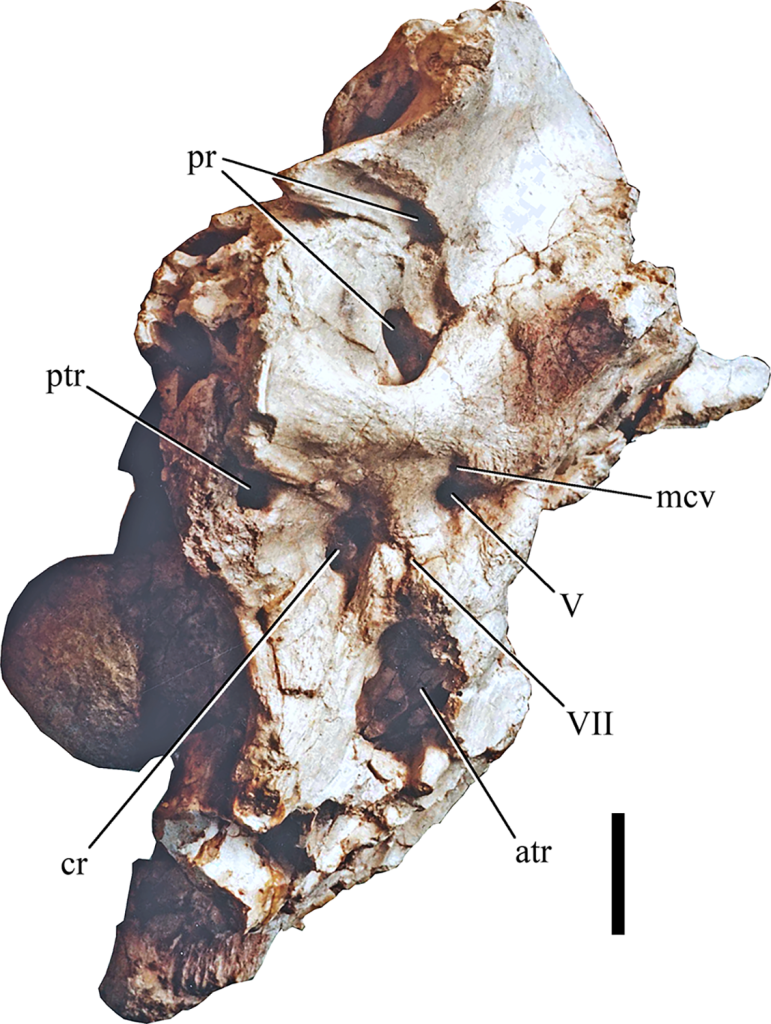

However, in 2025, paleontologist Maximilian Kellermann and colleagues argued that several of those characters are problematic or not limited to carcharodontosaurids. They found only one facial nerve opening and judged a lacrimal–postorbital contact “rather unlikely.” They also suggested the missing fossa on the maxilla’s rising branch might be damage. In all of their analyses, Shaochilong fell within Tyrannosauroidea—the wider tyrannosaur lineage. Even so, a 2026 braincase study still referred to a clade uniting it with Carcharodontosaurinae. For now, the same bones now support two readings, and its family remains an open question.
Interesting Points about Shaochilong
- Before it got its own genus, different authors had placed Shaochilong among megalosaurids, allosaurids, tyrannosauroids, and maniraptorans.
- Its sagittal crest rises 10 millimeters from a broad frontal surface, a combination its describers called unique among theropods.
- An unpublished 2000 thesis by Daniel Chure called these bones “Alshansaurus,” but that name was never formally published.
- The 2009 team suggested its Gondwanan relatives might mean its lineage arose before Pangaea split, or reflect north–south interchange in the Early Cretaceous.
- Hu named it in the same 1964 paper that introduced the much larger Chilantaisaurus tashuikouensis from nearby Tashuikou.
Dinosaurs from the Same Formation
Also known from the Maortu locality (exact level relative to Shaochilong not known): the ankylosaur Gobisaurus, the iguanodontian ornithopod Probactrosaurus, and the oviraptorosaur Yuanyanglong. The describers of Gobisaurus believed its large, virtually complete skeleton came from the same general locality as Shaochilong. Probactrosaurus was first described from Sino-Soviet material from Maortu, and Yuanyanglong was named in 2024 from two Miaogou specimens. The beds are dated only broadly. Charophytes from equivalent strata at Dashuiguo point to the Barremian to Albian, a window of roughly 25 million years. As a result, these animals may not all have lived at the same time.
Shaochilong in its Natural Habitat
The world Shaochilong roamed depends on which geology proves right. Under the Early Cretaceous reading, equivalent strata at Dashuiguo record an alluvial (river-built) plain with dinosaur bones in old channels. Soils, fossils, and evaporite crystals point to a subhumid climate with seasonal dry periods, and ponds formed in abandoned channels. Under the Turonian reading, the Ulansuhai Formation is mainly reddish sandstone and mudstone, though that description comes from another area.
Hu placed it among the carnosaurs, and its backward-curved, serrated tooth fits a meat-eater. While there is no direct evidence of its prey, the 2009 team discussed it among mid-Cretaceous Asia’s large theropods. Hu’s report lists ornithopods, sauropods, ankylosaurs, and turtles found with the bones. That list covers Maortu and Tashuikou together, so it cannot show which animals lived beside Shaochilong.
No publication describes its behavior. In 2010, Brusatte’s team suggested its short snout marked a unique morphotype, and perhaps ecotype (a distinct way of life). They also wrote that it was “not the largest carnivore in its fauna,” because it lived alongside the giant Chilantaisaurus tashuikouensis. In 2008, Benson and Xu put that giant at about 6,000 kilograms. However, a 2010 review derived lower figures of about 2,500 to 4,200 kilograms. That review went further, suggesting that carcharodontosaurians may have filled a variety of body-size niches. Still, Hu considered the Maortu horizon lower than Tashuikou’s, so that idea assumes a shared time not yet confirmed.
Frequently Asked Questions
It means “shark-tooth dragon,” from the Chinese words “shaochi” (shark tooth) and “long” (dragon).
That is debated. The 2009 team proposed under 92 million years ago, but later work favors about 126 to 100.5 million years ago.
Brusatte and colleagues estimated 16 to 20 feet (5 to 6 meters) and about 1,100 pounds (500 kilograms), based on its tooth row.
It was a theropod, usually classed as a carcharodontosaurid since 2009, though a 2025 study recovered it as a tyrannosauroid.
Its bones came from Maortu, about 60 kilometers north of Chilantai in the Alashan region of Inner Mongolia, China.
Its describers pointed to a nearly absent antorbital fossa and a tall sagittal crest rising from a broad frontal surface.
Sources
The information in this article is based on various sources, drawing on scientific research, fossil evidence, and expert analysis. The aim is to provide a comprehensive and accurate overview of Shaochilong. However, please be aware that our understanding of dinosaurs and their world is constantly evolving as new discoveries are made.
- https://ivpp.cas.cn/cbw/gjzdwxb/xbwzxz/200912/P020091230393410738156.pdf
- https://doi.org/10.1007/s00114-009-0565-2
- https://www.pure.ed.ac.uk/ws/files/8232136/PDF_Brusatteetal2009primeiroDefinitiveCarcharodontosaurid.pdf
- https://doi.org/10.11646/zootaxa.2334.1.1
- https://treatment.plazi.org/id/1C7A0606B912FFEB8CF06D84DEAFEBD2
- https://www.pure.ed.ac.uk/ws/files/8232292/PDF_Brusatteetal2010ShaochilongOsteology.pdf
- https://revistas.ucm.es/index.php/JIGE/article/view/JIGE1010220275A
- https://www.app.pan.pl/archive/published/app48/app48-235.pdf
- https://biblio.naturalsciences.be/rbins-publications/bulletin-of-the-royal-belgian-institute-of-natural-sciences-earth-sciences/71-sup-2001/irscnb_p4087_01ec08x_71-sup_bulletin-3.pdf
- https://doi.org/10.1016/j.cretres.2024.106023
- https://doi.org/10.1371/journal.pone.0311096
- https://doi.org/10.1098/rsos.210923
- https://doi.org/10.1371/journal.pone.0222489
- https://doi.org/10.1371/journal.pone.0345155
- https://doi.org/10.1046/j.1096-3642.2002.00027.x
- https://doi.org/10.1139/e01-051
- https://paleobiodb.org/classic/basicCollectionSearch?collection_no=66924
- https://stratigraphy.org/ICSchart/ChronostratChart2024-12.pdf
- https://blogs.nature.com/blog/largest-feathered-dinosaur-discovered-in-china/
This article was last fact checked: TheDinosaurs Team, 18-11-2026
Featured Image Credit: FunkMonk, CC BY-SA 3.0, via Wikimedia Commons
