
On the southwest coast of the Isle of Wight, the plant debris beds of the Wessex Formation hold what a 2008 monograph called the most complete large theropod known from Europe. Named Neovenator salerii in 1996, this predator lived during the Barremian stage of the Early Cretaceous—roughly 126 to 121 million years ago. Its describers introduced it as the first allosaurid dinosaur from Europe, a gracile animal about 24.6 feet (7.5 meters) long. Since then, its place on the family tree has shifted more than once—and the debate is still open.
The holotype came to light in 1978, and it was the first associated theropod skeleton known from the Wessex Formation. Before then, the island had yielded only what the describers called “tantalising fragments” of theropods. Eighteen years after the find, Steve Hutt, David M. Martill, and Michael J. Barker named the animal in a journal published in Stuttgart. Later, a full monograph and CT scans of its snout added detail from the hips to the nerves of the face. Decades on, this one skeleton still raises new questions.
Neovenator Key Facts
| Keyword | Fact |
|---|---|
| Pronunciation | nee-oh-ve-nay-tor |
| Meaning of name | New Hunter |
| Group | Theropoda |
| Type Species | Neovenator salerii |
| Diet | Carnivore |
| When it Lived | 126 to 121 MYA |
| Period | Cretaceous |
| Epoch | Early Cretaceous (Barremian stage) |
| Length | About 24.6 feet (7.5 meters) |
| Height | Not specified |
| Weight | Not specified |
| Mobility | Not specified |
| First Discovery | 1978, finder not specified |
| Described by | 1996 by S. Hutt, D.M. Martill, and M.J. Barker |
| Holotype | MIWG 6348 (also cited as NHMUK R10001) |
| Location of first find | Plant debris bed L9, west of Grange Chine, Wessex Formation, Isle of Wight, England, UK |
Neovenator Origins, Taxonomy and Timeline
The name Neovenator means “new hunter.” No source we could access explains the species name salerii.
Hutt and colleagues originally described Neovenator as an allosaurid, comparing it with the North American Allosaurus and the Asian Sinraptor. However, differences in the skull, pelvic girdle (hip bones), and vertebral column convinced them it deserved its own genus. In 2008, a monograph by Stephen Brusatte, Roger Benson, and Hutt recast it as the basalmost (earliest-branching) member of Carcharodontosauridae, within the larger group Allosauroidea. Two years later, Benson and colleagues grouped it with Australovenator, Fukuiraptor, Megaraptor, and several others in a new clade, Neovenatoridae. In 2017, paleontologist Chris Barker and colleagues still described it as a basal member of that group. No study we accessed disputes the genus or names a synonym.
The 1996 paper placed the skeleton in the Barremian stage, and later work narrowed its bed, known as L9, to the early Barremian. The International Commission on Stratigraphy’s current chart (2024) dates the whole stage to about 125.8 to 121.4 million years ago. However, no bed-level date appears in the sources we accessed. London’s Natural History Museum gives a similar range of 127 to 121 million years ago. Although the Wessex Formation is mostly Barremian, the base of its exposed strata reaches back into the older Hauterivian stage. During the Barremian, the Isle of Wight lay between 35 and 40 degrees north—a warm, storm-prone corner of Cretaceous Europe.
Discovery & Fossil Evidence
The holotype turned up in 1978 in bed L9, west of Grange Chine on the island’s southwest coast, though no source we could access names the finder. That same year, excavators recovered an iguanodontian skeleton from the same spot—the two lay together, with some overlap, in an area of about 10 by 20 feet (3 by 6 meters). Neither skeleton lay in articulation.
The holotype, MIWG 6348, is a partial skeleton that also appears in the literature as NHMUK R10001. MIWG stands for Museum of Isle of Wight Geology—the prefix for items accessioned before 1994. Today the collection sits with the Isle of Wight County Museum Service at Dinosaur Isle Museum. The specimen preserves extensive cranial (skull), axial (backbone), and appendicular (limb and girdle) material in excellent three-dimensional condition. In 1996, the describers said it made up some 70% of the skeleton. However, the 2008 monograph credits that 70% to the holotype and referred specimens together.
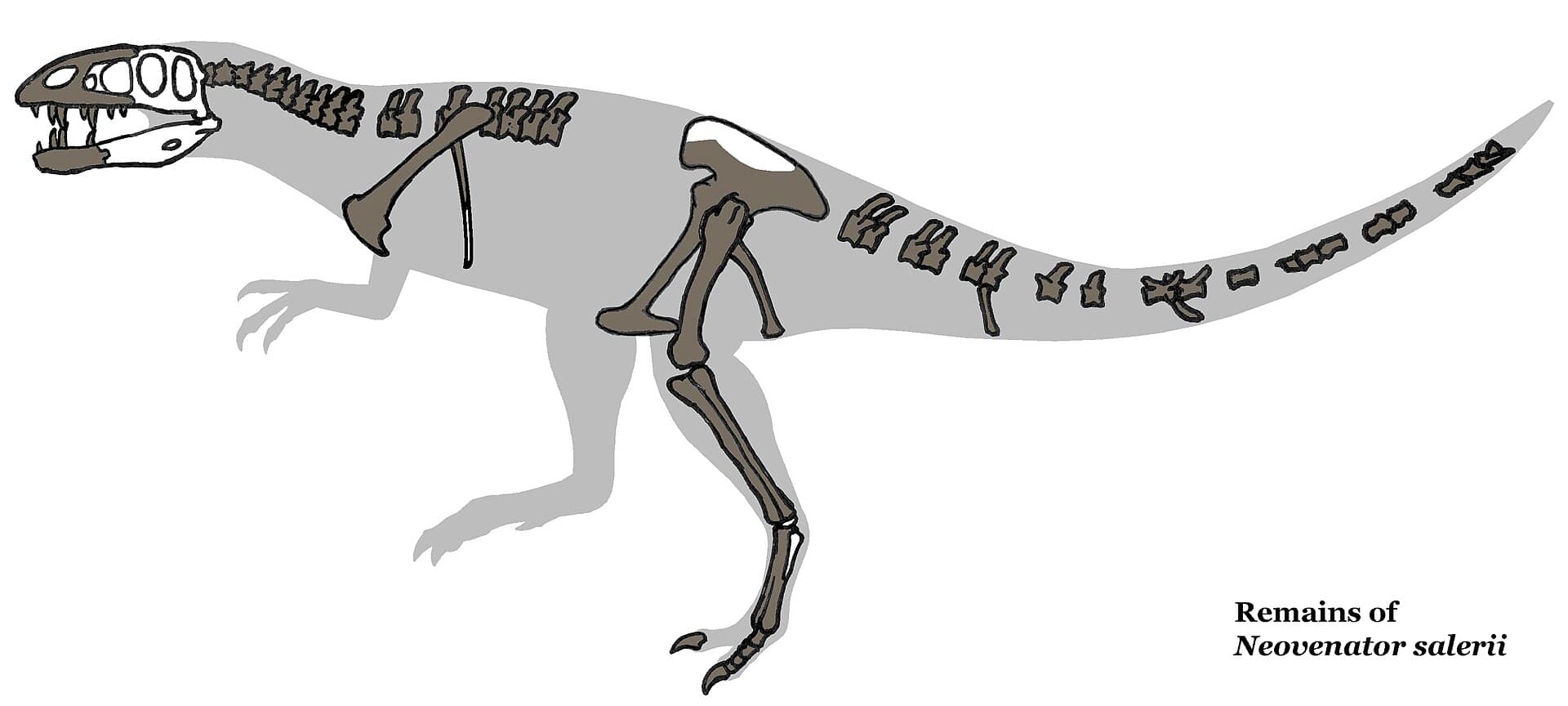

Neovenator also has several referred specimens, and Brusatte, Benson, and Hutt published the full osteology (bone-by-bone description) in 2008, a 75-page monograph with 45 plates. Even so, its skull is less complete than that of its neighbor Eotyrannus, whose holotype preserves more cranial material. Still, the describers had already called it “perhaps the most complete theropod from the European Cretaceous.” The monograph later narrowed that claim to large theropods—a wise choice, as the almost complete but smaller Concavenator turned up in Spain in 2010.
Neovenator Size and Description
Neovenator was a lightly built predator, but its most surprising details hide inside the skull.
Short description of Neovenator
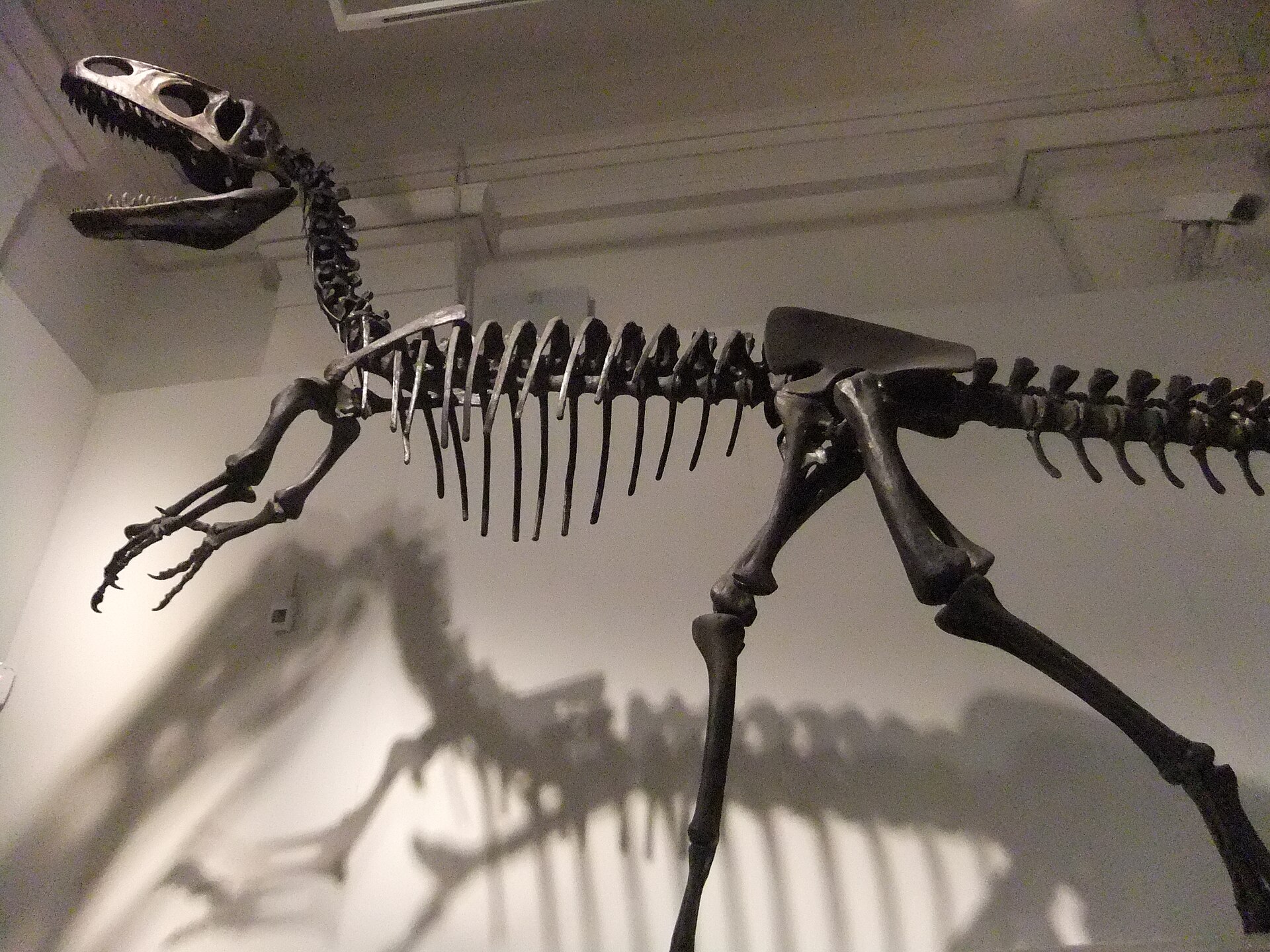
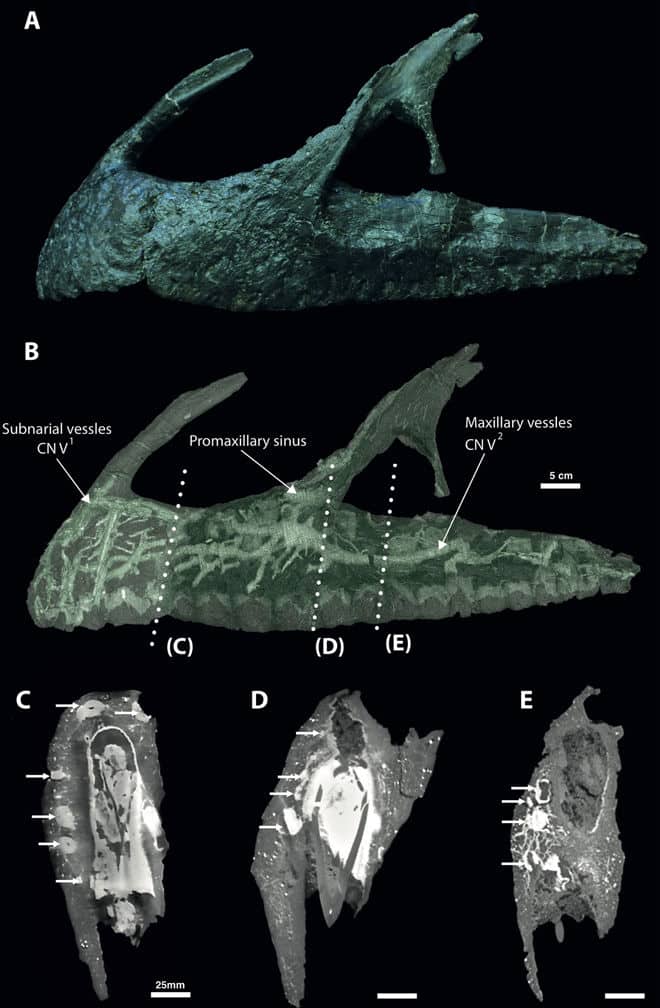
The original describers called Neovenator “gracile,” meaning slender for an allosaurid. Its skull was deep and laterally compressed—a shape termed oreinirostral—and lined with large, ziphodont (blade-like, serrated) teeth. Inside the premaxilla and maxilla (the front and main upper jaw bones), a network of large, branching canals carried nerves and blood vessels. These canals ended at foramina (small openings) on the outer surface of the snout.
Along the backbone, the front dorsal (back) vertebrae carried a ridge along their underside. In the tail, the zygapophyses—the small joints linking each vertebra to the next—flared outward. On the hip, a bulbous swelling on the brevis shelf (a bony ledge) marked where the caudofemoralis brevis muscle anchored.
The soft tissue of the face has to be inferred from the bones. Barker and colleagues found no bony signs of a horny beak, or rhamphotheca. Instead, the many foramina suggested to them that whatever tissue lay along the jaws was immobile.

Size and Weight of Type Species
Hutt and colleagues estimated Neovenator at 24.6 feet (7.5 meters) long, but their abstract does not say how. In 2021, Barker and colleagues called it a 23- to 26-foot (7- to 8-meter) animal, citing earlier studies. London’s Natural History Museum, meanwhile, lists about 24.3 feet (7.4 meters).
None of the descriptive studies we accessed gives a hip height or body weight, though Barker’s team called it a mid-sized allosauroid in 2017. For scale, the subadult Eotyrannus holotype from the same formation was only about 14.8 feet (4.5 meters) long.
The Dinosaur in Detail
One of the best-studied features of Neovenator lies hidden inside its face. In 2017, Barker and colleagues CT-scanned both premaxillae, the left maxilla, and the right nasal bone of the holotype. The scans revealed canals that fill at least 7.3% of the premaxilla’s internal volume and 6.7% of the maxilla’s. A large, serpentine canal also wound through the maxilla at mid-height. In the number of foramina on its snout, Neovenator is most comparable to abelisaurids such as Majungasaurus. Its rough bone texture, on the other hand, matches both abelisaurids and carcharodontosaurids.
The purpose of such a richly supplied snout is less certain. Barker’s team proposed that it gave Neovenator enhanced facial sensitivity—likely a trait shared by many large theropods. Possible uses, they suggested, included stripping flesh from carcasses, selecting or tending nests, and social interaction—though they framed these ideas as speculation.

Its relatives are just as debated. In 2013, Lindsay Zanno and Peter Makovicky described Siats from North America as a gigantic neovenatorid, comparing its vertebrae and hips directly with those of Neovenator. That same year, however, Novas and colleagues placed megaraptorans—Megaraptor and its close kin—among the tyrannosauroids. In 2022, Darren Naish and Andrea Cau supported that view, yet they still call Neovenator a carcharodontosaurian. Most of these studies keep Neovenator among the carcharodontosaurians, but even that is not settled. In 2025, Kellermann and colleagues placed it within that group in some analyses but considerably more basal, outside Carcharodontosauriformes, in others. Meanwhile, a 2026 study of Invictibellatrix, a new Isle of Wight megaraptoran, again classed megaraptorans as coelurosaurs. Taken together, Neovenator‘s closest relatives remain an open question.
Interesting Points about Neovenator
- When it was named in 1996, Neovenator was announced as “the first European allosaurid dinosaur.”
- The holotype was found in 1978, yet it was not formally named until 18 years later.
- Its skeleton lay alongside the iguanodontian Brighstoneus simmondsi in a patch just 10 by 20 feet (3 by 6 meters).
- CT scans show that nerve and blood vessel canals fill at least 7.3% of the inside of its premaxilla.
- Unpublished results reported in 2017 suggest that wear on two of its upper teeth resembles that of cheetahs, which avoid biting into bone.
Contemporary Dinosaurs
Lying beside the holotype in the same bed was Brighstoneus simmondsi, a non-hadrosaurid hadrosauriform—an early relative of the duck-billed dinosaurs. Its holotype, MIWG 6344, dates to the early Barremian. According to paleontologist Jeremy Lockwood and colleagues, one fragment of its backbone appears to carry theropod, or possibly crocodilian, bite marks. They do not name the biter, however, so no kill can be pinned on Neovenator.
Sharing the same formation was Eotyrannus lengi, a smaller tyrannosauroid known from a single subadult skeleton. It came from bed L11, a Barremian plant debris bed at Grange Chine. Naish and Cau state that it lived alongside Neovenator, although no direct interaction between the two is recorded.
Low to the ground moved Polacanthus foxii, an armored ankylosaur that William Blows classed as a nodosaurid in 1987. Its holotype comes from Barnes High, west of Cowleaze Chine, in Barremian beds of the Wessex Formation. It belongs to the same Barremian fauna, though no evidence connects the two directly.
The small ornithopod Hypsilophodon foxii also lived in the Wessex Formation. Its bed sits at the top of the formation, still within the Barremian, but higher than bed L9. In other words, the two shared a formation and a stage, but perhaps not the same moment.
Neovenator in its Natural Habitat
The world Neovenator roamed survives as sandstones and varicolored mudstones laced with plant debris beds. These rocks record a near-shore floodplain crossed by a large, winding river flowing from west to east. Seasonal lakes and ponds dotted the meander plains, while forests of conifers and ginkgos covered higher ground to the north. Ferns, cycad relatives, and early flowering plants also grew in the region. The climate was variable and “Mediterranean,” and conifer growth rings suggest a yearly swing from hot and dry to cool and wet. Forest fires and floods were common, and the plant debris beds that yield most of the island’s dinosaurs probably formed when local sheet floods turned into debris flows.
Neovenator was a land predator of vertebrates, and Barker’s team found no sign that it was aquatic or amphibious. Researchers have assumed that it preyed on ornithopods and other mid-sized dinosaurs. In 2017, Barker’s team also cited bite marks on an associated iguanodontian, then called Mantellisaurus, though this was probably the Brighstoneus skeleton found with the holotype. Meanwhile, unpublished results on wear on two upper teeth suggest that it avoided tooth-to-bone contact. Lockwood and colleagues describe the ecosystem as dominated by large basal iguanodontians.
While there is no direct evidence of whether Neovenator lived alone or in groups, Barker’s team raised social interaction as one possible use for its sensitive face. They also note that researchers have assumed it was an apex terrestrial predator, like its carcharodontosaurian close relatives. On a broader scale, Brusatte and colleagues proposed in 2008 that early carcharodontosaurids like Neovenator ranged more widely before the group became restricted to Gondwana (the southern supercontinent).
Frequently Asked Questions
It means “new hunter.”
It lived in the Barremian stage of the Early Cretaceous, roughly 126 to 121 million years ago.
Its describers estimated a length of about 24.6 feet (7.5 meters). They gave no weight or height estimate.
It was a carnivore, and researchers have assumed that it preyed on ornithopods and other mid-sized dinosaurs.
Its holotype came from bed L9 of the Wessex Formation, west of Grange Chine on the Isle of Wight, England.
It is one of Europe’s most complete large theropods. CT scans of its snout also revealed a dense network of nerve and blood vessel canals, which may have made its face especially sensitive—a trait researchers suspect was common among big predatory dinosaurs.
Sources
The information in this article is based on various sources, drawing on scientific research, fossil evidence, and expert analysis. The aim is to provide a comprehensive and accurate overview of Neovenator. However, please be aware that our understanding of dinosaurs and their world is constantly evolving as new discoveries are made.
- https://doi.org/10.1127/njgpm/1996/1996/635
- https://www.schweizerbart.de/papers/njgpm/detail/1996/92309/The_first_European_allosaurid_dinosaur_Lower_Creta
- https://www.schweizerbart.de/content/papers_preview/download/92309
- https://doi.org/10.1080/25761900.2008.12452864
- https://palaeobiology.web.ox.ac.uk/node/973811
- https://doi.org/10.1007/s00114-009-0614-x
- https://doi.org/10.1038/s41598-017-03671-3
- https://www.nature.com/articles/ncomms3827
- https://doi.org/10.7717/peerj.12727
- https://doi.org/10.1038/s41598-021-97870-8
- https://doi.org/10.1080/14772019.2021.1978005
- https://doi.org/10.1144/jgs2024-046
- https://www.biodiversitylibrary.org/part/173868
- https://www.nhm.ac.uk/discover/dino-directory/neovenator.html
- https://doi.org/10.1371/journal.pone.0311096
- https://doi.org/10.1098/rsos.260937
- https://doi.org/10.1038/nature09181
- https://stratigraphy.org/ICSchart/ChronostratChart2024-12.pdf
This article was last fact checked: TheDinosaurs Team, 01-11-2026
Featured Image Credit: Fred Wierum, CC BY-SA 4.0, via Wikimedia Commons
