
Near the town of El Rosario in Baja California, the sandstones of the El Gallo Formation hold the remains of a giant duck-billed dinosaur. Named Magnapaulia laticaudus, this plant-eater belonged to Lambeosaurinae—crested hadrosaurids, or duck-billed dinosaurs. It lived during the late Campanian stage of the Late Cretaceous, roughly 75 to 74.5 million years ago. The 2012 study that named its genus estimated its largest known individual at about 41 feet (12.5 meters). By comparison, adult hadrosaurids typically reached 23 to 33 feet (7 to 10 meters).
During the 1960s and 1970s, crews led by paleontologist William J. Morris prospected around El Rosario. In 1967, he announced in Science that Late Cretaceous dinosaurs had turned up on Baja California’s Pacific margin. Fourteen years later, he named the species as a possible member of Lambeosaurus—?Lambeosaurus laticaudus, question mark included. Then, in 2012, paleontologists Albert Prieto-Márquez, Luis M. Chiappe, and Shantanu H. Joshi gave it a genus of its own. Dinosaurs are scarce along North America’s Pacific coast, so this giant offers a rare glimpse of a seldom-sampled region.
Magnapaulia Key Facts
| Keyword | Fact |
|---|---|
| Pronunciation | MAG-nuh-PAW-lee-uh |
| Meaning of name | Large One (Honoring Paul Haaga) |
| Group | Ornithopoda |
| Type Species | Magnapaulia laticaudus |
| Diet | Herbivore |
| When it Lived | About 75 to 74.5 MYA |
| Period | Cretaceous |
| Epoch | Late Cretaceous (Campanian stage) |
| Length | About 41 feet (12.5 meters) for the largest individual (2012 estimate), down from Morris’s 46 to 49 feet (14 to 15 meters) |
| Height | Not specified |
| Weight | Not specified |
| Mobility | Not specified |
| First Discovery | 1960s to 1970s by field crews led by William J. Morris (first reported 1967) |
| Described by | 1981 by W.J. Morris (as ?Lambeosaurus laticaudus), genus named 2012 by A. Prieto-Márquez, L.M. Chiappe, and S.H. Joshi |
| Holotype | LACM 17715 |
| Location of first find | LACM locality 7253, El Disecado Member, El Gallo Formation, near El Rosario, Baja California, Mexico |
Magnapaulia Origins, Taxonomy and Timeline
Magna is Latin for “large,” chosen for the unusually large size that at least some specimens reached. The second part, paulia, honors Paul Haaga for his support of the Natural History Museum of Los Angeles County. Morris coined the species name laticaudus in 1981, when his diagnosis rested partly on a deep tail. Laticaudus means “broad tail.” Together, the name honors the animal’s bulk, its deep tail, and one of the museum’s supporters.
Magnapaulia belongs to Ornithischia and, within it, to Ornithopoda, the family Hadrosauridae, and the subfamily Lambeosaurinae. In 2012, Prieto-Márquez and colleagues recovered it as the sister taxon of Velafrons coahuilensis. The pair forms a clade—a group sharing one common ancestor—of southern North American lambeosaurines. That clade, in turn, is sister to a helmet-crested group that includes Hypacrosaurus, Olorotitan, Corythosaurus, and Lambeosaurus. Later, a 2021 study of ornithischian names led by Daniel Madzia listed it within the clade Lambeosaurini. Magnapaulia laticaudus is the type and only known species.
Its fossils come from the late Campanian El Disecado Member of the El Gallo Formation. The 2012 paper gave the member an older estimated age of 73.6 to 73.0 million years. However, Peecook and colleagues (2014) used recalibrated radiometric dates. They placed its fossil-bearing beds between volcanic ash layers, or tuffs, dated to 75.21 and 74.55 million years ago. In 2020, Fastovsky’s team dated a tuff near the base of the fossil-bearing sequence to about 74.7 million years. They also found most fossils above it slightly younger. Taken together, the newer dates place Magnapaulia roughly 75 to 74.5 million years ago.
Discovery & Fossil Evidence
Morris documented a few skull bones and many from the rest of the skeleton. At first, he referred them to Hypacrosaurus altispinus for their long tail spines and the boot-shaped tip of the ischium (a lower hip bone). He then switched to cf. Lambeosaurus (comparable to Lambeosaurus) for the narrow, elongate nostril opening. Finally, in 1981, he named a new species, diagnosed by its deep tail and large size.
The holotype, LACM 17715, is held by the Natural History Museum of Los Angeles County. It comes from LACM locality 7253, no more than three miles (about 4.8 kilometers) west of El Rosario. From the skull, it preserves the left premaxilla (front snout bone), the left maxilla—the main upper tooth-bearing bone—and the left jugal, or cheek bone. Behind the head, it includes neck and back vertebrae and a partial sacrum of four fused hip vertebrae. Shoulder bones, a breastbone, an upper arm bone, an ischium, a femur, part of a shin bone, and a foot bone complete the main elements.
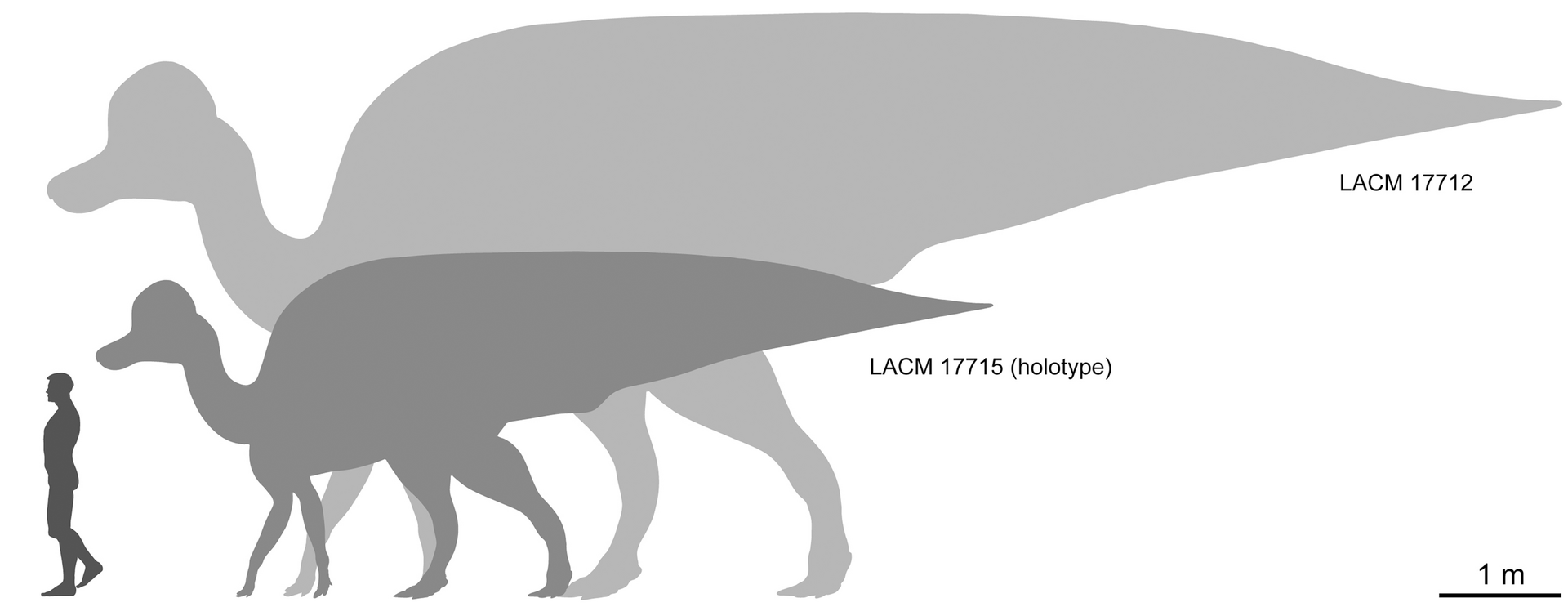

In 2012, Prieto-Márquez’s team referred 24 further museum catalog numbers to the species. They include an articulated run of 21 tail vertebrae, teeth, lower jaws, limb bones, and skin impressions. The referral rests on shared lambeosaurine traits and on association with the type at the same locality. Since two specimens are each diagnostic, the authors noted that two taxa could have been named. Instead, they chose a single species as “the most conservative, simpler explanation.” The 2012 study referred no specimens from outside locality LACM 7253.
Magnapaulia Size and Description
Although no complete skeleton exists, the bones reveal an animal built on an exaggerated scale—especially along its back and tail.
Short description of Magnapaulia
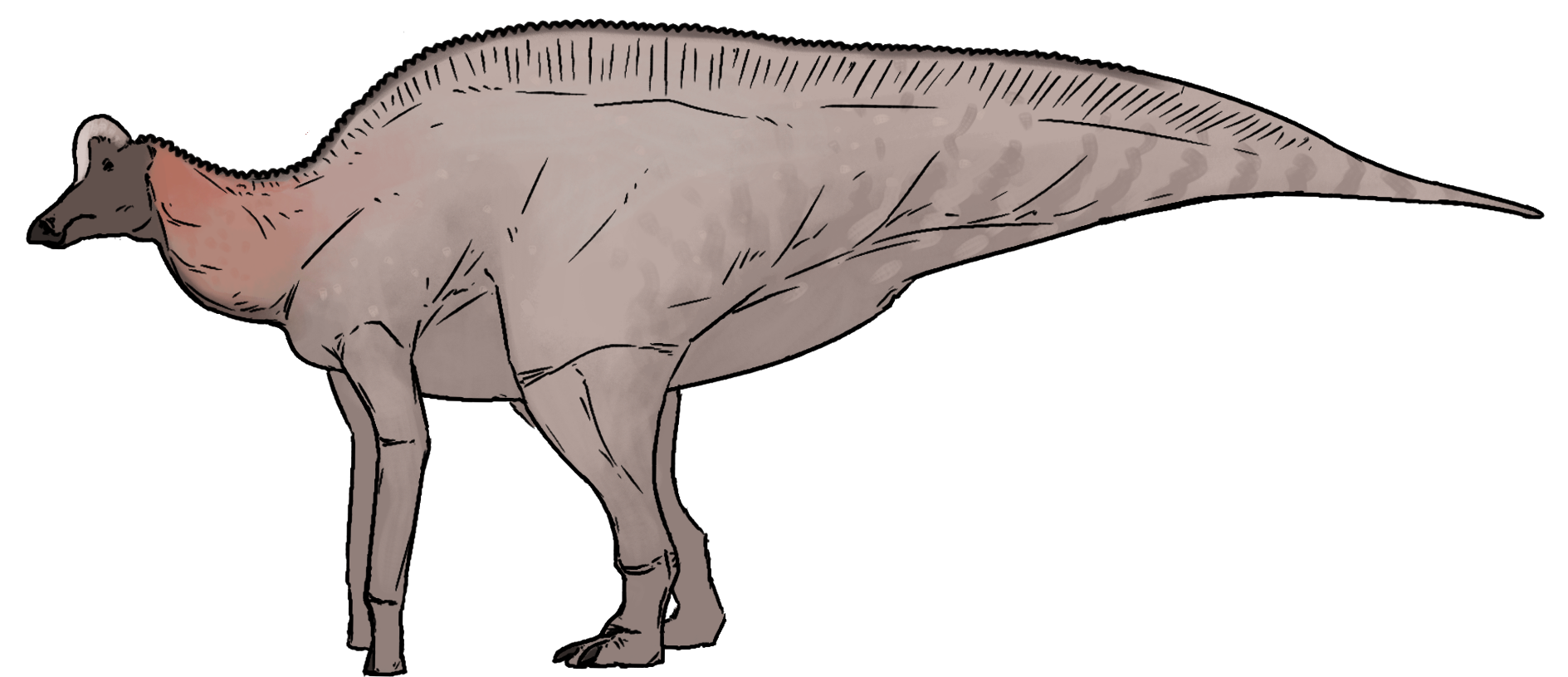
The toothed tip of the maxilla bent downward more than in other lambeosaurines except Tsintaosaurus, Angulomastacator, and Olorotitan. This gave the front of the upper jaw what the 2012 authors called “a characteristic pendant profile.” Its maxilla had 41 tooth positions, and the lower jaw carried a dental battery—tightly packed rows of stacked teeth. The nostril opening was long and tear-shaped, but the crest is not preserved. For that reason, the 2012 skeletal outline borrows one from Corythosaurus casuarius.
Along the back and hips, the neural spines—bony blades rising from the vertebrae—stood at least four times taller than their vertebral bodies. Below the tail, the haemal arches (bony chevrons) matched the spines in length, so the tail was deep above and below. In one tail vertebra, the body is 151 millimeters tall, while the spine reaches 580 millimeters.
Skin impressions show a mosaic of hexagonal to oval scales between about 2.5 and nearly 10 millimeters wide. Among them sat larger oval structures 35 to 40 millimeters across. The 2012 authors thought these may represent osteoderms (bony plates in the skin). Otherwise, the scales resemble those of many hadrosaurids.
Size and Weight of Type Species
As reported in 2012, Morris estimated Magnapaulia at 46 to 49 feet (14 to 15 meters) long. Prieto-Márquez and colleagues took a more cautious route. Their largest humerus (upper arm bone) measures 723 millimeters as preserved, and they estimated its full length at 803 millimeters (about 31.6 inches). Scaling body length from humerus length across hadrosaurids, they reached an indirect estimate of about 41 feet (12.5 meters).
Other specimens may also represent individuals over 12 meters long. Morris had also reported a humerus restored to about 950 millimeters. If accurate, that would mean a lambeosaurine nearing 15 meters. However, the 2012 team could not locate it, and it may or may not belong to Magnapaulia. No height or weight estimate could be verified.
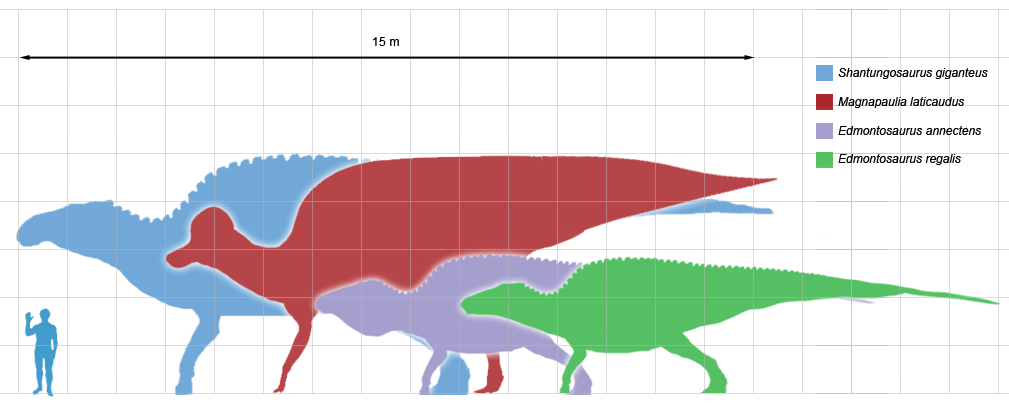

The 2012 authors called it the largest recorded lambeosaurine, since others do not surpass 30 to 33 feet (9 to 10 meters). Its possible North American rivals in size include Edmontosaurus annectens and Kritosaurus navajovius. Still, it falls short of the 48 feet (14.7 meters) reported for Shantungosaurus giganteus, which they called the largest known described hadrosaurid.
The Dinosaur in Detail
What sets this dinosaur apart is its tail, which carries both autapomorphies—traits found in no other species—named in the 2012 revised diagnosis. First, the longest haemal arches near the tail base are at least four times the depth of their vertebral bodies. Second, the bases of the prezygapophyses (forward joint processes) on the tail vertebrae merge into a bowl-shaped surface. In the first few tail vertebrae, that bowl runs into a deep groove on the front of the neural spine.
Its tall back spines are not unique, though. Hypacrosaurus has similar ones, which the 2012 authors regarded as convergent, or evolved independently. Likewise, the tall spines over its hips and tail base compare with those of Barsboldia sicinskii, another case of convergence.
The skull adds its own case for a separate genus. A shape analysis compared nostril outlines from 30 lambeosaurine specimens. It placed Magnapaulia in its own region of morphospace—the range of shapes a group occupies. Its nostril was 2.4 times as long as it was wide. Combined with the tail traits, this evidence “argues against” keeping the species in Lambeosaurus.
Its closest relative, Velafrons, has similar nostril proportions but differs in the orientation of the maxilla. Because the unique traits of Velafrons lie in bones Magnapaulia lacks, the 2012 team kept them separate. Their biogeographic analysis suggested that the southern and northern clades split from a widespread North American ancestor before about 75 million years ago. In 2024, Dalman and colleagues listed it among giants that evolved in southern Laramidia—the western landmass of North America—but did not migrate north. Taken together, these studies sketch a southern giant that followed its own evolutionary path.
Interesting Points about Magnapaulia
- The second half of the genus name honors Paul Haaga for his support of the Natural History Museum of Los Angeles County.
- At an estimated 41 feet (12.5 meters), it is the largest recorded lambeosaurine, according to its 2012 describers.
- In its tail, both the neural spines and the haemal arches ran about four times the height of the vertebral bodies, giving it an unusually deep tail.
- A 2025 model that used hoofed mammals as stand-ins estimated that Magnapaulia and another large Mexican hadrosaur lived at around 0.13 to 0.17 animals per square kilometer.
Magnapaulia in its Natural Habitat
The world Magnapaulia roamed lay near the coast, close to the then-young Peninsular Range. At the type locality, the 2012 paper described sandstones laid down by floods on a narrow, river-crossed floodplain. Fastovsky’s team tentatively read the upper El Disecado Member as a marginal-marine arid fan—a spread of river sediment—built by braided rivers. Fossil soils record wet and dry cycles, and the climate was generally dry, possibly more seasonally extreme than farther north. Meanwhile, flowering-plant fruits are the most common identified plant fossils, alongside petrified wood and abundant pollen.
As a hadrosaurid with a dental battery, Magnapaulia was a herbivore. There is no direct evidence of what it ate.

Turtles, lizards, crocodylomorphs, frogs, salamanders, fish, and mammals also lived in the area. Other dinosaurs turn up too, though none from the El Gallo Formation besides Magnapaulia has been named. In 2014, researchers described a single foot bone from the El Disecado Member. It was the first unambiguous tyrannosaurid skeletal material from Mexico and the Pacific coast. Its proportions resemble those of the gracile Albertosaurus, and its short length may point to a young animal. In addition, a tooth crown from El Disecado mudstone at El Jabón ravine records a nodosaurid, one of the ankylosaurs. Like other nodosaurid teeth, it has a shelf-like cingulum (a ridge around its base). Isolated teeth from near El Rosario have been referred to dromaeosaurids.
Rivers carried most bones before burial, and the large fossils are mostly scattered limb bones and vertebrae of adult hadrosaurs. A partial baby hadrosaur and eggshell fragments hint at nesting nearby, a possibility the 2020 authors said requires further exploration.
Frequently Asked Questions
Magna is Latin for “large,” and paulia honors Paul Haaga, a supporter of the Natural History Museum of Los Angeles County.
It lived in the late Campanian stage of the Late Cretaceous, roughly 75 to 74.5 million years ago.
A 2012 estimate puts its largest known individual at about 41 feet (12.5 meters), down from Morris’s 46 to 49 feet. No verified weight exists.
It was a herbivore, like other hadrosaurids, with a dental battery of tightly packed teeth.
Its fossils come from the El Gallo Formation near El Rosario, Baja California, Mexico.
Its tail was unusually deep, and the bases of its tail joint processes formed a bowl shape found in no other species.
Sources
The information in this article is based on various sources, drawing on scientific research, fossil evidence, and expert analysis. The aim is to provide a comprehensive and accurate overview of Magnapaulia. However, please be aware that our understanding of dinosaurs and their world is constantly evolving as new discoveries are made.
- https://doi.org/10.1371/journal.pone.0038207
- https://pmc.ncbi.nlm.nih.gov/articles/PMC3373519/
- https://journals.plos.org/plosone/article/file?type=supplementary&id=10.1371/journal.pone.0038207.s001
- https://doi.org/10.1126/science.155.3769.1539
- https://app.pan.pl/archive/published/app59/app20120003.pdf
- https://doi.org/10.1130/GES02207.1
- https://par.nsf.gov/servlets/purl/10215411
- https://rmcg.geociencias.unam.mx/index.php/rmcg/article/view/179
- https://info.igme.es/media/boletin/2015/126_1/Articulo_4.pdf
- https://doi.org/10.7717/peerj.12362
- https://doi.org/10.1038/s41598-023-47011-0
- https://doi.org/10.1016/j.eve.2025.100072
- https://stratigraphy.org/ICSchart/ChronostratChart2024-12.pdf
This article was last fact checked: TheDinosaurs Team, 05-11-2026
Featured Image Credit: Dmitry Bogdanov, modified by FunkMonk, CC BY 3.0, via Wikimedia Commons
