
In Davinópolis, near Imperatriz in Brazil’s Maranhão State, a road-rail cut exposes rocks that most likely belong to the lower Itapecuru Formation. From the base of that cut came the partial skeleton of Dasosaurus tocantinensis, a sauropod named in 2026. It lived in the Aptian stage of the Early Cretaceous, probably late in that stage. The Aptian as a whole spans about 121 to 113 million years ago. In one of the describers’ analyses, its closest relative lived in Spain. That link makes these bones a useful clue to how sauropod lineages moved between continents.
The bones surfaced in 2021, during earthworks for a railway terminal that archaeologists were monitoring. Construction workers uncovered them, and archaeologist Daniel Ribeiro da Silva identified them as fossils. At first, though, both he and the workers took them for giant sloth bones. Five years later, paleontologist Elver Mayer and fifteen colleagues named the animal in the Journal of Systematic Palaeontology. Combining anatomy, bone histology and biogeography, their study expands the known diversity of Early Cretaceous sauropods in northern South America.
Dasosaurus Key Facts
| Keyword | Fact |
|---|---|
| Pronunciation | Not specified |
| Meaning of name | Forest Lizard |
| Group | Sauropoda (Somphospondyli) |
| Type Species | Dasosaurus tocantinensis |
| Diet | Herbivore |
| When it Lived | About 121 to 113 MYA |
| Period | Cretaceous |
| Epoch | Early Cretaceous (Aptian stage, probably late Aptian) |
| Length | About 66 feet (20 meters), a tentative estimate |
| Height | Not specified |
| Weight | Not specified |
| Mobility | Moved on all four legs (quadrupedal) |
| First Discovery | 2021, uncovered by construction workers and identified by archaeologist Daniel Ribeiro da Silva |
| Described by | 2026 by E.L. Mayer, J.C.G. Silva Junior, L.R. Kerber, B.A. Navarro, K.L.N. Bandeira, J.C. Cisneros, E.P. Sousa, A.A. Pereira, M.A. Medeiros, R.M. Lindoso, F.P. Cavalcanti Neto, A.M. Ghilardi, T. Aureliano, P.L. Godoy, G.S. Ferreira, and M.C. Langer |
| Holotype | CPHNAM VT 1600 |
| Location of first find | Lower Itapecuru Formation (as assigned by the describers), Grajaú Basin, Davinópolis, near Imperatriz, Maranhão State, Brazil |
Dasosaurus Origins, Taxonomy and Timeline
The name Dasosaurus joins two Greek words—dasos, meaning “forest” or “copse,” and sauros, meaning “lizard.” It refers both to the dig site’s position within Brazil’s “Legal Amazonia” (Amazônia Legal) and to Maranhão itself. According to the describers, the state’s name “may derive from the Portuguese word ’emaranhado,'” meaning tangled, in reference to its thick vegetation. Meanwhile, the species name tocantinensis honors the Tocantins, “a major South American river” that flows near the collecting site.
Within Sauropoda, Dasosaurus falls in Neosauropoda, then Macronaria, and then Titanosauriformes. Narrower still, it sits in Somphospondyli, which the describers define as the largest clade containing Saltasaurus loricatus but not Giraffatitan brancai. Beyond that, its place depends on method—in the implied-weighting analysis, it lies outside Titanosauria, so the authors call it a non-titanosaur somphospondyl. That analysis also found it sister to—that is, the closest known relative of—Garumbatitan morellensis, from the older, late Barremian Arcillas de Morella Formation of Spain. With every character weighted equally, however, the analysis does not recover the pair. Dasosaurus tocantinensis is the type and only known species.
According to its describers, the bones probably come from late Aptian rocks of the Early Cretaceous. Even so, their biogeographic analyses used the whole Aptian, about 121 to 113 million years ago, as its age range. During this interval, reconstructions cited by the describers keep South America and Africa joined by land into at least the Albian. That lingering bridge sits at the heart of the Dasosaurus story.
Discovery & Fossil Evidence
The site lies within the Grajaú Basin of northeastern Brazil. News reports date the find to April 2021 and name the builder, Brado, and the monitoring archaeology firm, Arqueologística. Mayer learned of the find that year. “Given its depth of about eight meters, I realized that it was much older,” he told Agência FAPESP.
The fossils lay at the base of a road-rail cut about 26 feet (8 meters) high. Mayer and co-author L.R. Kerber led the excavation, mapping the bones in a grid of one-meter squares across roughly 65 square feet (6 square meters). Afterward, researchers studied the material in Pará before it returned to Maranhão.
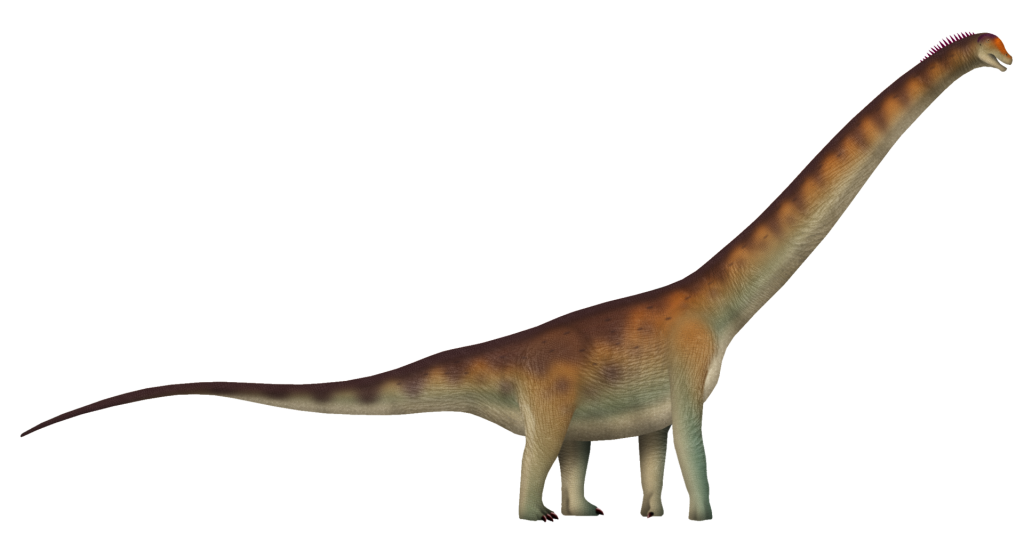

The holotype—the name-bearing specimen—is CPHNAM VT 1600, housed at the Centro de Pesquisa de História Natural e Arqueologia do Maranhão in São Luís. It consists of partial postcranial remains, meaning bones from behind the skull, from a single individual. The tail supplies five caudal vertebrae or centra, plus fragments of neural arches, spines and chevrons (the small bones beneath the tail). From the forelimb come the left radius and ulna (forearm bones) and part of the right manus, or hand. The hips add the lower end of the left pubis and the left ischium. From the legs come the right femur (thigh bone), parts of the tibia and fibula, and part of the left pes, or foot. Rib fragments and unidentified scraps complete the list.
Everything known about Dasosaurus rests on this one skeleton, but the story may not be finished. Paleontologist Max Langer told Agência FAPESP, “We believe there are more fossils from this same specimen” at the site. For now, no other specimens of Dasosaurus are known.
Dasosaurus Size and Description
Known only from tail, limb and hip bones, Dasosaurus survives only in outline—yet those bones carry a surprising amount of detail.
Short description of Dasosaurus
No skull, neck or back vertebrae survive, so its head and neck remain a blank, but the tail tells more. Its foremost centra—the spool-shaped bodies of the vertebrae—are amphiplatyan, or flat at both ends, while the rest are concave on both faces. Along the middle and rear of the tail, three lengthwise ridges marked muscle attachments. They served both the epaxial muscles along the top of the backbone and the hypaxial muscles beneath them. Between the lower two ridges sat a deep, oval pit called the costovertebral fossa.
Moving forward, the radius is broad at mid-shaft, 2.3 times wider from side to side than from front to back. The foot preserves a complete second metatarsal, half of the third, several toe bones and three unguals (toe claws). From these, the authors propose a possible phalangeal formula—the count of bones in each toe—of 2-3-3-2?-2?. Like other sauropods, it would have walked on all four legs.
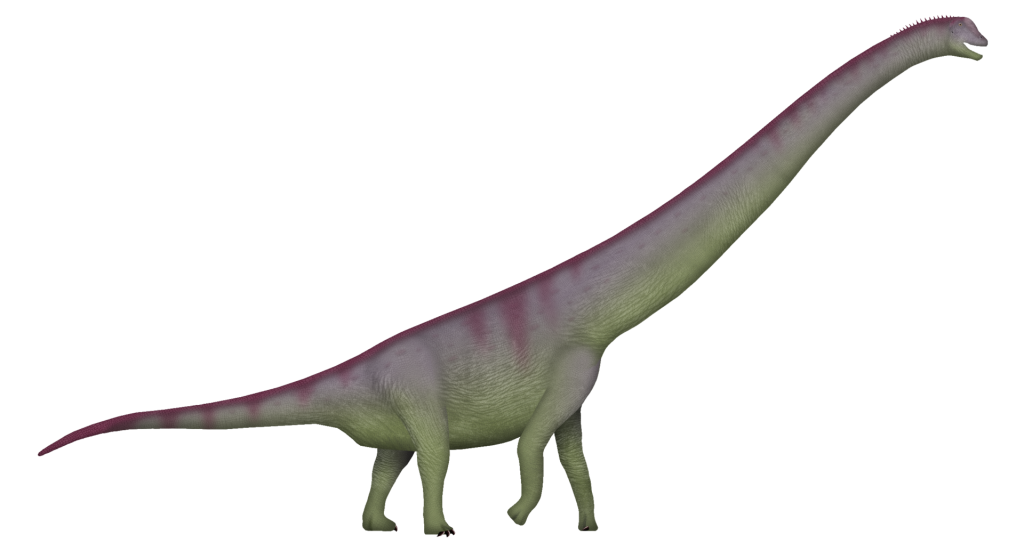
No skin impressions or soft tissue remain, so its outward appearance is speculative.

Size and Weight of Type Species
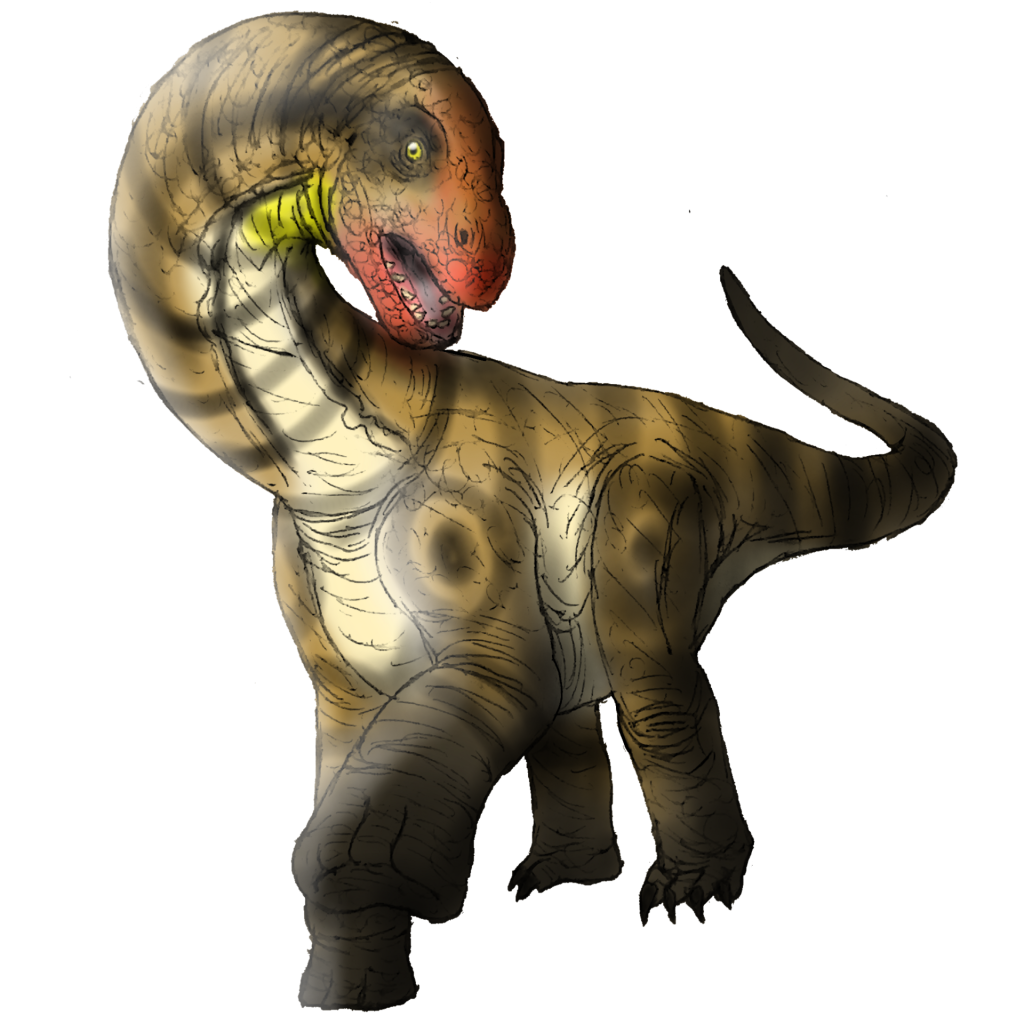
Mayer and colleagues measured a femur at least 4.9 feet (150 centimeters) long. Since the bone is incomplete, its full length was probably greater. From it, the team estimated a body length of about 66 feet (20 meters) with a linear regression based on Rapetosaurus krausei and Dreadnoughtus schrani.
The authors themselves say the estimate “should be regarded as tentative,” and no study has yet estimated its body mass or hip height.
That femur length places Dasosaurus near the boundary between the medium and large sauropodomorph size classes that González Riga and colleagues defined in 2022. Its bones also come from an adult rather than a youngster.
The Dinosaur in Detail
The ridged tail it shares with Garumbatitan stands out most. Together with a well-developed lateral bulge on the femur, the three-ridge complex on the middle and rear tail vertebrae unites the two genera. They also share a depression above the lowest tail ridge, a deflected crest on the second metatarsal, and details of the first toe and tibia.
Even so, Dasosaurus differs from its Spanish relative in six ways. Its front tail spines are “stake-like,” flaring outward toward the top, and its upper ridge borders a shallower pit. The femur shaft is slenderer and curves inward, and it lacks a muscle scar called the linea intermuscularis cranialis. Its femoral bulge, about 40 percent of the narrowest shaft width, is also less developed. Finally, the first two toe claws carry a small tubercle near their upper edge.

The team scored 558 anatomical characters across 119 taxa. With every character weighted equally, the analysis produced 232 equally short trees. A second method, implied weighting, gives less weight to characters that change often, and it yielded 59 trees. Under that method, a large group uniting the euhelopodids—relatives of Euhelopus—with the titanosaurs formed the sister group to a clade containing Tastavinsaurus and Europatitan.
Thin sections of the femur and tibia show an external fundamental system, a band of bone that suggests the individual was an adult at death. Heavy remodeling replaced much of the femur, with at least three generations of Haversian osteons—cylinders of replacement bone. Still, the authors rule out a senile individual because pyrophosphate biomineralization is absent. Remodeling has also obscured the growth lines in the outer femur, so they cannot be counted there. Overall, its bone tissue mixes features of early-diverging neosauropods and later titanosaurs.
Interesting Points about Dasosaurus
- The genus name refers both to Brazil’s “Legal Amazonia” and to Maranhão, a state name that may come from the Portuguese word for “tangled.”
- The bones turned up during railway-terminal earthworks, and at first both the workers and the archaeologist who examined them thought they belonged to a giant sloth.
- In one of the describers’ analyses, its closest relative is Garumbatitan of Spain, and they infer that the two shared a lineage of European origin.
- Its describers suggest that the lineage reached South America via northern Africa sometime between the Valanginian and Aptian stages.
- Bone histology shows that the only known individual was an adult, though not a senile one.
Dinosaurs from the Same Formation
Also known from the Itapecuru Formation (exact level relative to Dasosaurus not known): Amazonsaurus. Its 2003 describers diagnosed this diplodocoid as a “small sauropod.” In 2018, Canudo and colleagues recovered it at the base of Rebbachisauridae, as most earlier analyses had. Mayer and colleagues also treat it as a rebbachisaurid. It comes from Itapecuru-Mirim County, far to the northeast of Davinópolis. Researchers generally refer the formation to the Aptian and Albian, an interval of about 21 million years. As a result, the two sauropods may not have lived at the same time.
Dasosaurus in its Natural Habitat
The world Dasosaurus roamed survives in rocks that the describers interpret as fluvial, shallow-lake, estuarine and deltaic in origin. In their view, the region had a warm, semi-arid and strongly seasonal paleoequatorial climate, though some places stayed humid. At the dig site, crumbly siltstones and fine yellowish or reddish sandstones alternate with grayish muddy sandstones. They rest on an eroded surface of the Grajaú Formation, and their exact place in the sequence remains open. In fact, the describers note that the sediments “better match facies associations 2 and 3” of the Codó Formation. That formation’s typical lower unit formed in a lake-and-evaporite setting during the late Aptian. Still, they find the lithology “more reminiscent” of the Itapecuru, so the site is “most likely” lower Itapecuru.
While no direct evidence of its diet survives, sauropods were plant eaters, and Dasosaurus was likely no exception. The formation also yields the side-necked turtle Itapecuruemys amazonensis and the crocodyliform Candidodon itapecuruense. Large predatory dinosaurs appear only as unnamed carcharodontosaurid and spinosaurine remains, among them a tooth from the Boca de Forno Ravine. Further sauropod bones, identified only as Neosauropoda, Rebbachisauridae or Titanosauria, complete the list.
Whether Dasosaurus lived alone or in herds is unknown, since the site has yielded only one individual. Its wider significance may lie in geography instead. Using BioGeoBEARS, software that models how lineages spread between regions, the team concluded that the Dasosaurus–Garumbatitan clade had a European origin. They suggest that it dispersed to South America via northern Africa at some point between the Valanginian and Aptian. For that route, they draw on reconstructions of a lasting land link between South America and Africa. They also cite the “Eurogondwanan” hypothesis that Ezcurra and Agnolín proposed in 2012.
Frequently Asked Questions
It means “forest lizard,” referring to Brazil’s Legal Amazonia and Maranhão’s thick vegetation, and the species name honors the Tocantins River.
It lived in the Aptian stage of the Early Cretaceous, probably its later part. The Aptian spans about 121 to 113 million years ago.
Its describers tentatively estimated a length of about 66 feet from a femur at least 4.9 feet long. No weight estimate exists.
It was a sauropod, a non-titanosaur somphospondyl whose closest relative, in one of its describers’ analyses, is Garumbatitan from Spain.
Its bones came from a road-rail cut in Davinópolis, Maranhão State, Brazil, in rocks assigned to the lower Itapecuru Formation.
Its three-ridged tail vertebrae, shared with Garumbatitan, tie it to a lineage that its describers trace back to Europe.
Sources
The information in this article is based on various sources, drawing on scientific research, fossil evidence, and expert analysis. The aim is to provide a comprehensive and accurate overview of Dasosaurus. However, please be aware that our understanding of dinosaurs and their world is constantly evolving as new discoveries are made.
- https://doi.org/10.1080/14772019.2025.2601579
- https://doi.org/10.17605/OSF.IO/KH5CV
- https://doi.org/10.1016/j.cretres.2003.07.005
- https://doc.rero.ch/record/15005/files/PAL_E2158.pdf
- https://doi.org/10.4202/app.00524.2018
- https://doi.org/10.1016/j.cretres.2025.106163
- https://sappg.ufes.br/tese_drupal//tese_17195_Dissert_Lays_corrigida_2020230076.pdf
- https://doi.org/10.1111/j.1469-185X.2010.00137.x
- https://www.geol.umd.edu/~tholtz/G104/lectures/104saurop.html
- https://agencia.fapesp.br/new-long-necked-dinosaur-found-in-northeast-brazil-was-a-close-relative-of-a-european-species/57979
- https://olhardigital.com.br/2021/11/09/ciencia-e-espaco/fossil-de-dinossauro-encontrado-no-ma-impressiona-pelo-tamanho/
This article was last fact checked: TheDinosaurs Team, 21-11-2026
Featured Image Credit: Connor Ashbridge, CC BY 4.0, via Wikimedia Commons
