
In Dinosaur Provincial Park, Alberta, the sandstones and mudstones of the Dinosaur Park Formation have yielded a small carnivore, Saurornitholestes langstoni. Named in 1978, this dromaeosaurid—a member of the family often nicknamed “raptors”—lived during the Campanian stage of the Late Cretaceous. Within the formation, its fossils span roughly 76.5 to 75.8 million years ago. Cullen and colleagues found it considerably more common there than its relative Dromaeosaurus.
Amateur fossil hunter Irene Vanderloh found the first specimen in 1974, and paleontologist Hans-Dieter Sues described it four years later. For decades, however, only partial skeletons represented the animal, so its relationships proved difficult to resolve. That changed in 2014, when a nearly complete skeleton with a skull turned up nearby. According to its describers, the new skull places Saurornitholestes in a North American group of raptors. That group stands apart from Asia’s Velociraptor and its kin—a view that still divides researchers.
Saurornitholestes Key Facts
| Keyword | Fact |
|---|---|
| Pronunciation | SORE-or-NITH-oh-LESS-teez |
| Meaning of name | Lizard-Bird Thief |
| Group | Theropoda |
| Type Species | Saurornitholestes langstoni |
| Diet | Carnivore |
| When it Lived | About 76.5 to 75.8 MYA in the Dinosaur Park Formation, with older records from the upper Oldman Formation |
| Period | Cretaceous |
| Epoch | Late Cretaceous (Campanian stage) |
| Length | About 7.2 feet (2.2 meters), Canadian Encyclopedia estimate |
| Height | About 2 feet (60 centimeters) at the hip, Canadian Encyclopedia estimate |
| Weight | About 41 pounds (18.7 kilograms), 2020 estimate by Campione and Evans |
| Mobility | Moved on two legs (bipedal) |
| First Discovery | 1974 by Irene Vanderloh |
| Described by | 1978 by H.-D. Sues |
| Holotype | TMP 74.10.5 (also written TMP 1974.010.0005) |
| Location of first find | Dinosaur Park Formation, Dinosaur Provincial Park, Alberta, Canada |
Saurornitholestes Origins, Taxonomy and Timeline
According to a University of Colorado Museum exhibit, Saurornitholestes means “lizard-bird thief.” The original 1978 paper was not available to us in full, so we rely on this widely used popular gloss. The Canadian Encyclopedia gives the pronunciation as SORE-or-NITH-oh-LESS-teez, while the species name langstoni honors paleontologist Wann Langston Jr.
In 1978, Sues referred the animal to a new genus and species within Dromaeosauridae, a family of two-legged theropods. He separated it from Stenonychosaurus and Dromaeosaurus by its frontals (paired skull-roof bones) and marginal teeth. He also noted dromaeosaurid features such as the shape of the endocranial cavity—the space that housed the brain. Researchers traditionally placed it in the subfamily Velociraptorinae, but in 2009 Longrich and Currie erected a new clade, Saurornitholestinae, for Saurornitholestes, Atrociraptor, and Bambiraptor. Saurornitholestes langstoni remains the type species, although a second species is debated.
In 2021, Cullen and colleagues traced its fossils from the base of the Dinosaur Park Formation to just below 30 meters (98 feet) above the Oldman Formation contact. A 2023 study by Eberth and colleagues dates that interval to 76.47 to 75.77 million years ago. Combining the two studies places Saurornitholestes there roughly 76.5 to 75.8 million years ago, though neither paper makes that pairing. By contrast, the Canadian Encyclopedia allows 76.5 to 74.8 million years ago across a wider set of rocks. Either way, it predates the marine Bearpaw Formation, which began at the park about 74.4 million years ago.
Discovery & Fossil Evidence
Irene Vanderloh, an amateur fossil hunter, discovered the first specimen in Dinosaur Provincial Park in 1974. She showed the find to John Storer of the Provincial Museum, who then sent it to Sues. Sues attributed the rocks to the Judith River Formation, which today is the Dinosaur Park Formation of the Belly River Group. His paper, accepted in September 1976, appeared in the Zoological Journal of the Linnean Society in April 1978.
The holotype, TMP 74.10.5, belongs to the Royal Tyrrell Museum of Palaeontology in Drumheller. According to the Paleobiology Database, it came from a buff sandstone at Quarry 140 near Steveville. Sues’s abstract lists an incomplete skeleton and three frontals, but not whether all three belong to the holotype. Currie and Evans later summarized it as fewer than 30 associated skull and body bones from one individual.
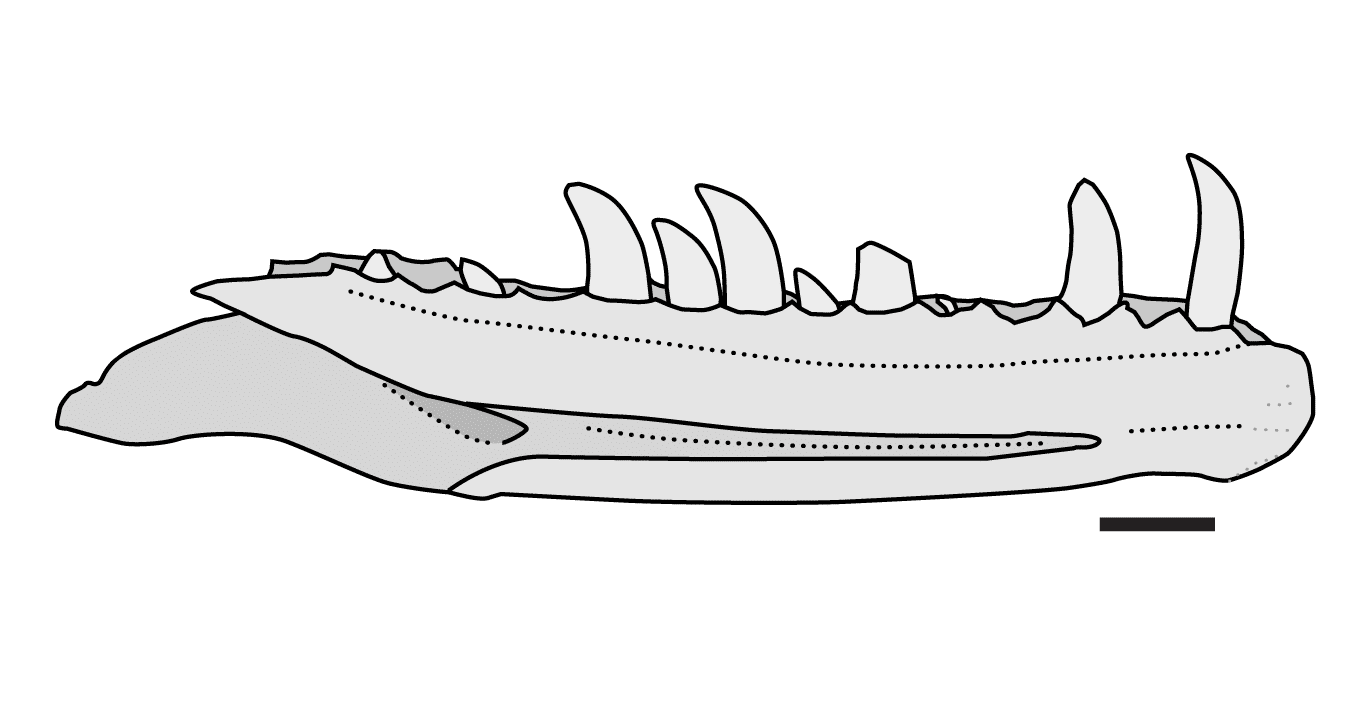

Over the next 25 years, four more partial skeletons emerged from Campanian rocks of Alberta and Montana. Then, in 2014, Clive Coy of the University of Alberta found a nearly complete skeleton less than a kilometer from the holotype site. Cataloged as UALVP 55700, it had every bone except the tail preserved in life position. Philip Currie said the find “ranks in the top discoveries of my career.” The formation has also produced many isolated bones, including numerous frontals. Later papers cite separate dentaries (lower jaw bones), sacra (fused hip vertebrae), and an ilium (upper hip bone) cataloged as MOR 660.
Saurornitholestes Size and Description
Saurornitholestes combined a modest body with a surprisingly specialized head.
Short description of Saurornitholestes
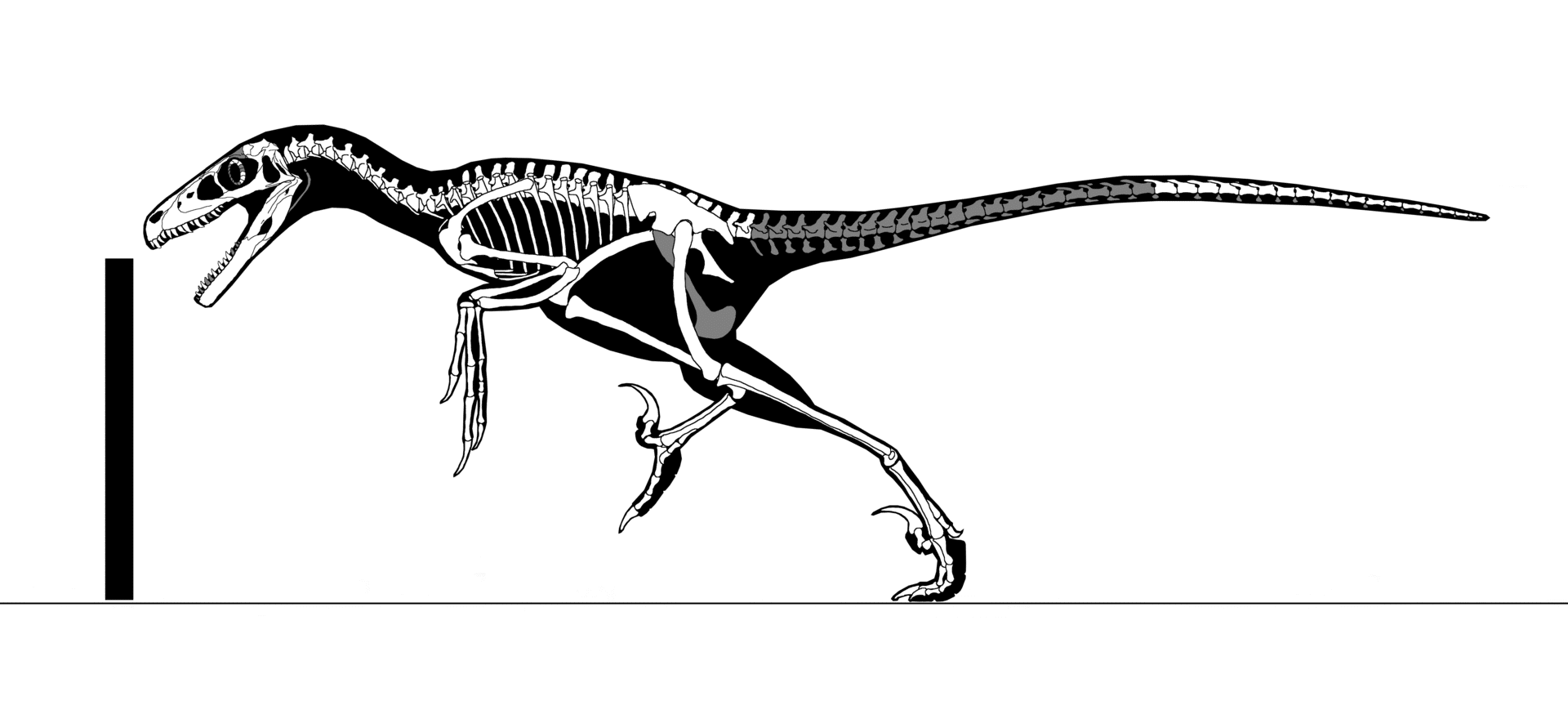
In 2020, Currie and Evans found it similar in body size to Velociraptor, although its face was relatively shorter, taller, and wider. Its nasal bones were pneumatic, meaning air spaces hollowed them out. Along the lower jaw, the interdental plates—small bony plates between the tooth sockets—had fused to the jaw margin. Its denticles (tiny serrations) also hooked toward the tooth tip—two traits it shares with Atrociraptor. In addition, a 2022 study listed it among dromaeosaurids whose skulls are about 92 to 95 percent of femur (thigh bone) length.
Behind the head, the deltopectoral crest—a ridge for chest and shoulder muscles—ran about a quarter of the upper arm’s length. The top of that bone also had an S-shaped, or sigmoidal, profile. Farther back, the sacrum arched slightly upward. No feathers have yet been found with Saurornitholestes. However, quill knobs on the forearm of its relative Velociraptor lead the Canadian Encyclopedia to conclude that it was likely feathered, too.

Size and Weight of Type Species
No peer-reviewed length or hip-height estimate turned up in our research. The Canadian Encyclopedia gives a length of about 7.2 feet (2.2 meters). It adds a hip height of about 2 feet (60 centimeters) but does not say who made either estimate.
Weight estimates differ more sharply. Rhodes and colleagues list a 2020 estimate by Campione and Evans of about 41 pounds (18.7 kilograms). They bracket it at roughly 31 to 52 pounds (±25 percent). That figure is indirect—it rests on a single femur. Similarly, Brown and colleagues cited about 40 pounds (18 kilograms) for an adult in 2021. In contrast, the Canadian Encyclopedia lists only about 19 pounds (8.5 kilograms), roughly half the peer-reviewed figures.
Published weight estimates therefore run from about 19 to 41 pounds, depending on the source. For comparison, Jasinski and colleagues in 2020 found the holotype of the New Mexico dromaeosaurid Dineobellator similar in size to Velociraptor and Saurornitholestes.
The Dinosaur in Detail
One of the most distinctive features of Saurornitholestes is its second premaxillary tooth, one of the upper front teeth. For years, paleontologists assigned isolated teeth of this shape to a separate animal, Zapsalis abradens. In 2020, however, Currie and Evans showed that the Dinosaur Park Formation teeth of this kind belong to S. langstoni. Based on shape and wear, they suggested these teeth may have helped with preening feathers. University press releases describe a flat tooth with long ridges, since found in Velociraptor and other dromaeosaurids.
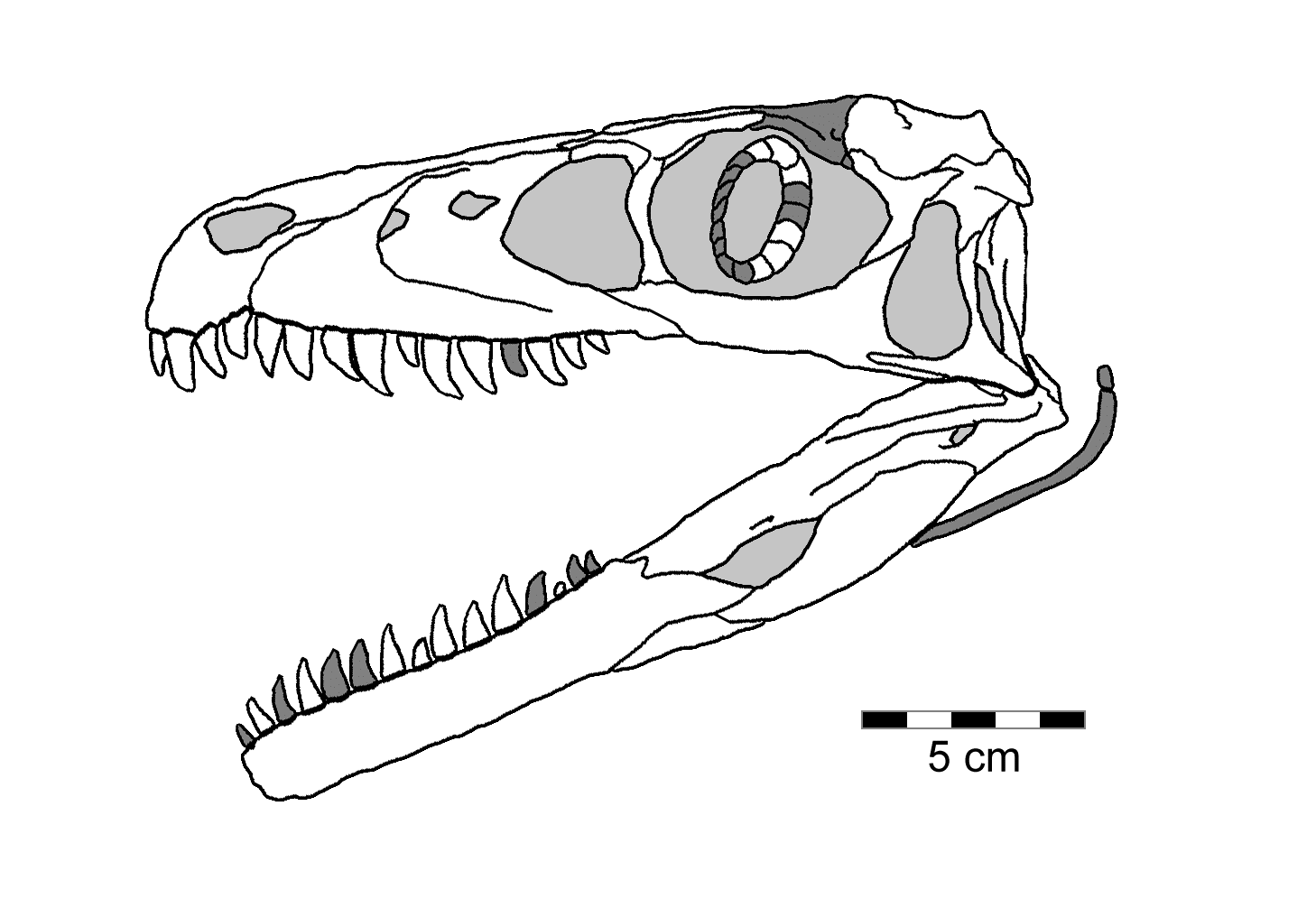

Its family tree has proven harder to pin down. Currie and Evans treated Saurornitholestinae as a North American clade distinct from Asia’s Velociraptorinae. In their view, that split supports at least two major faunal interchanges between Asia and North America. The Philip J. Currie Dinosaur Museum likewise places it closest to Atrociraptor, another Alberta dromaeosaurid. However, not every phylogenetic (family-tree) analysis recovers Saurornitholestinae, and in 2024 Tse and colleagues still listed the 2014 specimen under Velociraptorinae. Their study also found its skull shape intermediate between long-snouted and robust-skulled dromaeosaurids.
The genus has also gathered—and lost—species. In 2015, Jasinski named S. sullivani from a single frontal, SMP VP-1270, from New Mexico’s Kirtland Formation. Jasinski and colleagues treated it as valid in 2020, and the Paleobiology Database lists it. Still, every supporting study we found includes its describer. Meanwhile, “S.” robustus proved to be a troodontid in 2014 and in 2026 became the type species of the new genus Dinevenator.
Teeth add another layer of caution. Back in 2013, Larson and Currie regarded S. langstoni as limited to the Oldman and Dinosaur Park formations. Similar teeth from elsewhere, they argued, belong in Saurornitholestinae rather than in the species.
Interesting Points about Saurornitholestes
- A broken Saurornitholestes tooth tip lay in an azhdarchid pterosaur bone, which Currie and Jacobsen in 1995 attributed to probable scavenging.
- According to a University of Alberta press release, some researchers once called this animal “Velociraptor langstoni.”
- Dinosaur Park Formation teeth long known as Zapsalis abradens turned out to be the second upper front teeth of S. langstoni.
- A 2021 reconstruction of its hip muscles found a nearly 50:50 split between hip flexors and hip extensors.
- The nearly complete 2014 skeleton lay less than a kilometer from where Irene Vanderloh found the first specimen forty years earlier.
Contemporary Dinosaurs
Sharing the lower levels of the formation was Centrosaurus, a centrosaurine ceratopsid of the horned-dinosaur family. Its remains come from about 20 football-field-size bonebeds—each dominated by a single species—and many isolated skulls and skeletons. The assemblage zone shared with Saurornitholestes takes part of its name from this animal, but no record of an interaction between them exists.
Also lending its name to that zone was Corythosaurus, a lambeosaurine hadrosaur, or crested duck-billed dinosaur. Two successive species, C. casuarius and C. intermedius, occur within the zone. Saurornitholestes shared this landscape with it, although no fossil links them directly.
Adding armor to the scene was Euoplocephalus, an armored ankylosaurid. According to Eberth and colleagues, most of its specimens—about seven—come from the same assemblage zone as Saurornitholestes. Even so, no source documents contact between them.
Among the formation’s larger theropods was Gorgosaurus, a tyrannosaur. Rather than marking one zone, it ranges through much of the formation, according to Cullen and colleagues. Its overlap with Saurornitholestes therefore rests on the broader formation record, and no study reports a direct interaction.
Saurornitholestes in its Natural Habitat
The world of Saurornitholestes sat between rivers and the sea. Eberth and colleagues describe the formation as an alluvial (river-laid), estuarine, paralic (near-shore), and marine unit about 260 feet (80 meters) thick in the park. Its sandstones, mudstones, shales, and coals belong to the Belly River Group, an eastward-thinning wedge that interfingers with marine shales of the Western Interior Seaway. Higher in the formation, the rocks record the advancing shoreline of the Bearpaw Sea.
The best direct evidence of its diet is a pterosaur bone bearing tooth marks and a broken Saurornitholestes tooth tip. Currie and Jacobsen concluded that the dromaeosaurid was probably scavenging in that case. In 2018, Torices and colleagues studied tooth wear and bite mechanics. They found both Saurornitholestes and Dromaeosaurus well-adapted for handling struggling prey. Brown and colleagues also compared its jaws with gnawing-like marks on a hadrosaur toe bone but could not pin them on one tracemaker.
While there is no direct evidence of whether Saurornitholestes hunted alone or in groups, it had dromaeosaurid company. Van der Reest and Currie note that it and Dromaeosaurus lived at the same time in the formation. Rhodes and colleagues also linked its hip muscles to a pattern of increased leg rotation on the line to birds. Altogether, more than 166 vertebrate species from the park place this small predator in a crowded ecosystem.
Frequently Asked Questions
A University of Colorado Museum exhibit translates it as “lizard-bird thief,” and langstoni honors paleontologist Wann Langston Jr.
Its Dinosaur Park Formation fossils date to roughly 76.5 to 75.8 million years ago, in the Late Cretaceous (Campanian stage), and older finds come from the upper Oldman Formation.
A 2020 estimate gives about 41 pounds, while the Canadian Encyclopedia gives about 7.2 feet long and 19 pounds.
It was a carnivore, and Currie and Jacobsen linked a tooth tip in a pterosaur bone to probable scavenging.
The first specimen came from the Dinosaur Park Formation in Dinosaur Provincial Park, Alberta, Canada, in 1974.
Its face was shorter, taller, and wider than that of Velociraptor, and a ridged front tooth may have helped with preening.
Sources
The information in this article is based on various sources, drawing on scientific research, fossil evidence, and expert analysis. The aim is to provide a comprehensive and accurate overview of Saurornitholestes. However, please be aware that our understanding of dinosaurs and their world is constantly evolving as new discoveries are made.
- https://doi.org/10.1111/j.1096-3642.1978.tb01049.x
- https://doi.org/10.1002/ar.24241
- https://europepmc.org/article/MED/31497925
- https://doi.org/10.1139/cjes-2020-0145
- https://doi.org/10.1139/cjes-2023-0037
- https://doi.org/10.1139/cjes-2017-0031
- https://doi.org/10.1038/s41598-020-61480-7
- https://doi.org/10.1371/journal.pone.0054329
- https://doi.org/10.7717/peerj.11557
- https://doi.org/10.7717/peerj.10855
- https://doi.org/10.1139/e95-077
- https://doi.org/10.1016/j.cub.2018.03.042
- https://doi.org/10.1139/cjes-2014-0073
- https://doi.org/10.1371/journal.pone.0235078
- https://doi.org/10.1186/s12862-024-02222-5
- https://doi.org/10.1038/s41598-022-24602-x
- https://doi.org/10.3390/fossils4030021
- https://paleobiodb.org/classic/checkTaxonInfo?taxon_no=54556
- https://thecanadianencyclopedia.ca/en/article/saurornitholestes
- https://dinomuseum.ca/2019/09/albertas-best-dromaeosaur
- https://www.ualberta.ca/en/science/news/2019/october/dinosaurs-theropod-specimen.html
- https://cumuseum-archive.colorado.edu/Exhibits/BioLounge/HarvesterAnts/saurornitho.html
This article was last fact checked: TheDinosaurs Team, 03-11-2026
Featured Image Credit: Connor Ashbridge, CC BY 4.0, via Wikimedia Commons
