
In the Nemegt Basin of Mongolia’s South Gobi, the river-laid rocks of the Nemegt Formation teem with the bones of a giant predator. In fact, tyrannosaurid remains rank among the most common dinosaur fossils in these beds. That predator was Tarbosaurus bataar, which most analyses recover as the closest known relative of Tyrannosaurus. It lived during the Late Cretaceous, although the formation’s exact age has long been poorly constrained.
The story began in 1946, when a Soviet paleontological expedition found a skull and neck vertebrae at Nemegt. In 1955, paleontologist Evgeny A. Maleev named that skull Tyrannosaurus bataar, and in a second paper that year he created the genus Tarbosaurus for a smaller animal, T. efremovi. A decade later, a revision folded both names into one species. Yet whether this predator deserves a genus of its own has been debated for decades.
Tarbosaurus Key Facts
| Keyword | Fact |
|---|---|
| Pronunciation | Tar-bow-SORE-us |
| Meaning of name | Horrible Lizard (also rendered “Alarming Lizard”) |
| Group | Theropoda (Tyrannosauridae, Tyrannosaurinae) |
| Type Species | Tarbosaurus bataar (originally Tyrannosaurus bataar), with the genus first founded on T. efremovi |
| Diet | Carnivore |
| When it Lived | Around 72 to 68 MYA (museum estimate), with a 2023 tooth date supporting a Maastrichtian age |
| Period | Cretaceous |
| Epoch | Late Cretaceous (late Campanian to Maastrichtian stages; Maastrichtian favored by 2023 dating) |
| Length | 32.8 to 39.4 feet (10 to 12 meters), Maleev’s unexplained 1955 genus estimate |
| Height | 13.8 to 16.4 feet (4.2 to 5.0 meters), Maleev’s 1955 estimate |
| Weight | About 4,958 to 6,209 pounds (2,249 to 2,816 kilograms) for two adult specimens, 2019 volumetric models |
| Mobility | Not specified |
| First Discovery | 1946 by a paleontological expedition of the Academy of Sciences USSR |
| Described by | 1955 by Evgeny A. Maleev (as Tyrannosaurus bataar and, separately, Tarbosaurus efremovi) |
| Holotype | PIN 551-1 |
| Location of first find | Nemegt, Nemegt Formation, South Gobi, Mongolia |
Tarbosaurus Origins, Taxonomy and Timeline
The name Tarbosaurus comes with two slightly different translations. In 2003, paleontologists Jørn H. Hurum and Karol Sabath rendered it as “horrible lizard,” while an Australian Museum fact sheet gives “alarming lizard,” from the Greek. The species name has a twist of its own—Maleev glossed bataar as Mongolian for “giant,” but Hurum and Sabath later identified it as a misspelling of baatar, meaning “hero.” Together, the name pairs a warning with a slightly garbled tribute.
Maleev placed his Mongolian giants in the family Deinodontidae. Hurum and Sabath instead class Tarbosaurus as a theropod within Tyrannosauridae and its subfamily Tyrannosaurinae—the branch that also holds Tyrannosaurus and Daspletosaurus. They even proposed splitting this subfamily into Asian and North American groups, though only as a working hypothesis. Tarbosaurus bataar is the type and only known species.
Hurum and Sabath placed the type horizon in the late Campanian to early Maastrichtian stages, with a question mark attached. In 2011, paleontologist Takanobu Tsuihiji and colleagues still called the formation’s age “not well constrained.” The Australian Museum gives roughly 72 to 68 million years ago. In 2023, however, researcher Myu Tanabe and colleagues dated Tarbosaurus teeth directly from the uranium–lead in their apatite (tooth mineral). Their least-altered sample gave 66.7 ± 2.5 million years, a lower limit for fossilization. They say this supports a Maastrichtian age for the middle and upper formation. Taken together, Tarbosaurus belongs to the final stretch of the Late Cretaceous.
Discovery & Fossil Evidence
After the 1946 skull, Soviet teams returned in 1948 and 1949 to dig at Nemegt, Altan-Ula, and Tsagan-Ula. The main Nemegt basin alone produced four almost complete skeletons and many well-preserved bones. From this haul, Maleev named Tarbosaurus efremovi and two species he assigned to Gorgosaurus. In 1965, however, paleontologist A. K. Rozhdestvensky merged all of Maleev’s Mongolian tyrannosaurids into Tarbosaurus bataar. Under the rule of priority, efremovi became a junior synonym—a later name for the same animal.
The holotype, PIN 551-1, consists of the skull and cervical (neck) vertebrae. It sits in the Paleontological Institute in Moscow beside PIN 551-2, the skeleton Maleev made the holotype of T. efremovi. Maleev measured the skull at 1,220 millimeters (4.0 feet) from snout tip to occipital condyle—the knob where skull meets spine. He counted 13 teeth in the maxilla (main upper tooth-bearing bone) and 15 in the lower jaw.
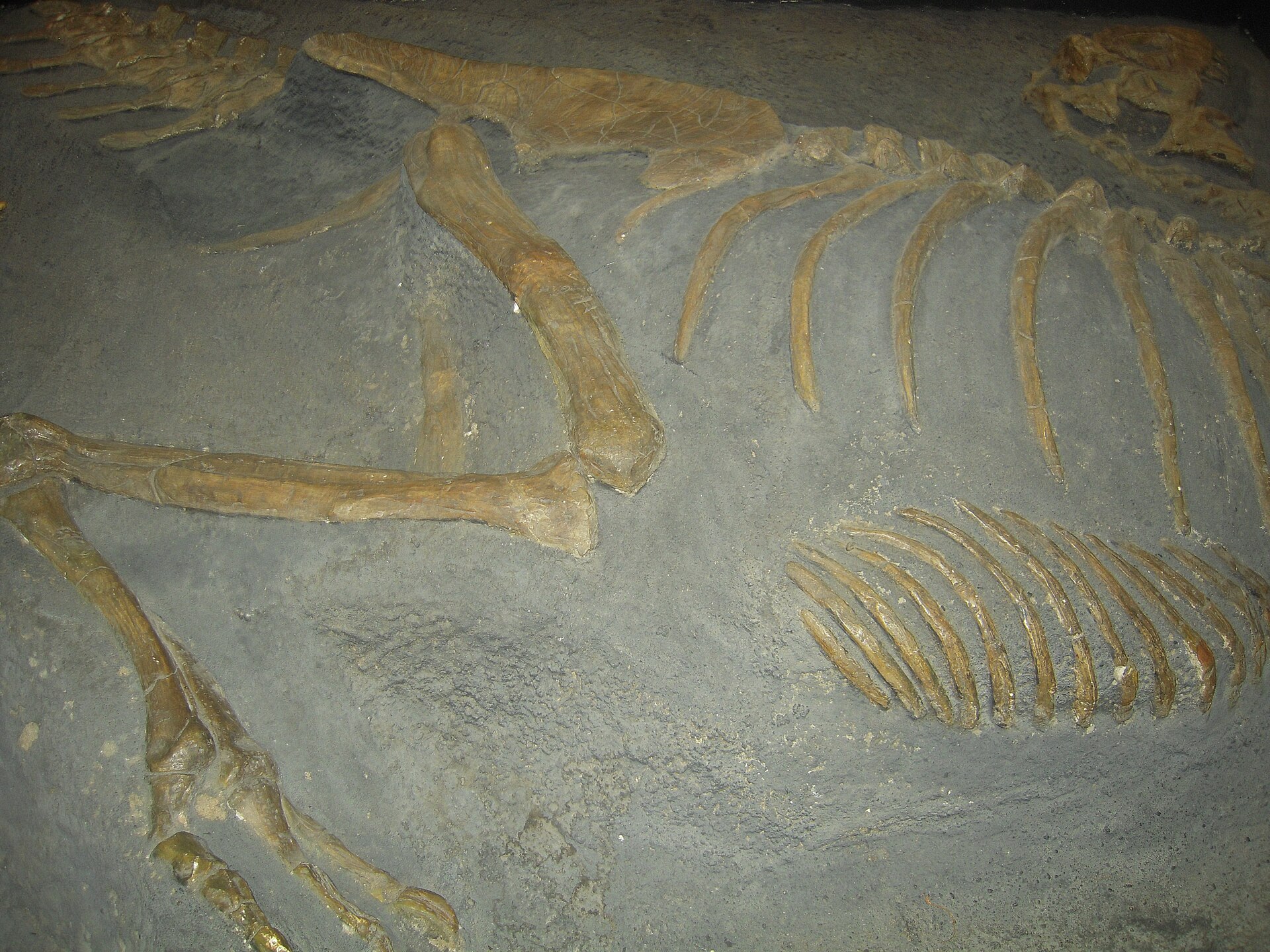

Polish-Mongolian expeditions between 1963 and 1971 added material now kept in Warsaw, mostly from the Nemegt Basin. By 1990, paleontologist R. E. Molnar and colleagues could list at least five skulls and about 30 individuals—a tally Hurum and Sabath later called conservative. In 2006, a Japanese–Mongolian expedition found a juvenile at Bugin Tsav with a skull just 290 millimeters (11.4 inches) long. Some Chinese fossils have also been listed under this species, but those referrals remain debated.
Tarbosaurus Size and Description
Tarbosaurus followed the classic tyrannosaur plan, with a few telling differences in the skull.
Short description of Tarbosaurus
The skull was deep in side view, much like that of Tyrannosaurus. From above, however, it was narrower, with a slender snout and a rear half that widened less abruptly. Its nasal bones formed a raised dome, and an interlocking joint between two lower jaw bones made the mandible more rigid than in T. rex. The teeth were serrated and slightly curved, and the largest crowns in the holotype’s lower jaw reached about 4.7 inches (120 millimeters).
Maleev’s 1955 account gives a short neck of eight or nine vertebrae and a tail of at least 35 to 45. The forelimbs were reduced, each short hand bearing two fingers with strongly curved, sharp claws. By contrast, he called the thigh bone, shin, and foot massive, with three well-developed toes. Fossilized skin from Tarbosaurus and other large tyrannosaurids is scaly and reptile-like. Maleev also pictured the head as “continually raised” on a fairly static neck—a 1955 view, not a modern reconstruction.
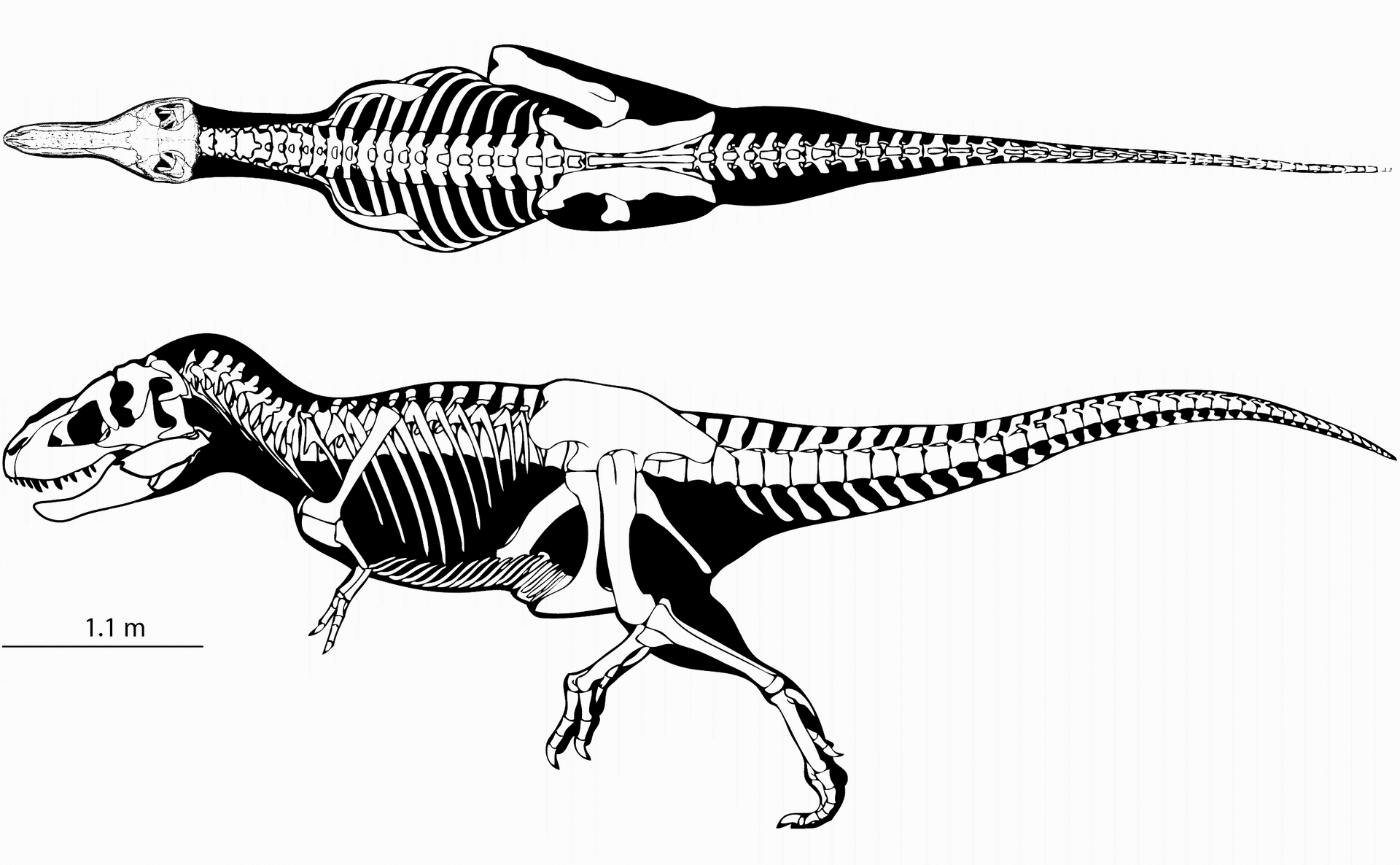

Size and Weight of Type Species
In 1955, Maleev gave the genus a length of 32.8 to 39.4 feet (10 to 12 meters) and a height of 13.8 to 16.4 feet (4.2 to 5.0 meters). Both unexplained figures come from his genus diagnosis, which rested on the smaller T. efremovi type.
Modern weights come from computer models rather than scales. In 2019, paleontologist Eric Snively and colleagues built volumetric models from skeletal reconstructions. Their adult ZPAL MgD-I/4 came out at about 4,958 pounds (2,249 kilograms). A second adult, PIN 552-1, reached about 6,209 pounds (2,816 kilograms), while a juvenile weighed in at about 1,604 pounds (727 kilograms).
Maleev’s holotype skull slightly outmeasured the 1,210-millimeter T. rex skull in his table, and the Australian Museum calls Tarbosaurus “nearly as large as T. rex.” However, the same 2019 models put two adult T. rex at about 15,400 to 20,100 pounds (7.0 to 9.1 metric tons). By most measures, it was huge—though clearly smaller than its North American cousin.
The Dinosaur in Detail
What sets this dinosaur apart most obviously from Tyrannosaurus is its domed nasal bone. It rose high between the lacrimals (bones at the front of the eye sockets) and sat more loosely against its neighbors than in most tyrannosaurids. Hurum and Sabath linked this to a “shift in the handling of the crushing bite.” Tarbosaurus also carried more teeth—12 to 13 in the maxilla and 14 to 15 in the dentary (lower jaw), against 11 to 12 and 12 to 14 in T. rex. Maleev saw T. bataar as close to T. rex but “somewhat more primitive,” judging by its longer snout and extra teeth.
The genus itself remains contested. Paul in 1988, Carr in 1999, and Holtz in 2001 all placed bataar within Tyrannosaurus or treated the two as possibly congeneric. Hurum and Sabath disagreed, allying Tarbosaurus with the smaller Alioramus and blaming parallel evolution for the shared traits. Most phylogenetic analyses, including those by paleontologist Stephen L. Brusatte and colleagues, recover Tarbosaurus and Tyrannosaurus as sister taxa—each other’s closest relatives. In 2013, however, Loewen and colleagues paired Tarbosaurus with Zhuchengtyrannus instead.
In 2016, Brusatte and Carr found Tyrannosaurus nested within a subgroup alongside those two Asian taxa. They judged two histories equally simple—Asian lineages spreading from North America, or a group born in Asia with T. rex later immigrating. Newer studies still disagree. In 2024, paleontologist Sebastian G. Dalman and colleagues traced the group to southern North America, with one lineage later reaching Asia. In 2025, Jared Voris and colleagues instead placed the split that led to T. rex in Asia. Taken together, Tarbosaurus sits at the heart of a question still open—where the last giant tyrannosaurs began.
Interesting Points about Tarbosaurus
- The species name bataar was meant to mean “giant,” but it is a misspelling of the Mongolian word baatar, meaning “hero.”
- The species has also been given its own genus, Jenghizkhan, while Carpenter coined Maleevosaurus for a skeleton Carr later identified as a juvenile.
- Growth lines in the leg bones of the Bugin Tsav juvenile suggest it was only 2 to 3 years old when it died.
- Many skeletons lie with neck and tail arched back—a pose Hurum and Sabath, following Gradziński’s 1970 work, tied to drying, though others blame death throes or decay in water.
- In 2010, bite marks on a Saurolophus arm bone were read as a scavenging event—stronger evidence, its authors argued, than earlier tyrannosaurid cases.
Contemporary Dinosaurs
Some of the most direct evidence of Tarbosaurus at work involves Saurolophus, a hadrosaurid (duck-billed dinosaur) counted among the Nemegt’s bulk-feeding megaherbivores. A humerus (upper arm bone) from Bugin Tsav carries punctures, drag marks, and bite-and-drag marks. In 2010, paleontologists David W. E. Hone and Mahito Watabe attributed them to Tarbosaurus, partly because its teeth and bones occur at the same locality and horizon. Since the rest of the hadrosaur skeleton showed no such damage, they interpreted the marks as scavenging rather than a kill.
Among its strangest neighbors was Deinocheirus, the largest known ornithomimosaur (ostrich-mimic dinosaur)—a heavily built “megaomnivore” that was no runner. According to paleontologist Phil R. Bell and colleagues, bite marks on its gastralia (belly ribs) point to Tarbosaurus as “the most likely culprit.” The marks record feeding, not whether Tarbosaurus killed the animal or found it dead.
Sharing the same river country was Gallimimus, the formation’s most common ornithomimid, first described by Osmólska and colleagues in 1972. No fossil links it directly to Tarbosaurus, so any encounters remain unrecorded.
Adding further diversity was Therizinosaurus, a therizinosaur that paleontologist Jin-Young Park and colleagues listed among the formation’s megaherbivores. No fossil records any interaction between it and Tarbosaurus. Still, these four animals shared the Nemegt Formation—but not necessarily the same moment within it.
Tarbosaurus in its Natural Habitat
The world Tarbosaurus roamed was shaped by meandering rivers, and most fossils come from channel fills, point bars, and overbank deposits. These sediments formed under more humid conditions than the semi-arid, wind-swept Baruungoyot Formation beneath. Early in Nemegt times, dunes and rivers sat side by side, and the two formations interfinger over about 25 meters at Nemegt. Even so, Hurum and Sabath, following Gradziński, read the many arched skeletons as dried-out carcasses and inferred periods of drought—a disputed reading of the pose.
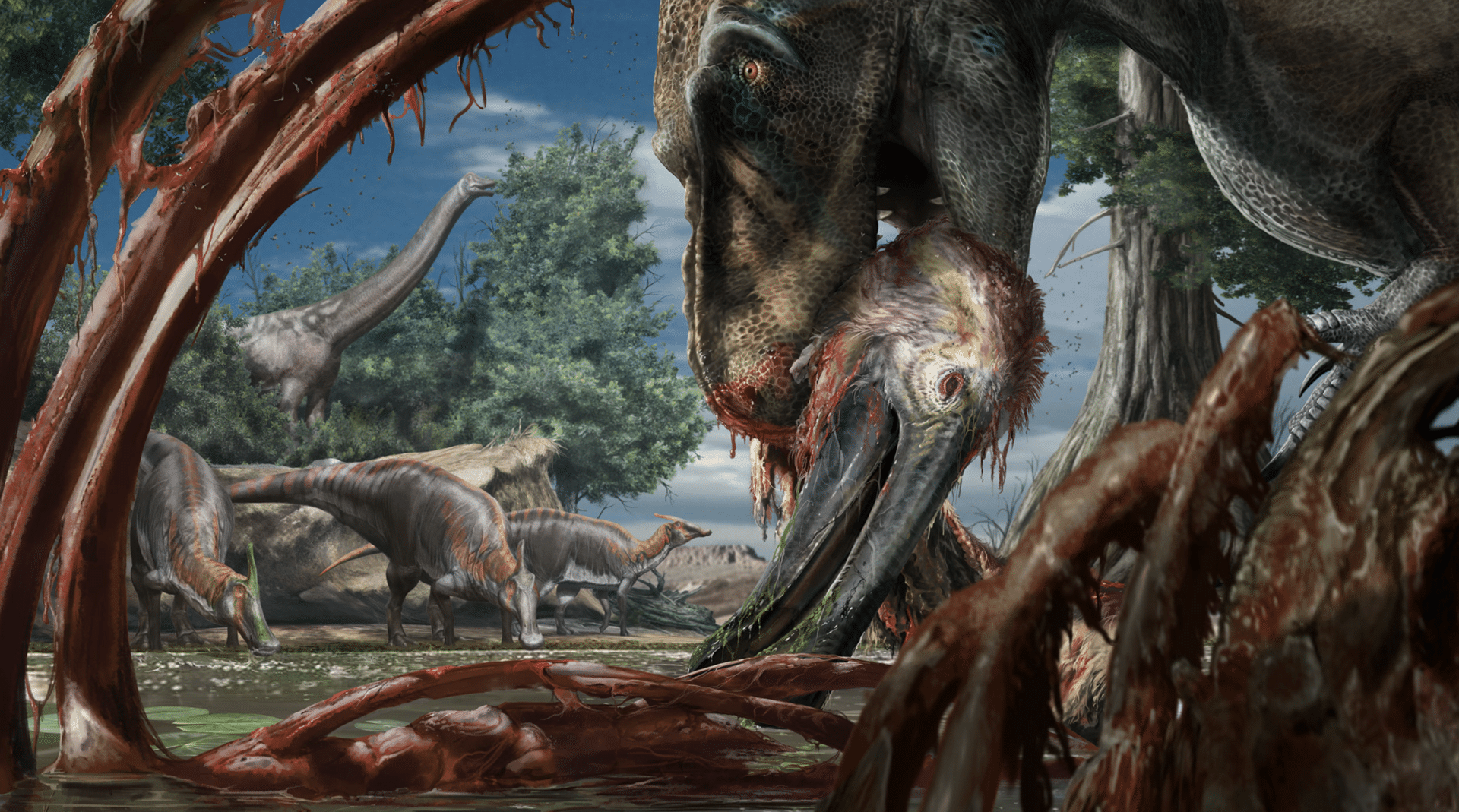

Maleev tied its jaws and teeth to “gulping large chunks of flesh.” Hurum and Sabath inferred that it fed on sauropods, hadrosaurs, and perhaps ankylosaurs, hunting large prey but also scavenging when the chance arose. Diet probably changed with age, since the juvenile skull lacks the adult features that resist high feeding forces. Meanwhile, the much smaller Alioramus shared the formation but lacked adaptations for a powerful bite.
While there is no direct evidence of whether Tarbosaurus lived alone or in groups, its remains are plentiful. In 2019 turning models, Snively and colleagues gave an adult nearly twice the agility score of the lighter Sinraptor. Together, the bite marks and the sheer number of specimens paint a picture of a big carnivore that may have ruled this landscape.
Frequently Asked Questions
It is usually translated as “horrible lizard,” though one museum gives “alarming lizard.” The species name is a misspelling of Mongolian baatar, “hero.”
It lived in the Late Cretaceous, perhaps 72 to 68 million years ago, and a 2023 tooth date supports its final Maastrichtian stage.
Maleev put it at 32.8 to 39.4 feet (10 to 12 meters) long, and 2019 models of two adult specimens gave 4,958 to 6,209 pounds (2,249 to 2,816 kilograms).
It was a carnivore, and bite marks attributed to it appear on Saurolophus and Deinocheirus bones.
The first skull was found in 1946 at Nemegt in Mongolia’s South Gobi, in the Nemegt Formation.
Maleev first named it Tyrannosaurus bataar. Some researchers have since placed it in Tyrannosaurus, while others keep the genera separate.
Sources
The information in this article is based on various sources, drawing on scientific research, fossil evidence, and expert analysis. The aim is to provide a comprehensive and accurate overview of Tarbosaurus. However, please be aware that our understanding of dinosaurs and their world is constantly evolving as new discoveries are made.
- https://naturalhistory.si.edu/sites/default/files/media/translated_publications/Maleev_55a.pdf
- https://naturalhistory.si.edu/sites/default/files/media/translated_publications/Maleev_55b.pdf
- https://www.app.pan.pl/archive/published/app48/app48-161.pdf
- https://people.ohio.edu/witmerl/Downloads/2011_Tsuihiji_et_al._Tarbosaurus_juvenile_skull.pdf
- https://www.app.pan.pl/archive/published/app55/app20090133.pdf
- https://hdl.handle.net/1959.11/14794
- https://pmc.ncbi.nlm.nih.gov/articles/PMC4735739/
- https://peerj.com/articles/6432/
- https://pmc.ncbi.nlm.nih.gov/articles/PMC5493735/
- https://pmc.ncbi.nlm.nih.gov/articles/PMC3275628/
- https://pmc.ncbi.nlm.nih.gov/articles/PMC8616956/
- https://cactus.utahtech.edu/jharris/Kobayashi&Barsbold_ornithomimids.pdf
- https://pubmed.ncbi.nlm.nih.gov/25337880/
- https://paleobiodb.org/data1.2/taxa/opinions.json?name=Tarbosaurus%20bataar&op_type=all&show=ref
- https://australian.museum/learn/dinosaurs/fact-sheets/tarbosaurus-bataar/
- https://mylog.pub.ous.ac.jp/gyoseki/english/researchersHtml/8337/REP_RONBUN/8337_REP_RONBUN_69.html
- https://pmc.ncbi.nlm.nih.gov/articles/PMC10784284/
- https://news.ucalgary.ca/news/ucalgary-paleontologists-identify-closest-known-ancestor-tyrannosaurs-0
- https://www.sciencedaily.com/releases/2012/02/120216111227.htm
This article was last fact checked: TheDinosaurs Team, 28-10-2026
Featured Image Credit: Shalom, CC BY-SA 3.0, via Wikimedia Commons
