
On La Anita Farm, southwest of El Calafate in Argentina’s Santa Cruz Province, the floodplain rocks of the Chorrillo Formation hide a giant. Named Maip macrothorax in 2022, this theropod belonged to the Megaraptoridae, a family of predatory dinosaurs. It probably lived in the early Maastrichtian stage of the Late Cretaceous. At an estimated 9 to 10 meters long, it is the biggest megaraptorid currently known, according to its describers. In 2022, it was also the most informative megaraptorid from Maastrichtian rocks. That title has since passed to the more complete—and probably younger—Joaquinraptor from central Patagonia, named in 2025.
Its first bones came out of the ground in early 2019, during expeditions by paleontologist Fernando Novas and his team. According to CONICET, Argentina’s national research council, the team collected the skeleton in mid-March 2020, days before the pandemic halted fieldwork. Two years later, paleontologist Alexis M. Aranciaga Rolando and five colleagues gave the animal its name. Even without a skull, its spine, ribs, and shoulder offer a rare glimpse of the last megaraptorids’ body plan.
Maip Key Facts
| Keyword | Fact |
|---|---|
| Pronunciation | Not specified |
| Meaning of name | Maip (an Evil Being of Aonikenk Mythology), Big Thorax |
| Group | Theropoda (Megaraptoridae) |
| Type Species | Maip macrothorax |
| Diet | Carnivore |
| When it Lived | Around 70 MYA (probably early Maastrichtian, per CONICET and Ibiricu et al. 2025) |
| Period | Cretaceous |
| Epoch | Late Cretaceous (probably early Maastrichtian stage) |
| Length | About 29.5 to 32.8 feet (9 to 10 meters) in the 2022 description, and about 26.2 to 29.5 feet (8 to 9 meters) in Novas et al. 2019 |
| Height | Not specified |
| Weight | Not specified |
| Mobility | Not specified |
| First Discovery | 2019 by Fernando Novas’s team (part of the holotype), with further bones collected in 2020 |
| Described by | 2022 by A.M. Aranciaga Rolando, M.J. Motta, F.L. Agnolín, M. Manabe, T. Tsuihiji, and F.E. Novas |
| Holotype | MPM 21545, Museo Padre Molina, Río Gallegos |
| Location of first find | Megaraptorid Site (Locality 3), La Anita Farm, Chorrillo Formation, near El Calafate, Santa Cruz Province, Argentina |
Maip Origins, Taxonomy and Timeline
The name Maip comes from Aonikenk (Tehuelche) mythology, where Maip is an evil being—”the shadow of the death”—that roams the Andes and kills with cold wind. The species name joins macro, meaning “big,” with thorax, which refers to the animal’s wide chest cavity. According to CONICET, Aranciaga Rolando chose it partly because the site lies in cold country within sight of the Andes.
Within Theropoda, Maip falls in Tetanurae and Coelurosauria, then in Megaraptora and the family Megaraptoridae. In the describers’ analyses, megaraptorans formed the sister group of Tyrannosauroidea, the lineage of Tyrannosaurus. However, some researchers instead treat megaraptorans as archaic allosauroids, relatives of Allosaurus. The 2022 team noted that view but favored the coelurosaur placement. Maip macrothorax is the type and only known species.
The describers placed Maip in the lower Maastrichtian Chorrillo Formation, but their paper gives no age in years. CONICET rounds its age to almost 70 million years, and in 2025 Ibiricu and colleagues called it “probably early Maastrichtian.” The Paleobiology Database, meanwhile, files it under the whole Maastrichtian. In 2019, Novas and colleagues noted that the Chorrillo beds lie beneath the late Maastrichtian Calafate Formation and “may be early Maastrichtian in age.” Yet they added that the lower third of the formation could be late Campanian, and they placed the Maip site in its middle part. Either way, Maip is one of the youngest records of its clade, though Joaquinraptor is probably younger still.
Discovery & Fossil Evidence
The holotype comes from the Megaraptorid Site, or Locality 3, on La Anita Farm, 30 kilometers (19 miles) southwest of El Calafate. Novas’s team first collected bones there during its 2019 field season. Their report listed them as “Megaraptoridae gen. et sp. indet. 1″—a megaraptorid without a name—and the 2022 team later folded them into the holotype. That report, however, also puts the site at the base of the upper third, so its exact level remains unsettled.
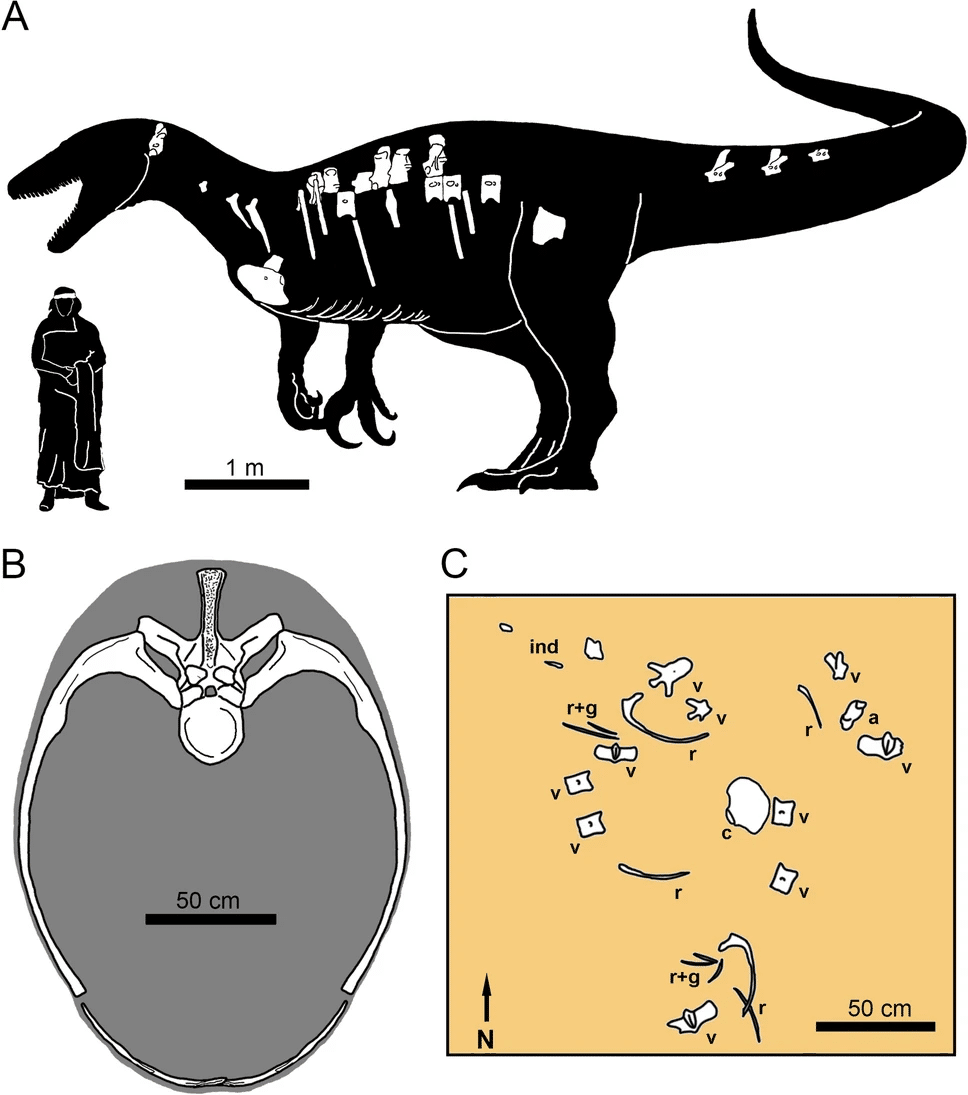
The Museo Padre Molina in Río Gallegos houses the holotype, MPM 21545. It includes the axis (the second neck vertebra), nine dorsal (back) vertebrae, and parts of three proximal caudals (tail vertebrae near the hips). Also present are cervical ribs, many fragments of dorsal ribs and gastralia (belly ribs), and pieces of the scapula (shoulder blade). A left coracoid (a shoulder-girdle bone), the upper end of the right pubis (a hip bone), and the end of the second metatarsal complete the list. The bones lay together but disarticulated, across about 5 by 3 meters of a bed under 1 meter thick.
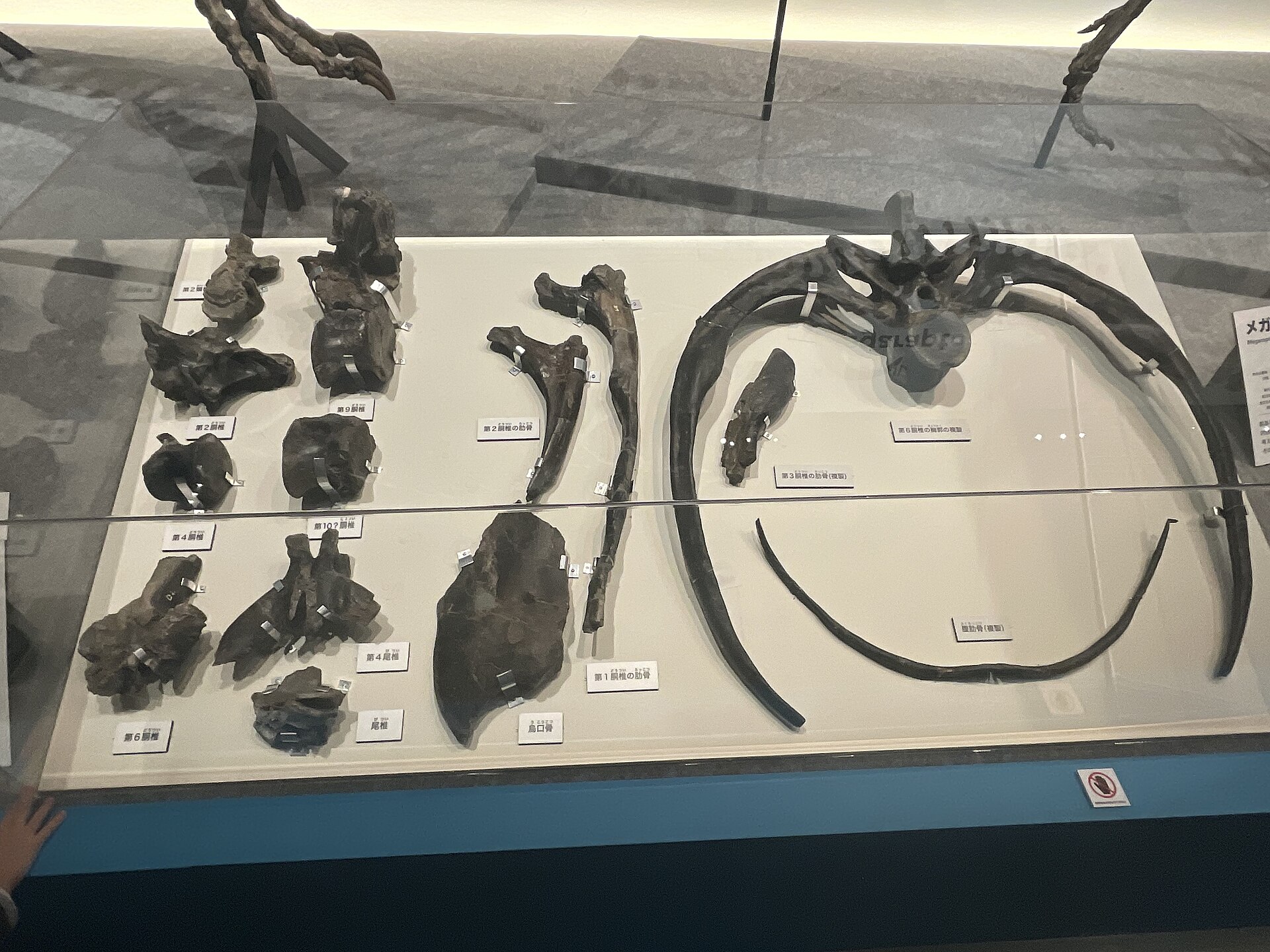

Other megaraptorid fossils from the formation include an isolated dorsal centrum, a tooth, and two sets of teeth. The describers kept these apart from the holotype and suggested the centrum might even be unenlagiid. For now, Maip rests on a single partial skeleton.
Maip Size and Description
Only part of the skeleton survives, yet what remains points to an unusually heavy-chested predator.
Short description of Maip
The skeleton of Maip lacks the skull, teeth, arms, and hand claws. Megaraptorans in general had elongate skulls and short, strongly curved teeth. They also had long, powerful arms with large claws on the first two fingers. Without direct evidence for Maip, these traits remain only the best guide to its missing front half.
Every preserved vertebra was camellate—honeycombed inside with small air spaces. The chest was the standout, reconstructed at more than 1.2 meters (3.9 feet) wide. Elsewhere, the paper puts its widest point at 1.4 meters (4.6 feet). Its largest belly rib survives at about 45 centimeters, and the describers reconstructed it at about 60 centimeters (2 feet). From the hind limb, only the end of one metatarsal (a foot bone) survives. No skin or other soft tissue is preserved.

Size and Weight of Type Species
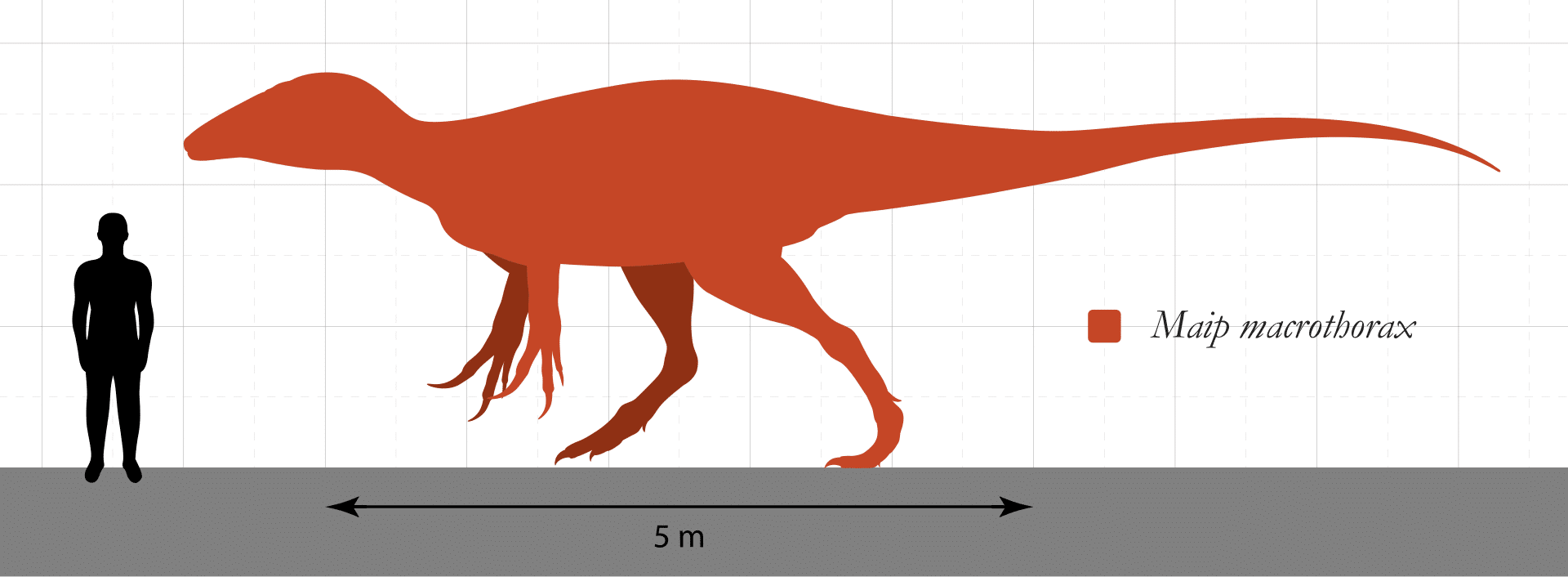
In 2022, Aranciaga Rolando and colleagues estimated Maip at about 29.5 to 32.8 feet (9 to 10 meters) long. They based this on the vertebral proportions of Megaraptor, Aerosteon, and Murusraptor. Elsewhere, the same paper gives a single value of 9.5 meters (31.2 feet).
Before the naming, Novas and colleagues in 2019 judged the specimen similar in size to Aerosteon, at about 26.2 to 29.5 feet (8 to 9 meters). In 2025, Ibiricu and colleagues agreed that more than 9 meters would likely make it the largest megaraptorid.

Weight is far less certain. Neither the 2022 paper nor the other studies we could read give a peer-reviewed mass. At the naming, a CONICET press release quoted about 5 metric tons (about 11,000 pounds) without giving a method. In contrast, a 2026 study by Aranciaga Rolando found megaraptorids 40 to 70 percent lighter than theropods of similar length. Its abstract notes that air spaces fill much of Maip‘s vertebrae and ribs, but it gives no figure for Maip, and the full paper is paywalled. Likewise, no source gives a hip height.
The Dinosaur in Detail
What sets this dinosaur apart is its chest. Its describers listed seven diagnostic traits, five of them autapomorphies—features unique to Maip. Two lie in the spine: saddle-shaped rib facets on the middle back vertebrae and an extra bony strut that divides a hollow on the mid-tail vertebrae. The coracoid adds three—a forward projection, no ridge below the shoulder socket, and a deep joint for the sternum (breastbone).
Even its ribs were unusual. The first dorsal rib carries a honeycomb of air pockets—something the describers observed in no other theropod. Compared with Aerosteon, the second-largest megaraptorid, its vertebrae are slightly larger but notably bulkier. Its coracoid is broader too, with a height-to-width ratio of 1.6 against 2.0. Meanwhile, the tall axis matches the 2.1 height-to-width ratio of Tyrannosaurus, against 1.8 in Acrocanthosaurus and 1.3 in Allosaurus.
Ligament scars on the ribs and vertebrae suggested to the describers that the ribs could rotate. That would have let Maip expand and contract its chest while breathing, as previously reconstructed for tyrannosaurids. They also proposed that rising pneumaticity, or air-filled bone, helped keep larger megaraptoran skeletons light yet strong. Because no sternum turned up, the authors judged it probably cartilaginous or poorly ossified.
In the full 2022 analysis, Maip grouped with Murusraptor, Aerosteon, and Tratayenia, though support values were low. A second analysis yielded an informal “Clade B” of Orkoraptor, Tratayenia, Aerosteon, and Maip. In 2025, Ibiricu and colleagues recovered a similar “Megaraptorid Clade 1” without Orkoraptor. Its earliest-diverging member was the newly named Joaquinraptor. Still, they cautioned that this clade rests on a single shared trait and that much of Maip is missing. Taken together, Maip is clearly a large megaraptorid, but its nearest relatives remain uncertain.
Interesting Points about Maip
- During the COVID-19 quarantine, the De Pasqua family let the team prepare the specimen in their own home.
- A Japanese partner, the National Museum of Nature and Science, funded a major part of the expedition behind the discovery.
- Its first dorsal rib holds a honeycomb of air pockets that its describers had observed in no other theropod.
- A preprint titled “The Biggest Megaraptoridae (Theropoda: Coelurosauria) of South America” appeared on Research Square in December 2021, months before formal publication.
Contemporary Dinosaurs
Towering over the same floodplains was Nullotitan glaciaris, a giant titanosaurian sauropod named by Novas and colleagues in 2019. Its describers judged that the holotype “almost probably surpassed 20 meters long.” Most of its bones come from lower in the formation, but its highest record lies near the Maip site’s level. Nothing, however, ties these two giants together directly.
Adding further diversity was Isasicursor santacrucensis, a medium-sized elasmarian—a basal iguanodontian ornithopod—also named in 2019. Several individuals turned up in one bed, a sign to its describers that it lived in groups, at least when it died. Its type locality lies in the upper third of the formation, about 20 meters below the marine Calafate Formation. That likely makes it somewhat younger than Maip.
Not every neighbor was a dinosaur. Patagorhynchus pascuali was a monotreme, an egg-laying mammal, described in 2023 by Chimento and colleagues from a partial lower jaw with a single molar. It is the first Cretaceous monotreme known from South America, and it comes from the “Puma Cave” site on La Anita Farm. Those early Maastrichtian beds sit mid-formation, yet nothing links it to Maip beyond the shared landscape.
Maip in its Natural Habitat
The world Maip roamed was a low-gradient river plain of thick floodplain muds, cut by channel sandstones and crevasse splays—sand spilled from breached riverbanks. Soils formed on these often waterlogged muds, and snail fossils point to varied tree cover and some dry-humid seasonality. Speaking to CONICET, Novas described a warm ecosystem—”a forest, almost a jungle.” In 2023, however, Chimento and colleagues placed La Anita at about 60°S and linked it to humid, cool, densely forested settings. Fish, frogs, turtles, snakes, the bird Kookne yeutensis, mammals, and aquatic insects shared the land and waters. Higher up, mosasaur teeth mix with ornithopod bones, until the shallow sea of the Calafate Formation finally covered the plain.
Like the rest of its group, Maip was a carnivore, although nothing shows directly what it ate. In 2019, Novas and colleagues proposed that Chorrillo megaraptorids preyed on different herbivores as they grew, from small elasmarians to bigger titanosaurs. Those authors added that megaraptorids may have been the main predators of the region. In contrast, abelisaurids, the family of Carnotaurus, are absent from the Chorrillo beds—a gap the team linked “more probably” to environment than to age.
Whether Maip hunted alone or in groups is unknown, since the site yielded only one individual. On a wider scale, Aranciaga Rolando’s team hypothesized that megaraptorids, with other theropods, replaced carcharodontosaurids—the family of Giganotosaurus—as southern apex predators after the Cenomanian–Turonian. In 2025, Ibiricu and colleagues suggested that bigger bodies helped them fill those niches. If so, Maip stands among the last and largest of these hunters, a barrel-chested predator near the close of the Cretaceous.
Frequently Asked Questions
Maip is an evil being of Aonikenk mythology, and macrothorax means “big thorax,” for its wide chest.
It probably lived in the early Maastrichtian, around 70 million years ago.
Its describers estimated about 29.5 to 32.8 feet (9 to 10 meters) long, but we found no peer-reviewed weight estimate in the studies we could read.
It was a carnivore, and researchers proposed that Chorrillo megaraptorids hunted elasmarians and titanosaurs as they grew.
Its bones come from the Chorrillo Formation on La Anita Farm, about 30 kilometers southwest of El Calafate, Argentina.
It has an exceptionally wide chest and a honeycomb of air pockets in the head of its first dorsal rib, a pattern its describers observed in no other theropod.
Sources
The information in this article is based on various sources, drawing on scientific research, fossil evidence, and expert analysis. The aim is to provide a comprehensive and accurate overview of Maip. However, please be aware that our understanding of dinosaurs and their world is constantly evolving as new discoveries are made.
- https://doi.org/10.1038/s41598-022-09272-z
- https://pmc.ncbi.nlm.nih.gov/articles/PMC9042913/
- https://doi.org/10.22179/revmacn.21.655
- https://revista.macn.gob.ar/index.php/RevMus/article/download/655/537
- https://doi.org/10.1038/s41467-025-63793-5
- https://doi.org/10.1007/s00114-026-02151-x
- https://doi.org/10.1038/s42003-023-04498-7
- https://doi.org/10.1038/s42003-023-05596-2
- https://doi.org/10.21203/rs.3.rs-1152394/v1
- https://paleobiodb.org/classic/checkTaxonInfo?taxon_no=455622
- https://www.conicet.gov.ar/paleontologos-descubren-a-maip-el-enorme-depredador-carnivoro-que-fue-uno-de-los-ultimos-dinosaurios-antes-de-la-extincion/
This article was last fact checked: TheDinosaurs Team, 29-10-2026
Featured Image Credit: SpinoDragon145, CC BY-SA 4.0, via Wikimedia Commons
