
On Elderslie Station in central Queensland, Australia, an ancient oxbow lake in the Winton Formation preserved a lean predator beside a titanosaur. The site lies about 37 miles (60 kilometers) northwest of the town of Winton. Named Australovenator wintonensis in 2009, this theropod was first dated to the latest Albian, the close of the Early Cretaceous. Later work, however, placed its bones in the Cenomanian stage of the Late Cretaceous, about 95 million years ago. Its describers called it the most complete theropod skeleton so far found in Australia—a title later studies still grant it.
The site first came to light when the landowners found large, broken sauropod bones. Excavations began in 2006, and in 2009 paleontologist Scott Hocknull and six colleagues described Australovenator in PLoS ONE, alongside two new sauropods. Preparation continued after publication, however, and new bones of the same skeleton were reported in 2012, 2013, 2015, and 2016. Today, most analyses place Australovenator at or near the base of the megaraptorids, a lineage of Cretaceous predators whose wider place among theropods is still debated.
Australovenator Key Facts
| Keyword | Fact |
|---|---|
| Pronunciation | Not specified |
| Meaning of name | Southern Hunter |
| Group | Theropoda |
| Type Species | Australovenator wintonensis |
| Diet | Carnivore |
| When it Lived | Around 95 MYA |
| Period | Cretaceous |
| Epoch | Late Cretaceous (Cenomanian stage) |
| Length | Not specified |
| Height | Not specified |
| Weight | About 690 pounds (314 kilograms), estimated from femur circumference |
| Mobility | Not specified |
| First Discovery | 2006 |
| Described by | 2009 by S.A. Hocknull, M.A. White, T.R. Tischler, A.G. Cook, N.D. Calleja, T. Sloan, and D.A. Elliott |
| Holotype | AODF 604 |
| Location of first find | Matilda Site (AODL 85), Winton Formation, Elderslie Station near Winton, Queensland, Australia |
Australovenator Origins, Taxonomy and Timeline
The name Australovenator joins the Latin “australis” (“southern”) and “venator” (“hunter”)—the second part, its describers wrote, a reference to its carnivorous diet. The species name wintonensis comes from the township of Winton. Together, the name places a meat-eater in its southern landscape.
Originally, Hocknull and colleagues described Australovenator as “a medium-sized allosauroid,” a member of the group that includes Allosaurus. Their analysis recovered it as the sister group of Carcharodontosauridae, the “shark-toothed” predators. Yet a tree just one step longer collapsed that result into an unresolved cluster. In 2010, Benson, Carrano, and Brusatte grouped it with Neovenator, Fukuiraptor, Aerosteon, Chilantaisaurus, Megaraptor, and Orkoraptor in a new clade, Neovenatoridae, and named a subgroup with long, raptorial forelimbs—Megaraptora. Subsequent workers placed Australovenator in Megaraptoridae, though they disagreed about where Megaraptora fits among theropods. Australovenator wintonensis is the type and only known species.
Using pollen from nearby rocks, the 2009 paper dated the remains to the latest Albian, near the base of the Winton Formation. By contrast, zircon dating by Bryan and colleagues in 2012 pointed to a Cenomanian age of about 95 million years, which White and colleagues adopted in 2013 and 2015. In 2021, Hocknull’s team then placed the Matilda Site about 1,150 feet (350 meters) above the formation’s base. They favored a maximum age in the mid-Cenomanian—roughly 96 to 95 million years ago. The formation as a whole spans about 103 to 92 million years ago.
Discovery & Fossil Evidence
Over five field seasons, the Matilda Site (AODL 85) yielded hundreds of scattered bones of Australovenator and the titanosaur Diamantinasaurus, mixed together. Many of the theropod bones were sealed in a phosphatic crust, and work on those concretions continued long after the 2009 description. The landholders donated the specimens to the Australian Age of Dinosaurs Museum near Winton.

The holotype, AODF 604, first included nine teeth, a left dentary (lower jaw bone), dorsal ribs, and gastralia (belly ribs). It also preserved part of the right ilium (hip bone), both ulnae, the right radius, and hand bones with their unguals (claws). From the hind limbs came the right femur (thigh bone), both tibiae (shin bones), a fibula, an astragalus (ankle bone), and foot bones with claws. Later studies added both humeri (upper arm bones), wrist bones, a left fibula, more toe bones, and a toothed right dentary.
In 2015, White and colleagues counted ten isolated teeth from the site, all first assigned to the holotype. Because they were shed crowns, however, they are unlikely to belong to the skeleton itself. In 2009, Hocknull’s team suggested that an older ankle bone from Victoria, once labeled Allosaurus, most likely came from an Australovenator. Earlier authors had linked that same bone to ornithomimosaurs (“ostrich mimics”), to Fukuiraptor, or to abelisauroids. In 2012, however, Benson and colleagues did not follow the referral—they classed the bone only as a neovenatorid, possibly a megaraptoran. Apart from that contested ankle bone, the anatomy described here comes from the single Matilda Site skeleton.
Australovenator Size and Description
Australovenator is known from much of the arm and leg, but its skull survives only as lower jaws and teeth.
Short description of Australovenator
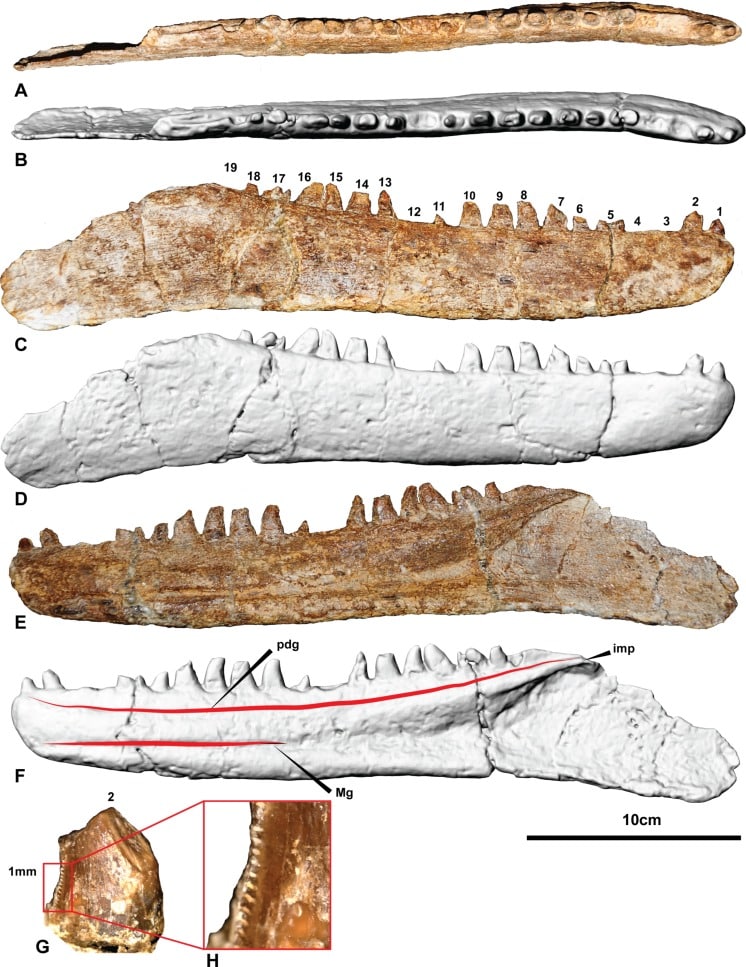
The dentary was gracile, with nearly parallel upper and lower edges and a rounded, chinless front end. Hocknull’s team counted 18 tooth positions in the left dentary. However, the better-preserved right dentary, described by White and colleagues in 2015, held 19 sockets with 15 teeth in place. It also lacked the row of nerve openings reported in 2009—its outer surface is smooth. The teeth described in 2009 were recurved and finely serrated, without the crown wrinkles typical of carcharodontosaurids.

Behind the head, the dorsal ribs held pneumatic cavities—air spaces linked to the breathing system. The thumb carried a very large, narrow, and curved claw. According to the 2012 restudy, the first and second hand claws were nearly equal in size but differed in shape. The metatarsals (long foot bones) were elongate and gracile, and the legs were long for the animal’s size. No skin impressions are listed among the holotype material.
Size and Weight of Type Species
The 2009 paper gave no length or weight, describing Australovenator only as “medium-sized.” No study gives a length measured from this skeleton. Still, Lamanna’s team in 2020, as cited by Ibiricu and colleagues in 2025, put early Australian megaraptorids at about 16 feet (5 meters) and 660 pounds (300 kilograms). That is a group-level estimate, not one taken from these bones.
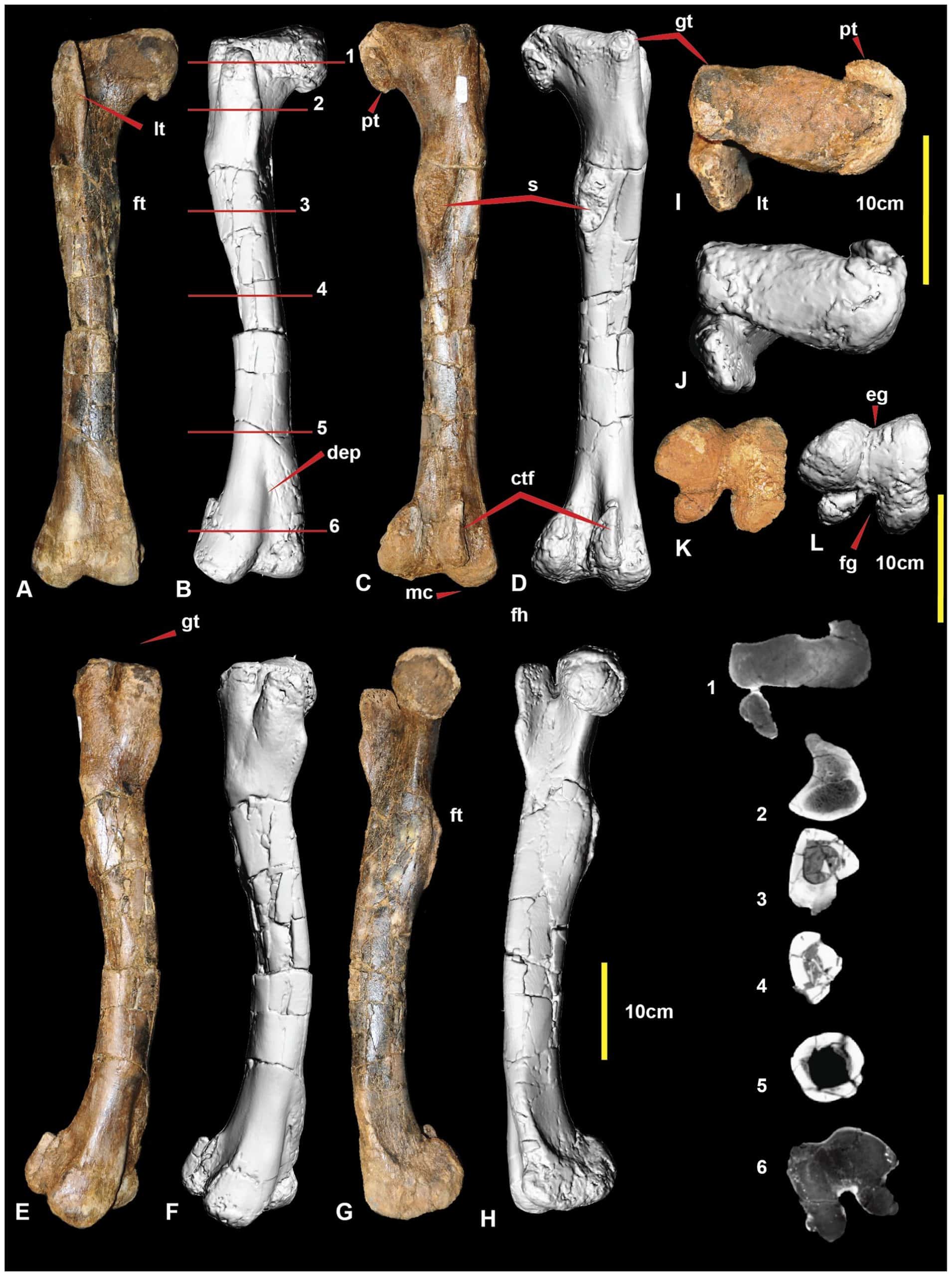
Instead, the best guide lies in measured bones, starting with a right femur 22.8 inches (578 millimeters) long. Together, the femur, tibia, and metatarsus make a hind limb about 4 feet 10 inches (1,464 millimeters) long. In 2014, Benson and colleagues used femur circumference to estimate a body mass of about 690 pounds (314 kilograms)—an indirect estimate, not a direct measurement.

Within its own lineage, Australovenator was modest—a second Winton megaraptorid specimen, AODF 967–979, came from a slightly larger individual. Meanwhile, the South American megaraptorids in a 2025 analysis reached or exceeded about 23 feet (7 meters) in total length.
The Dinosaur in Detail
What sets this dinosaur apart are three unique traits from its 2009 diagnosis. The ulna (a forearm bone) bears a groove along its outer shaft. In addition, the lesser trochanter, a muscle attachment on the femur, reaches as high as the greater trochanter. Finally, the top of the fibula is beveled toward the front.
In 2013, White and colleagues compared the legs of several neovenatorids. The smaller Australovenator and Fukuiraptor had longer, more slender leg bones than the larger Neovenator and Chilantaisaurus. White’s team described Australovenator as having the most elongate metatarsus, though their own measurements gave Fukuiraptor slightly higher foot ratios. Both animals had long strides for their body size. Its humerus is a little over half the length of the femur, a ratio of 0.56. The 2012 restudy took this as support for a neovenatorid placement.
In 2015, White and colleagues reconstructed the forearm’s range of motion. They found the humerus far more mobile than in Allosaurus, Acrocanthosaurus, or Tyrannosaurus, and closer to that of Bambiraptor. The first hand claw, they concluded, was blade-like and capable of extreme flexing and hyperextension.
Its place on the family tree remains debated, since some authors treated megaraptorans as archaic allosauroids. In 2022, however, Aranciaga Rolando’s team argued that growing evidence places them within Coelurosauria—the theropod branch that includes birds. Their analysis made megaraptorans the sister group of Tyrannosauroidea (tyrannosaurs and their kin). Moreover, the 2022 study and one of the 2025 analyses by Ibiricu and colleagues both recovered it among the earliest-branching megaraptorids. The 2022 paper also named a South American member of the family, Maip, from Patagonia. Taken together, these studies show a predator whose bones are well known, even as its wider family remains unsettled.
Interesting Points about Australovenator
- The name Australovenator means “southern hunter,” a nod to the meat-eating habits its describers inferred for it.
- Later studies still call Australovenator the most complete non-avian theropod found in Australia.
- A 2015 study counted 19 tooth sockets in the newly prepared right dentary, one more than the 2009 count for the left.
- Replica footprints from a reconstructed Australovenator foot closely matched the dinosaur tracks of “Trackmaker A” at Lark Quarry, but the study did not name it the trackmaker.
- One figure caption in the 2009 paper misprinted the holotype number, giving the catalog number of Wintonotitan instead of AODF 604.
Contemporary Dinosaurs
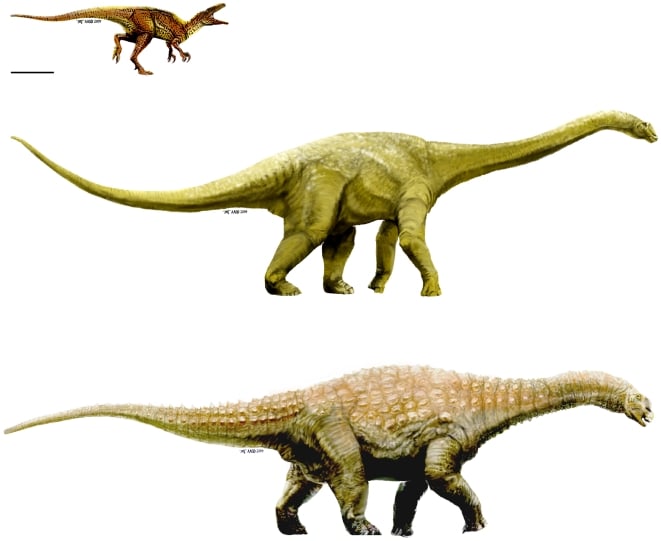
Sharing the same billabong—the Australian name for an oxbow lake—was Diamantinasaurus, an early-diverging titanosaur (or a close relative of titanosaurs) whose species name honors the song “Waltzing Matilda.” Named in the same 2009 paper, it came from the Matilda Site itself, where its bones lay interspersed with those of Australovenator. Even so, White’s team noted in 2015 that the association between the two had not yet been addressed. In 2024, Beeston and colleagues judged the giant Australotitan cooperensis, named in 2021, probably a junior synonym of Diamantinasaurus.
Close by stood Wintonotitan wattsi, a sauropod also named in 2009 and now placed with Diamantinasaurus in Diamantinasauria. Its site, Triangle Paddock, lies about 2 miles (3 kilometers) from the Matilda Site on the same station.
On another property, Belmont Station, lived Savannasaurus elliottorum, a titanosaur described in 2016 from the Ho-Hum site. Its bones lie less than 330 feet (100 meters) above the formation’s base—the Matilda Site sits about 1,150 feet (350 meters) up. Both sites share a favored maximum age of about 96 to 95 million years. However, Hocknull and colleagues cautioned in 2021 that the Winton sauropod sites, the Matilda Site among them, could differ considerably in age.
Australovenator in its Natural Habitat
The world Australovenator roamed was a broad, flat plain near the coast, crossed by sluggish rivers that left behind oxbow lakes. Open forest and floodplain covered the land, with flowering plants, araucarian conifers, ginkgoes, and ferns. Fish, crocodyliforms, turtles, and hyriid bivalves (freshwater mussels) shared the lake. Its rocks formed near 51 degrees south latitude. According to Poropat and colleagues, global warming at the time had flattened temperature differences between latitudes.
As a carnivore, Australovenator fed on other animals, though none of the studies reviewed here names its prey. In 2015, White and colleagues proposed that its forearms played a dominant role in prey capture. They envisioned prey dispatched by both hands and feet, with the large thumb claw doing most of the work.
While there is no direct evidence of whether Australovenator hunted alone or in groups, it may have relied on speed. White’s team described megaraptorid hind limbs as “built for running.” Meanwhile, a second, slightly larger megaraptorid specimen from Winton may represent another species—or simply individual variation.
Frequently Asked Questions
It means “southern hunter,” and the species name wintonensis refers to the township of Winton in Queensland.
The 2009 paper dated it to the latest Albian, but later studies favor the Cenomanian, around 95 million years ago.
No length has been measured from its skeleton, but early Australian megaraptorids are estimated at about 16 feet (5 meters), and its femur suggests about 690 pounds.
It was a theropod, first called an allosauroid and now usually placed in Megaraptoridae, whose wider placement is still debated.
Its bones came from the Matilda Site in the Winton Formation, about 37 miles northwest of Winton, Queensland.
It is the most complete theropod skeleton known from Australia, with highly mobile arms and a large, blade-like thumb claw.
Sources
The information in this article is based on various sources, drawing on scientific research, fossil evidence, and expert analysis. The aim is to provide a comprehensive and accurate overview of Australovenator. However, please be aware that our understanding of dinosaurs and their world is constantly evolving as new discoveries are made.
- https://doi.org/10.1371/journal.pone.0006190
- https://doi.org/10.1007/s00114-009-0614-x
- https://doi.org/10.1371/journal.pone.0039364
- https://doi.org/10.1371/journal.pone.0068649
- https://doi.org/10.1371/journal.pone.0137709
- https://doi.org/10.7717/peerj.1512
- https://doi.org/10.7717/peerj.2312
- https://doi.org/10.7717/peerj.3427
- https://doi.org/10.1098/rsos.191462
- https://doi.org/10.1371/journal.pbio.1001853
- https://journals.plos.org/plosbiology/article/file?id=10.1371/journal.pbio.1001853.s011&type=supplementary
- https://doi.org/10.1038/srep34467
- https://doi.org/10.7717/peerj.11317
- https://doi.org/10.1038/s41598-022-09272-z
- https://doi.org/10.1038/s41467-025-63793-5
- https://doi.org/10.7717/peerj.17180
- https://doi.org/10.1371/journal.pone.0037122
This article was last fact checked: TheDinosaurs Team, 30-10-2026
Featured Image Credit: PaleoEquii, CC BY-SA 4.0, via Wikimedia Commons
