
Along the Kulinda River in southeastern Siberia, the base of the Ukureyskaya Formation holds the remains of a small, two-legged plant-eater. Named Kulindadromeus zabaikalicus in 2014, this herbivore lived during the Bathonian stage of the Middle Jurassic—roughly 168 to 166 million years ago. It was an ornithischian, a distant relative of Triceratops and Parasaurolophus, yet its fossils carry both scales and featherlike filaments. From this, its describers argued that feathers may have been present in the earliest dinosaurs.
In 2010, Sofia M. Sinitsa and her team of geologists from the Institute of Natural Resources, Ecology and Cryology in Chita found the site. Four years later, paleontologist Pascal Godefroit and seven colleagues named the animal in Science. Their study drew on six partial skulls and several hundred disarticulated skeletons. As a result, one quiet Siberian deposit, probably laid down in a lake, now sits at the center of a much larger question—where feathers came from.
Kulindadromeus Key Facts
| Keyword | Fact |
|---|---|
| Pronunciation | Not specified |
| Meaning of name | Kulinda Runner from the Zabaikal Region, per a University of Bristol blog |
| Group | Ornithischia, basal Neornithischia |
| Type Species | Kulindadromeus zabaikalicus |
| Diet | Herbivore |
| When it Lived | 168 to 166 MYA |
| Period | Jurassic |
| Epoch | Middle Jurassic (Bathonian stage) |
| Length | About 4.9 feet (1.5 meters) |
| Height | Not specified |
| Weight | Not specified |
| Mobility | Moved on two legs (bipedal) |
| First Discovery | 2010 by Sofia M. Sinitsa and her INREC team, who found the site |
| Described by | 2014 by P. Godefroit, S.M. Sinitsa, D. Dhouailly, Y.L. Bolotsky, A.V. Sizov, M.E. McNamara, M.J. Benton, and P. Spagna |
| Holotype | INREC K3/109, a partial skull |
| Location of first find | Kulinda locality, base of the Ukureyskaya Formation, Chernyshevsky District, Chita Region (Zabaikalsky Krai), southeastern Siberia, Russia |
Kulindadromeus Origins, Taxonomy and Timeline
A University of Bristol blog translates the name as “Kulinda runner from the Zabaikal region,” after the Kulinda locality and the region now called Zabaikalsky Krai. However, a blog is not the formal description, so the translation is best read with some caution.
Kulindadromeus belongs to Ornithischia. Godefroit and colleagues placed it at the base of Neornithischia—forms closer to Parasaurolophus than to Ankylosaurus or Stegosaurus—as the sister of Cerapoda, the group uniting Triceratops and Parasaurolophus. In 2019, Cincotta and colleagues, Godefroit among them, grouped it with Agilisaurus and Hexinlusaurus among Middle Jurassic Asian forms leading toward Cerapoda. Since then, analyses from Godefroit’s own circle have moved it. In July 2020, Dieudonné and colleagues recovered it as an early ornithopod outside Clypeodonta. Two months later, Yang and colleagues found it closest to Marginocephalia, the horned and dome-headed dinosaurs. Both results put it inside Cerapoda, although it has generally been treated as a non-cerapodan. Kulindadromeus zabaikalicus is the type and only known species.
The age took several attempts to pin down. In 1986, Sinitsa and Starukhina compared insects and microfossils to date the whole Ukureyskaya Formation as Late Jurassic to Early Cretaceous. Later potassium-argon dates from the formation’s base ranged between 147 and 165 million years. In 2014, Godefroit’s team called the beds Middle to Late Jurassic, while paleontologists V.R. Alifanov and S.V. Saveliev proposed a possible Tithonian age. Then, in 2019, Cincotta and colleagues paired uranium-lead dates from zircon crystals with fossil pollen and spores. The zircons set a maximum age of about 172.8 million years, whereas the pollen pointed to the Bathonian—roughly 168.3 to 166.1 million years ago. In 2025, Maidment and colleagues accepted that age.
Discovery & Fossil Evidence
The Kulinda locality lies in the Chita Region’s Chernyshevsky District, about 137 miles (220 kilometers) east of Chita. At roughly 52°31′N, 116°42′E, it sits along the Kulinda River in a basin called the Olov Depression. Sinitsa’s team came across it there in 2010 during a geological survey. Since then, excavators have dug three ornithischian-rich bonebeds, and the middle trench alone has revealed seven bone-bearing layers.
The holotype—the specimen that anchors the name—is INREC K3/109, a partial skull figured in right lateral (side) view. Its prefix refers to the Chita institute whose geologists found the site. Alongside it, the original sample held six partial skulls and several hundred disarticulated skeletons from two neighboring bonebeds. Because each skeletal element showed a single morphotype (one consistent shape), the describers credited the differences to growth and individual variation. Many bones are also strongly iron-stained, suggesting partial replacement during diagenesis (the physical and chemical changes after burial).
By 2020, Godefroit’s group had analyzed more than 1,000 isolated bones and partial skeletons. Most belong to small individuals, most likely juveniles or subadults, and larger animals are rare. The authors noted that this skew could point to attritional accumulation—deaths piling up over time—rather than a single catastrophe, an idea they said still needs testing. In bonebed 4, finely laminated, organic-rich claystone laid down in calm water even kept delicate skin structures as thin carbon films. Bonebed 3, by contrast, yields well-preserved but mostly disarticulated bones with little integument.
Kulindadromeus Size and Description
Kulindadromeus was a small animal, but its bones and skin together give an unusually full picture of an early ornithischian.
Short description of Kulindadromeus
Godefroit and colleagues reconstructed Kulindadromeus as a small, two-legged herbivore with a short skull and plant-eating teeth. Among its distinguishing skull traits, the maxillary fenestra (an opening in the upper jaw) is larger than the antorbital fenestra. The jugal, or cheekbone, has a notched branch toward the postorbital bone, which in turn carries a rear branch expanded from top to bottom.
Behind the head, the forelimbs were short and the hindlimbs long. In 2020, Yang and colleagues noted that its humerus (upper arm bone) is distinctly longer than its scapula (shoulder blade). On the hip, the ilium—the upper hip bone—has a slender rear process and a narrow front process bent strongly downward. Deep extensor fossae, hollows on the metatarsals (upper foot bones), and an elongate tail complete the skeleton.
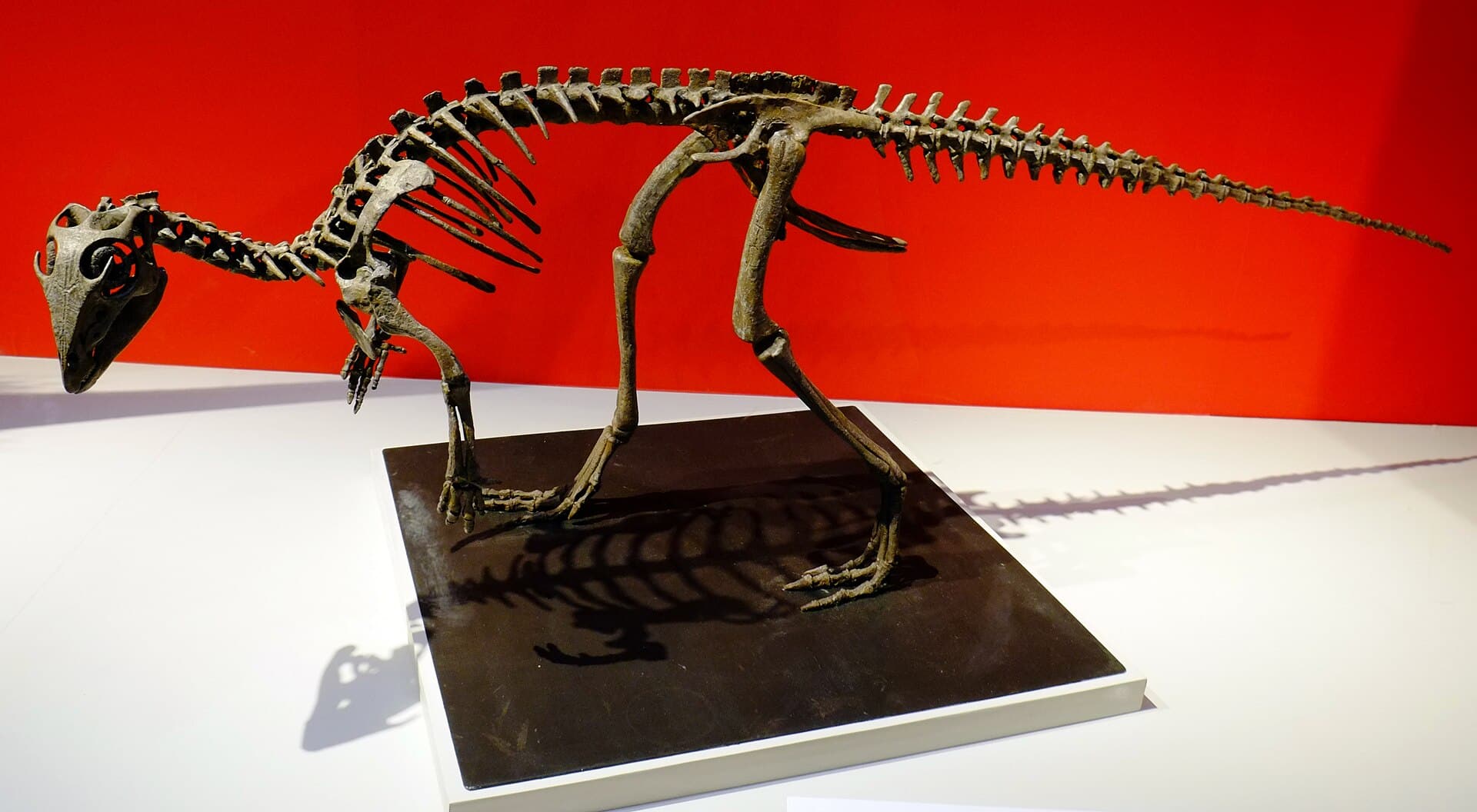

Unusually for a dinosaur, its skin does not have to be guessed at. Scales covered the lower limbs, hands, and tail, while filaments covered the head, body, and upper limbs. A 2020 restudy also found thick, hemispherical pads under the finger bones, one per phalanx, each covered in tiny rounded scales. In the describers’ view, the scaly lower legs might reflect a partial inhibition of feather development, much as in birds.
Size and Weight of Type Species
Godefroit and colleagues put Kulindadromeus at about 4.9 feet (1.5 meters) long, and their 2020 chapter repeats the figure. The main paper does not explain how they got it, but the bones are disarticulated, so their skeletal drawing is a composite.
Press coverage in 2014, including University College Cork’s release, gave only about 3.3 feet (1 meter). Still, the peer-reviewed 1.5 meters is the value used here. We found no peer-reviewed hip height or body weight. Size is also complicated by age, since most Kulinda individuals were probably juveniles or subadults.
The Dinosaur in Detail
Its covering sets this dinosaur apart—three kinds of scales and three kinds of featherlike structures. Small, overlapping hexagonal scales on the lower shin resemble the scutella of bird legs. Tiny rounded scales on the hands and feet instead recall bird reticula. Along the tail, thin arched scales up to about 20 millimeters long sat in rows—at least five in 2014, about a dozen in 2020. On top of the tail, a triangular spur clipped each scale to the one before it. At under 100 micrometers thick, these tail scales are unlikely to be bony osteoderms like those of armored ornithischians. In 2020, the team also described bristles under the tail, the longest over 5.5 inches (140 millimeters).
Simple monofilaments up to about 1.2 inches (30 millimeters) long covered the head, thorax, and back. They look more like those of the theropod Sinosauropteryx than the thicker bristles of Psittacosaurus. On the upper arm and thigh, groups of six or seven filaments rose from a basal plate, recalling the down of Silkie chickens. Ribbon-shaped structures on the upper shin, each built from about ten fine filaments, had never been reported before.
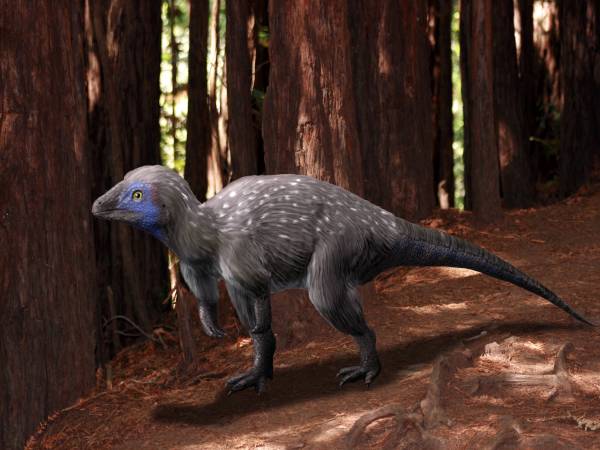

Not everyone accepts these as feathers. In 2014, Lingham-Soliar argued that the structures were collagen support fibers alongside badly degraded scales. The describers replied that the taphonomy—how the remains were buried and preserved—and the shape of the structures made this highly unlikely. In 2015, analyses by Barrett and colleagues usually recovered scales as the ancestral dinosaur covering. Ornithischian filaments, they argued, might be independent acquisitions. A decade later, Xu and Barrett called the feather identity of the basal-plate filaments “less secure.” Meanwhile, Cockx, Keating and Benton, one of its describers, found broad support for filaments evolving more than once, perhaps separately in ornithischians. Feather origins therefore remain an open question.
Interesting Points about Kulindadromeus
- In 2019, Cincotta and colleagues called it the oldest known dinosaur with “feather-like” structures, older than Chinese finds such as Anchiornis and Germany’s Archaeopteryx.
- A 2024 study lists it with Psittacosaurus and Juravenator as the only non-avian dinosaurs known with both body scales and feathers.
- It was not the first ornithischian with filaments, since quill-like structures had already been reported in Psittacosaurus and Tianyulong.
- Godefroit said in 2014 that the find “clinches it: all dinosaurs had feathers, or at least the potential to sprout feathers.”
Kulindadromeus in its Natural Habitat
The world Kulindadromeus roamed was a quiet, low-energy setting, probably around a freshwater lake. Tuffs (ash layers) and ignimbrites—deposits from hot volcanic flows—show that volcanoes were active nearby. Laminated mudstones, tuffaceous siltstones, and coarse sandstones complete the sequence, partly built from debris worn off nearby granites. The region sat between two major fault zones tied to the closing Mongol-Okhotsk Ocean. After the early Middle Jurassic, marine deposits there gave way to continental sediments in fault-bounded basins.
Plants, insect larvae, and freshwater crustaceans lie preserved with the bones. The plant record is relatively poor, and rare mosses occur alongside conifers, Czekanowskia, horsetails, and ferns such as Coniopteris. Conifers and Czekanowskia formed the trees and bushes, part of a flora widespread across the Siberian paleofloristic region. While there is no direct evidence of what it ate, Kulindadromeus may have fed on this vegetation.
The 2020 chapter proposed that the filament coat on the head and body may have served as insulation. In contrast, its authors doubted that the limb filaments and ribbons mainly kept the animal warm. Instead, they proposed a role in visual display.
According to Godefroit’s group, the only other dinosaur evidence from the site is a single shed tooth of an unnamed, medium-sized theropod. The names given to other Kulinda fossils remain disputed, however. Alifanov and Saveliev named Kulindapteryx and Daurosaurus from the site in a Russian journal dated 24 June 2014, a month before the Science paper. In 2015, they added Lepidocheirosaurus, which they pictured as an ornithomimosaur hunting small prey in water. Godefroit’s group treats all three as nomina dubia—doubtful names—and very likely synonyms of Kulindadromeus. In 2018, Alifanov replied that Kulindadromeus itself rests on a mistaken assumption that the site holds only one dinosaur, and on an ambiguous holotype.
Frequently Asked Questions
A University of Bristol blog translates the full name as “Kulinda runner from the Zabaikal region.”
It lived in the Bathonian stage of the Middle Jurassic, roughly 168 to 166 million years ago.
Its describers estimated a length of about 4.9 feet (1.5 meters). We found no peer-reviewed height or weight.
It was a small, two-legged herbivore with plant-eating teeth.
Its fossils come from the Kulinda locality, at the base of the Ukureyskaya Formation in the Chita Region of southeastern Siberia.
Its fossils preserve three kinds of scales and three kinds of featherlike structures, making it one of the few ornithischians known with filaments.
Sources
The information in this article is based on various sources, drawing on scientific research, fossil evidence, and expert analysis. The aim is to provide a comprehensive and accurate overview of Kulindadromeus. However, please be aware that our understanding of dinosaurs and their world is constantly evolving as new discoveries are made.
- https://doi.org/10.1126/science.1253351
- https://biblio.naturalsciences.be/library-1/rbins-staff-publications/pdfs/Godefroit%20et%20al.-%202014%20-%20Kulindadromeus.pdf
- https://doi.org/10.7717/peerj.6239
- https://www.ebi.ac.uk/europepmc/webservices/rest/PMC6361000/supplementaryFiles
- https://doi.org/10.1007/978-3-030-27223-4_4
- https://doi.org/10.1134/S0031030114040029
- https://doi.org/10.1134/S0031030115060039
- https://doi.org/10.1126/science.1259983
- https://doi.org/10.1126/science.1260146
- https://doi.org/10.1098/rsbl.2015.0229
- https://doi.org/10.7717/peerj.9832
- https://doi.org/10.1080/08912963.2020.1793979
- https://doi.org/10.1134/S0031030118130026
- https://doi.org/10.1093/sysbio/syaf063
- https://doi.org/10.1098/rsos.241624
- https://doi.org/10.1098/rsbl.2024.0517
- https://doi.org/10.1038/s41467-024-48400-3
- https://dinocolour.blogs.bristol.ac.uk/?p=224
- https://www.ucc.ie/en/news/archive/2014andbeyond/2014-(jan-june)/new-fossils-suggest-all-dinosaurs-had-feathers.html
This article was last fact checked: TheDinosaurs Team, 13-11-2026
Featured Image Credit: Tomopteryx, CC BY-SA 4.0, via Wikimedia Commons
