
Along the Oldman River in southern Alberta, the uppermost beds of the St. Mary River Formation hold a horned dinosaur unlike its closest kin. Named Regaliceratops peterhewsi in 2015, it likely lived during the middle Maastrichtian stage of the Late Cretaceous—roughly 68.5 to 67.5 million years ago. Its frill carries a ring of large bony plates, the biggest of them spade-shaped, set like the points of a crown. Yet its horns break the pattern of its Maastrichtian relatives. Instead, a tall nose horn pairs with tiny brow horns—a layout typical of the centrosaurines, a separate branch of horned dinosaurs.
In 2005, geologist Peter Hews spotted a snout jutting from a riverside cliff. A decade later, paleontologists Caleb M. Brown and Donald M. Henderson described it as a new genus and species. Their study presented Regaliceratops as the first demonstrated case of convergence in horn-like display structures between dinosaur clades. Yet all of this rests on a single skull—the only specimen known.
Regaliceratops Key Facts
| Keyword | Fact |
|---|---|
| Pronunciation | Not specified |
| Meaning of name | Royal Horned Face |
| Group | Ceratopsia |
| Type Species | Regaliceratops peterhewsi |
| Diet | Herbivore |
| When it Lived | 68.5 to 67.5 MYA |
| Period | Cretaceous |
| Epoch | Late Cretaceous (Maastrichtian stage) |
| Length | Not specified |
| Height | Not specified |
| Weight | Not specified |
| Mobility | Moved on all four legs (quadrupedal) |
| First Discovery | 2005 by Peter Hews |
| Described by | 2015 by C.M. Brown and D.M. Henderson |
| Holotype | TMP 2005.055.0001 |
| Location of first find | Uppermost St. Mary River Formation, Oldman River (Waldron Flats area), southern Alberta, Canada |
Regaliceratops Origins, Taxonomy and Timeline
The name Regaliceratops blends the Latin regalis, meaning “royal,” with the Greek ceratops, meaning “horned face.” According to Brown and Henderson, “royal” points to the crown-shaped frill and its bony ornaments. It also honors the Royal Tyrrell Museum, which received its royal title from Queen Elizabeth II in 1990. Meanwhile, the species name peterhewsi honors Peter Hews, who found the skull. Together, the name salutes the animal’s headgear, its home museum, and its discoverer.
Regaliceratops belongs to Ceratopsidae, the family of large horned dinosaurs, and to its subfamily Chasmosaurinae. Within that subfamily, Brown and Henderson placed it in the tribe Triceratopsini, the lineage that includes Triceratops. Their analysis grouped it in an unresolved cluster with Eotriceratops and Ojoceratops. That cluster sits as the sister group to the remaining triceratopsins, such as Triceratops and Torosaurus. Regaliceratops peterhewsi is the type and only known species.
No radiometric date exists for the specimen itself, so its age comes from correlation. Pollen of Scollardia trapaformis in the rock, together with geological mapping, ties it to the formation’s upper beds. Those beds correlate with the combined Carbon and Whitemud members of the Horseshoe Canyon Formation farther north. Brown and Henderson then drew the age from Carbon Member strata north of Drumheller. As a result, the holotype likely shares their middle Maastrichtian age of roughly 68.5 to 67.5 million years. In Brown and Henderson’s view, that timing places Regaliceratops after the early Maastrichtian extinction of the centrosaurines.
Discovery & Fossil Evidence
The skull came to light in 2005 near Waldron Flats on the Oldman River, about 102 miles (164 kilometers) south of Calgary. Its snout protruded from a cliff about 3.3 feet (1 meter) above the water, locked in hard siltstone. The Royal Tyrrell Museum excavated it in blocks in 2006 and 2008, although nearby spawning habitat of the protected bull trout (Salvelinus confluentus) complicated the work. Thanks to the slow dig, the tough rock, and the tiny pitted brow horns, the specimen earned the nickname “Hellboy.”
The skull was then prepared, largely by D. Tanke, with a 4.5-inch angle grinder and rock-saw blade, plus an airscribe—a small pneumatic engraving tool. Speaking to National Geographic, Brown said preparation took around 18 months. Meanwhile, the quarry’s exact level relative to the Willow Creek Formation is hard to pin down, because the strata are upthrust and faulted. Still, geological maps place it within the upper 98 feet (30 meters) of the St. Mary River Formation.
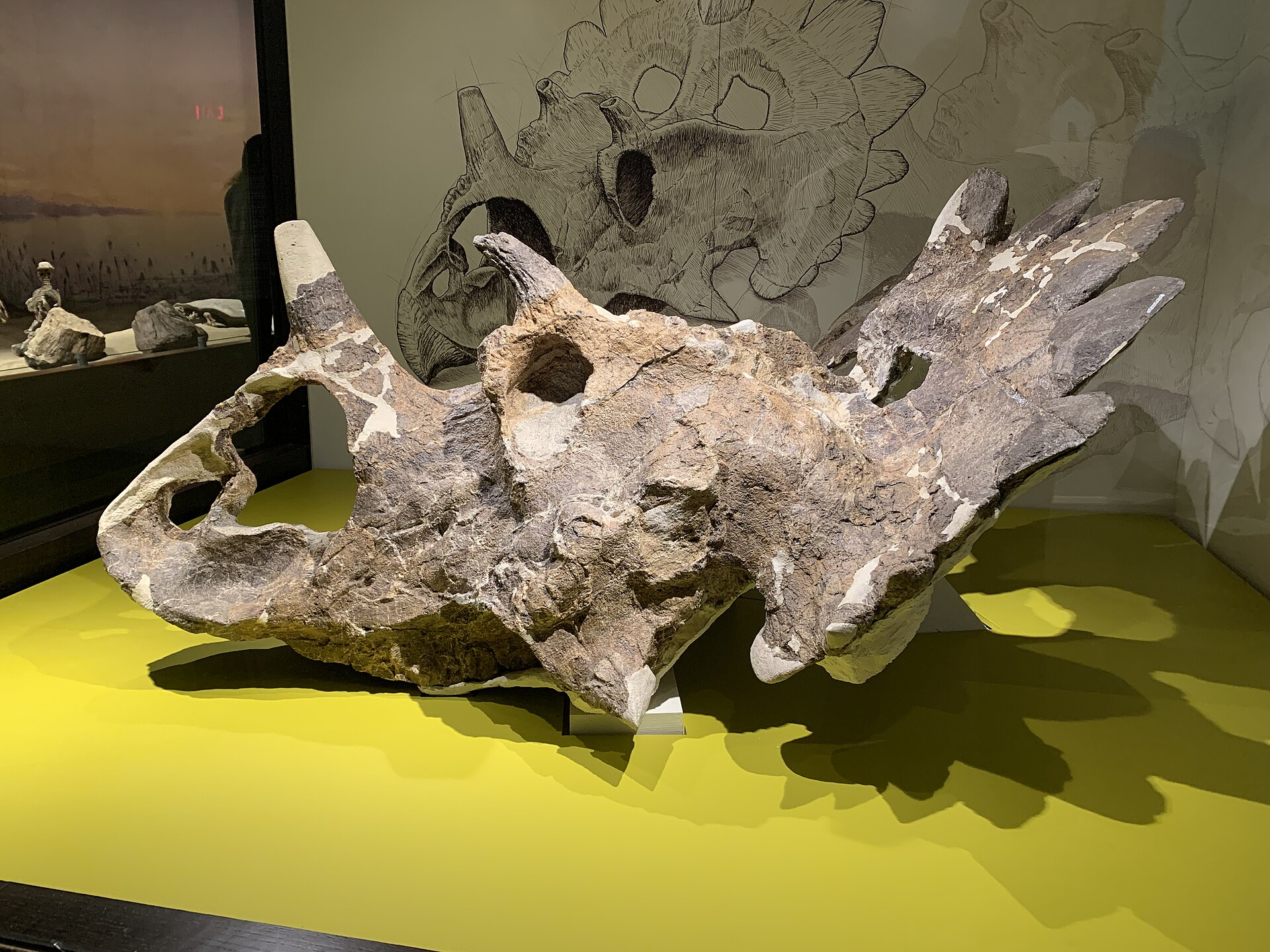

The holotype, TMP 2005.055.0001, is housed at the Royal Tyrrell Museum in Drumheller, Alberta. It is a nearly complete cranium lacking only the rostral bone—the beak-forming bone at the tip of the upper jaw—and the lower jaws. In 2015, rock still hid the palate and braincase, and the teeth had been lost. Fused bones, fused frill ornaments, pitted horn tips, and rugose bone without juvenile grain all show it was an adult. In 2020, paleontologist Albert Prieto-Márquez and colleagues mirrored its better-preserved side to offset distortion in a frill study. No additional specimens of Regaliceratops have been confirmed.
Regaliceratops Size and Description
Short description of Regaliceratops
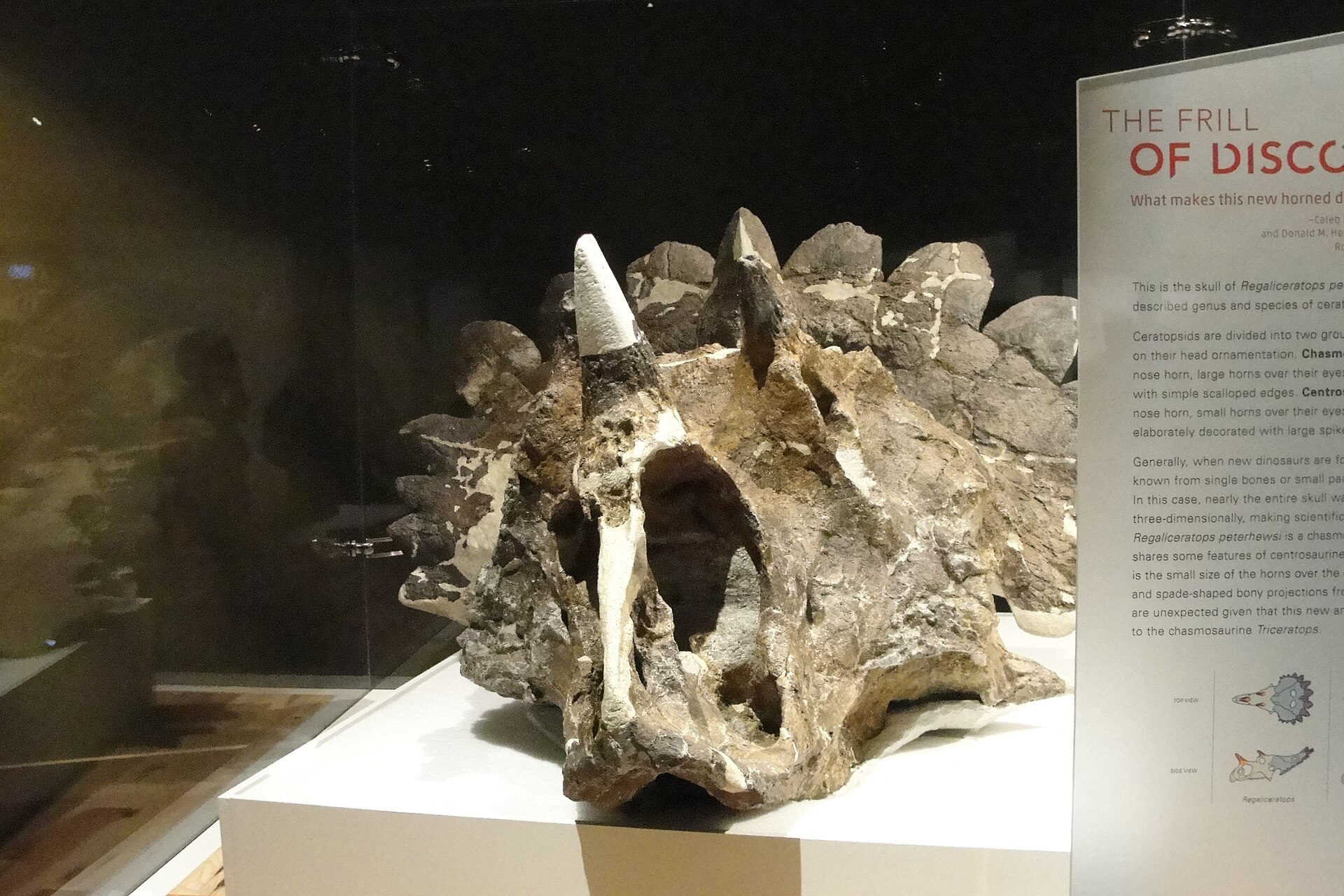
At the front, a large, straight nasal horn rose steeply above the snout, its cross-section teardrop-shaped. Behind it, the postorbital (brow) horns were small, and each tip ended in a resorption pit—a hollow left where bone was broken down. Below them, a conical epijugal (a bony knob capping the cheek) had a base only slightly smaller than the brow horns. Meanwhile, the parietosquamosal frill (the bony shield at the back of the skull) formed a nearly perfect semicircle with no notch at the midline.
A single median plate rose from the frill’s midline just inside its edge. Beside it, at least seven epiossifications—bony ornaments fused to the frill—lined each side of the rim. Its two frill openings, the parietal fenestrae, were small and enclosed by the parietal bone, as in its Maastrichtian relatives. They were also wider than long, as in Kosmoceratops, though that shape may come from distortion. The snout also carried an interpremaxillary fenestra (an opening between the paired snout bones). It shares this feature with Maastrichtian relatives such as Anchiceratops and Triceratops. Like other ceratopsids, it presumably walked on all fours. However, no skin impressions or bones behind the skull are known, so any picture of its body borrows from relatives.

Size and Weight of Type Species
The original description gives no body length, height, or weight, and we found no peer-reviewed estimate in later work.
Instead, the skull provides direct measurements, starting with a maximum midline length of about 5.2 feet (1,570 millimeters). The frill is short but wide, at about 2.4 feet (720 millimeters) long and 4.3 feet (1,300 millimeters) across. The brow horns stand about 5.5 inches (140 millimeters) tall. By contrast, its largest frill plates reach about 7.9 inches (201 millimeters) long, possibly the biggest recorded in any chasmosaurine.
Still, these figures come with a warning, since tectonic forces shortened the whole cranium by about 30 percent front to back. They also sheared the snout upward and tilted the frill up by 30 degrees. As a result, its describers advise caution with many of these measurements. The nasal horn’s tip also eroded away, leaving a preserved height of about 5.8 inches (148 millimeters). By extending its sloping sides to a cone, Brown and Henderson estimated an original 9.4 to 11.0 inches (240 to 280 millimeters). Today’s tip is plaster, added to stabilize the bone rather than based on rigorous comparison.
The Dinosaur in Detail
What sets this dinosaur apart is the mismatch between its horns. Among its clade, Regaliceratops has the smallest brow horns and the tallest nasal horn relative to skull size. It is also the only known Maastrichtian chasmosaurine with short brow horns. Its horn proportions fall within the range of the centrosaurines, far from its Maastrichtian cousins. In 2026, Ames, Rowe, and Button still called it the main exception to the reduced nasal horns of later chasmosaurines.
The frill tells a second story, centered on a backward-projecting midline plate called P0. Brown and Henderson argued that P0 likely matches the midline plate of Triceratops and the curved frill hooks of Anchiceratops. Scoring the frill that way gave them a shorter, better-resolved tree—309 steps and 5 equally simple trees, against 313 steps and 170.
Its exact position remains debated, although the original analysis put it closer to Triceratops than to Anchiceratops. Mallon and colleagues (2016), whose trees left out Eotriceratops as a wildcard (an unstable taxon), gave a less settled picture. With the traditional frill scoring, Regaliceratops sat in an unresolved cluster with Anchiceratops and a group joining Arrhinoceratops to Triceratopsini. With the new scoring, it became the sister to that group instead, again closer to Triceratops than to Anchiceratops.
Taken together, the skull pairs a Triceratops-like frill and snout with horns that echo the centrosaurines. Brown and Henderson’s analysis also supported a deep split in Chasmosaurinae—an older, mostly Campanian lineage around Chasmosaurus and a younger, mostly Maastrichtian lineage around Triceratops. If confirmed, that split implies a ghost lineage—an unsampled stretch of history—at the base of the Triceratops lineage. Brown and Henderson put that gap at about 3 million years, whereas Mallon and colleagues later put it nearer 6 million, depending on which species belong there.
Interesting Points about Regaliceratops
- Its excavators nicknamed the skull “Hellboy,” a name inspired partly by its tiny, pitted brow horns.
- With frill plates up to 7.9 inches long, it may have the largest frill ornaments recorded in any chasmosaurine.
- Brown and Henderson called their 172-character, 28-taxon dataset the largest yet assembled for ceratopsids.
- Its describers presented it as the first demonstrated case of convergent horn-like display structures between dinosaur clades.
Regaliceratops in its Natural Habitat
The world Regaliceratops roamed left behind shales and siltstones alternating with thin sandstones. Its host shale holds abundant loose shells of unionid (freshwater) mussels, suggesting an aquatic or waterlogged setting. The formation also preserves an abundance of dinosaur footprints.
Because the teeth and lower jaws are missing, only its group points to its diet—ceratopsids were herbivores. In 2019, Mallon suggested it may have filled the vanished centrosaurines’ ecological role as well as their behavioral one. As of 2015, however, the formation had yielded only eight or nine dinosaur taxa, against about 23 species in the Horseshoe Canyon. Most come from Scabby Butte, in its lowest beds, including Pachyrhinosaurus canadensis—the only species-level dinosaur Brown and Henderson listed from the formation in Alberta. Other finds there include fragmentary remains referred to Edmontosaurus and Edmontonia, troodontid teeth (then called Troodon), an ornithomimid, and an unnamed tyrannosaur. In Montana, the formation also yields the small horned dinosaur Montanoceratops cerorhynchus. Yet none of these comes from a level verified to match Regaliceratops.
While there is no direct evidence of how Regaliceratops used its horns and frill, researchers have suggested that ceratopsid ornaments served as display or sociosexual signals. Brown and Henderson went further, speculating that it converged behaviorally with centrosaurines after that group died out. They also suggested that the extinction of two diverse horned dinosaur clades opened the way for Triceratopsini to diversify. If so, Regaliceratops offers a glimpse of that turnover—a chasmosaurine wearing a centrosaurine’s horns. Farther north, its relative Eotriceratops comes from correlated Horseshoe Canyon beds, but that quarry’s 2020 date of about 68.8 million years falls just outside the Regaliceratops range.
Frequently Asked Questions
It means “royal horned face,” a nod to its crown-like frill and the Royal Tyrrell Museum.
It likely lived in the middle Maastrichtian stage of the Late Cretaceous, roughly 68.5 to 67.5 million years ago, based on correlation.
We found no peer-reviewed estimate of its body length or weight. Its deformed skull measures about 5.2 feet (1,570 millimeters) along the midline.
Like other ceratopsids, it was a herbivore, although its own teeth and lower jaws are missing.
Peter Hews found it in 2005 along the Oldman River in southern Alberta, in the uppermost St. Mary River Formation.
Its tall nose horn and tiny brow horns converge on the horn layout of the centrosaurines, a different branch of horned dinosaurs.
Sources
The information in this article is based on various sources, drawing on scientific research, fossil evidence, and expert analysis. The aim is to provide a comprehensive and accurate overview of Regaliceratops. However, please be aware that our understanding of dinosaurs and their world is constantly evolving as new discoveries are made.
- https://doi.org/10.1016/j.cub.2015.04.041
- https://www.sciencedirect.com/science/article/pii/S0960982215004923
- https://ars.els-cdn.com/content/image/1-s2.0-S0960982215004923-mmc1.pdf
- https://pubmed.ncbi.nlm.nih.gov/26051892/
- https://doi.org/10.1371/journal.pone.0154218
- https://doi.org/10.1038/s41598-019-51709-5
- https://doi.org/10.1002/ece3.6361
- https://doi.org/10.7717/peerj.21728
- https://doi.org/10.1139/e07-011
- https://doi.org/10.1139/e75-142
- https://doi.org/10.1139/cjes-2019-0019
- https://doi.org/10.7717/peerj.7926
- https://weblex.canada.ca/html/014000/GSCC00053014440.html
- https://weblex.canada.ca/html/006000/GSCC00053006702.html
- https://www.nationalgeographic.com/science/article/newly-named-horned-dinosaur-was-a-copycat
- https://www.smithsonianmag.com/science-nature/e-is-for-eotriceratops-118421651/
- https://www.thecanadianencyclopedia.ca/en/article/royal-tyrrell-museum-of-palaeontology
This article was last fact checked: TheDinosaurs Team, 13-11-2026
Featured Image Credit: Alan & Flora Botting, CC BY-SA 2.0, via Wikimedia Commons
