
In the Phu Wiang hills of northeastern Thailand, the red sandstones of the Sao Khua Formation hold a predator whose family ties are still debated. Named Siamotyrannus isanensis in 1996, this large theropod lived during the Early Cretaceous. Its describers hailed it as the earliest known tyrannosaur—at least 20 million years older than any tyrannosaurid then on record. Later work has pulled it away from that famous family, and scientists still argue over its true place.
The bones came to light in 1993, when Somchai Triamwichanon of Thailand’s Department of Mineral Resources found them at Phu Wiang. Three years later, paleontologists Eric Buffetaut, Varavudh Suteethorn, and Haiyan Tong described them in Nature. The material covers only the hips, part of the backbone, and a long run of tail bones. Even so, that partial skeleton has wandered across the theropod family tree—a reminder of what a pelvis can and cannot reveal.
Siamotyrannus Key Facts
| Keyword | Fact |
|---|---|
| Pronunciation | Not specified |
| Meaning of name | Siam Tyrant |
| Group | Theropoda |
| Type Species | Siamotyrannus isanensis |
| Diet | Carnivore (inferred from theropods generally) |
| When it Lived | About 134 to 132 million years ago (age of the Sao Khua Formation) |
| Period | Cretaceous |
| Epoch | Early Cretaceous (late Valanginian–early Hauterivian stages) |
| Length | About 21 to 23 feet (6.5 to 7 meters) |
| Height | Not specified |
| Weight | Not specified |
| Mobility | Moved on two legs (bipedal), inferred from theropods generally |
| First Discovery | 1993 by Somchai Triamwichanon |
| Described by | 1996 by E. Buffetaut, V. Suteethorn, and H. Tong |
| Holotype | SM-PW9-1 |
| Location of first find | Phu Wiang Site 9, Sao Khua Formation, Phu Wiang National Park, Khon Kaen Province, Thailand |
Siamotyrannus Origins, Taxonomy and Timeline
The name Siamotyrannus joins “Siam,” the old name of Thailand, with the Greek tyrannos, meaning “tyrant.” Its species name, isanensis, comes from “Isan,” the local name for northeastern Thailand, where the skeleton turned up. A 2019 doctoral dissertation by paleontologist Adun Samathi at the University of Bonn quotes both explanations from the original paper. Together, the name ties the animal to its country, its home region, and the tyrant dinosaurs its describers believed it joined.
Siamotyrannus belongs to Theropoda and, within it, to Tetanurae and Avetheropoda—the branch that unites allosauroids and coelurosaurs. Beyond that, opinions split. Its describers placed it in Tyrannosauridae, the family of Tyrannosaurus. In contrast, a 2024 analysis by paleontologist Oliver Rauhut and colleagues recovers it within Metriacanthosauridae, a family inside Allosauroidea. A 2019 dissertation offers a third view—a basal member of Coelurosauria, the theropod branch that later produced birds. Siamotyrannus isanensis is the type species, and a single specimen represents it.
For years, scientists placed the Sao Khua Formation in the late Barremian stage, roughly 130 to 125 million years ago. In 2022, however, Tucker and colleagues dated detrital zircons—mineral grains washed into the sediment—using uranium-lead methods. As a result, they bracketed deposition at about 133.6 to 132.1 million years ago, in the late Valanginian to early Hauterivian. A 2023 review by Manitkoon and colleagues later adopted that range. Still, each limit carries an error of about 2 million years, and no study has placed Site 9 within the formation. Tucker’s team concluded that the fauna is about 5 to 9 million years older than once thought.
Discovery & Fossil Evidence
The skeleton lay in red sandstones at Phu Wiang Site 9, inside Phu Wiang National Park in Khon Kaen Province. Locally, the spot is known as “Lan Hin Lad Yao.” Triamwichanon found the bones there in 1993, and the Nature description followed on June 20, 1996. Phu Wiang already had a place in Thai paleontology. During a uranium survey in 1976, a geologist found the country’s first dinosaur bone there—a fragment of a sauropod femur.
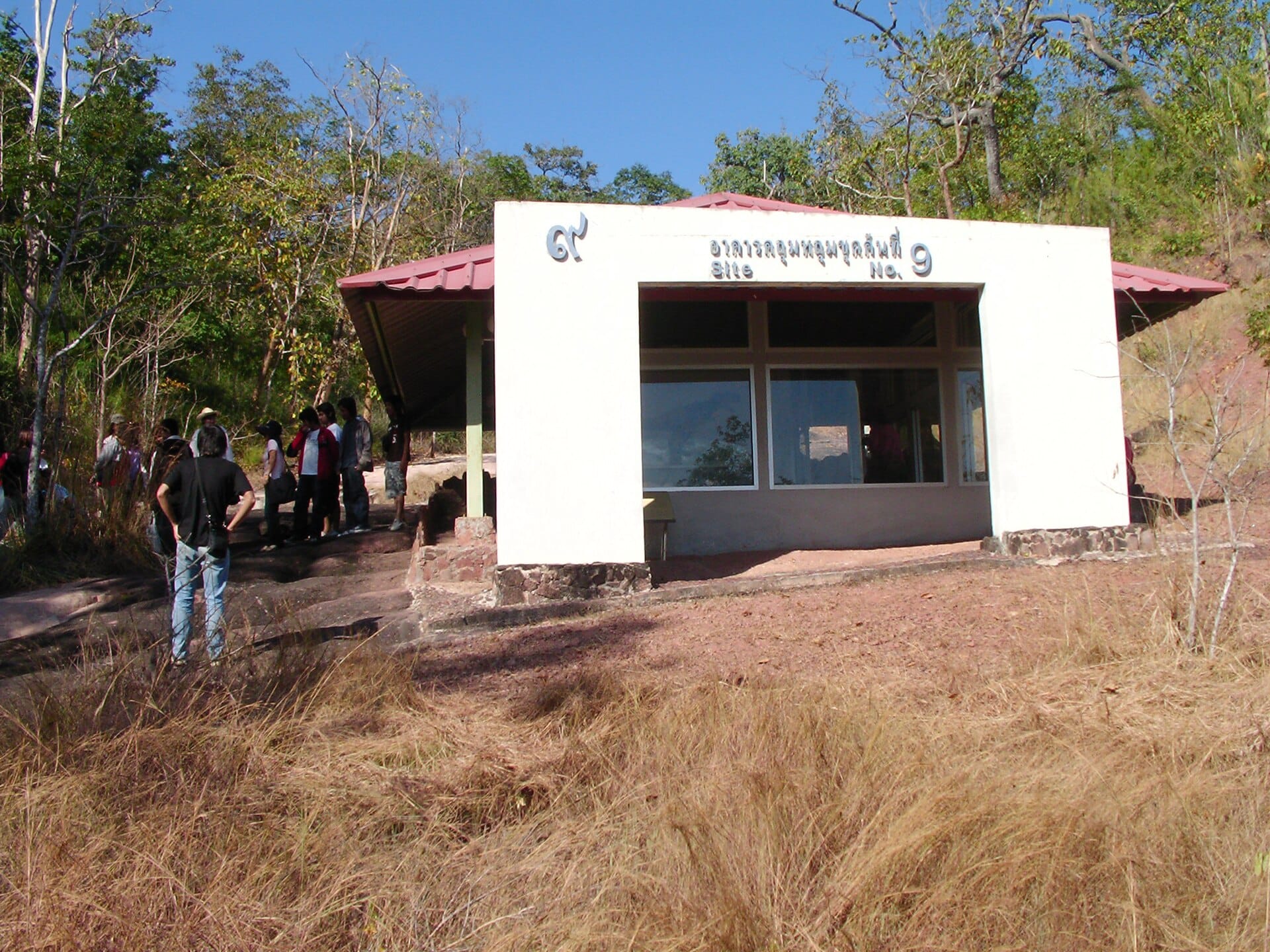

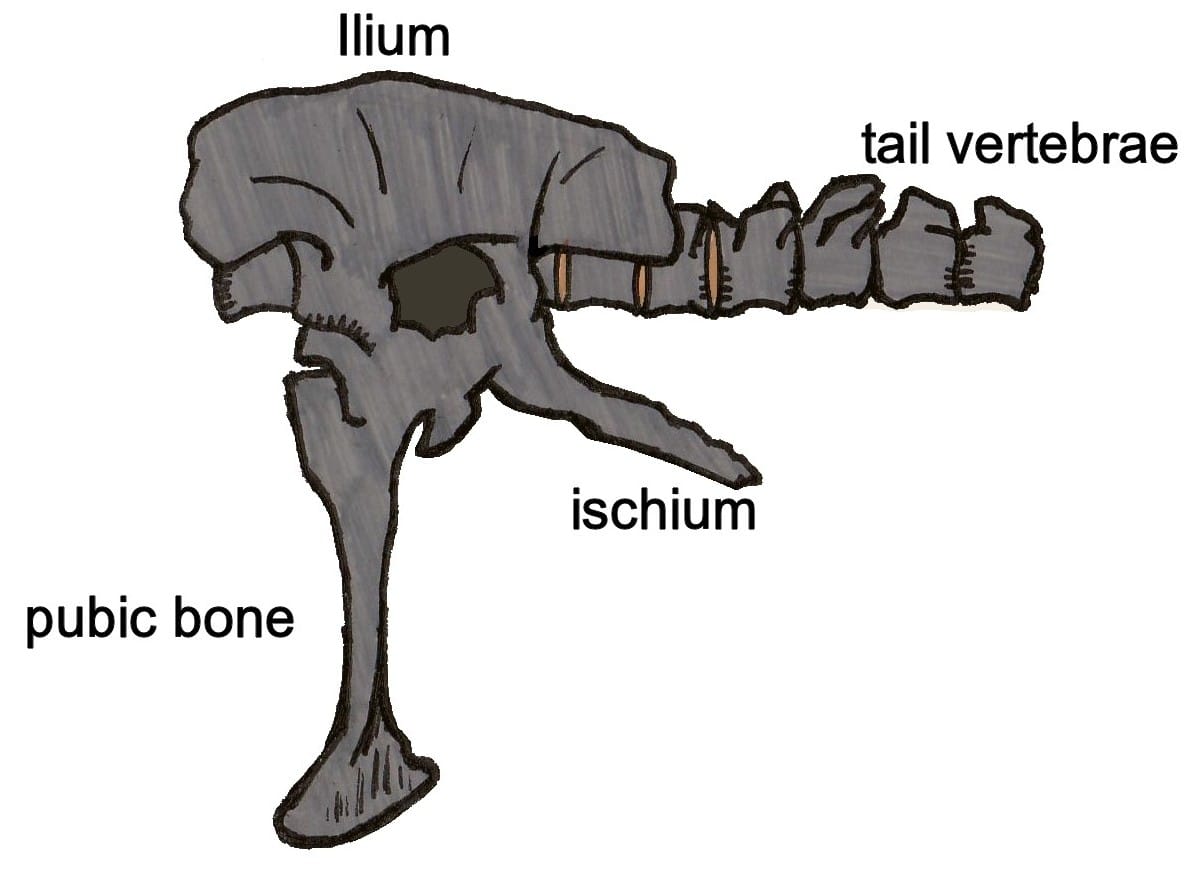
Most of the holotype, SM-PW9-1, sits in the paleontological collection of the Sirindhorn Museum in Kalasin Province. It consists of the left half of the pelvis, the sacrum (the fused hip vertebrae), and five dorsal (back) vertebrae. Thirteen caudal (tail) vertebrae also survive, along with chevrons—small bones that hang beneath the tail. However, a 2019 paper by Chokchaloemwong and colleagues lists it slightly differently—a pelvic girdle, the last dorsal, a sacrum, and articulated front tail vertebrae.
No skull is known. Early on, the dorsal vertebrae lacked full preparation and a proper description, which kept the genus out of at least one early analysis. According to a 2019 review, a tibia and partial sacrum referred to it in 1999 more probably belong to another animal. As far as the published record shows, the holotype remains the only confirmed specimen of Siamotyrannus.
Siamotyrannus Size and Description
Because only the back half of the skeleton survives, any portrait of Siamotyrannus rests on its hips, spine, and tail.
Short description of Siamotyrannus
The five dorsal vertebrae have neural arches—the bony arches over the spinal cord—fused to their centra, or vertebral bodies. These hourglass-shaped centra lack pleurocoels (pneumatic openings). Behind them, the sacrum stretches about 26.8 inches (680 millimeters). The ilium, the main hip blade, is long and relatively low, with two broad vertical ridges on its outer face.
Below the ilium, the pubis points almost straight down and ends in a massive distal boot—an expanded foot at its tip. The ischium, the rear lower hip bone, is slender and curved and bears a scar for a leg muscle, the M. flexor tibialis internus. Farther back, the front tail vertebrae carried tall, slender neural spines, and the chevrons beneath were long and straight. As a theropod, it presumably walked on two legs, although no leg bones belong to the holotype. Its bones offer no clue to skin or feathers, so any restoration of its outer covering is speculative.

Size and Weight of Type Species
As quoted in Samathi’s 2019 dissertation, the original diagnosis describes a large theropod about 21.3 feet (6.5 meters) long. However, a 2019 paper by Samathi, Chanthasit, and Sander quotes the same 1996 source as giving approximately 6.5 to 7 meters. Combined, the two quotations point to an animal about 21 to 23 feet long.
No hip height or body mass appears in the sources consulted. Individual bones give a better sense of scale. The ilium is 31.5 inches (800 millimeters) long, and the pubis reaches 33.9 inches (860 millimeters). The preserved tail series runs about 5.2 feet (1.6 meters). Because the dorsal neural arches had fused to their centra, the animal was probably an adult.
For comparison, Rauhut and colleagues describe metriacanthosaurids in general as 16 to 26 feet (5 to 8 meters) long. Two other Sao Khua theropods were smaller—Phuwiangvenator, at an estimated 20 feet (6 meters), and Vayuraptor, at about 13 to 15 feet (4 to 4.5 meters).
The Dinosaur in Detail
What sets it apart is a pair of low, broad vertical ridges on the outer face of the ilium. Tyrannosauroids, the wider tyrannosaur lineage, have one narrow ridge there instead. This is one reason a 2019 review concluded that Siamotyrannus “is clearly not tyrannosauroid.” It also lacks the notched or two-lobed front edge of the ilium seen in that group. Samathi’s dissertation adds a notch on the rear upper edge of the ilium as a second unique trait.
Since then, Siamotyrannus has moved again and again. In 2001, paleontologist Thomas Holtz placed it outside Tyrannosauridae proper, although it shares five synapomorphies (shared derived traits) with that family. He thought it might be an early member of the tyrannosaur lineage but called this uncertain without a skull. In 2003, Rauhut recovered it as a primitive allosauroid, and Holtz and colleagues agreed in 2004, placing it close to Fukuiraptor. Then, in 2008, Brusatte and Sereno suggested that its ischium could mark it as a carcharodontosaurid (“shark-toothed reptile”) near Acrocanthosaurus.
In 2012, Carrano and colleagues placed it in Metriacanthosauridae, close to Sinraptor and Metriacanthosaurus. Rauhut’s team agreed in 2024, finding an unresolved cluster with both and Alpkarakush. Under some settings of one weighting method, Alpkarakush emerges as its sister taxon (closest relative)—yet only 6.8 percent of characters could be scored for Siamotyrannus. The study also calls it the youngest known metriacanthosaurid and the group’s only Cretaceous member.
In 2019, Samathi, Chanthasit, and Sander called it an avetheropod, possibly a basal coelurosaur or a basal allosauroid. Samathi’s dissertation recovered it as a coelurosaur, in one analysis grouped with Chilantaisaurus and Gualicho. As far as we know, that chapter has not appeared as a journal article. Taken together, most studies since 2003 agree on what Siamotyrannus is not—a tyrannosauroid—but not yet on what it is.
Interesting Points about Siamotyrannus
- The 1996 Nature paper carried the title “The earliest known tyrannosaur from the Lower Cretaceous of Thailand,” a label later studies have abandoned.
- Its describers suggested that tyrannosaurids may have first evolved in Asia, an idea built on a placement later work rejects.
- A 2019 review proposed that an isolated carcharodontosaurid upper jaw bone from Phu Wiang might belong to the same animal.
- If Siamotyrannus was a basal coelurosaur, Samathi’s dissertation argued, then some early coelurosaurs were already large-bodied.
- As of 2019, some of the holotype’s tail vertebrae still lay at the dig site, Site 9 in Phu Wiang National Park.
Siamotyrannus in its Natural Habitat
The world Siamotyrannus knew was a floodplain crossed by meandering rivers, recorded today as red clay, sandstone, and conglomerate. Tucker and colleagues describe large sediment-laden channels, freshwater lakes, ancient soils, and a stable humid subtropical climate. In contrast, an earlier soil-based reconstruction cited by Chokchaloemwong’s team points to a semi-arid climate. In 2025, Zhang and colleagues found pollen in the formation dominated by the extinct conifer family Cheirolepidiaceae, suggesting humid subtropical conditions with periodic dry seasons. Hybodont sharks, bony fishes, turtles, and crocodilians shared its fresh waters.
Like other non-avian theropods, Siamotyrannus was presumably a carnivore, although no study describes its diet directly. Sauropods and theropods dominated the dinosaur fauna, and no ornithischian has turned up yet. Among the sauropods is Phuwiangosaurus sirindhornae, classed as a basal titanosauriform or a euhelopodid. Even so, no fossil evidence links Siamotyrannus to any particular prey.
While there is no direct evidence of its social life, Siamotyrannus lived amid many theropods. Also known from the Sao Khua Formation is Phuwiangvenator yaemniyomi, a megaraptoran—one of the large-clawed, long-snouted theropods—named in 2019 from Phu Wiang Site 9B. Site 9B belongs to the same Hin Lad Yao locality as the Siamotyrannus quarry. However, no study has shown that the two animals come from the same bed. The formation has also yielded Kinnareemimus khonkaenensis, a small ornithomimosaur or “ostrich dinosaur,” and Vayuraptor nongbualamphuensis, a basal coelurosaur.
Teeth named Siamosaurus suteethorni come from the formation too, although the validity of this spinosaurid is debated. In 2025, Puntanon and colleagues tentatively classified spinosaurid remains from Hin Lad Yao as distinct from Siamosaurus. Unnamed finds include a carcharodontosaurid upper jaw bone and a small tetanuran tibia and humerus. According to Tucker’s team, the formation holds some of the oldest records anywhere of ornithomimosaurs, spinosaurids, megaraptorans, and somphospondylan sauropods.
Frequently Asked Questions
It means “Siam tyrant,” and the species name isanensis refers to Isan, the local name for northeastern Thailand.
Older sources say 130 to 125 million years ago. Radiometric dating published in 2022 puts the Sao Khua Formation at roughly 134 to 132 million years old.
Quotations of the original description put it at about 21 to 23 feet (6.5 to 7 meters) long. The sources consulted give no weight or height.
It was a theropod first described as a tyrannosaurid, but newer studies place it among metriacanthosaurids or, possibly, basal coelurosaurs.
Somchai Triamwichanon found it in 1993 at Phu Wiang Site 9, in Phu Wiang National Park, Khon Kaen Province, Thailand.
Its ilium bears two broad vertical ridges, unlike the single narrow ridge of tyrannosauroids.
Sources
The information in this article is based on various sources, drawing on scientific research, fossil evidence, and expert analysis. The aim is to provide a comprehensive and accurate overview of Siamotyrannus. However, please be aware that our understanding of dinosaurs and their world is constantly evolving as new discoveries are made.
- https://doi.org/10.1038/381689a0
- https://bonndoc.ulb.uni-bonn.de/xmlui/handle/20.500.11811/8088
- https://doi.org/10.4202/app.00540.2018
- https://doi.org/10.1016/j.annpal.2019.03.003
- https://doi.org/10.1371/journal.pone.0222489
- https://doi.org/10.1093/zoolinnean/zlae090
- https://tb.plazi.org/GgServer/xml/03EE87AEFFA2FF8EFEE7F8888B600DA5
- https://doi.org/10.7717/peerj.12727
- https://doi.org/10.1016/j.palaeo.2022.111107
- https://doi.org/10.3897/fr.26.e93456
- https://doi.org/10.1144/SP315.16
- https://doi.org/10.1127/0077-7749/2010/0036
- https://doi.org/10.1038/s41598-026-47482-x
- https://doi.org/10.1080/08912963.2021.1874372
- https://doi.org/10.5252/geodiversitas2025v47a15
- https://doi.org/10.1080/14772019.2011.630927
- https://li01.tci-thaijo.org/index.php/tnh/article/download/261261/178438
- https://doi.org/10.1080/03115518.2025.2540656
This article was last fact checked: TheDinosaurs Team, 13-11-2026
Featured Image Credit: Xeist, CC BY-SA 4.0, via Wikimedia Commons
