
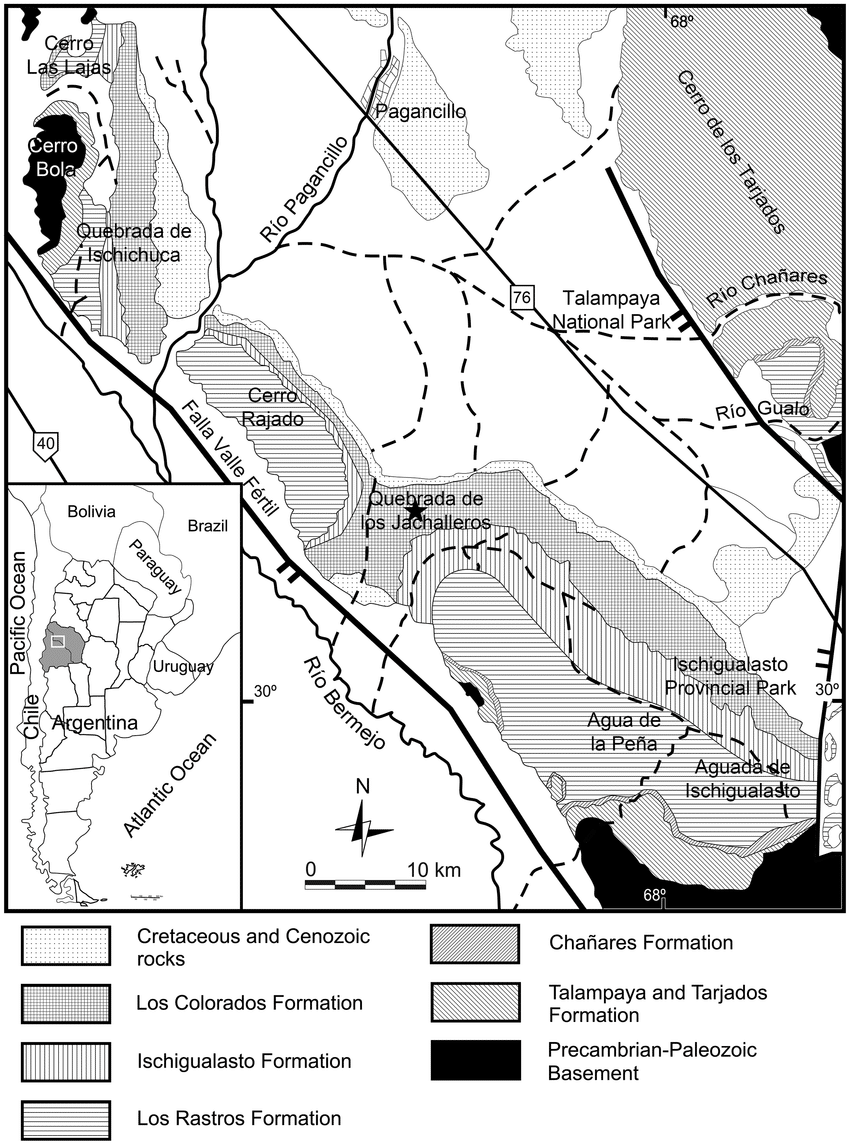
In the red sandstones of Argentina’s Los Colorados Formation, at a La Rioja site called La Esquina, Bonaparte’s team found the bones of an early giant. Named Lessemsaurus sauropoides in 1999, this sauropodomorph—a member of the first successful group of plant-eating dinosaurs—lived during the Norian stage of the Late Triassic. Its back vertebrae carry neural arches almost twice as tall as the bone’s body, a proportion that reminded its describer of early sauropods.
A 1971 expedition of Tucumán’s Miguel Lillo Foundation, led by Argentine paleontologist José F. Bonaparte, collected the first bones. Nearly three decades later, Bonaparte named the animal in a study of how sauropodomorph vertebrae evolved. Later work on its limbs, hips, and bone growth put Lessemsaurus at the center of a debate on early gigantism. Its bones suggest that great size arrived before the classic sauropod body plan did.
Lessemsaurus Key Facts
| Keyword | Fact |
|---|---|
| Pronunciation | Not specified |
| Meaning of name | In honor of Donald Lessem, with the species name meaning “like sauropods” |
| Group | Sauropodomorpha, Lessemsauridae |
| Type Species | Lessemsaurus sauropoides |
| Diet | Herbivore, inferred for its group |
| When it Lived | About 220–211 million years ago (mid-to-late Norian, though estimates vary) |
| Period | Triassic |
| Epoch | Late Triassic (Norian stage) |
| Length | Not specified |
| Height | Not specified |
| Weight | About 11,600 to 22,000 pounds (about 5 to 10 metric tons) for larger specimens, per Apaldetti and colleagues in 2018, and about 4,600 pounds (2.1 metric tons) from referred limb bones in the original 1971 collection, per McPhee and colleagues in 2018 |
| Mobility | Debated: on two legs at times (facultatively bipedal) or on all four legs (quadrupedal) |
| First Discovery | 1971 by a Miguel Lillo Foundation expedition led by José F. Bonaparte |
| Described by | 1999 by José F. Bonaparte |
| Holotype | PVL 4822-1, restricted in 2007 to eight presacral neural arches |
| Location of first find | Paraje La Esquina, upper Los Colorados Formation, Independencia Department, La Rioja, Argentina |
Lessemsaurus Origins, Taxonomy and Timeline
The genus honors Donald Lessem, whom the 1999 paper calls the founder of The Dinosaur Society in the United States. Meanwhile, the species name sauropoides means “like sauropods” and points to vertebrae that recall those of primitive sauropods. Together, the name pairs a personal tribute with a hint about the animal’s place in evolution.
At first, Bonaparte placed Lessemsaurus among the prosauropods, in the family Melanorosauridae. He judged its backbone more advanced than those of Riojasaurus and Plateosaurus, yet more primitive than the “cetiosaurid” grade of later sauropods. In 2018, paleontologist Cecilia Apaldetti and colleagues made it the namesake of a new clade, Lessemsauridae. They defined the group as Lessemsaurus, the South African Antetonitrus, and all descendants of their most recent common ancestor. Lessemsaurus sauropoides is the type and only known species.
The original paper placed the bones in the Coloradian Reptile Age, which Bonaparte equated roughly with the upper Norian. In 2014, geologist Dennis V. Kent and colleagues used magnetochronology—dating rocks by Earth’s magnetic reversals—to bracket the formation between 227 and 213 million years ago. They judged the La Esquina fauna most probably no younger than about 213 million years. Citing recent dating work, a 2022 study allowed a mid-Norian window of roughly 220 to 211 million years ago. Either way, the upper Los Colorados is described as the earliest assemblage in which dinosaurs are dominant components.
Discovery & Fossil Evidence
The bones came from Paraje La Esquina in southwestern La Rioja, about 5 miles (8 kilometers) west of provincial route 26. They lay in the upper Los Colorados Formation, roughly 490 feet (150 meters) below its upper contact. Technicians M. Vince, J.C. Loyal, and T.H. Fasola joined Bonaparte in the field, on a trip funded by CONICET, Argentina’s research council.
The collection, catalogued as PVL 4822, mixes the remains of three individuals of different sizes. Bonaparte then chose the smallest as the holotype, PVL 4822-1. As first listed, it held three cervical (neck) neural arches, three cervical centra (vertebral bodies), 14 dorsal (back) arches, two sacral (hip) arches, and many dorsal centra. In 2007, however, paleontologists Diego Pol and Jaime Powell restricted it to the eight presacral arches—those ahead of the hips—that Bonaparte had figured.
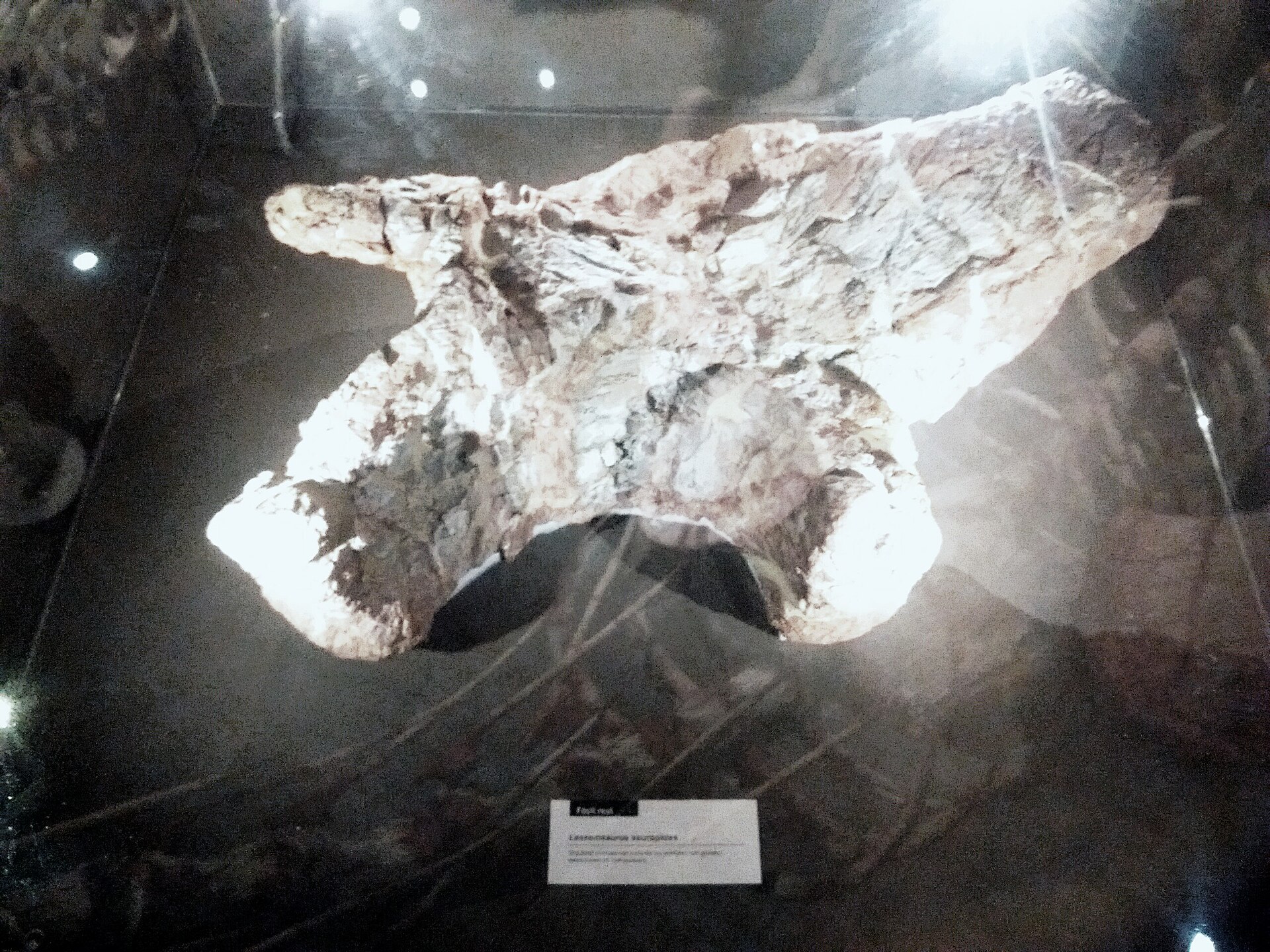

Pol and Powell referred the rest of the collection to the species, from scapulae (shoulder blades) to a femur (thigh bone) and toe bones. However, the bones were not articulated, so only articulated finds can fully test this referral. In 2018, Apaldetti’s team added partial scapulae, a tail vertebra, an ilium (upper hip bone), ischia, and part of a femur. The femur came from Bonaparte’s 1970s La Esquina expeditions. The rest came from sites midway between La Esquina and Los Jachalleros creek. So far, every confirmed Lessemsaurus fossil comes from this upper part of the formation.
Lessemsaurus Size and Description
Short description of Lessemsaurus
No skull or teeth appear in the 1999, 2007, or 2018 specimen lists, so the head remains unknown. The neck vertebrae were acamerate—lacking large internal air chambers—and amphicoelous, or concave at both ends. One mid-neck centrum was about twice as long as its rear face was tall. Farther back, the tall dorsal arches bore well-developed hyposphenes, extra interlocking joints between vertebrae.
The scapula was robust, with a markedly expanded blade. In the hand, the first metacarpal was extremely short, its upper end wider than the bone was long, and the thumb claw was only weakly curved. The femur bent backward at its lower end, with the fourth trochanter—a crest for a large tail muscle—at mid-length. Skin and other soft tissues are not preserved, so any picture of its outer covering is speculative.

Size and Weight of Type Species
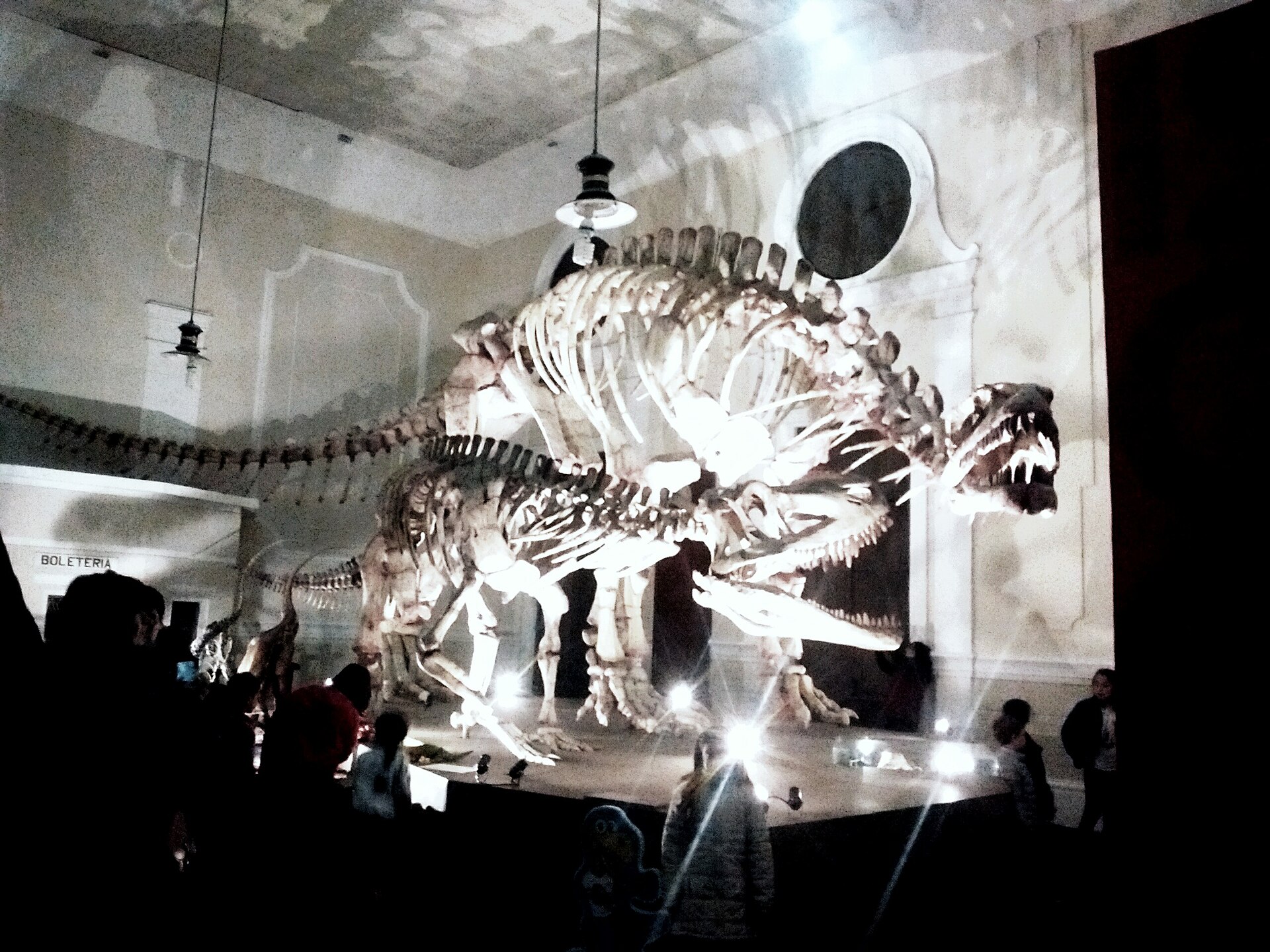
Bonaparte gave no length or weight, only calling it a prosauropod larger than Riojasaurus. No peer-reviewed source we consulted has since published a length or hip height. According to paleontologist Ignacio Cerda and colleagues, one femur measures 33 inches (84 centimeters) long, with a midshaft circumference of 14 inches (36 centimeters).
Earlier estimates by paleontologist Roger Benson and colleagues put the original collection at about 2 metric tons, as Apaldetti’s team reported. However, the newer specimens are clearly larger. Their scapula reaches an estimated 31.5 inches (80 centimeters), against 25.6 inches (65 centimeters) in the original collection. Likewise, their ilium measures 29.5 inches (75 centimeters), against about 22 inches (56 centimeters).
From ilium length, Apaldetti’s team calculated about 15,800 pounds (7,165 kilograms), while the scapula gave about 11,600 pounds (5,268 kilograms). By comparison with early sauropods such as Vulcanodon, they suggested about 7 to 10 metric tons. They judged the 2-ton figure probably too low, since it rested on subadult bones that had lost their outer layer. Later in 2018, paleontologist Blair McPhee and colleagues gave about 4,600 pounds (2.1 metric tons) for the most complete specimen—while noting that adults were likely much larger.
Growth helps explain the gap. The original 1971 animals were not yet fully grown—the holotype’s neck vertebrae have unfused sutures, and a referred femur from the same collection shows active growth. That femur has growth marks through the whole cortex, together with very thick zones of fast-forming fibrolamellar bone. By dividing zone thickness by 365 days, a rough proxy, Apaldetti’s team estimated 20 to 37 micrometers of new bone a day. In contrast, the fastest known eusauropods (the “true sauropods”) stay below 12. Studying the same femur, however, Cerda’s team judged its rapid growth phases only equivalent to those of derived sauropods.
The Dinosaur in Detail
What sets this dinosaur apart is the height of its vertebrae. Bonaparte measured a centrum-to-neural-arch height ratio of 1:1.9, against about 1:1 in Plateosaurus, Anchisaurus, and Riojasaurus. Elsewhere in the same paper, he rounds it to 1:2. He read the taller arches as extra room for the epaxial muscles along the top of the spine. Its rear neck vertebrae also show an early infrapostzygapophyseal constriction—a pinched zone beneath the rear joints that is characteristic of sauropods.
Ideas about its relatives have shifted often, starting with Bonaparte, who linked it more closely to Riojasaurus than to Plateosaurus. In contrast, Pol and Powell found traits shared exclusively with Antetonitrus, such as a broad scapular blade, within a unique mix of prosauropod-grade and eusauropod-like characters.
In 2018, Apaldetti’s analysis recovered Ingentia prima as its sister, with both sister to Antetonitrus. Yet support for that Lessemsauridae was weak, with a Bremer value—the extra steps needed to break a grouping—of only 2. That same year, McPhee’s team placed Lessemsaurus as sister to Antetonitrus and Ledumahadi. In 2020, however, paleontologist Oliver Rauhut and colleagues did not recover Lessemsauridae when all characters were weighted equally, although the group reappeared under implied weighting.
Posture is just as unsettled. The 2018 supplement calls lessemsaurids probable facultative bipeds, while a 2021 study led by the same first author groups Lessemsaurus with large quadrupedal relatives. Apaldetti’s team also saw possible pneumatic fossae, or air-sac hollows, in its vertebrae. In 2025, however, paleontologist Samantha Beeston and colleagues judged them too shallow and undivided to count as clear evidence. Taken together, Lessemsaurus remains a key but contested witness to the dawn of sauropods.
Interesting Points about Lessemsaurus
- Two of its vertebrae appeared in print in 1986 to illustrate a primitive stage of sauropod vertebrae, thirteen years before the animal received its name.
- The original 1971 collection mixed bones from three individuals of different sizes, and Bonaparte chose the smallest of them as the holotype.
- In 2018, Apaldetti and colleagues argued that lessemsaurids grew large while keeping an ancestral cyclical growth pattern and lacking most traits once linked to gigantism.
- Under broad definitions of Sauropoda, its family would count as the basal-most sauropod clade, and under stricter ones as a very close relative.
Contemporary Dinosaurs
Bonaparte reported that the Lessemsaurus bones came from the same levels as the plateosaurid and melanorosaurid prosauropods he had described from La Esquina. Sharing that locality was Coloradisaurus, a medium-sized basal sauropodomorph first named Coloradia brevis by Bonaparte in 1978. Its holotype and a second specimen come from the upper section at La Esquina—the area that yielded Lessemsaurus. No direct interaction between the two is recorded.
Also known from La Esquina was Riojasaurus incertus, a sauropodomorph that Bonaparte and Pumares called a melanorosaurid prosauropod. Its specimen ULR 56 came from the formation’s upper sector near Pagancilla. According to Pol and Powell, both it and Lessemsaurus are known only from this upper section, and Bonaparte placed the two in the same levels. He also used Riojasaurus as his yardstick, calling Lessemsaurus the larger animal, though the fossils record no contact between them.
Lessemsaurus in its Natural Habitat
The world Lessemsaurus roamed was one of rivers and floodplains. The formation’s measured section is about 1,970 feet (600 meters) thick, made of red sandstones, siltstones, and floodplain mudstones. Its moderately sinuous rivers graded into flat-lying floodplain deposits. At La Esquina, the horizon that yielded the cynodont Tessellatia was a floodplain sporadically covered by sandy splays from nearby channels. Paleomagnetic data place the basin at about 48 degrees south, within the austral temperate humid belt of idealized climate zones.

Without a skull or teeth, its diet has to be inferred from its family tree. Sauropodomorphs were the first successful group of herbivorous dinosaurs, so it was likely a herbivore too. In 2018, Apaldetti’s team linked its broad scapular blade to a more horizontal neck posture, following earlier work by Remes. Exactly how it gathered plants, however, remains an open question.
While there is no direct evidence of herding, the 1971 collection holds three individuals found closely associated. Still, the bones alone cannot show whether they lived together. Other dinosaurs also known from the upper Los Colorados Formation include the early neotheropods Zupaysaurus and Powellvenator, though neither has been tied to the same beds as Lessemsaurus. Unnamed sauropodomorphs occur there too. Aetosaurs, ornithosuchids, rauisuchids, turtles, and small cynodonts such as Chaliminia and Tessellatia filled out the fauna. In this earliest assemblage in which dinosaurs are dominant components, prosauropod-grade sauropodomorphs were the major element. Lessemsaurus may well have been among its major plant-eaters.
Frequently Asked Questions
It honors Donald Lessem, founder of The Dinosaur Society, and the species name sauropoides means “like sauropods”.
It lived in the Late Triassic (Norian stage), roughly 220 to 211 million years ago by recent estimates.
No length has been published. Larger specimens may have reached 11,600 to 22,000 pounds, while limb bones from the original collection suggest about 4,600 pounds.
No teeth are known, but as a sauropodomorph it was likely a herbivore.
Its first bones came from La Esquina, in the upper Los Colorados Formation of La Rioja, Argentina, in 1971.
Its back neural arches stand almost twice as tall as its vertebral bodies, and its neck shows an early sauropod-type constriction.
Sources
The information in this article is based on various sources, drawing on scientific research, fossil evidence, and expert analysis. The aim is to provide a comprehensive and accurate overview of Lessemsaurus. However, please be aware that our understanding of dinosaurs and their world is constantly evolving as new discoveries are made.
- Bonaparte 1999, original description: https://ameghiniana.org.ar/index.php/ameghiniana/article/view/2480
- English translation of Bonaparte 1999 by S. Apesteguía, edited by M. Carrano: https://naturalhistory.si.edu/sites/default/files/media/translated_publications/Bonaparte_99.pdf
- https://staff.mef.org.ar/images/investigadores/diego_pol/papers/20.pdf
- https://doi.org/10.1038/s41559-018-0599-y
- https://ri.conicet.gov.ar/handle/11336/89332
- https://doi.org/10.1073/pnas.1402369111
- https://doi.org/10.1371/journal.pone.0179707
- https://doi.org/10.1016/j.cub.2018.07.063
- https://doi.org/10.1186/s00015-020-00360-8
- https://doi.org/10.1038/s41598-021-01120-w
- https://doi.org/10.1111/joa.70045
- https://doi.org/10.1080/02724634.2014.859147
- https://naturalhistory.si.edu/sites/default/files/media/translated_publications/Bonaparte%26amp%3BPumares%25201995.pdf
- https://www.ameghiniana.org.ar/index.php/ameghiniana/article/download/955/1718
- http://hdl.handle.net/11336/97772
- https://doi.org/10.5710/AMGH.04.08.2017.3100
- https://doi.org/10.1038/s41598-022-10486-4
- https://doi.org/10.1371/journal.pone.0148575
This article was last fact checked: TheDinosaurs Team, 13-11-2026
Featured Image Credit: L. C. Gaetano, F. Abdala, F. D. Seoane, A. Tartaglione, M. Schulz, A. Otero, J. M. Leardi, C. Apaldetti, V. Krapovickas and E. Steimbach, CC BY 4.0, via Wikimedia Commons
